Austin rooms better than another tech happy hour
The loudest room on Rainey is rarely where the useful connection happens. In Austin, the better intro is more likely made at 8:12 a.m. in a coffee line, after a sweaty group run around Town Lake, at a coworking community breakfast, or while waiting for a natural wine bar seat on the East Side.
That matters because Austin’s professional scene is friendly, but not automatic. People will talk to you. They will also forget you if you show up with a pitch deck face and no reason to be in the room beyond “networking.” The city rewards repeat presence, low-pressure curiosity, and a little taste. It punishes transactional energy fast.
The tech happy hour is not dead. Capital Factory, SXSW-adjacent events, founder dinners, AngelList intros, Meetup groups, Lunchclub, On Deck alumni threads, South Park Commons visitors, and the usual WeWork or Industrious gatherings still have a place. But if you only chase name-tag events, you miss how Austin actually works in 2026: outdoors, early, casual, creator-heavy, operator-heavy, and more mixed across tech, food, wellness, real estate, music, CPG, and media than newcomers expect.
Austin networking has moved into third places
Post-pandemic Austin did not abandon offices. It just got more selective. The full-time corporate badge crowd is thinner in some downtown towers, while hot desk days, dedicated desk memberships, and occasional day passes still draw founders who need structure without signing a long lease. Coworking now works less like a desk rental and more like a social filter.
At the same time, third-wave coffee shops, beer gardens, fitness studios, hotel lobbies, supper clubs, and neighborhood markets became practical networking rooms. Not because everyone there is “looking to connect,” but because they create repeated overlap. Same faces. Same hours. Same habits.
That is the Austin edge. The room does not need to announce itself as a networking event. It needs to attract people with enough agency to leave the house.
Good categories to prioritize:
- Third-wave coffee shops with communal tables, outlets, and a real morning rhythm
- Coworking lounges that host member breakfasts, pitch nights, and founder office hours
- Brewery patios where people bring dogs, laptops, and half-finished product ideas
- Run clubs, climbing gyms, yoga studios, and cycling groups with post-workout hang time
- Natural wine bars and restaurant counters where solo seating is normal
- Civic, climate, AI, CPG, and creator Meetups that skew practical, not performative
- House-party-style founder dinners and supper clubs where the host curates the room
The local trick is to pick two or three rooms and become a regular. Austin is too socially porous for cold grinding and too small, reputation-wise, for sloppy behavior.
What to order / what to look for
!Austin coworking lounge with founders talking over coffee
Do not overthink the order. Do pay attention to the room.
At a serious coffee shop, order like someone who will not camp for four hours on a single drip during peak service. A single-origin pour-over is fine if the bar is not slammed. An espresso, cortado, or cold brew is faster and less precious. If you are taking a table for work, buy food or a second drink. The staff notices. So do regulars.
For Austin coffee networking, look for:
- Communal tables where laptop work is accepted but not the entire point
- A line long enough to create casual conversation, not chaos
- Outdoor seating with shade, because half the year that determines the length of stay
- A mix of solo workers, small team meetings, and neighborhood regulars
- Baristas who know regulars by name, which usually means the room has rhythm
Known Austin coffee anchors like Houndstooth Coffee, Jo’s Coffee, Merit Coffee, and Mozart’s Coffee Roasters each pull different crowds depending on location and time. Do not treat them as interchangeable. Downtown coffee can lean investor, legal, conference, and hotel-meeting adjacent. South Congress can tilt brand, retail, creator, and visiting-founder. Lake and neighborhood spots have more local repeat traffic.
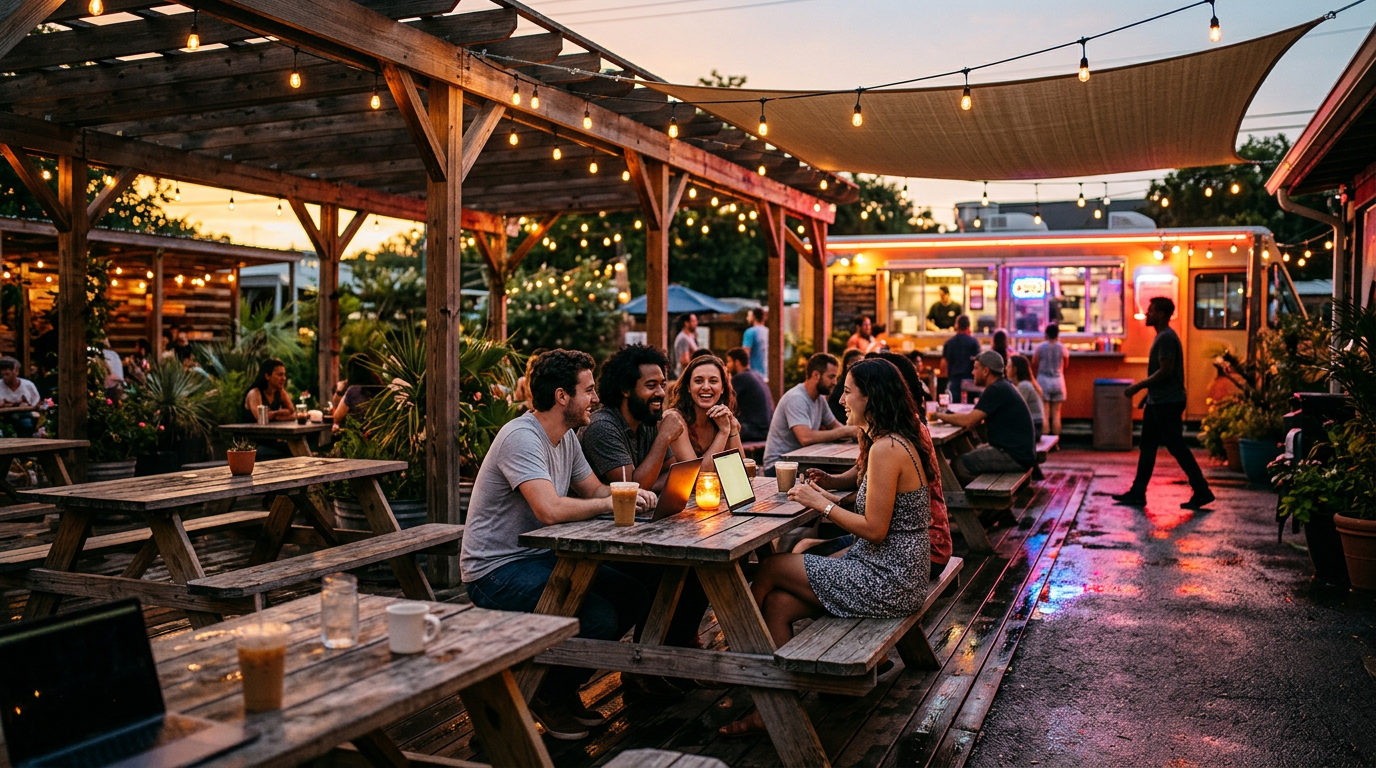
At a brewery or coffee-beer hybrid, order something simple first. Cosmic Coffee + Beer Garden, Radio Coffee & Beer, Meanwhile Brewing, and Central Machine Works all represent a very Austin pattern: a place where the professional conversation is softened by picnic tables, food trucks, dogs, and no one wanting to feel like they are at a conference reception.
At a natural wine bar or restaurant counter, do not turn dinner into a sales floor. Sit solo, ask the bartender what is drinking well, and talk to the person next to you only if the moment is open. Austin’s food scene is full of operators, designers, builders, and investors, but the room is still a room for eating.
At coworking spaces, look less at the furniture and more at the programming. WeWork, Spaces, Industrious, and Capital Factory all serve different use cases in Austin. A day pass can be enough to test the room. A dedicated desk only makes sense if the community rhythm fits your calendar.
Best time of day to go
Austin networking rewards mornings more than outsiders expect.
The 7:30 to 9:30 a.m. window is excellent for coffee shops, run clubs, gym-adjacent conversations, and focused coworking arrivals. People are less guarded. They have not been swallowed by Slack yet. A simple “What are you working on today?” lands better over coffee than over a sticky bar table at 7 p.m.
Late morning, roughly 10:30 to noon, is good for coworking common areas. That is when founders surface after their first calls and freelancers are deciding whether to keep working or take a meeting. If a coworking space has community coffee, a member breakfast, or open office hours, go then. Do not hide in a phone booth and complain that no one introduced themselves.
Lunch works when the place has counter seating or a known professional crowd. It is weaker for random networking because people are often compressed between calls. Use lunch for scheduled one-on-ones, not fishing.
The 4 to 6 p.m. patio window is very Austin. It is less sloppy than late-night drinks and more social than coffee. Breweries, hotel lobbies, and casual restaurant patios work well here, especially Tuesday through Thursday.
Evenings are strongest when there is a built-in reason to gather: founder dinner, Meetup, gallery opening, civic panel, listening party, supper club, or industry-specific event. Generic happy hours can still work, but only if you arrive with intent and leave before the room gets too loud to remember names.
Avoid Friday night as your main networking play. Austin gets recreational fast. Sundays can be surprisingly useful if you are in wellness, food, creator, real estate, or community building because people are out, unhurried, and more open to casual conversation.
Etiquette and unwritten rules
!Austin run club members chatting after a sunrise workout

Austin is casual, not careless. The hoodie does not excuse bad manners.
The first rule: do not lead with valuation, fundraising status, follower count, or who you know. People here hear enough imported status theater. Lead with what you are building, what you are testing, or what you are trying to understand.
Better openers:
- “I’m trying to learn where Austin operators actually meet outside formal events. Is this place part of your routine?”
- “Are you working from here for the day or just between meetings?”
- “I’m new to this particular room. What nights or mornings are actually good here?”
- “That sounded like a product call. Are you building in Austin or just passing through?”
- “I’m looking for more CPG and creator-ops people locally. Any rooms you think are worth showing up to twice?”
Keep it short. If the person gives one-word answers, release them. If they ask a question back, you have permission to continue.
Do not interrupt someone wearing headphones, typing intensely, reading a book, or eating with another person. Do not hover near a table waiting for the laptop to close. Do not pitch the bartender, the barista, or the event host while they are working. Tip well. Buy something. Respect the room’s primary purpose.
Austin also has a strong anti-flake norm in serious circles because the city can feel socially abundant. If you say you will send an intro, send it. If you RSVP to a small dinner, show up. If you cannot make it, cancel early. The casual surface hides a very real memory for reliability.
How to actually meet people there
Weak ties matter in Austin. The useful person is often not your new best friend; it is the person two tables over who knows the perfect fractional CFO, venue host, angel syndicate, videographer, chef, or ops lead. Your goal is not to collect contacts. It is to become easy to route.
Use a three-step pattern.
First, create a normal opening. Comment on the shared context, not their identity. “This patio is the only place I can take calls without feeling trapped indoors” is better than “So what do you do?” Context lowers the temperature.
Second, trade specifics. Say one concrete sentence about your work. Not a monologue.
- “I run growth for a bootstrapped SaaS team and I’m trying to meet more Austin operators who sell to healthcare.”
- “I produce short-form video for local brands, but I’m moving toward founder-led content.”
- “I’m building a CPG product and trying to understand retail distribution before I raise.”
Third, ask for a local map, not a favor.
- “Where would you go if you wanted to meet more people in that lane?”
- “Is there a Meetup that is actually worth attending twice?”
- “Who hosts thoughtful small dinners here?”
- “Which coworking rooms have real operator density, not just nice chairs?”
This makes the other person useful without making them responsible for your career.
Follow-up within 24 hours. Austin conversations evaporate if you wait a week. Send a short note:
“Good meeting you at Cosmic this afternoon. I appreciated the point about Austin CPG people clustering around smaller dinners, not big panels. If useful, I can send you the retail ops checklist I mentioned. Either way, I’ll be back there next Wednesday.”
Notice the move: memory, value, low pressure, repeat location. That is stronger than “Let’s grab coffee sometime.”
Rooms that work better than tech happy hours
The best Austin networking rooms have an activity in the center, with conversation around the edges.
Coffee shops with a work rhythm
Use these for light-touch intros, one-on-ones, and ambient awareness of who is active locally. Houndstooth, Jo’s, Merit, Mozart’s, and neighborhood third-wave shops all work when you choose the right hour. Do not assume every coffee shop wants laptop campers. Look around. If every table is turning fast, keep it moving.
Coworking with programming
Capital Factory remains a serious node for startups, especially if you are trying to understand the local tech map quickly. WeWork, Industrious, and Spaces can be useful depending on location and tenant mix. The move is to attend hosted events, community breakfasts, office hours, and member mixers rather than renting a desk and waiting for magic.
Ask the community manager one precise question: “Which recurring events bring actual founders and operators, not just vendors?” A good manager will know.
Brewery patios and coffee-beer hybrids
Cosmic, Radio, Meanwhile, Central Machine Works, and similar rooms are strong for low-friction meetings. They are also useful for small group hangs after a Meetup. The patio makes introductions feel less formal, which is a feature. Keep business talk crisp; let the social layer do some work.
Fitness and outdoor groups
Run clubs, climbing gyms, cycling groups, and yoga communities are not networking hacks. They are communities. Join because you will actually show up. Austin Bouldering Project and city run groups attract founders, designers, engineers, creators, and healthcare people because the city’s ambitious class likes movement. The post-workout coffee is often where the connection happens.
Food, wine, and small dinners
Restaurant counters, natural wine bars, supper clubs, and founder dinners are better for deeper ties. If you get invited to a small dinner, do not hijack it. Ask good questions. Help connect two other people at the table. Thank the host the next morning. Hosts remember guests who improve the room.
Mistakes to avoid
The biggest mistake is treating Austin like a smaller San Francisco with warmer weather. It is not. The city has tech gravity, but it also has music, hospitality, wellness, state politics, real estate, energy, consumer brands, film, and a strong independent streak. If every conversation is about VC, you will miss half the room.
Other mistakes:
- Showing up once and declaring a place “not good for networking”
- Asking for investor intros before anyone trusts your judgment
- Confusing friendliness with commitment
- Taking calls on speaker in coffee shops or coworking lounges
- Camping at a four-top alone during peak hours
- Treating run clubs or yoga classes like prospecting lists
- Only attending events with panels and name tags
- Over-indexing on South Congress, downtown, or East Austin because they are visible on social media
- Forgetting that hosts, baristas, bartenders, and community managers are social infrastructure
The smarter play is slower. Pick one coffee room, one coworking or professional community, and one non-work community. Show up on a schedule. Be useful before you ask. Send clean follow-ups. Make one intro every week without needing credit.
That is how Austin opens up. Not through another plastic cup happy hour where everyone is half-listening for someone more important to walk in. Through rooms where people already want to be, at hours when they can actually hear you, with enough repetition that your name starts to mean something.
Discussion (0)
Loading comments…