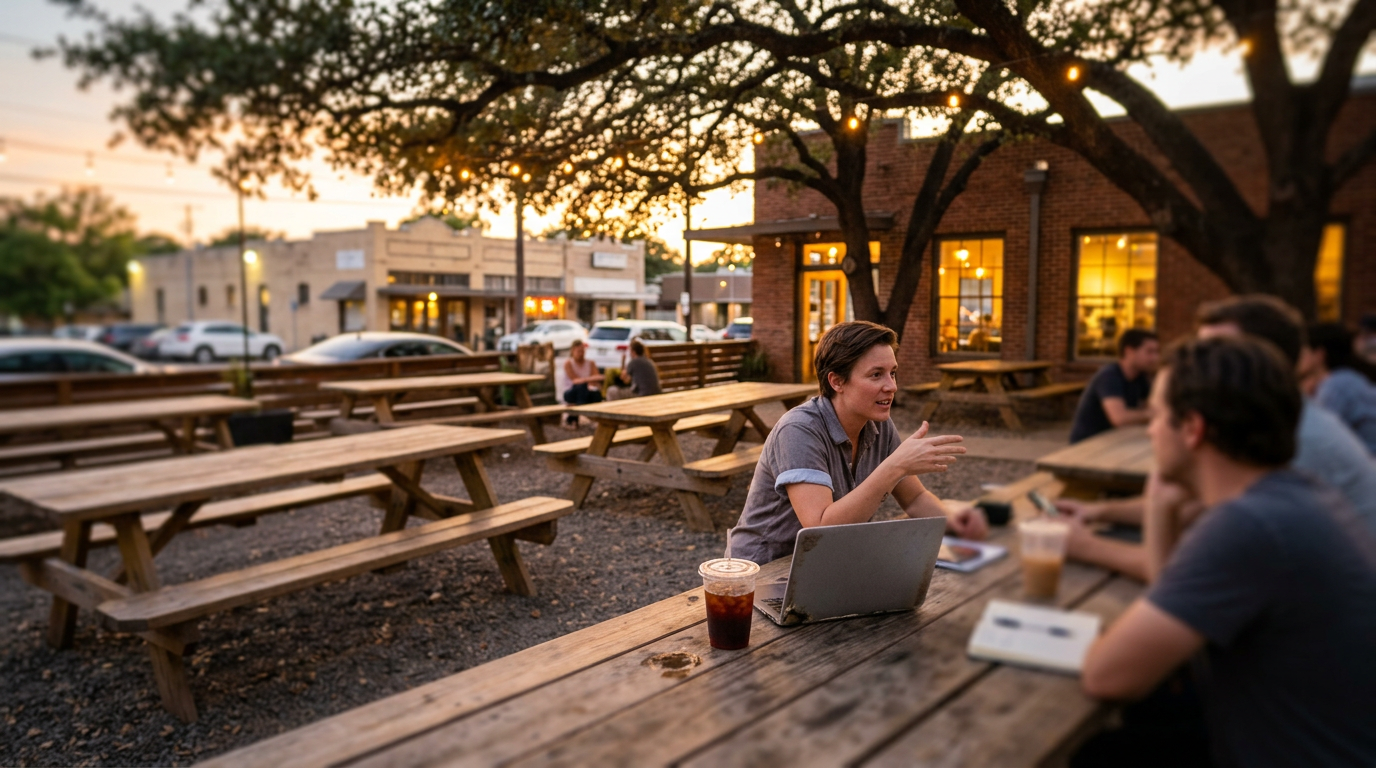
Where Austin operators meet when happy hour gets old
The smartest Austin networking often happens before noon, in the five minutes between a cortado and a laptop opening, or after a Tuesday group run when nobody is performing for a panel moderator. The city still has plenty of tech happy hours. Some are useful. Many are a room full of people scanning name tags while pretending the noise level is normal.
Austin in 2026 is not one scene. It is founders around Capital Factory, creators on the East Side, remote operators posted up in South Congress hotel lobbies, CPG people comparing retail notes over coffee, AI builders drifting between coworking day passes, and musicians who somehow know every serious investor before the investors know each other.
If your job is to find the right room, behave like a normal adult, and leave with two real follow-ups, stop treating networking like a calendar full of drinks. Austin rewards consistency, specificity, and low-pressure repetition. Weak ties matter here: the person you see three Tuesdays in a row at coffee is often more useful than the person you pitched for six minutes at a packed rooftop event.
The Austin rooms that beat another tech happy hour
Austin has grown up, but it has not become San Francisco with brisket. The local rhythm is looser. People want ambition, but they do not want your deck before your handshake.
The strongest networking rooms tend to fall into a few categories:
- Serious coffee shops with enough table churn: Look for third-wave coffee, bar seating, communal tables, and a crowd that includes laptops but not only laptops.
- Coworking spaces with real programming: A day pass at Capital Factory, Industrious, Spaces, or WeWork can be worth more than a month of random evening mixers if you use the kitchen and lounge correctly.
- Hotel lobbies that function as soft workrooms: South Congress and downtown hotels often attract visiting founders, festival people, brand operators, and investors between meetings.
- Fitness-adjacent communities: Run clubs, climbing gyms, recovery studios, and cycling groups create repeat contact without the forced sales energy.
- Small food and wine rooms: Natural wine bars, izakaya-style counters, supper clubs, and chef pop-ups work because the table does half the introduction for you.
- Skill-specific meetups: Product, design, AI, climate, CPG, music business, and creator events beat generic “founder networking” almost every time.
The rule: choose rooms where a shared context already exists. Coffee, work, training, a talk, a tasting, a demo night. Context saves you from walking up cold with “So what do you do?”
Coffee shops where the conversation does not feel forced
!Austin coworking lounge with founders talking over coffee
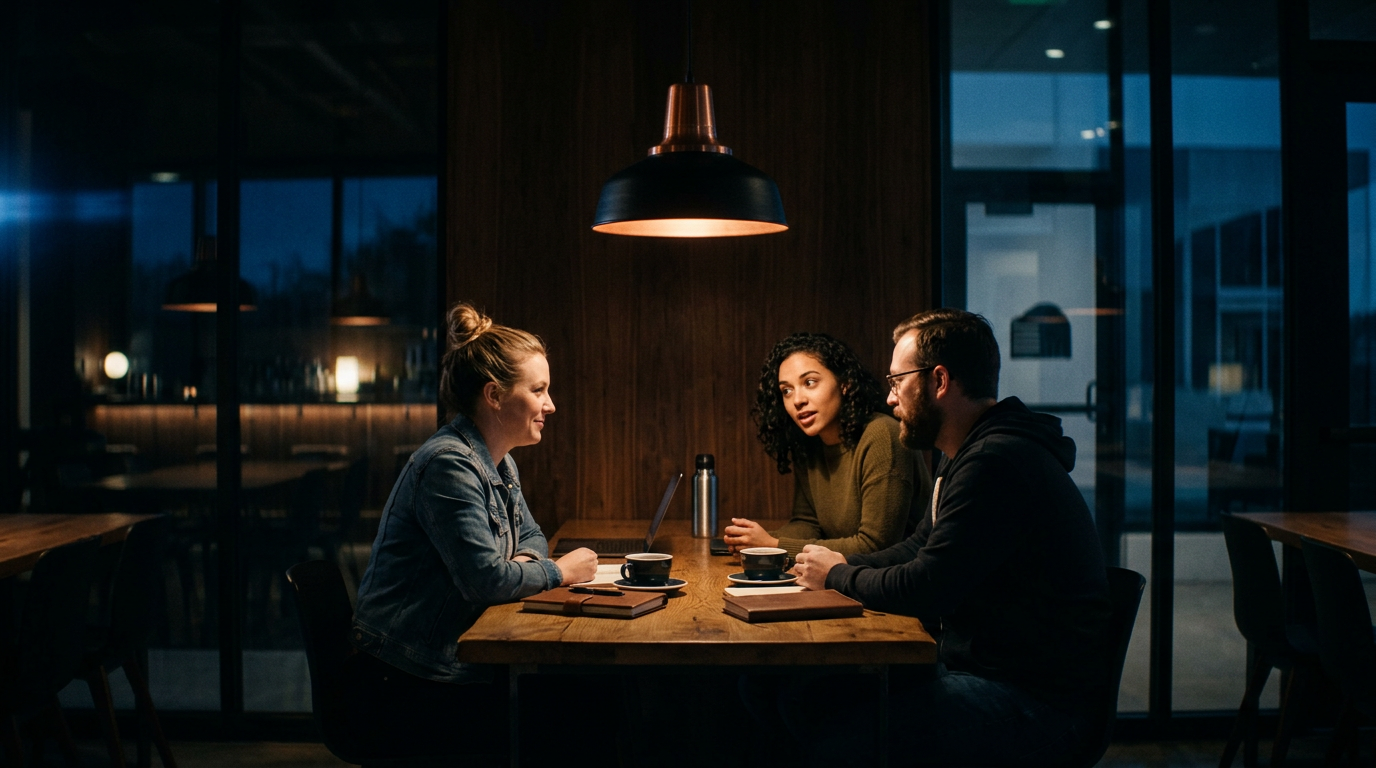
Austin coffee networking is less about camping for six hours and more about becoming a familiar face. The best rooms are high-quality but not precious, social without turning into a nightclub.
Reliable names to know include Houndstooth Coffee, Merit Coffee, Fleet Coffee, Figure 8 Coffee Purveyors, Jo’s Coffee, Radio Coffee & Beer, Cosmic Coffee + Beer Garden, and The Meteor. They each pull a different crowd. Downtown and North Austin skew more operator and enterprise. East Austin brings creators, designers, early-stage founders, and hospitality people. South Austin is better for casual recurring contact than formal intros.
Use coffee like this:
- Pick two regular spots instead of ten random ones.
- Go on the same weekday block for four weeks.
- Sit at the bar or a communal table when available.
- Learn the room before trying to work the room.
- Bring one tight reason you are open to meeting people: hiring, finding a beta user, sourcing a designer, learning the CPG retail path, comparing coworking options.
Do not open with a pitch. Open with the room.
Good Austin openers:
- “Do you come here to work often, or is this a meeting-between-meetings stop?”
- “I’m trying to find more operator-heavy rooms in Austin that are not just happy hours. Any you rate?”
- “I saw you had the Capital Factory sticker. Are you based there or just passing through?”
- “I’m new to the Austin CPG crowd. Is there a better recurring event than the big mixers?”
Keep it under three minutes unless they clearly extend the conversation. The move is not to trap someone. It is to earn a second conversation.
What to order / what to look for
Your order is not the point, but it can signal whether you understand the room. Austin’s coffee scene is mature now. Third-wave coffee is not a novelty. Single-origin pour-over is normal. So is a quick espresso, sparkling water, and a laptop.
What to order:
- At a serious coffee bar: cortado, drip, espresso, or single-origin pour-over if you are not in a rush.
- At a coffee-beer garden: coffee in the morning, Topo Chico or a low-ABV beer later, food if you are occupying a table.
- At a hotel lobby: coffee if you are working, a proper drink if you are staying past late afternoon.
- At a natural wine bar or supper-club-style event: ask for something by the glass and let the staff steer you. Do not perform expertise.
- At coworking: buy the paid day pass or attend the event properly. Do not hover like you are sneaking into a private office.
What to look for:
- Tables where people are taking meetings, not only wearing headphones.
- Event boards, Slack community QR codes, or member breakfast announcements.
- Rooms with founders and operators, not only service providers selling to founders.
- A mix of repeat locals and visitors.
- Staff who know regulars by name. That usually means the room has continuity.
Avoid places where every person is either on a sales call, filming content, or waiting for a reservation. You want ambient openness, not chaos.
Coworking still works if you stop treating it like real estate
!Small Austin dinner table with wine, plates, and notebooks

Post-pandemic coworking in Austin is no longer just a desk solution. It is a routing layer. The operators who get value from it use the lounge, pantry, demo nights, and member intros. The ones who complain usually sit in a phone booth all day and leave.
Start with the obvious nodes. Capital Factory remains one of the clearest startup Schelling points in town, especially for founders, investors, and technical operators. Industrious, Spaces, and WeWork can also be useful depending on neighborhood, company stage, and meeting density. A hot desk or day pass is enough to test the room before committing to a dedicated desk.
How to use a coworking day pass well:
- Arrive between 8:30 and 9:15 a.m., not at lunch.
- Ask the front desk what events are actually worth attending this week.
- Take one call, then spend time in the shared areas.
- Eat lunch in the common space if allowed.
- Leave one soft ask with a community manager: “I’m looking to meet seed-stage B2B SaaS founders selling into healthcare. If someone comes to mind, I’d appreciate the pointer.”
That is better than cornering strangers. Community managers know the map. Treat them like people, not intro machines.
Best time of day to go
Austin has a real daily rhythm, and fighting it is pointless.
7:30 to 9:30 a.m. is strong for coffee shops, run clubs, fitness communities, and quiet operator conversations. People have not been dragged into calls yet. This is also the least performative window.
10:30 a.m. to 12:30 p.m. works for coworking lounges and hotel lobbies. Visitors are between meetings. Locals are willing to take a quick intro. Coffee shops start turning tables, so do not claim a four-top with one laptop.
2:00 to 4:00 p.m. is underrated for founder-to-founder conversation. The lunch rush has passed, happy hour has not started, and the serious people are more relaxed. This is a good window for South Congress, East Austin coffee-beer hybrids, and coworking common areas.
5:30 to 7:00 p.m. is useful only when the event has a clear purpose: demo night, investor office hours, creator salon, wine tasting, book launch, industry panel, or founder dinner. Generic drinks get thin fast.
After 8:00 p.m. is for bonding, not prospecting. If you are at an izakaya counter, natural wine bar, or supper club, stop acting like you are collecting leads.
Etiquette and unwritten rules
Austin is friendly, but it is not frictionless. The city has seen enough newcomers arrive with a “networking strategy” and no patience. Do better.
Unwritten rules:
- Do not ask “Who should I know here?” within the first five minutes.
- Do not lead with your fundraising round unless asked.
- Do not treat musicians, hospitality owners, or creative people as lifestyle accessories for your startup story.
- Do not camp at a coffee shop without buying enough to justify the seat.
- Do not pitch someone wearing headphones.
- Do not turn a run club into a sales floor.
- Do not assume every person in a hat and sneakers is unemployed. In Austin, that may be the person who signs the check.
The right posture is clear and relaxed. Say what you are building, who you help, and what kind of Austin room you are trying to find. Then listen.
A useful self-intro:
“I’m based in Austin and building software for independent clinics. I’m trying to meet more operators who sell into healthcare, not just general startup people. What rooms have been useful for you lately?”
That gives the other person something specific to respond to. It also shows you are not just extracting contacts.
How to actually meet people there
The easiest Austin networking plan is a four-week loop.
Week one: pick one coffee spot, one coworking day, and one skill-specific event. Do not overbook. Your goal is to observe and make three light contacts.
Week two: return to the same coffee spot at the same time. Attend one event with a sharper purpose. Ask one person for a recommendation, not an intro.
Week three: host a tiny table. Three to five people. Breakfast tacos, coffee, or a casual dinner. No agenda beyond one shared topic: hiring first sales, selling to restaurants, creator monetization, AI tooling for agencies, retail distribution, whatever is actually relevant.
Week four: follow up with the two people who showed signal. Not everyone. Just the ones where there was a real next step.
Good follow-up moves:
- Send a two-line note within 24 hours.
- Mention the exact thing you discussed.
- Offer one useful link, intro, or event suggestion.
- Suggest a specific next step: “Coffee next Wednesday at 10 near East Sixth?”
- If there is no clear reason to meet, say so gracefully: “Good meeting you. I’ll keep an eye out for CPG ops events and send any solid ones your way.”
Use AngelList, Lunchclub, Meetup, On Deck alumni circles, and founder Slack groups as routing tools, not substitutes for showing up. The real Austin advantage is combining online context with repeated local presence.
Better alternatives to the generic mixer
If you are tired of tech happy hours, swap them for rooms with built-in filters.
- Founder breakfasts: Lower ego, better attendance, easier exits.
- Demo nights: People have a reason to talk about product and customers.
- Coworking member lunches: Less glamorous, more useful.
- Run clubs and climbing sessions: Repeat exposure without forced intros.
- Creator salons and small workshops: Good for media, brand, and community builders.
- Natural wine bar meetups: Better for relaxed second meetings than first contact.
- Supper clubs: High trust if curated, awkward if everyone is pitching.
- Hotel lobby coffees: Strong for out-of-town investors, conference overlap, and quick meetings.
- Member’s clubs: Soho House Austin can work for creative and media-adjacent meetings, but only if you already have a reason to be there. Membership is not a strategy.
The best Austin rooms are not always advertised as networking. A product teardown, a CPG tasting, a founder dinner, a climate meetup, or a music-tech panel can outperform a 300-person happy hour because the room has a spine.
Mistakes to avoid
The biggest mistake is chasing density. A packed room feels productive, but most people leave with vague LinkedIn connections and no next step.
Other mistakes:
- Only going downtown: Downtown matters, but East Austin, South Austin, and North Austin each carry different networks.
- Confusing friendliness with commitment: Austin people will say “Let’s connect” easily. Put a real time on the calendar or let it go.
- Over-indexing on SXSW energy: Conference weeks are not normal Austin. Useful, yes. Representative, no.
- Ignoring non-tech rooms: Some of the strongest operators in town are in food, music, wellness, real estate, hospitality, and consumer brands.
- Showing up once: The city rewards repeat presence. One coffee visit is a transaction. Four creates familiarity.
- Trying to sound bigger than you are: Austin has a good radar for inflated founder language.
A better standard: leave with one useful conversation, one name to research, and one reason to come back. That compounds.
A simple Austin networking week that actually works
Do this before you add another generic happy hour:
- Monday morning: work from a serious coffee shop for 90 minutes and start one light conversation.
- Tuesday: take a coworking day pass and ask the community manager about member events.
- Wednesday evening: attend a skill-specific Meetup, product event, or demo night.
- Thursday afternoon: schedule one coffee with a person from earlier in the week.
- Friday morning: go to a run club, climbing session, or recurring founder breakfast.
- Weekend: host or join a small table with one clear topic and no pitch deck.
Austin is still open to newcomers, but it is less impressed by noise than it used to be. The people worth meeting are already busy building, hiring, selling, writing, producing, cooking, training, and making the city work. Meet them where the work is already happening. Then act like someone they would want to see again next week.
Discussion (0)
Loading comments…