
Austin networking without the pitch-deck happy hour
The fastest way to look new in Austin is to show up to a rooftop happy hour in a blazer, lead with your deck, and ask everyone what they do before they have a drink in hand.
Austin has tech money, yes. It has AI founders, climate operators, real estate people, film crews, musicians, CPG builders, agency owners, and a lot of people who moved here with a remote job and a calendar full of nothing. But the better rooms rarely feel like a formal mixer. They feel like a coffee line at 8:15, a coworking kitchen after lunch, a natural wine bar on a slow Tuesday, a trail run that ends with tacos, or a small founder dinner where nobody is allowed to pitch for the first hour.
The city rewards people who can hang without grabbing the microphone. Less LinkedIn theater. More consistency, specificity, and follow-through.
The Austin room you actually want
The cliché is the tech happy hour: bad name tags, loud room, two sponsors, one VC associate, and six people explaining their marketplace for something nobody requested.
There is a place for those events. Capital Factory still matters if you are trying to understand the formal Austin startup map. SXSW still compresses a year of weak ties into one overpacked week. WeWork, Industrious, Spaces, and independent coworking operators still host useful panels and breakfasts. But if your goal is to build a real local network in 2026, you need to stop treating Austin like a conference floor.
The strongest Austin rooms tend to have a shared activity first and networking second:
- Third-wave coffee shops where regulars actually work before noon
- Coworking spaces where a day pass can put you near operators, not just laptop tourists
- Fitness groups with founders, designers, and sales leaders who would rather talk after the run
- Natural wine bars and neighborhood restaurants where small groups linger
- Music, film, and creative events where the tech crowd is not the whole room
- Supper clubs and founder dinners with a tight guest list and a clear host
This matters because Austin is relationship-dense but not anonymous like New York. People remember tone. If you are helpful and normal, word moves fast. If you treat every conversation like a funnel, that moves fast too.
What to order / what to look for
!Austin coworking lounge with people talking near hot desks
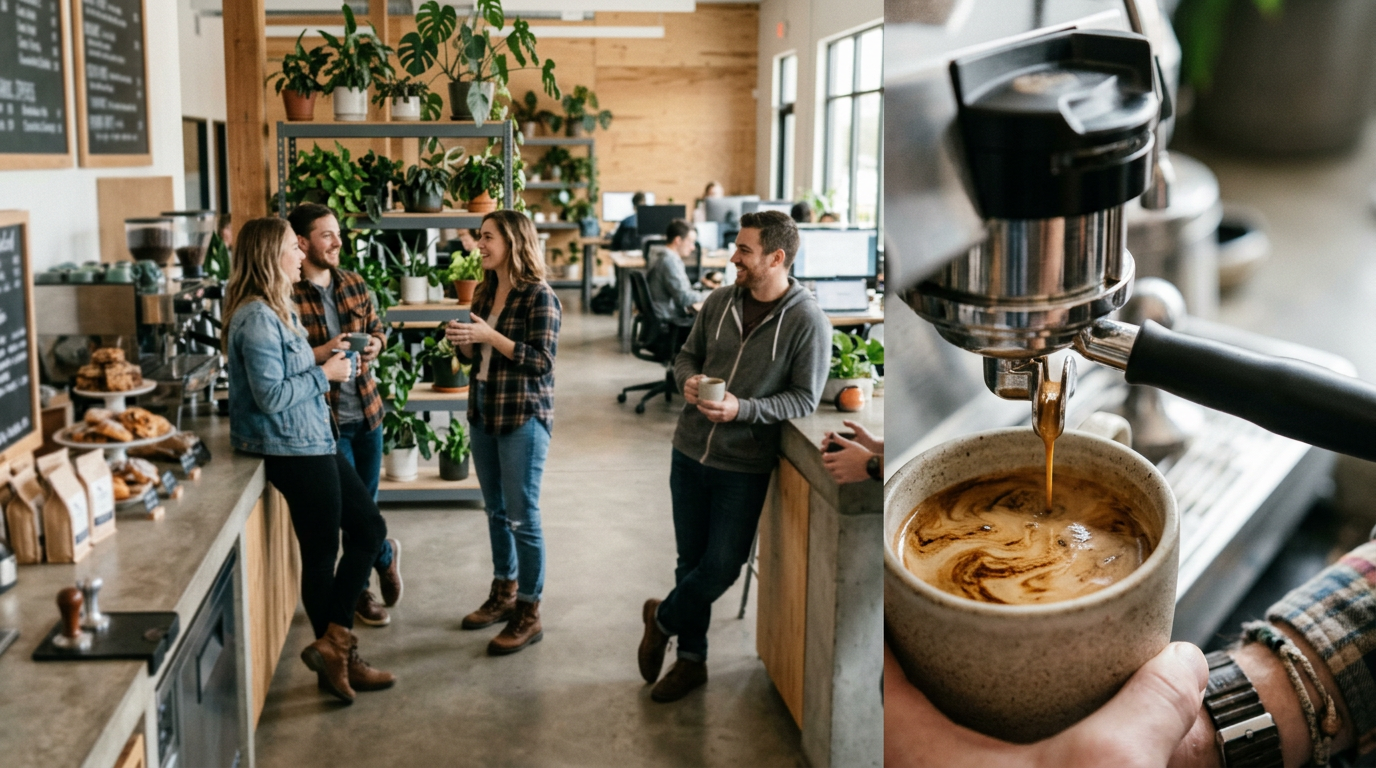
At coffee shops, order like someone who plans to stay but not camp forever. A drip coffee, espresso, cold brew, or single-origin pour-over is fine. If the shop is slammed, do not make the barista your concierge. Houndstooth Coffee, Merit Coffee, Fleet Coffee, Greater Goods Coffee, and Patika all sit in the broader Austin third-wave coffee lane, though the best location depends on where you actually live and work.
What to look for is more important than the cup:
- Long communal tables where people are not wearing headphones all morning
- Outdoor seating with enough space to talk without performing for the whole patio
- A breakfast crowd that includes operators, not only students and tourists
- A bulletin board or event calendar with workshops, readings, tastings, or meetups
- Regulars who clearly know the staff
For coffee-meets-beer settings, places like Cosmic Coffee + Beer Garden, Radio Coffee & Beer, Lazarus Brewing, and Central Machine Works work because the day can stretch from laptop time into casual conversation. You are not forcing a meeting into a sterile lobby. You are giving it somewhere to breathe.
At a natural wine bar or neighborhood restaurant, order something simple and shareable if you are meeting one or two people. Do not turn a first connection into a heavy dinner unless the host set that tone. Austin has become much more comfortable with the low-pressure wine bar meeting: one glass, one snack, 50 minutes, clean exit.
In coworking spaces, look for programming more than furniture. A hot desk is useful if you need density for a day. A dedicated desk makes sense if you want repeated exposure to the same people. A day pass is the best trial move. Ask what events are actually attended by members, not just listed on a calendar.
Best time of day to go
Austin networking is unusually time-sensitive because heat, traffic, and live music all shape behavior.
Early morning is underrated. Between 7:30 and 9:30 a.m., coffee shops and trail-adjacent meetups catch serious people before Slack eats the day. A run club, cycling group, or strength class followed by coffee will often beat a formal founder mixer because people are more relaxed and less guarded.
Midday works for coworking. If you buy a day pass, arrive by 9:30, take one or two real calls, and be visible around lunch. The kitchen, patio, or coffee area from 12:15 to 1:30 is where casual introductions happen. Do not hide in a phone booth all day and then complain that coworking is dead.
Late afternoon is strong for founder-to-founder coffees. Austin does not have the same aggressive breakfast-meeting culture as Manhattan, but it also does not love 8 p.m. business dinners on weeknights unless there is a reason. A 4 p.m. coffee or 5:30 p.m. wine bar meet can work well.
Tuesday through Thursday is the real networking window. Monday is for recovery and planning. Friday is unreliable unless it is a small dinner, a music event, or something tied to a conference. Saturday morning can be excellent if the activity is social by design: run clubs, markets, volunteer builds, outdoor classes, creator meetups.
During SXSW, Austin becomes a different animal. The move is not to chase every badge event. Pick two daytime anchors, one small dinner, and one late event where you already know someone. The people who win SXSW are not the ones who collect the most wristbands. They are the ones who follow up before everyone flies home.
Etiquette and unwritten rules
!Small Austin wine bar table with glasses, plates, and notebooks

Austin is casual, but it is not loose. The dress code may be sneakers and a clean T-shirt, but the social code is more demanding than people think.
Do not open with your raise. Do not ask for investor intros in the first five minutes. Do not pretend you just want feedback when you really want a check. And do not talk over the musician, comic, chef, organizer, or host who made the room worth attending.
The city has a strong anti-performance instinct. If you came from New York, San Francisco, or Los Angeles, you do not need to apologize for that. Plenty of the room did too. But you do need to avoid the line that kills conversations here: comparing Austin to the place you left as if locals have been waiting for your audit.
Better etiquette:
- Say what you are building in one plain sentence
- Ask people what brought them to the room, not only what they do
- Offer one useful local lead before requesting anything
- Respect the difference between friendly and available
- Leave the table better than you found it
If someone introduces you, protect that trust. Reply quickly. Be specific. Do not send a five-paragraph bio. Austin runs on weak ties, the kind sociologist Mark Granovetter made famous: the not-quite-friends who pass along jobs, clients, hires, apartments, and invitations. Weak ties work only when you make them easy to maintain.
How to actually meet people there
Do not wait for a perfect opening. Create a small, low-friction one.
At a coffee shop, the move is not to interrupt someone mid-email. Look for transitions: standing in line, waiting for a drink, packing up, or sitting near a communal table with no headphones. Keep it short.
Use openers that fit the room:
- "Have you worked from here before, or is this your first time testing it?"
- "I’m trying to find Austin rooms that are useful without being pitchy. Any you’d actually recommend?"
- "That event calendar looks better than most. Have you been to anything here?"
- "I’m new to this side of town during the workday. Where do people actually get things done around here?"
At coworking spaces, ask the community manager a better question than "Do you have networking events?" Try: "Which events do members actually show up for?" or "Are there any operators here working in climate, CPG, AI tooling, film, or agencies?" Specific beats broad.
At run clubs or climbing gyms like Austin Bouldering Project, do the activity first. Do not corner someone while they are chalking up or catching breath. The conversation happens after, over water, coffee, or tacos. Say, "I’m trying to meet more people who build things here without making every night a happy hour. Do you know any good recurring groups?"
At natural wine bars and supper clubs, respect the host. If you are invited to a founder dinner, ask who else should be in the room next time. Bring someone high-quality later. That is the currency. Not your pitch.
For follow-up, send the note within 24 hours:
- "Good meeting you at Radio after the run. You mentioned hiring a fractional ops lead. I know one person who may fit. Want an intro?"
- "Thanks for the coworking tip. I’m going to try a day pass next Thursday. If you’re around, coffee is on me."
- "That comment about Austin CPG distribution stuck with me. Sending the local operator dinner I mentioned when the host opens the next round."
Specific memory plus one next step. That is enough.
Better Austin networking spots by situation
For solo work with possible conversation, choose a serious coffee shop or coffee-beer hybrid with visible regulars. The ideal setup has outdoor seating, not-too-loud music, and a crowd that changes from laptop mode to social mode after 4 p.m. Cosmic and Radio fit this pattern well, though both can get crowded.
For early founder density, test coworking with a day pass before committing. Capital Factory is the obvious startup node. Industrious, WeWork, and Spaces can be useful depending on building, tenant mix, and programming. The question is not whether the brand is cool. The question is whether the same serious people show up twice a week.
For creative and operator crossover, watch Austin’s music, film, and design calendars. Austin Film Society events, BookPeople author nights, The Contemporary Austin programming, and smaller gallery openings often attract people who are building companies but do not want to be trapped in a SaaS-only room.
For relationship-first dinners, look for curated founder dinners, supper clubs, and member's club programming. Soho House Austin can be useful if you already have access and know how to avoid the scene-chasing. The better dinner tables are usually hosted by one trusted operator, not blasted across every Slack group.
For low-pressure repeat contact, fitness wins. Run clubs, cycling groups, yoga studios, climbing, pickleball, and social training groups give you repetition without scheduling another coffee. Repetition is the part people skip. One meeting is a contact. Three casual sightings become a relationship.
Mistakes to avoid
The biggest mistake is treating Austin like a smaller San Francisco. The second is assuming casual means unserious.
Avoid these moves:
- Going only to sponsored tech happy hours and declaring the scene shallow
- Asking "Who here is an investor?" before you know anyone’s name
- Taking calls loudly from a coffee shop patio for two hours
- Turning every social activity into a prospecting list
- Ignoring non-tech rooms where the best local context lives
- Overbooking SXSW and doing no follow-up
- Joining coworking for the furniture instead of the member mix
- Waiting for someone else to make the room useful
Also avoid the founder monologue. Austin people will let you talk. That does not mean it is going well. If you have been speaking for more than 90 seconds, ask a question.
A practical weekly rhythm
If you are serious about building an Austin network, make it boring enough to repeat.
Try this for six weeks:
- One morning coffee work block at the same place each week
- One coworking day pass or recurring member day
- One activity-based group: run, climb, ride, volunteer, or class
- One small dinner, wine bar meet, or industry event
- Two thoughtful follow-ups every Friday
Keep a simple note after each interaction: name, context, one thing they care about, one possible useful intro. Do not build a creepy CRM for humans. Just remember people.
The goal is not to become everywhere in Austin. That is exhausting and fake. The goal is to become familiar in two or three rooms where your work, taste, and generosity are legible.
Austin still has plenty of loud networking. Let other people fight for the sponsored beer line. The better version is quieter: a shared table, a clean ask, a real introduction, a reason to see each other again next week.
Discussion (0)
Loading comments…