The Brooklyn coffee bar test for serious operators
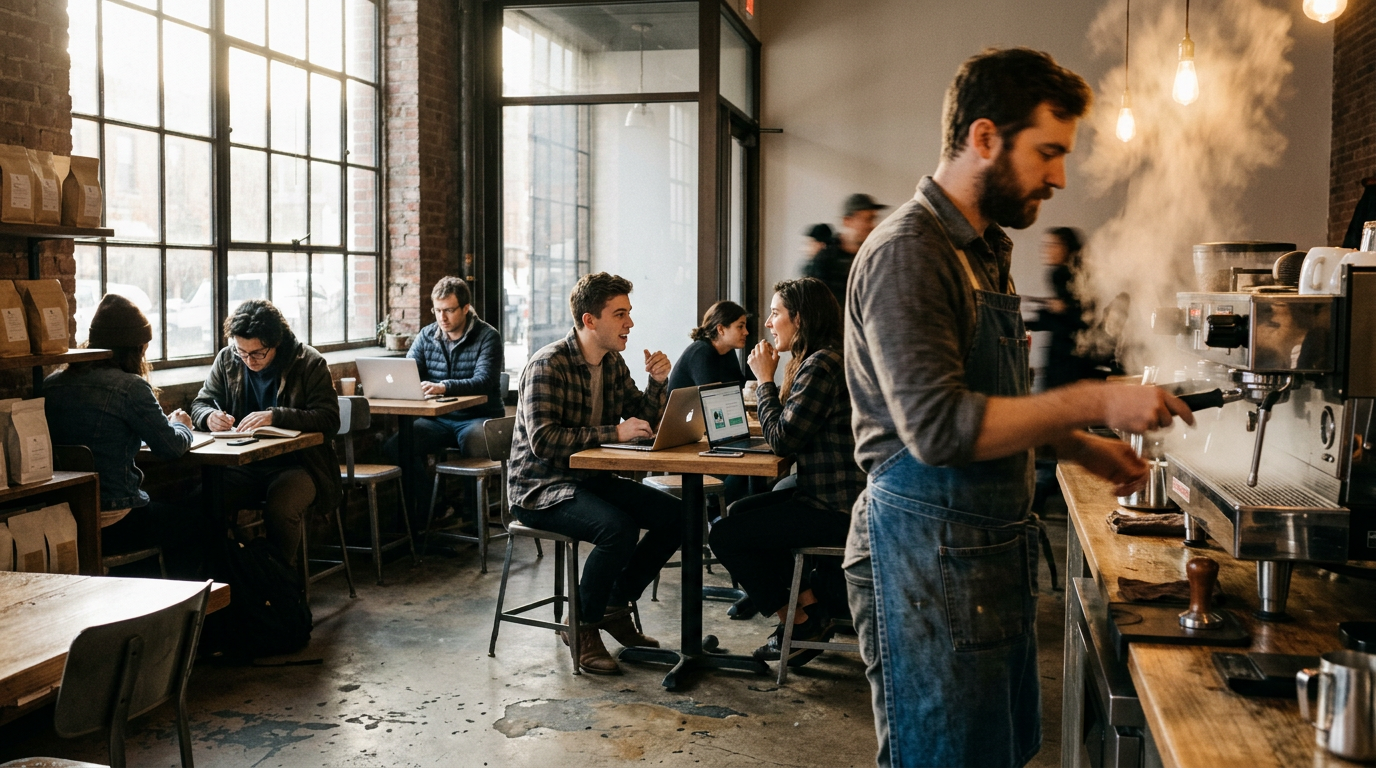
At 9:12 on a Tuesday in Williamsburg, the real coffee shop is already giving itself away. The barista is purging the group head without drama. Someone at the counter asks about a washed Colombian and gets a clear answer, not a lecture. Three laptops are open, but nobody has turned a four-top into a personal office. The music is present, not performing. The room has founders, designers, writers, production people, and a few regulars who do not need to announce that they are regulars.
Brooklyn has enough third-wave coffee now that the old signals are useless. White tile, a La Marzocco, oat milk, and a bag of beans on a shelf do not mean much in 2026. The category matured. A real third-wave coffee shop is not just a pretty room with expensive espresso. It is a place that treats coffee as a product, hospitality as a craft, and the room as a living system.
A wannabe usually treats coffee as décor. It photographs well, charges like it knows what it is doing, and hopes nobody asks hard questions about roast dates, extraction, sourcing, or why the cappuccino tastes like burnt almond milk.
This matters if you are using coffee shops the way many New York operators do: for soft meetings, solo work, weak-tie networking, and a read on the neighborhood. The right room can put you near people who are actually building. The wrong one burns $8 and an hour of attention.
The real signal is the bar, not the branding
Start at the counter. Not Instagram. Not the wall color. Not the tote bag.
A serious third-wave coffee shop in Brooklyn usually has a focused menu. Espresso. Batch brew. Single-origin pour-over, sometimes. Maybe a cortado, cappuccino, flat white, iced coffee, tea, and a few pastries from a known local bakery. The menu is not trying to be brunch, boba, smoothie bar, coworking lounge, and dessert shop at once.
Look for these tells:
- Beans with visible roast dates, not just vague origin language.
- A barista who can explain the difference between a washed, natural, and honey process without making you feel stupid.
- Batch brew that is treated with respect, not as the cheap option for people in a hurry.
- Espresso that tastes balanced, not sour for the sake of being “modern” or bitter because nobody dialed it in.
- A grinder station that looks used and cared for, not decorative.
- Milk drinks where texture matters. Microfoam is not optional at this level.
A wannabe shop often hides behind sweeteners. Lavender syrup, cereal milk cold brew, pistachio foam, birthday-cake matcha. None of those are crimes. But if the entire menu is flavored milk and the plain espresso cannot stand up, you are in a concept, not a coffee program.
The best rooms in Brooklyn do not need to shout. Think of the seriousness you find around places like Devoción in Williamsburg, Sey Coffee in Bushwick, La Cabra in Soho and the East Village, Coffee Project New York, Joe Coffee, Cafe Grumpy, and the stronger Blue Bottle locations. Different personalities, different levels of laptop tolerance, but the better ones share the same operating truth: coffee is not a prop.
What to order / what to look for
!Barista preparing espresso and pour-over at a focused Brooklyn coffee bar

If you want to test a shop fast, do not start with the most complicated drink.
Order one of these:
- Espresso if you can handle a small, honest read on the bar.
- Cortado if you want to judge espresso and milk skill together.
- Batch brew if you want to know whether the shop respects daily coffee drinkers.
- Single-origin pour-over if the bar is not slammed and the menu suggests they actually care about it.
Ask one clean question: “What are you liking on filter right now?” That is enough.
A strong barista will usually give you a useful answer: “The washed Ethiopian is floral and lighter, the Colombian is more structured, the natural is fruitier.” A weak shop will point to the menu and say everything is good. That is not a scandal, but it tells you the level of the room.
Then watch the pace. Real third-wave coffee can be careful without being precious. If a pour-over takes time, fine. If the barista acts like you have interrupted a ceremony by ordering during business hours, that is not craft. That is theater.
Also look at who comes in and how staff treat them. Regulars are a serious signal. Not famous people. Not influencers. Regulars. The person who gets a nod, the designer who knows where to stand, the local contractor grabbing drip before a job, the founder taking a ten-minute meeting before heading to a dedicated desk nearby. A good shop has range.
Best time of day to go
Brooklyn coffee rooms change by the hour. Use that.
7:30 to 9:30 a.m.
This is the neighborhood truth window. Operators before calls. Parents after drop-off. Freelancers trying to protect the first serious hour of the day. If the shop cannot handle morning volume without collapsing into attitude, that is useful information.
For networking, keep it light. This is not the time to pitch. Order, read the room, maybe make one quick comment at the condiment station or while waiting outside.
10 a.m. to noon
Best window for solo work and soft introductions. The rush has passed, but the room still has energy. If you are testing a coffee shop as a possible recurring work base, come now. You will see laptop behavior, table turnover, outlet scarcity, and whether calls are tolerated or quietly despised.
2 to 4 p.m.
This is the sweet spot for low-pressure meetings. Investors, agency leads, fractional operators, creators, and early-stage founders often use this window because it does not destroy the day. A serious coffee shop can support a 30-minute catch-up here without feeling like a WeWork common area.
After 5 p.m.
Most coffee shops thin out. Some shift toward wine, events, or a softer neighborhood mode. If a shop runs a natural wine bar program, readings, small product meetups, or founder dinners after hours, that can be a good sign. Not because wine makes it better. Because it shows the operator understands community programming, not just beverage margins.
Etiquette and unwritten rules
!People talking outside a Brooklyn coffee shop after work

New York coffee etiquette is not complicated, but it is enforced socially.
Buy something before you sit. If you stay more than 90 minutes, buy again. If the place is small, do not take a four-top alone. If every seat is full and you have been nursing one drip for two hours, leave.
Calls are the biggest tell. A real third-wave coffee shop is not automatically a hot desk. If you need to speak, step outside or keep it under five minutes. Nobody wants to hear your AngelList update, your Lunchclub scheduling problem, or your “quick sync” with the growth team.
Do not colonize outlets. Do not unpack a laptop stand, external keyboard, mouse, charger brick, notebook stack, and protein bar unless the shop clearly operates like a work café. If you need that setup, book a day pass at Industrious, Spaces, WeWork, or a local coworking studio. Coffee shops are for lighter work and human proximity. Coworking is for infrastructure.
Tip well, especially if you are becoming a regular. Learn names if the relationship develops naturally. Do not force it. The barista is working, not auditioning to be your local friend.
And please, stop asking for “the least acidic one” as if acidity is a defect. Better: “I usually like chocolatey or rounder coffees. What would you suggest?” That gets you a real answer.
How to actually meet people there
The coffee shop is not a networking event. That is why it works.
The best connections come from repeated proximity. Sociologist Mark Granovetter’s idea of weak ties fits here: the person you see often but barely know can be more useful than someone deep inside your existing circle. Coffee shops create those light, repeated overlaps.
Your job is not to work the room. Your job is to become recognizable without becoming annoying.
Try this sequence:
- Pick one or two shops and visit at the same time twice a week.
- Sit in a visible but non-dominant spot.
- Keep your setup small.
- Make one normal comment when the moment is obvious.
- Leave before you become furniture.
Good openers in Brooklyn are specific and low-pressure:
- “Have you had the filter today? I’m deciding between that and a cortado.”
- “Is this table usually a laptop zone, or am I about to annoy everyone?”
- “I keep seeing people meet here before heading to coworking. Are you based nearby?”
- “That notebook setup looks serious. Are you designing, writing, or pretending to do both?”
Use humor carefully. No pitch voice. No business-card ambush. If the person gives short answers, let it die. That restraint is part of the local code.
If the conversation goes well, do not turn it into a 25-minute extraction. Close cleanly:
- “Good talking. I’m here most Tuesdays around this time.”
- “Want to swap emails? I can send that event link.”
- “I’m putting together a small coffee-before-work table next week. No agenda, just operators comparing notes.”
Follow up within 24 hours. One sentence of context, one useful link, one light next step. If you met a founder, mention the specific thing they are building. If you met a designer, reference the kind of work they described. Specificity is respect.
Real third-wave versus wannabe, in one pass
Here is the quick field read.
A real third-wave coffee shop usually feels edited. The menu is edited. The room is edited. The staff can talk coffee without performing superiority. The pastries are chosen, not random. The beans rotate with some logic. The shop can survive a rush without losing its mind.
A wannabe feels overdesigned and under-operated. Too many signs. Too many rules nobody enforces consistently. Too many drinks built for photos. Staff who cannot answer basic coffee questions because ownership spent on tile before training. A room full of people taking pictures of drinks nobody seems to finish.
The laptop policy is another clue. Good operators know what kind of room they want. Some welcome laptops on weekdays. Some limit them. Some discourage them entirely. Any of those can be legitimate. The red flag is confusion: staff glaring at laptop users while the shop advertises Wi-Fi, or a room full of outlets with signs shaming people for working.
Bathrooms matter. So do trash stations, water, bus tubs, and the way the line moves. Third-wave coffee is not only taste. It is operations under pressure.
Mistakes to avoid
The first mistake is judging by aesthetics. Brooklyn is full of rooms that look serious and pull careless espresso. A beautiful counter is not a credential.
The second mistake is assuming expensive means good. Coffee prices rose for real reasons: green coffee costs, rent, wages, milk, insurance, payment fees. Still, a high price does not excuse a sloppy drink or a cold room.
The third mistake is bringing coworking expectations into a café. If you need a dedicated desk, monitors, call booths, mail handling, and three hours of Zoom, go to a coworking space. If you want ambient awareness, a good drink, and a chance to bump into a smart stranger, choose the coffee shop.
The fourth mistake is over-networking. Nobody in Brooklyn wants to be hunted while waiting for a cappuccino. Let the room breathe.
The fifth mistake is chasing only famous shops. Well-known places can be excellent, but the best working café for you might be a smaller neighborhood spot with disciplined coffee, kind staff, and a crowd that matches your week. A serious shop does not need a line down the block.
The room you want depends on the work
For deep writing, choose a calm café with good batch brew, limited seating, and no pressure to perform. For a first founder meeting, choose a place near transit with enough table turnover that you will not hover awkwardly. For investor coffee, pick somewhere polished but not loud. For meeting other operators, look near coworking clusters, design studios, small agencies, and member’s club spillover.
Soho House and NeueHouse have their place. So do On Deck circles, Meetup groups, South Park Commons-adjacent gatherings, and founder dinners. But the daily fabric of New York work still happens in smaller rooms: coffee before a pitch, a quick post-standup reset, the unplanned introduction that turns into a referral two weeks later.
That is why the third-wave test matters. You are not only buying caffeine. You are choosing a room with standards. Standards attract people who notice standards.
When in doubt, order the batch brew, stand to the side, listen for how the staff talks about the coffee, and watch who stays. The real place will reveal itself in ten minutes.
Discussion (0)
Loading comments…