The Cambridge coffee rooms founders actually use
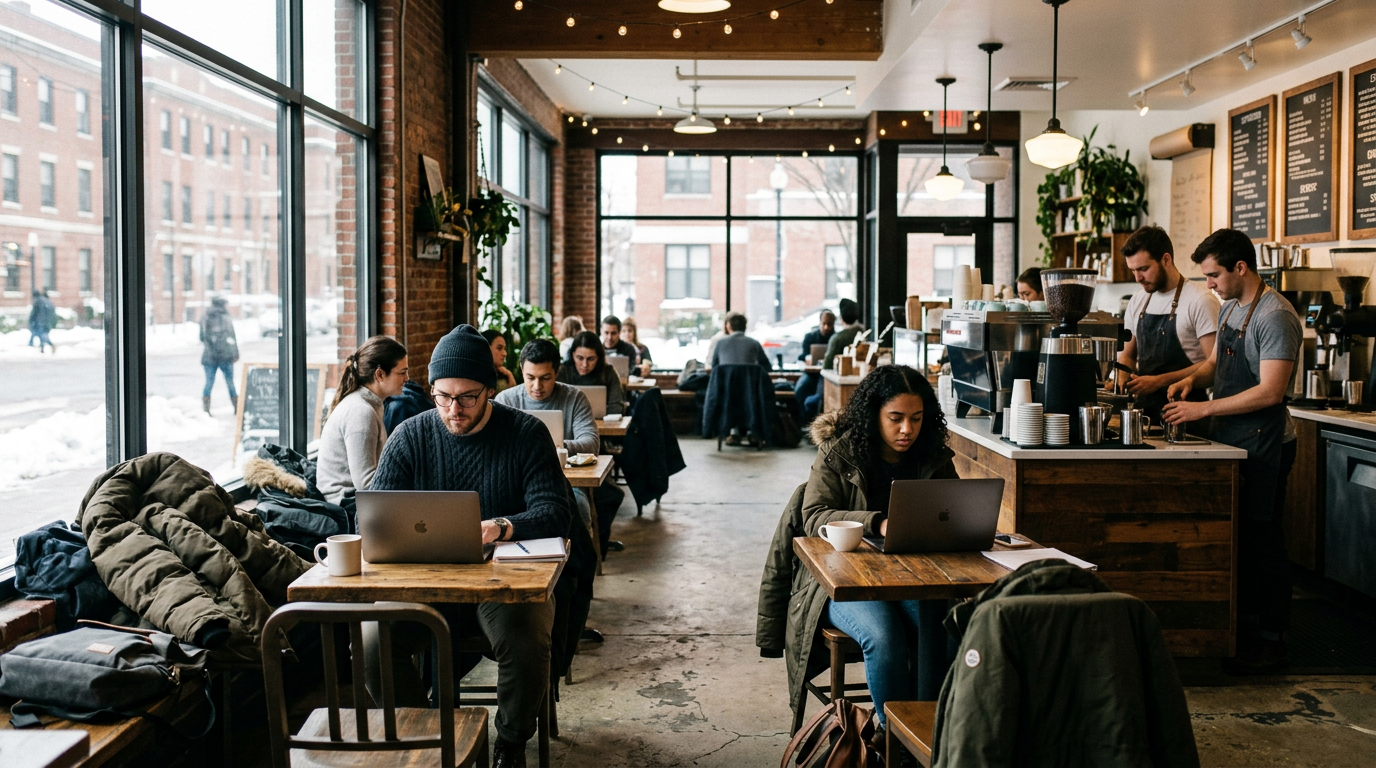
At 8:47 a.m. in Kendall Square, the room tells on itself. A PhD founder is half-listening to a term sheet call. Two biotech operators are arguing quietly over trial timelines. Someone from a robotics lab is eating breakfast too fast before walking back toward Mass Ave. Nobody is here for café romance. They are here because a 28-minute coffee can move a company along.
Boston founder coffee is not like New York founder coffee. It is less performative. Less loud. More credentials in the room, fewer people announcing them. Near MIT and Harvard, the best coffee shops work as Schelling points: obvious meeting places where people with overlapping worlds can find each other without overplanning. That matters in Cambridge, where the real network is split across labs, hospitals, accelerators, venture offices, coworking floors, and faculty calendars.
The job is simple: pick the right room, behave like someone people want to meet again, and leave with one clean follow-up. Not five vague LinkedIn adds. One useful next step.
The real map is Kendall, Central, and Harvard
When people say “Boston coffee shops near MIT and Harvard,” they usually mean Cambridge. The useful founder circuit runs along a few Red Line stops:
- Kendall/MIT for AI, robotics, biotech, climate, enterprise SaaS, deep tech, and investor-adjacent meetings.
- Central Square for scrappier operators, grad-student founders, early hires, builders, and people who do not want every conversation overheard by a VC associate.
- Harvard Square for student founders, edtech, consumer ideas, policy-adjacent startups, alumni meetings, and academic crossover.
There are good places across the river in Boston, but if your meetings are tied to MIT, Harvard, CIC Cambridge, LabCentral, The Engine ecosystem, or university calendars, do not make people cross the Charles for a casual intro. That is a small local mistake with a big social cost. Cambridge people optimize for proximity.
A few reliable anchors are worth knowing. Tatte Bakery & Cafe works when you need a polished, predictable room in Kendall or Harvard Square. Flour Bakery + Cafe is a strong Kendall option for breakfast meetings that need food, not just caffeine. 1369 Coffee House in Central and Inman has long been more neighborhood than pitch-deck theater, which can be exactly right. Broadsheet Coffee Roasters near Harvard is a better fit when coffee quality matters and the meeting can be a little more intentional. Curio Coffee in East Cambridge is small and specific; use it for focused one-on-ones, not sprawling laptop sessions. Caffè Nero in Harvard Square is not third-wave purist territory, but it is practical, recognizable, and often useful when you need seats.
The move is not to memorize a venue list. It is to match the meeting to the room.
What to order / what to look for
!Two founders in a focused coffee meeting at a small Cambridge cafe table

Order in a way that fits the meeting. This sounds minor until you watch someone derail a 20-minute investor intro by studying the pastry case like they are choosing a wedding venue.
For a first founder-to-founder chat, keep it fast:
- Drip coffee or cold brew if the place is busy.
- Espresso or cortado if you know what you want.
- Tea if you are already over-caffeinated and still need to sound coherent.
- A pastry only if the other person is also eating or the meeting is scheduled over breakfast.
For a more relaxed operator conversation, a better third-wave shop can help. A single-origin pour-over is fine if the room is calm and the bar is not slammed. Do not order one during a line out the door and then make your guest wait seven minutes while you narrate processing methods. Cambridge respects expertise. It does not respect unnecessary friction.
What to look for in the room:
- Tables for two that are not jammed against the register.
- Enough ambient noise to protect sensitive details.
- A layout where a laptop can open briefly, then close.
- Staff who are moving efficiently, not fighting the room.
- A customer mix that includes students and operators, not just remote workers camping for six hours.
If the conversation involves confidential funding details, hiring issues, university IP, or a messy cofounder situation, choose a louder room or walk after ordering. Cambridge coffee shops are full of people who know the same people.
Best time of day to go
Timing is the difference between a useful coffee meeting and a table hunt with oat milk.
Kendall works best between 8:00 and 10:00 a.m. That is when founders, lab people, and investors are already moving. Breakfast meetings here feel normal. After 11:30, the lunch rush starts to distort the room. By midafternoon, you are more likely to hit laptop campers and internal team spillover.
Central Square is strongest from 10:00 a.m. to noon and again around 3:00 p.m. It is looser than Kendall. Better for candid conversations, early cofounder chats, and meeting someone who is still deciding whether they are “starting a company” or just working on a serious project. The 3:00 p.m. slot is underrated because people have cleared morning obligations but are not yet rushing to evening events.
Harvard Square is best before 10:30 a.m. or after 2:00 p.m. Avoid the lunch crush and the post-class wave when possible. Student founders often suggest Harvard because it is familiar, but familiar does not always mean functional. If you need a serious conversation, propose a specific time and a specific corner of the neighborhood.
Evenings are less reliable for coffee. Cambridge networking after 6:00 p.m. often migrates to natural wine bars, low-key restaurants, university events, founder dinners, or invite-only gatherings around labs and accelerators. Coffee is the daytime operating system.
Etiquette and unwritten rules
!Morning coffee crowd near a Cambridge square with laptop bags and brick storefronts
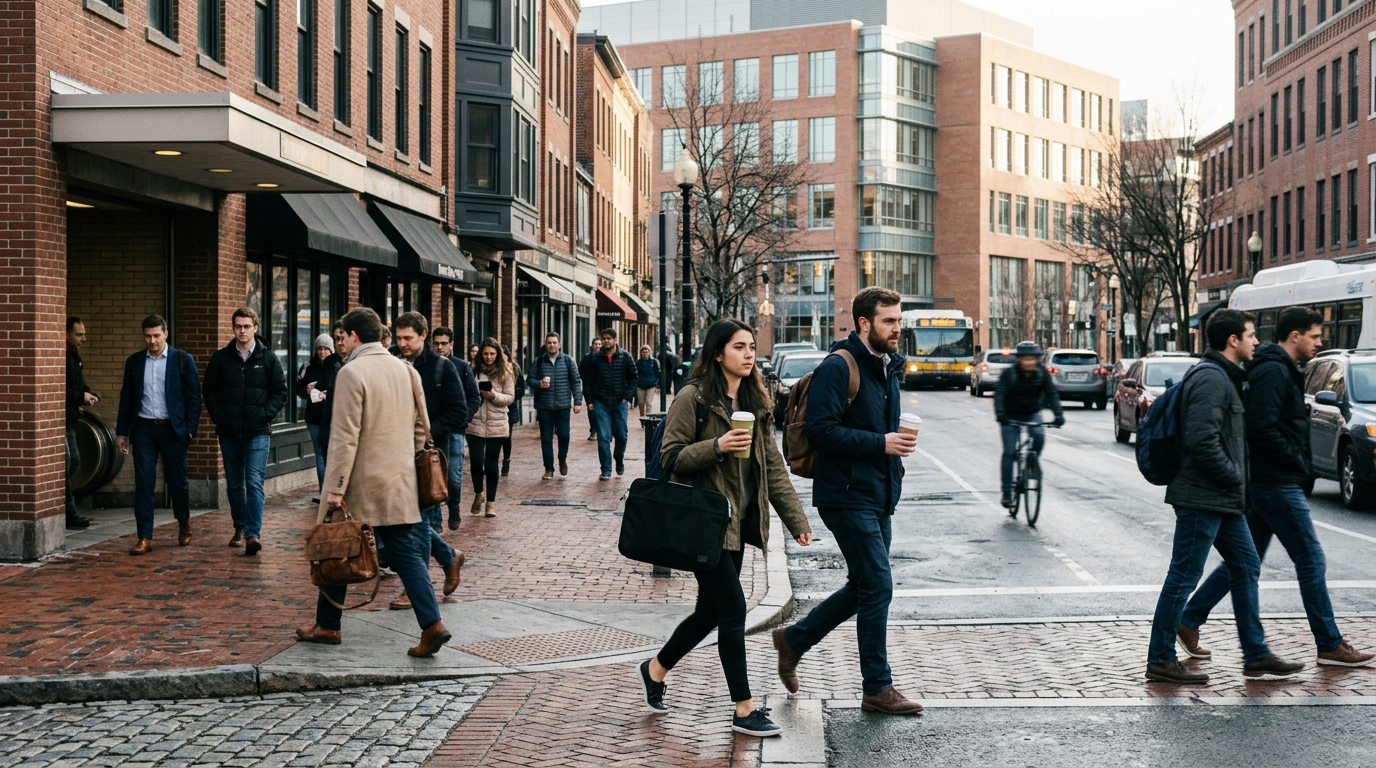
Boston is not impressed by volume. Cambridge is especially allergic to the obvious hard sell. The room may be casual, but the social code is not.
Follow these rules:
- Buy something quickly. Do not occupy a table while “waiting to see” if the other person wants coffee.
- If seating is tight, keep the meeting to 30 minutes unless both people explicitly extend it.
- Do not take a four-person table for a two-person intro during peak hours.
- Keep your pitch deck closed unless someone asks to see it.
- Never lead with valuation, famous advisors, or “we are raising.”
- Do not name-drop MIT, Harvard, YC, AngelList, or a venture firm unless it is directly relevant.
- If you recognize someone, do not interrupt a meeting. A nod is enough.
The best local opener is still the plainest one: “What are you working on right now?” In Cambridge, that question lands better than “What do you do?” because half the room has multiple identities: researcher, founder, advisor, operator, adjunct, angel, fellow, former something.
If you are the one who requested the meeting, arrive five minutes early and secure the table. If the other person is coming from a lab, class, clinic, or investor office, assume they are navigating a tight calendar. Make it easy.
How to actually meet people there
A coffee shop is not a networking event. Treating it like one is how you become the person everyone avoids.
The best way to meet people in Cambridge coffee rooms is through light, situational contact plus a reason to continue later. Weak ties matter here because many useful introductions come from people who are not close friends: a founder one stage ahead, a former labmate, an angel who writes small checks, an operator who knows the hiring market.
Use openers that do not trap people:
- “Are you here for the MIT event later, or just working nearby?”
- “I saw the laptop stickers and guessed climate or robotics. Am I close?”
- “Do you know if this place gets impossible after lunch? I am trying to pick a regular meeting spot.”
- “I am new to the Cambridge founder circuit. Is there one event people actually show up for?”
If they answer warmly, continue. If they answer with one word and return to headphones, you are done. Respect the signal.
Better yet, use coffee as the second touch, not the first. Meet someone at a Meetup, an On Deck alumni gathering, a university demo night, a South Park Commons-adjacent event, a founder dinner, a coworking happy hour, or through Lunchclub-style matching. Then suggest coffee near where they already are:
- “I am in Kendall Tuesday morning. Want to do 25 minutes before your first meeting?”
- “If you are near Harvard Square this week, I can come to you.”
- “No pitch. I would value your read on the customer segment.”
That last line works because it is specific and modest. Cambridge people will often help if the ask is bounded.
Your follow-up should be sent the same day:
- “Good meeting you at Broadsheet. I took your point on hospital procurement seriously. I am going to talk to two more operators before building the next feature. If useful, I can send a short note on what I hear.”
- “Thanks for the Kendall coffee. You mentioned a founder working on lab automation; happy to send a three-line blurb if an intro makes sense.”
- “Appreciated the pushback. I will follow up in a month with actual customer data, not vibes.”
Short. Useful. No essay.
Matching the shop to the meeting
Use Kendall when the meeting has commercial intent: investor intro, enterprise customer conversation, biotech partnership, technical hiring, accelerator office hours, or a quick pre-meeting before going to CIC Cambridge or a nearby lab. Tatte and Flour both work here because they are legible. Nobody needs a map. Nobody wonders if there will be food.
Use Central Square when the conversation is earlier, messier, or more peer-level. 1369 is good for this because it does not feel like a stage set for fundraising. Central is also useful when one person is coming from MIT and the other from Harvard, and neither wants to concede the whole commute.
Use Harvard Square when the university connection matters: student founder chats, alumni coffees, edtech, policy, social impact, consumer, creator tools, or anything involving faculty and students. Broadsheet is the stronger coffee choice. Caffè Nero is the pragmatic seating choice. Tatte is the polished default when you are meeting someone who does not know the area.
Use East Cambridge for focused conversations with people tied to the Kendall ecosystem but allergic to the main Kendall crush. Smaller shops can be better for thoughtful one-on-ones, but do not assume you can camp. Buy, meet, move.
If you need a full workday, choose a coworking day pass, hot desk, or dedicated desk instead of pretending a café is your office. WeWork, Industrious, Spaces, and local innovation centers changed after the pandemic, but the basic rule remains: coffee shops are for meetings and short work blocks; coworking is for calls, documents, and staying put.
Mistakes to avoid
The biggest mistake is treating Cambridge like a generic startup district. It is not. The social fabric is academic, technical, and reputation-heavy. People remember sloppiness.
Avoid these moves:
- Scheduling “coffee near MIT” and picking somewhere that requires a 20-minute walk from the actual lab or office.
- Asking a senior operator to “pick your brain” with no agenda.
- Turning a casual coffee into a fundraising pitch without permission.
- Taking calls on speaker or discussing confidential hiring issues at full volume.
- Assuming every student with a laptop is a founder.
- Camping through lunch with one small coffee and a laptop charger stretched across traffic.
- Sending a follow-up that asks for three introductions and offers nothing back.
Also avoid over-optimizing for coffee purity. Yes, Boston has mature third-wave coffee now. Yes, a good espresso matters. But founder coffee is a utility. The best room is the one your guest can reach, hear you in, and leave without losing half a day.
A practical Cambridge coffee playbook
If you are trying to build a real local network over the next month, do this:
- Pick one Kendall default, one Central default, and one Harvard default.
- Schedule coffees in clusters instead of scattering them across the week.
- Keep first meetings to 25 or 30 minutes.
- Ask one specific question per meeting.
- Offer one useful thing before asking for anything.
- Follow up the same day with a short note and a clear next step.
- Return to the same rooms often enough that staff and regulars recognize you.
That last part matters. Local networks are built through repeated low-pressure contact. Not one big entrance. Not a stack of business cards. A coffee shop near MIT or Harvard becomes useful when you stop treating it as a backdrop and start treating it as part of your operating rhythm.
In Cambridge, the right coffee meeting does not feel like networking. It feels like two busy people making one another slightly smarter before the next calendar block. That is the standard. Meet it, and the rooms start to open.
Discussion (0)
Loading comments…