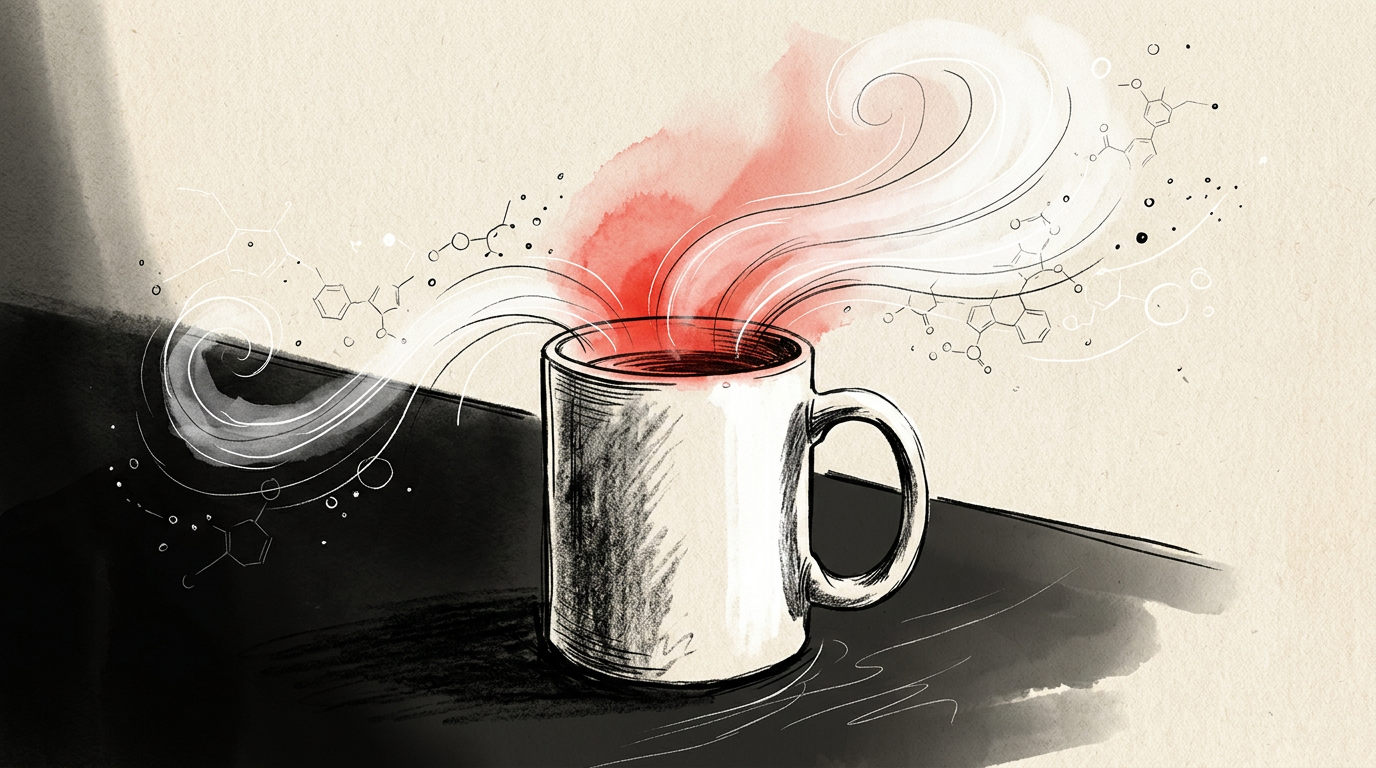
Your coffee gets cold for a brutally simple reason
A mug on the counter at 7:43 a.m.
The coffee was perfect ten minutes ago. Too hot to gulp, warm enough to forgive the inbox. Then a notification pulled you away. A reply became three replies. Now the mug is sitting there like evidence.
You take a sip. Flat. Lukewarm. Not ruined by age, exactly. Ruined by physics.
Nothing dramatic happened. No visible leak. No tiny refrigerator climbed into the cup. The coffee simply shared its heat with the room. Some heat went into the ceramic mug. Some warmed the air just above the surface. Some left by radiation as infrared light. A lot left through evaporation, which is why an uncovered mug cools faster than a covered one.
The strange part is not that coffee cools. The strange part is that it does not warm itself back up.
You have probably never watched a cold mug on a desk pull heat out of the room until it becomes piping hot again. You have never seen spilled milk gather itself back into the glass. You have never seen smoke crawl neatly back into a match.
That one-way feeling is the point. Entropy is the name physics gives to the reason some things happen all the time, while their reverse is technically not forbidden in the small print but might as well be forbidden in real life.
What it actually is
Entropy is a measure of how spread out energy is, and how many microscopic arrangements can produce the same visible situation.
That sentence needs unpacking.
A hot cup of coffee contains molecules moving, vibrating, rotating, and bumping into one another faster than the molecules in the cooler air around it. Temperature is a measure of average molecular motion. Hotter usually means more energetic molecular jostling.
At first, the energy is concentrated. The coffee is hot. The room is cooler. There is a difference.
Over time, energy spreads. Coffee molecules bump into the mug. The mug bumps into air molecules. Water molecules escape as vapor from the surface and carry energy away. The room gains a tiny amount of heat. The coffee loses a noticeable amount because the coffee is small and the room is big.
Entropy rises because the spread-out version can happen in vastly more microscopic ways than the concentrated version.
Rudolf Clausius introduced the term entropy in the 1860s while working on heat, engines, and the second law of thermodynamics. In 1865, he gave the idea a famous thermodynamic form: the entropy of the universe tends toward a maximum. In plain English, heat naturally flows from hotter things to colder things, and the total spreading of energy tends to increase.
Ludwig Boltzmann sharpened the idea in 1877 by connecting entropy to probability. His famous relation, S = k log W, says entropy S is tied to W, the number of microscopic ways a system can be arranged while looking the same at the large scale. You do not need the math to feel the idea. A neat deck of cards has very few arrangements we would call ordered. A shuffled deck has an absurd number of arrangements we would call mixed.
Coffee cooling is the same kind of story, but with energy instead of cards.
Why it matters
Entropy matters because it explains why time feels like it has a direction.
Most basic physical laws do not care much whether a movie runs forward or backward. If you filmed two billiard balls colliding on a frictionless table, the reversed film could still look physically plausible. But a real breakfast table is not that clean. Steam spreads. Toast cools. Ice melts. Eggs crack.
The arrow of time points in the direction of increasing entropy.
That does not mean every single object must become messier every second. A freezer can make water into ice. A plant can build a leaf. A person can clean a kitchen. Local order can increase, but only by using energy and pushing even more entropy into the surroundings.
Your refrigerator is not a loophole. It pumps heat out of the cold interior and dumps heat into your kitchen, using electricity to do it. The fridge makes one small region colder while the larger system, including the power plant or solar panel and the room air behind the fridge, pays the entropy bill.
This is why entropy sits underneath engines, batteries, weather, biology, computing, and the long-term fate of stars. It is not just a classroom word. It is the accounting system for energy spreading.
Claude Shannon borrowed the word entropy in 1948 for information theory because the math looked similar. Shannon entropy measures uncertainty in messages: a predictable message has low information entropy; a surprising one has high information entropy. Physical entropy and information entropy are not identical in ordinary conversation, but they are cousins. Both count possibilities.
That link became important in the 20th century because information is physical. In 1961, IBM physicist Rolf Landauer argued that erasing information has a minimum thermodynamic cost. Computers are not ghost machines floating outside physics. They make heat too.
Your laptop fan and your cooling coffee are distant relatives.
The simplest analogy that works
Think of a crowded party in a house with one very loud room.
At 9 p.m., almost everyone is packed into the kitchen, shouting over the music. The living room is half empty. The hallway is quiet. The bedrooms have a few people looking for coats.
That is the hot coffee at the start: energy crowded into one place.
Now open all the doors and wait.
People drift. Some leave the kitchen because it is too packed. Some move into the living room. A few end up in the hallway. After a while, the crowd is more spread out. No organizer needed. No grand plan. There are simply many more ways for people to be distributed across the house than for almost everyone to remain packed into one room.
Could everyone randomly wander back into the kitchen at the same time? In principle, yes. Nothing about walking makes it logically impossible.
In practice, no. Not in any time span you should plan around.
That is entropy. It is not a mysterious force pushing people around. It is probability plus lots of moving parts.
The coffee version has unimaginably more moving parts than the party. A mug contains an enormous number of molecules. Each molecule has position, speed, direction, and energy. The number of ways for heat to be spread among the coffee, mug, and room is staggeringly larger than the number of ways for the coffee to stay hot while the room stays cool.
So the ordinary outcome wins almost every time.
This is why calling entropy disorder can help at first and then betray you. A messy bedroom is a decent cartoon, but entropy is not about your laundry’s moral state. It is about how energy and matter can be arranged at the microscopic level.
A clean-looking glass of room-temperature water can have high entropy. It looks calm. Microscopically, its molecules are moving in countless possible ways. The surface does not need to look chaotic for the entropy to be high.
What your mug is actually doing
A cooling mug uses several heat-transfer routes at once.
Conduction is heat moving through direct contact. Coffee warms the ceramic. The ceramic warms the table and nearby air.
Convection is heat moving through fluid motion. Warm air above the mug rises, cooler air replaces it, and the cycle keeps carrying heat away.
Radiation is energy leaving as electromagnetic waves, mostly infrared at these temperatures. You cannot see it with your eyes, but a thermal camera can.
Evaporation is the escape of faster water molecules from the surface. Those escaping molecules take energy with them. This is also why sweat cools your skin.
Isaac Newton studied cooling behavior around 1701, and the rule named after him is still useful for everyday cases: the cooling rate is roughly proportional to the temperature difference between the object and its surroundings. Translation: very hot coffee cools quickly at first, then slows down as it approaches room temperature.
That is why the first five minutes hurt more than the next five. A mug at 180°F in a 70°F room has a large temperature gap. Later, at 105°F, the gap is much smaller. There is less push for heat to leave.
The coffee usually stops near room temperature, not absolute cold. It does not keep cooling forever on your desk because it reaches thermal equilibrium. That means energy is still moving microscopically in both directions, but there is no net heat flow. The back-and-forth balances out.
Quiet, boring balance. The universe loves that more than your ideal sip temperature.
A five-minute test at home
You can make entropy feel less abstract with a mug, a thermometer, and a little patience.
- Pour hot water or coffee into two identical mugs.
- Leave one uncovered and cover the other with a saucer or lid.
- Record both temperatures at the start, then every two minutes for ten minutes.
- Keep the mugs away from a vent, sunny window, or cold countertop if you want cleaner results.
- Compare the cooling curves. The uncovered mug should usually cool faster because evaporation and air movement are doing extra work.
If you want a second test, stir one mug and leave the other alone. Stirring can speed heat transfer by mixing hotter liquid from the center with cooler liquid near the edges. You are not changing the second law. You are changing the path the heat takes.
The measurement that matters is the temperature gap between the liquid and the room. A larger gap usually means faster cooling. That simple gap explains a surprising amount.
Common misconceptions
Entropy does not mean everything becomes ugly.
A snowflake has beautiful structure, yet it forms while the wider environment increases in entropy. Local order can appear when energy flows through a system. The catch is that the total accounting still favors more entropy overall.
Entropy is not laziness.
The coffee is not trying to become cold. Molecules do not have plans. They collide, exchange energy, and explore possible arrangements. The warmer-to-cooler pattern emerges from huge numbers of those tiny exchanges.
The second law is not absolute in the way a brick wall is absolute.
For a tiny system with only a few particles, small fluctuations can briefly run against the usual trend. Modern statistical mechanics allows that. But for a coffee mug with a vast number of molecules, the odds of spontaneous reheating are so small that ordinary language gives up and calls it impossible.
Entropy is not the same as temperature.
A hot object can have less entropy than a cooler but much larger object. Entropy depends on energy, temperature, volume, molecular arrangements, and the amount of matter involved. The room gains only a tiny temperature bump from your coffee, but because the room is large, the total entropy increase still wins.
Heat death is not the reason your coffee cooled before lunch.
Cosmologists use entropy to discuss the far future of the universe, including scenarios where useful temperature differences fade away. That is a huge idea. Your mug is the household version: useful heat difference disappears, and the coffee can no longer warm your hands or your mood.
Key takeaways
- Entropy measures energy spreading and the number of microscopic arrangements behind what we see.
- Hot coffee cools because heat flows into the mug, air, table, and surrounding room until thermal equilibrium is reached.
- The second law of thermodynamics says total entropy tends to increase in an isolated system.
- The arrow of time is tied to entropy: cooling coffee, melting ice, and spreading smoke look normal forward and absurd backward.
- Disorder is only a rough metaphor. Entropy is really about probability, energy, and microscopic possibilities.
- Local order is allowed, but it requires energy and increases entropy somewhere else.
Entropy sounds grim until you see what it really says. The universe is not personally against your coffee. It is just very good at spreading things out.
Discussion (0)
Loading comments…