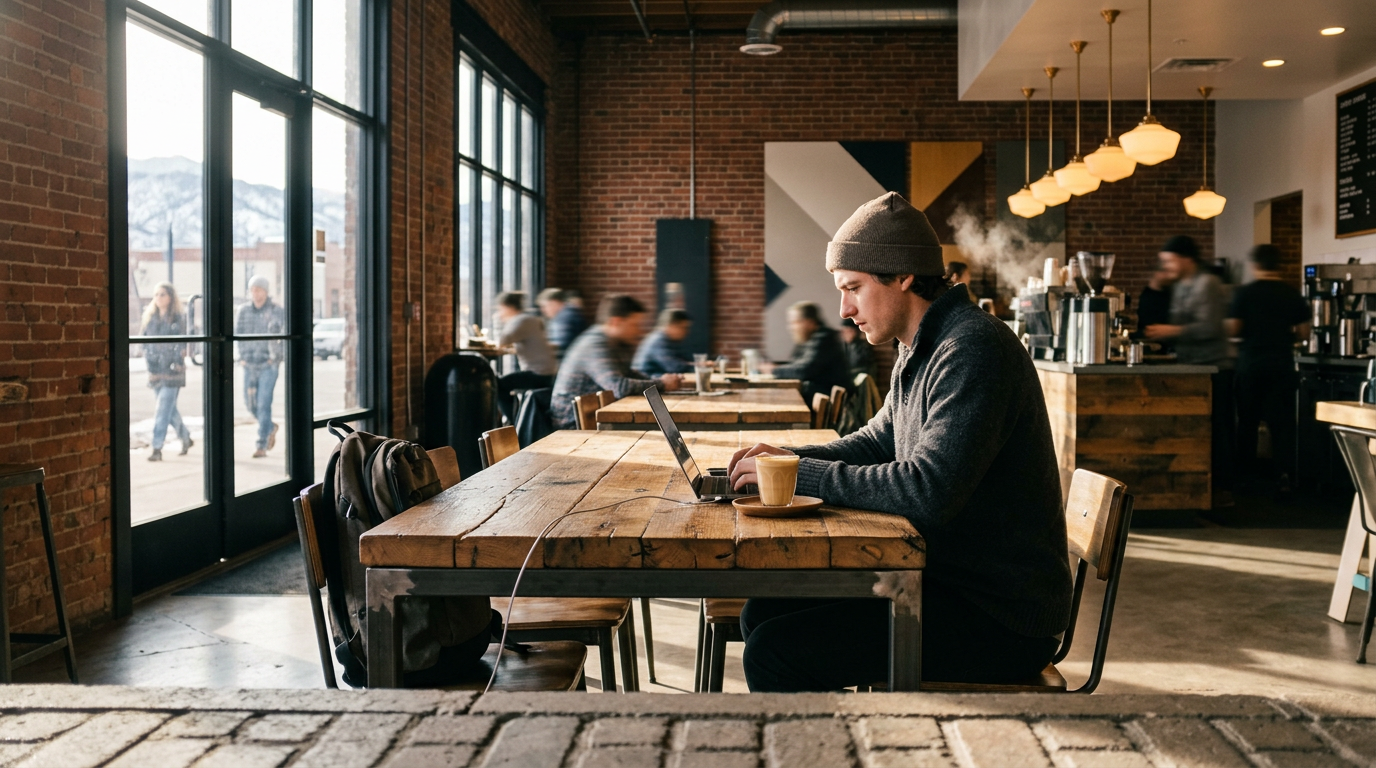
Denver cafés that beat another WeWork lobby
At 8:12 on a Tuesday in RiNo, the laptop crowd is already negotiating outlets without saying a word. One person has the wall plug. Another has the communal table corner. Somebody in a fleece vest is taking a funding call outside because Denver still has a little shame about speakerphone behavior.
This is the Denver remote-work reality in 2026: plenty of people still need a room, but fewer want the glazed-over lobby energy of a national coworking chain. The classic WeWork setup has its place. So do Industrious, Spaces, Shift Workspaces, Enterprise Coworking, and a proper hot desk when you need a printer, phone booth, and a door that closes. But a lot of founders, freelancers, product people, agency operators, and solo consultants want something different most days.
They want a coffee-first room with natural light, grown-up espresso, tolerable noise, and enough social surface area to meet someone without joining a forced networking circle.
Denver is good for that, if you understand the rules. The city is early-rising, outdoorsy without being unserious, friendly without being needy, and suspicious of anyone who treats a café like a free private office. The sweet spot is not camping eight hours over one drip coffee. It is using the right café type at the right hour, behaving like a regular, and turning weak ties into useful follow-ups.
Granovetter's weak ties idea matters here because Denver runs on loose connections: the person beside you knows the fractional CFO, the climate-tech founder, the Boulder engineer, the CPG buyer, or the Denver Startup Week organizer you actually need. Your job is to be visible without being weird.
The Denver room you are actually looking for
Not every café with Wi-Fi is a coworking café. In Denver, the best laptop rooms tend to fall into a few reliable categories.
The roaster café with bar seating. Think Huckleberry Roasters, Corvus Coffee Roasters, Novo Coffee, Queen City Collective Coffee, or Pablo's Coffee as reference points. These places are coffee-first, which matters. The staff is not there to manage your Zoom calendar. You get good espresso, single-origin pour-over if you care, and a crowd that often includes designers, startup employees, writers, recruiters, and remote sales people between calls.
The neighborhood third-wave café with a workday rhythm. Crema Coffee House, Little Owl Coffee, Thump Coffee, and similar rooms tend to attract people who know the city rather than people passing through for a conference. These are better for heads-down work and casual recognition over time. You will not meet ten people on day one. You might meet one useful person after three Tuesdays.
The café attached to a serious hotel or mixed-use building. This is for the person who wants a polished setting without a member's club. Denver has enough business travel, convention traffic, and hybrid teams that a hotel café can be productive midmorning. The downside: the crowd can skew transient, and the coffee may be weaker than at a roaster.
The coworking-adjacent café. Near RiNo, LoDo, Union Station, Cherry Creek, and parts of LoHi, you will find cafés full of people who have day passes, hot desks, or dedicated desks nearby but prefer coffee-shop energy for the first half of the day. These rooms are useful because they sit next to the network without forcing you into the lobby.
The afternoon café-to-wine-bar room. Denver has more natural wine, aperitivo, and all-day hospitality energy than it used to. Some rooms are great from 2 to 5 p.m. when the espresso machine is still running and the dinner crowd has not arrived. Be careful here. If the room turns into date-night lighting, close the laptop.
Neighborhood read: where the work energy changes
!Laptop and espresso on a Denver café table near a power outlet
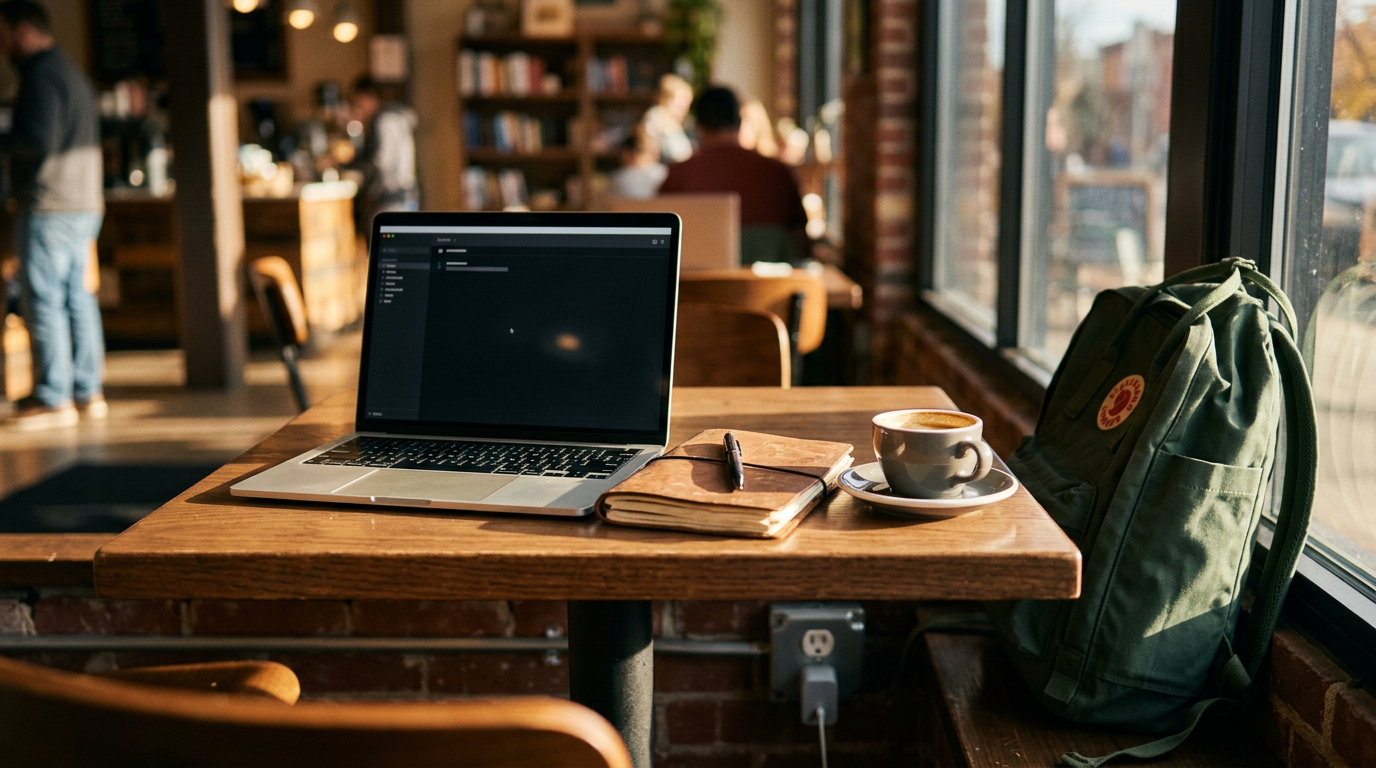
RiNo is the obvious founder-and-creative zone, but it is not always the most productive. It has the highest chance of bumping into a designer, startup marketer, angel investor, or brand operator. It also has the highest chance of ambient distraction. Use RiNo when your calendar includes soft networking, partnership chats, or creative work that benefits from people around you.
LoDo and Union Station are better for business density. If you are meeting a client, investor, recruiter, or out-of-town operator, this is the clean handoff zone. It is central, transit-friendly by Denver standards, and familiar to people who do not know the neighborhoods. The tradeoff is less local texture and more rolling suitcase energy.
Cap Hill and Uptown work well for solo operators. The rooms feel more residential, less performative. Good for writing, finance admin, design production, or client prep. You can become a recognizable regular faster here than in RiNo.
Baker and South Broadway attract independent creatives, small agencies, musicians with day jobs, and people building something outside the standard SaaS lane. The workday can be less buttoned-up, but the conversations are often more interesting.
Cherry Creek is expensive-client territory. If you sell professional services, real estate, wealth, wellness, retail strategy, hospitality, or anything that benefits from a polished buyer, do not ignore it. The rooms are less founder-scrappy and more appointment-driven.
Highland and LoHi are useful for the remote worker who wants calm, good food nearby, and a crowd that has jobs with real calendars. Less random collision than RiNo. Better for staying sane.
What to order / what to look for
Order like someone who wants the place to survive. Denver cafés have watched three years of laptop inflation: more remote workers, longer dwell times, bigger monitors, fewer people buying lunch. Good operators notice.
For a two-hour session, a real drink is enough. For a half day, buy food or a second drink. If the café serves a proper breakfast burrito, toast, pastry, sandwich, or yogurt bowl, that is your rent. Tip like you are using heat, Wi-Fi, water, bathrooms, and staff patience, because you are.
Coffee-wise, Denver has enough third-wave maturity that you do not need to overthink it. A cortado tells you if the bar is dialed. A drip coffee tells you if the shop respects volume. A single-origin pour-over is worth it when you are not trying to jump on a call in six minutes. Cold brew is fine, but do not make it your whole personality.
Look for these physical signs before you commit:
- Wall outlets that are not all behind occupied two-tops
- A communal table with at least one person already working
- Bar seats facing the room, not just the window
- Music loud enough for privacy but not loud enough to fight calls
- Staff who do not look annoyed by laptops before 10 a.m.
- A bathroom that is accessible without a key ceremony every time
- Tables that are small enough to discourage fake office sprawl
Avoid rooms where every table is set for brunch service. If there are host stands, cloth napkins, or servers trying to turn tables, you are not in a work café. You are in a restaurant that happens to open early.
Best time of day to go
!Remote workers talking outside a Denver neighborhood café
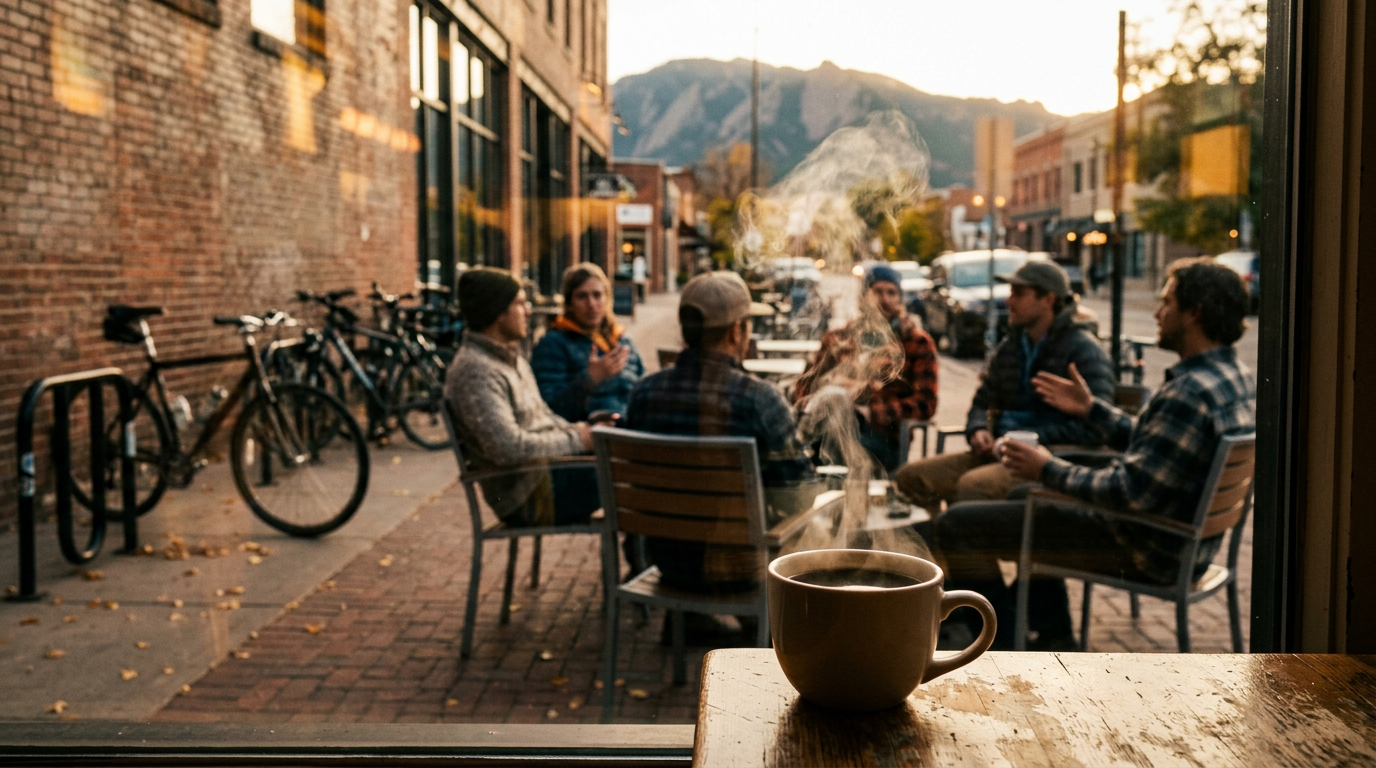
Denver starts early. Respect that.
7:30 to 9:00 a.m. is the regulars' window. Good for claiming a seat, doing focused work, and noticing who else has a routine. Bad for taking loud calls. People are caffeinating, not auditioning for your pipeline review.
9:30 to 11:30 a.m. is the prime remote-work block. This is when the room has enough density to feel useful but not enough lunch pressure to make your laptop rude. If you want to meet people, this is your window.
Noon to 1:30 p.m. is risky. If the café sells lunch, give up your table or buy lunch. Do not sit at a four-top with a laptop while the staff watches paying groups hover.
2:00 to 4:30 p.m. is underrated. The morning rush is gone, the remote workers who only wanted a backdrop have left, and the people still there are often doing real work. This is a strong time for casual conversation.
After 5:00 p.m. depends on the room. Some cafés become community spaces. Others become wine bars, date spots, or staff-cleaning zones. If candles appear, laptops disappear. That is the rule.
Season matters too. In winter, people linger. In summer, Denver's outdoor gravity is real. The best networking may happen before noon because half the city wants a trail, patio, Red Rocks show, bike ride, or pickup league after work.
Etiquette and unwritten rules
Denver is polite, but not passive. People will clock bad café behavior even if nobody says anything.
The main rule: scale your footprint to your spend and the room's demand. One person gets one seat. If the café is half empty, fine, use the adjacent chair for your bag. If people are circling, move the bag.
Calls are the biggest tell. A short call at low volume with headphones is acceptable in some rooms. A 45-minute all-hands, sales demo, therapy-adjacent founder meltdown, or investor update is not. Step outside, book a phone booth at a coworking space, go home, or use your car if you must. Denver people are forgiving until you make your calendar everyone else's problem.
Do not bring a full external monitor unless you are in a true coworking space. A laptop stand is acceptable. A mouse and notebook are fine. A ring light in a café is a cry for help.
Do not ask the barista if the Wi-Fi is fast enough for video calls while a line forms behind you. Ask another laptop person quietly after you order.
Do not treat outlets as claimed territory. If your battery is full and someone asks, rotate. If you carry a compact multi-port charger and offer a plug, you instantly become less annoying and more memorable.
Do not do cold outbound calls from a coffee shop. Email, write proposals, design, code, recruit quietly, edit, analyze, plan. Save live selling for a private room.
How to actually meet people there
The move is not to scan the room and pounce. Denver rewards low-pressure consistency.
Start by becoming a Tuesday person or a Thursday person in one neighborhood. Same general time, same type of order, same two-hour block. Familiarity does half the work. After two or three visits, a nod becomes normal. After that, a short opener does not feel random.
Use context, not pickup lines. Good openers:
- I see you here a lot on Tuesdays. Are you remote full-time or just escaping an office?
- Quick local question: where do you go when you need a real phone booth for an hour?
- That sticker looks like a startup logo. Are you building here in Denver?
- I am trying to find more founder dinners that are not pitch events. Heard of anything decent lately?
- Are you going to Denver Startup Week this year, or is that too much conference energy?
Keep it short. If they remove one earbud, you get one minute. If they remove both and turn their chair, you have a conversation. If they answer and look back at the screen, let them work.
Your follow-up should be specific and light:
- Good talking. Want me to send you that Meetup group?
- I know one fractional ops person who might fit what you described. Want an intro?
- I am doing coffee here next Wednesday morning with two other solo operators. Easy if you want to join.
Use LinkedIn if that is where they live. Use email for clients. Use Instagram only if the conversation is creator, food, fitness, design, or hospitality-adjacent. AngelList is useful for startup context, but not as a first follow-up unless the conversation was clearly fundraising or hiring. Lunchclub and Meetup still have utility in Denver, but the higher-signal move is usually a small recurring coffee, walk, or founder breakfast.
When a café is not enough
There are days when you need the boring infrastructure. Take the day pass.
If you have more than two calls, need confidentiality, or are working with sensitive client material, use a coworking space. Industrious, Spaces, WeWork, Shift Workspaces, Enterprise Coworking, and similar operators exist because cafés cannot solve everything. A hot desk is not a moral failure. A dedicated desk may be cheaper than burning your goodwill across five cafés a week.
The smarter Denver pattern is hybrid: café for ambient awareness and soft ties, coworking day pass for calls and execution, home for deep work. Add one real in-person event per week: a founder dinner, a Meetup with an actual topic, a Denver Startup Week session when the season hits, a small operator breakfast, or a niche group around climate, outdoor industry, SaaS, CPG, wellness, aerospace, or agency owners.
Do not chase every room. Pick a circuit:
- One coffee-first room near home
- One central room for meetings
- One coworking space for call-heavy days
- One evening community channel, such as Meetup, a curated dinner, or a Slack group that actually meets offline
That circuit will beat random hopping.
Mistakes to avoid
The first mistake is choosing the prettiest room instead of the most functional one. Instagrammable seating often means bad tables, weak outlets, and people hovering for brunch. You are not location scouting. You are working.
The second mistake is confusing friendliness with availability. Denver people will chat. That does not mean they want a 20-minute explanation of your marketplace, newsletter, agency, app, or coaching offer. Earn the second conversation.
The third mistake is staying too long. Four hours in one café can be fine if the room is quiet and you keep ordering. Four hours through rush periods is not. Move before the staff resents you.
The fourth mistake is only networking with people who look like you. Denver's useful rooms are not just tech. The city has energy, climate, aerospace, healthcare, outdoor, food and beverage, real estate, fitness, and nonprofit operators all crossing paths. The best connection may not know what product-led growth means. Good.
The fifth mistake is treating Boulder as the only serious startup node. Boulder still matters, especially for venture, accelerators, and deep tech history. But Denver has its own operator density now, and the café scene reflects that. Do not talk about the city like it is a waiting room for Boulder.
The sixth mistake is bringing chain-coworking expectations into a hospitality room. No one owes you a phone booth, perfect Wi-Fi, ergonomic seating, or silence. If you need office guarantees, pay for office infrastructure.
The practical Denver play
If you hate WeWork lobbies, do not replace them with café chaos. Build a small operating system.
Pick a roaster café for two mornings a week. Pick a quieter neighborhood café for heads-down afternoons. Keep a coworking day pass option for call-heavy days. Become recognizable without becoming entitled. Order properly. Tip. Take calls outside. Learn the staff's rhythm. Talk to one person per visit, not six.
Denver rewards that pace. The city is social, but it is not desperate. People have meetings, dogs, trail plans, school pickup, investor updates, client deadlines, and ski traffic trauma. Respect the room and you will get more than Wi-Fi.
You will get the thing the lobby was supposed to provide in the first place: a place to work, a few familiar faces, and one conversation that changes the week.
Discussion (0)
Loading comments…