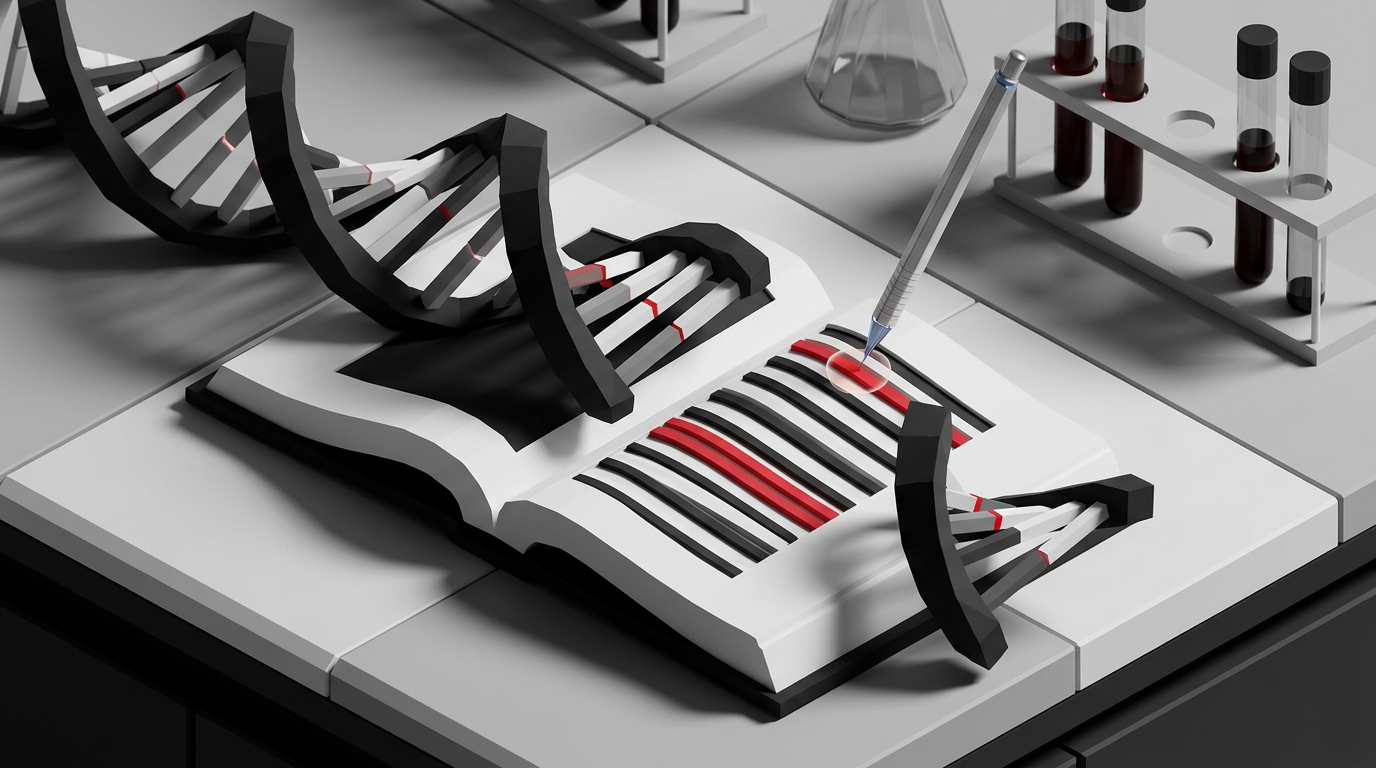
DNA is the cookbook. CRISPR is the pencil
A scene from a lab bench
A blood sample arrives at a hospital lab. Not a sci-fi lab. A normal one, with barcode stickers, nitrile gloves, freezer drawers, and machines that hum all day.
Inside that tube are white blood cells. Inside many of those cells is a nucleus. Inside the nucleus is DNA, packed so tightly that roughly six feet of it fits inside a space you cannot see without a microscope.
That is the strange part. Your body is not carrying one giant instruction poster. It is carrying billions of tiny libraries, one in almost every cell. A skin cell, liver cell, and neuron usually contain the same DNA library. They behave differently because they read different pages.
By 2026, DNA is not just a classroom diagram anymore. Doctors can sequence it. Drugmakers can target it. Some therapies can edit it. The words DNA, RNA, and CRISPR now show up in cancer care, inherited disease treatment, vaccines, agriculture, and ethics hearings.
The hard part is that people often explain them backward. They start with enzymes, base pairs, and acronyms. Better to start with the job each one does.
DNA stores. RNA carries and helps run the work. CRISPR finds and changes a chosen spot.
That is the core. The details are where it gets interesting.
What it actually is
DNA stands for deoxyribonucleic acid. It is a long molecule made of smaller chemical units called nucleotides. Each nucleotide contains one of four bases: A, T, C, and G. Those letters stand for adenine, thymine, cytosine, and guanine.
The letters pair in a regular way: A pairs with T, and C pairs with G. That pairing helps DNA copy itself. It is also why the famous shape is a double helix, like a twisted ladder.
In 1953, James Watson and Francis Crick published the double-helix model of DNA. Rosalind Franklin’s X-ray diffraction work, especially the image known as Photo 51, was central to understanding the structure. Maurice Wilkins also contributed to the X-ray research. The history is messy, but the science lesson is clean: shape matters. DNA’s structure explains how biological information can be stored and copied.
A gene is a stretch of DNA that usually contains instructions for making a functional product, often a protein. Proteins do much of the body’s work: they build structures, send signals, speed up chemical reactions, and help cells respond to the world.
RNA stands for ribonucleic acid. It is chemically similar to DNA, but it usually acts more like a working copy than a long-term archive. RNA uses the base U, uracil, instead of DNA’s T. Many RNA molecules are single-stranded, which makes them flexible and reactive.
The RNA most people heard about during the COVID vaccine years is mRNA, or messenger RNA. It carries a temporary instruction from DNA to the cell’s protein-making machinery. But RNA is not only a messenger. rRNA helps form ribosomes, the machines that build proteins. tRNA brings amino acids, the building blocks of proteins, to those ribosomes. Other RNAs help regulate genes.
CRISPR is different. It is not a storage molecule like DNA or a working copy like RNA. CRISPR stands for clustered regularly interspaced short palindromic repeats. The name is ugly because scientists named what they saw in bacterial DNA before the public cared.
In bacteria, CRISPR is part of an immune system. When a virus attacks, some bacteria can save small pieces of the virus’s genetic material. Later, if that virus comes back, the bacterium can use those saved snippets as a recognition system.
The tool most non-specialists mean when they say CRISPR is often CRISPR-Cas9. Cas9 is an enzyme that can cut DNA. A designed guide RNA leads Cas9 to a matching DNA sequence. Once Cas9 gets there, it cuts. Then the cell tries to repair the break. Scientists can use that repair process to disable a gene, change a sequence, or insert new material in some contexts.
Jennifer Doudna and Emmanuelle Charpentier showed in 2012 that CRISPR-Cas9 could be programmed as a gene-editing tool. They later received the 2020 Nobel Prize in Chemistry. That work helped turn a bacterial defense system into one of the most important tools in modern biology.
Why it matters
DNA matters because it is one of biology’s main storage systems for inherited information. RNA matters because stored information is useless unless cells can read and act on it. CRISPR matters because it gives scientists a relatively direct way to target a chosen genetic sequence.
Medicine is the obvious place to look first.
Some diseases are caused by changes in a single gene. Sickle cell disease is one famous example. In 2023, the FDA approved Casgevy, a CRISPR-based therapy for sickle cell disease. The treatment does not simply “fix” every cell in the body. It edits a patient’s blood-forming stem cells outside the body, then returns them after intense preparation. The goal is to help the body produce fetal hemoglobin, which can reduce the sickling problem.
That distinction matters. CRISPR therapy is not a magic wand. Delivery is hard. Safety is hard. Cost is hard. Biology has more knobs than a recording studio.
RNA has already changed medicine too. The Pfizer-BioNTech and Moderna COVID-19 vaccines used mRNA to give cells temporary instructions to make the coronavirus spike protein, which trained the immune system. The mRNA did not enter the nucleus and did not rewrite DNA. It was more like a short-lived recipe card that the cell read and then broke down.
Cancer research also depends heavily on DNA and RNA. Tumor sequencing can reveal mutations that help doctors choose targeted treatments. RNA patterns can show which genes are active. In some cases, the issue is not the text of the DNA itself but which parts of it are being read too loudly, too quietly, or at the wrong time.
Agriculture is another major area. Gene editing can help develop crops with traits such as disease resistance or different nutritional profiles. That does not mean every edited crop is good or every concern is silly. It means the method deserves a more precise conversation than “natural versus unnatural.” Humans have altered crops for thousands of years through selection and breeding. CRISPR is more targeted than many older methods, but targeted does not automatically mean risk-free.
There is also a civic reason to understand this stuff. Gene editing raises questions about access, disability, embryos, consent, and who gets to decide what counts as a medical need. In 2018, Chinese scientist He Jiankui announced the birth of gene-edited babies, an act widely condemned by the scientific community and later punished by Chinese authorities. That episode is a reminder that technical ability can arrive before social judgment catches up.
The simplest analogy that works
Think of the cell as a busy restaurant.
DNA is the master cookbook locked in the manager’s office. It contains many recipes, but the cooks do not carry the whole book around the kitchen. Too valuable. Too bulky. Too risky.
RNA is the photocopy or order ticket. When the kitchen needs a recipe, the cell makes an RNA copy of the relevant DNA section. That process is called transcription. The RNA can leave the nucleus and go to a ribosome.
The ribosome is the cooking station. It reads the RNA in three-letter chunks called codons. Each codon corresponds to an amino acid or a stop signal. The ribosome links amino acids into a chain, and that chain folds into a protein. This process is called translation.
CRISPR is the search tool plus scissors plus, sometimes, a pencil. The guide RNA is the search query. Cas9 is the scissors. The cell’s repair machinery is the messy hand that tries to tape the page back together. If scientists provide a repair template, the cell may copy in a desired edit, but that does not happen perfectly every time.
Here is the whole flow in plain terms:
- DNA keeps the long-term instructions.
- A cell copies one useful instruction into RNA.
- A ribosome reads the RNA instruction.
- The ribosome builds a protein.
- Proteins help create traits, reactions, structures, and signals.
- CRISPR can be aimed at a DNA sequence to cut it and possibly change it.
Claude Shannon’s 1948 work on information theory is helpful here, as long as we do not push it too far. Shannon showed that information could be treated as patterns in a system, not just human meaning. DNA is like that. The sequence of A, T, C, and G carries biological information because cells have machinery that reads the pattern.
But DNA is not a sentence in English. It has context. The same genome can be read differently in different cell types. A liver cell and a neuron share much of the same book, but they use different recipes.
A second analogy helps: a piano.
The DNA is the set of keys available. RNA is the sheet music being played right now. Proteins are the sound. CRISPR can retune or damage a specific key. But the final song also depends on timing, pressure, the room, and the player.
That is why genes matter enormously without being the whole story.
Common misconceptions
“DNA is destiny.”
Not exactly. DNA influences traits and disease risk, sometimes strongly. But environment, chance, development, lifestyle, infections, stress, and random cellular events also matter. Kahneman’s idea of anchoring from Thinking, Fast and Slow is useful here: once people hear “gene for,” they anchor too hard on that phrase. Most traits are not controlled by one simple switch.
“One gene equals one trait.”
Sometimes a single gene has a major effect. Often, many genes contribute to one trait, and one gene can affect many traits. Height, for example, involves many genetic variants plus nutrition and health. Biology is full of networks.
“RNA is just a temporary DNA copy.”
Messenger RNA often works that way, but RNA has more jobs. Some RNA forms part of the ribosome. Some helps translate the code. Some regulates gene activity. RNA is not an intern. It is part of management.
“CRISPR edits DNA like a word processor.”
This is the most tempting misconception. CRISPR can be targeted, but cells are alive, crowded, and variable. A cut can be repaired in different ways. Edits can be incomplete. There can be off-target effects, meaning changes at unintended locations. Scientists test heavily because “close enough” is not acceptable when the patient is a person.
“CRISPR always means designer babies.”
Most serious CRISPR work is not about choosing eye color or height. It is about disease biology, lab models, diagnostics, agriculture, and therapies for severe conditions. Editing embryos is ethically and scientifically far more fraught because changes can affect every cell and future generations.
“Natural DNA is safe, edited DNA is dangerous.”
Nature makes genetic changes constantly. Mutations happen when cells copy DNA, when radiation damages DNA, or when viruses insert genetic material. Some changes are harmless. Some are helpful. Some are dangerous. The right question is not whether a change is natural. The right question is what changed, where it changed, what evidence exists, and what the consequences are.
“The human genome is a finished instruction manual.”
The Human Genome Project announced a draft sequence in 2001 and a more complete version in 2003. Since then, scientists have kept improving references and studying variation among people. A genome sequence is not the same as full understanding. It is more like having the text of a huge book in a language you are still learning to interpret.
Key takeaways
- DNA is the long-term storage system for genetic information, written in four chemical letters: A, T, C, and G.
- RNA is the working layer that helps cells use those instructions; mRNA is only one kind.
- Proteins are the main products built from genetic instructions, and they do much of the body’s daily work.
- CRISPR-Cas systems came from bacterial immunity and can be programmed to target specific DNA sequences.
- Gene editing is powerful, but not perfectly precise, cheap, or ethically simple.
- The best mental model is not fate. It is instructions plus context, timing, repair, and messy living systems.
DNA, RNA, and CRISPR are not three random science terms. They are three parts of one story: how life stores information, reads it, and now, in limited but real ways, edits it.
That should make us excited. It should also make us careful.
Discussion (0)
Loading comments…