Dopamine explained simply: reward, prediction error, and apps
An opening scene: the phone on the table
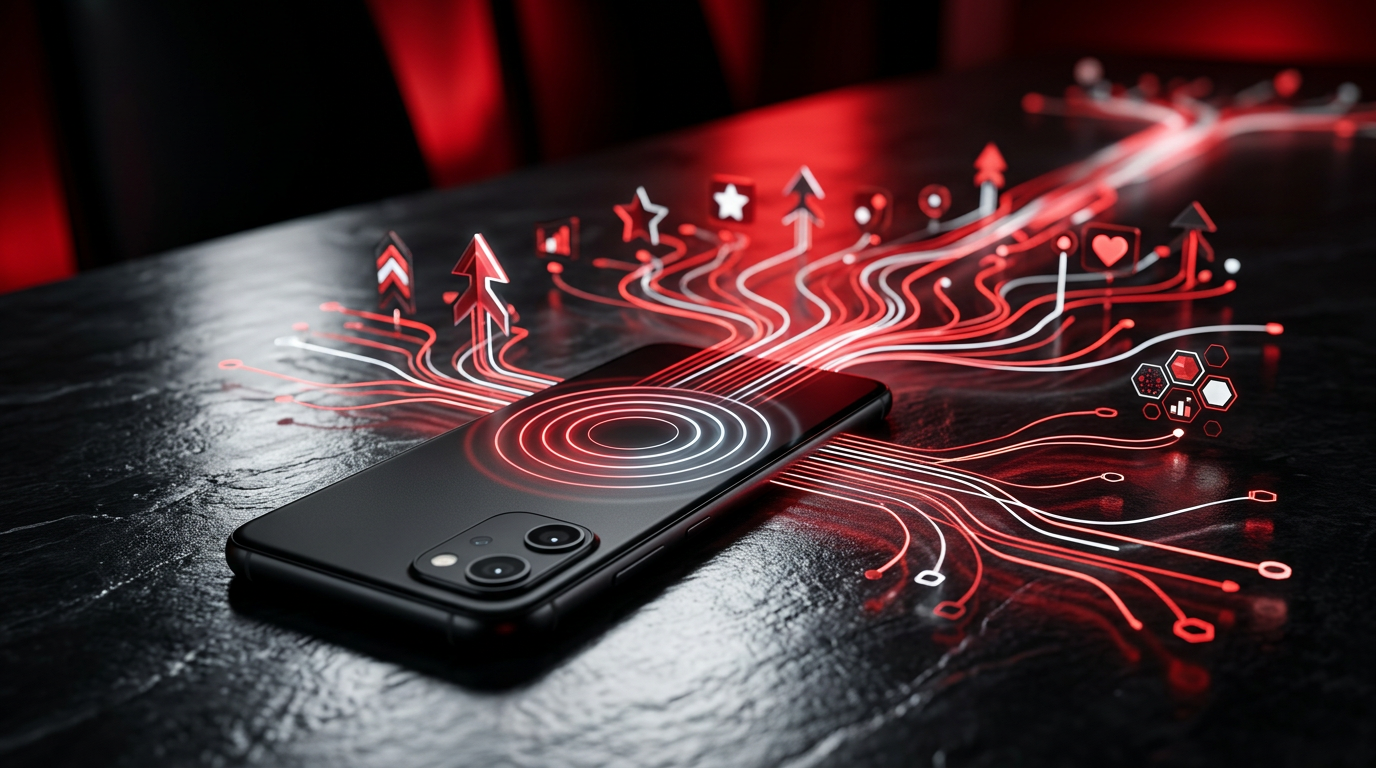
Your phone is face down on the table. You are trying to read, cook, work, or talk to someone you like. Then it buzzes.
You do not know what it is. It could be a bank alert, a work message, a friend sending something funny, a reply to a post, a delivery update, or nothing important at all. Before you even pick it up, something has already happened in your brain: a tiny prediction has formed.
Maybe this is useful. Maybe this is social. Maybe this is rewarding.
That moment is where dopamine becomes interesting.
Most people learned a cartoon version of dopamine: dopamine equals pleasure. Eat cake, get dopamine. Win money, get dopamine. Open an app, get dopamine. That version is not completely useless, but it is too blunt. It misses the part that explains why a notification can pull your attention before you know what it says, why slot machines are more gripping than predictable payouts, and why modern apps feel less like tools and more like weather systems you keep checking.
The better simple version is this: dopamine helps the brain learn from rewards, especially when reality turns out better or worse than expected. It is less like “pleasure juice” and more like a teaching signal.
That teaching signal is called reward prediction error. The phrase sounds technical, but the idea is beautifully simple: your brain is constantly guessing what will happen next. When the result is better than expected, dopamine activity tends to rise. When the result is exactly as expected, the signal settles down. When the result is worse than expected, dopamine activity can dip.
That is why the buzz matters. Not because the phone is magical. Because uncertainty is powerful.
What it actually is
Dopamine is a neurotransmitter, a chemical messenger that neurons use to communicate. Neurons are nerve cells; neurotransmitters are one way they pass signals across tiny gaps called synapses.
Dopamine is involved in several brain systems, including movement, motivation, learning, attention, and decision-making. It is not one thing doing one job. In different brain circuits, dopamine can play different roles.
A major early clue came from Swedish pharmacologist Arvid Carlsson, who showed in the late 1950s that dopamine was not merely a chemical stepping stone on the way to norepinephrine. It was an important neurotransmitter in its own right. Carlsson later shared the 2000 Nobel Prize in Physiology or Medicine for work that helped explain dopamine’s role in the nervous system, including movement disorders such as Parkinson’s disease.
For our topic, the key circuit runs through areas including the ventral tegmental area and the nucleus accumbens. You do not need to memorize those names. The plain-English version is that parts of the midbrain send dopamine signals to regions involved in motivation, learning, and action.
In the 1990s, neuroscientist Wolfram Schultz and colleagues studied dopamine neurons in monkeys during reward-learning tasks. A classic pattern emerged. At first, when a monkey unexpectedly received juice, dopamine neurons fired strongly after the juice arrived. Later, once a cue reliably predicted the juice, the dopamine response shifted earlier, to the cue itself. If the cue appeared but the expected juice did not arrive, dopamine activity dropped around the time the reward should have appeared.
In 1997, Schultz, Peter Dayan, and Read Montague published an influential paper in Science connecting this pattern to prediction error, a concept used in learning models. Prediction error means the gap between what was expected and what actually happened.
Think of it as a simple equation:
Prediction error = what happened - what you expected
- If you expected nothing and got something good, the signal is positive.
- If you expected something good and got it, there is little new information.
- If you expected something good and did not get it, the signal is negative.
This is why dopamine is deeply tied to learning. A surprise tells the brain, “Update the model.”
Why it matters
Dopamine matters because brains have a hard job: they must decide what deserves energy.
Should you approach, ignore, repeat, quit, explore, eat, save, speak, swipe, wait, or walk away? Every organism faces a version of that problem. Rewards are not just pleasures; they are signals about survival, connection, status, safety, and opportunity.
The reward prediction error system helps solve that problem by marking what was unexpectedly useful or disappointing. If a certain action produces a better-than-expected result, the brain becomes more likely to repeat the behavior in a similar situation. If the result is worse than expected, the brain may weaken that behavior.
This is not conscious in the way balancing a budget is conscious. It is more like how you learn the feel of a neighborhood intersection. After enough close calls, you slow down before you can explain why. The brain is constantly compressing experience into expectation.
Dopamine also helps explain why “wanting” and “liking” are different.
Psychologists Kent Berridge and Terry Robinson developed the influential incentive salience theory in the 1990s. In plain English, they argued that dopamine is especially important for “wanting” — the pull toward a cue or object — and not simply for “liking,” the pleasure you feel when you consume it.
That distinction makes modern behavior easier to understand. You can want to check an app without enjoying the next 20 minutes. You can reach for a snack you are not even excited to eat. You can feel pulled toward a notification even when experience tells you most notifications are boring.
“Wanting” is not always a wise vote. Sometimes it is a learned pull.
This also helps explain why habits can persist after the reward shrinks. The cue still has power. The red badge, the vibration, the streak count, the spinning loading icon, the partially hidden preview — all of these can become signals that something potentially rewarding is near.
The simplest analogy that works
Imagine your brain as a weather app for rewards.
It does not simply record what feels good. It forecasts what is likely to happen next.
You walk into a coffee shop. The smell predicts coffee. The line predicts a wait. The loyalty app predicts a free drink soon. Your brain is not calmly observing all this like a security camera. It is making live forecasts: “This place usually pays off.”
Now imagine three mornings.
Morning one: you expect an ordinary coffee, but the barista gives you a free pastry because they made an extra. Better than expected. Positive prediction error. Your brain updates: this place has a little extra sparkle.
Morning two: you expect coffee, and you get coffee. Good, but not surprising. The forecast was accurate. Less teaching signal.
Morning three: you expect coffee, but the espresso machine is broken. Worse than expected. Negative prediction error. Your brain updates again.
That is the dopamine story in simple form. The brain is less impressed by reward alone than by reward compared with expectation.
This is why uncertainty is so sticky.
If every time you opened an app you saw the exact same thing, the experience would become predictable. But modern apps rarely work like that. In 2026, many feeds are ranked by machine-learning systems that constantly reorder posts, videos, replies, ads, recommendations, and notifications based on likely engagement. From the user’s point of view, the feed behaves like a slot machine with social content instead of coins.
That comparison is not random. Psychologist B.F. Skinner studied reinforcement schedules in the 20th century. A variable ratio schedule rewards an action after an unpredictable number of tries. Slot machines are the famous example. The reward does not come every time, but it comes often enough and unpredictably enough to keep behavior going.
Now translate that to daily life:
- Pull to refresh: maybe something good appears.
- Check messages: maybe someone important replied.
- Open short-form video: maybe the next clip is perfect.
- Post a photo: maybe the likes arrive quickly, slowly, or not at all.
- Check a marketplace app: maybe the item you wanted dropped in price.
The key word is maybe.
“Maybe” creates prediction. Prediction creates attention. Surprise updates learning.
A vending machine that always gives the same snack is useful. A feed that sometimes gives you exactly the thing you did not know you wanted is compelling.
Modern apps and the dopamine loop
A “dopamine loop” is not a formal diagnosis. It is a useful shorthand for a repeated pattern: cue, action, uncertain reward, learning, repeat.
Here is the loop in plain language:
- Cue: Something points to possible reward. A buzz, badge, streak, headline, thumbnail, or “typing…” indicator.
- Action: You check, tap, scroll, swipe, post, refresh, or reply.
- Outcome: You get something good, boring, annoying, or mixed.
- Prediction error: The result is compared with what your brain expected.
- Learning: Your brain adjusts how strongly that cue pulls you next time.
Modern apps are excellent at producing cues. They are also excellent at producing variable outcomes. The next item might be useless, funny, beautiful, enraging, flattering, urgent, or socially important. That range is part of the pull.
This does not mean app designers are literally injecting dopamine into your brain. It means the structure of many apps fits the brain’s reward-learning machinery unusually well.
Some common design patterns are especially relevant:
- Infinite scroll: There is no natural stopping point, so the next chance is always one tiny motion away.
- Variable notifications: Not every alert matters, but enough do to keep checking alive.
- Social approval signals: Likes, comments, shares, saves, and replies turn social feedback into visible counters.
- Streaks and progress bars: These use consistency and loss aversion; once you have a streak, losing it feels costly.
- Algorithmic feeds: The app learns what keeps you engaged, then rearranges the environment around those signals.
- Short-form video: Fast feedback lowers the effort needed to sample the next reward.
Daniel Kahneman’s idea of System 1 and System 2, from Thinking, Fast and Slow (2011), is useful here. System 1 is fast, automatic, and reactive. System 2 is slower and more deliberate. App cues often reach System 1 first. By the time System 2 says, “Do I actually want to spend 30 minutes here?” your thumb may already be moving.
That is why willpower alone is a weak strategy. If the cue is constant, the behavior is easy, and the reward is variable, the loop has favorable conditions. B.J. Fogg’s behavior model, often summarized as B=MAP — behavior happens when motivation, ability, and prompt converge — explains the same pattern from another angle. Apps lower friction and increase prompts. The behavior becomes almost effortless.
Common misconceptions
Misconception 1: Dopamine is the pleasure chemical
Dopamine is involved in rewarding experiences, but calling it the pleasure chemical hides the most useful part. It is heavily involved in learning, motivation, and prediction. You can have dopamine-driven wanting without much pleasure.
Misconception 2: More dopamine is always better
Not true. Dopamine systems need balance. Too little dopamine activity in certain circuits is involved in Parkinson’s disease. Dysregulated dopamine signaling is also implicated in addiction and psychosis. The goal is not “more dopamine.” The goal is a healthier relationship with cues, rewards, attention, and behavior.
Misconception 3: Apps control your brain like a remote control
Apps influence behavior; they do not erase agency. A better metaphor is not mind control but environment design. If a room is full of open cookies, you may eat more cookies. If your phone is full of badges, autoplay, and variable rewards, you may check more often. The environment nudges the loop.
Misconception 4: Only “weak” people get pulled in
This is backwards. Reward prediction is a normal brain function, not a character flaw. Smart, disciplined people still respond to uncertainty, novelty, and social cues. The system evolved for learning in a messy world. Modern apps exploit normal learning machinery at unusual speed and scale.
Misconception 5: Deleting every app is the only answer
For some people, removing an app is the right move. But the broader lesson is subtler: change cues, add friction, and reduce variable rewards where they are not serving you. Turn off nonessential notifications. Move tempting apps off the home screen. Use grayscale. Set app limits. Check messages at chosen times instead of letting every buzz become a command.
The point is not to live like a monk. It is to stop letting every “maybe” rent space in your attention.
A short thought experiment
Picture two boxes.
Box A gives you $1 every time you press a button.
Box B gives you nothing most of the time, but occasionally gives you $5. You never know when.
Which box feels more interesting?
Even if Box A is more reliable, Box B is harder to ignore. It creates suspense. Each press carries a small question: “What about now?”
Now replace dollars with social information.
Did someone reply? Did people like the post? Is there new drama? Is there a better video? Is there a deal? Is there a message from the person I care about?
The brain treats social signals as meaningful because, for humans, they are meaningful. Reputation, belonging, attraction, status, and cooperation have always mattered. Modern apps compress those signals into icons, counters, alerts, and feeds that can update hundreds of times a day.
That is the strange new part. The brain is ancient. The feed is not.
Key takeaways
- Dopamine is not simply pleasure. It is strongly tied to motivation, learning, and the brain’s predictions about reward.
- Reward prediction error is the core idea. Dopamine activity changes when outcomes are better or worse than expected.
- Cues can become powerful. A notification, badge, or thumbnail can pull attention because it predicts possible reward.
- Uncertainty keeps behavior going. Variable rewards, like unpredictable replies or feed discoveries, are more gripping than fully predictable outcomes.
- Modern apps fit old brain systems. Infinite scroll, algorithmic feeds, social counters, and alerts interact with normal reward-learning machinery.
- You are not powerless. Changing cues, adding friction, and choosing when to check can weaken loops that no longer serve you.
Dopamine is easiest to understand when you stop asking, “What gives me pleasure?” and start asking, “What is my brain learning to expect?”
That question explains the phone on the table. It explains the refresh gesture. It explains why the next video feels promising even after the last ten were forgettable.
The brain is not just chasing rewards. It is chasing better-than-expected surprises.
Discussion (0)
Loading comments…