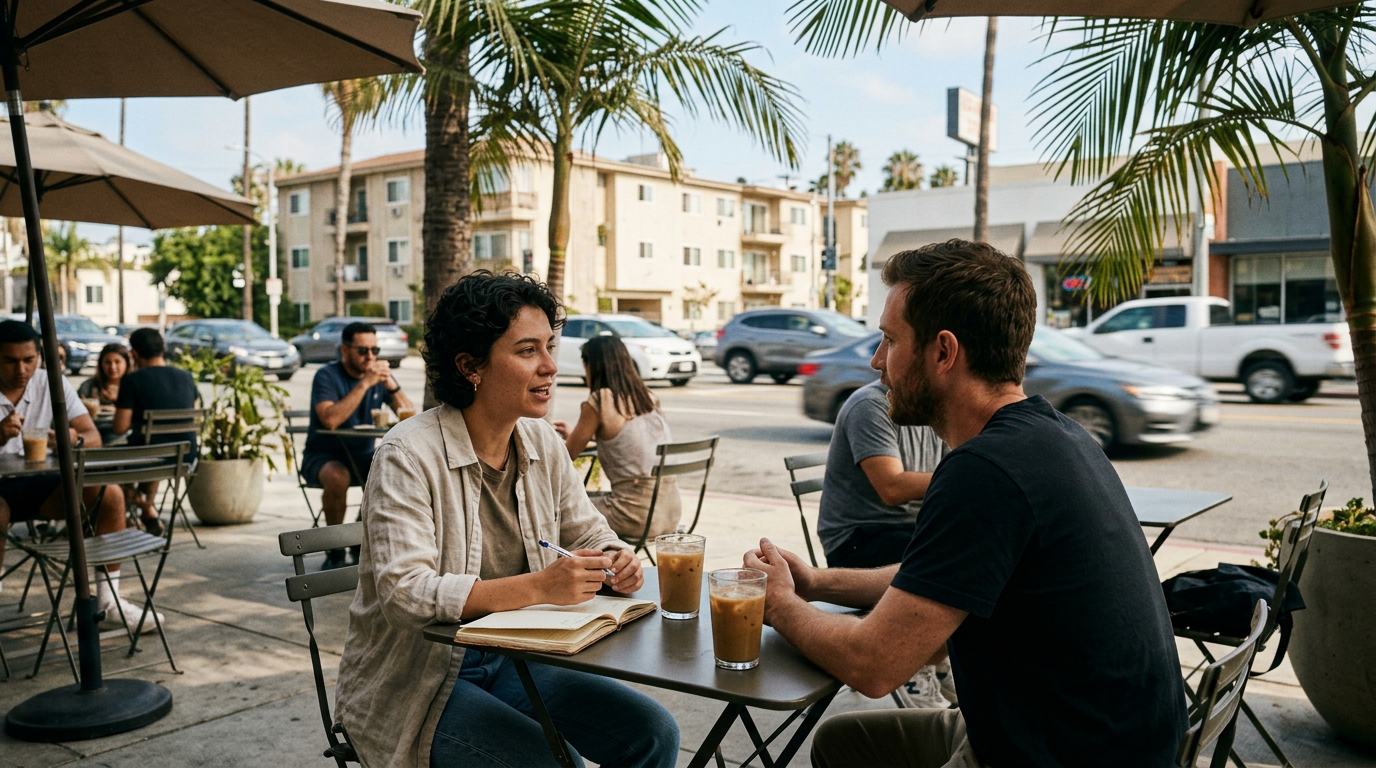
LA breakfast rooms where founder talk feels normal
At 8:17 a.m. in LA, the room tells you what kind of meeting you are about to have. Venice has someone in a fleece vest taking a call outside by a bike rack. Culver City has a product lead with a laptop half-open and a matcha going cold. Larchmont has agents, founders, and operators pretending they are not scanning the room. Silver Lake has the coffee people, the media people, and the person building an AI tool from a two-top near the window.
Breakfast works in Los Angeles because dinner is too loaded and drinks are too ambiguous. Breakfast says: I am serious, I have another thing after this, and I did not cross the 405 for small talk. The trick is picking a room where founder conversation is already normal, then behaving like you belong there without turning the table into a pitch deck.
This is not about chasing celebrity tables or forcing a networking agenda into a café. It is about choosing the right room for the job: investor check-in, cofounder chemistry read, operator referral, creator collaboration, advisor coffee, soft hiring conversation. LA rewards specificity. Neighborhood matters. Parking matters. Sun angle sometimes matters more than anyone wants to admit.
The LA breakfast map is really a geography filter
Los Angeles networking is less one scene than a set of overlapping commute agreements. People say yes to breakfast when it does not destroy the rest of their day. That means the strongest rooms are usually near where people already live, fundraise, shoot, write, design, or run teams.
For Westside founder meetings, Venice and Santa Monica still carry weight. Gjusta in Venice is a classic for casual but serious morning conversations, especially for people in consumer, media, wellness, design, and early-stage tech. It is not quiet in the library sense, but it has the right social permission: lots of short meetings, no one shocked by a cap table aside, and enough movement that a first meeting does not feel trapped.
Culver City is the pragmatic middle. It works for people splitting the difference between the Westside, Mid-City, and the studios. Look for all-day cafés, hotel-adjacent lobbies, and polished coffee bars with real seating. Destroyer in Culver City has long been a design-forward daytime room; the broader point is the same: choose a place where ordering food does not become a 20-minute production.
Mid-City, Fairfax, and Larchmont are better for media-tech, entertainment-adjacent founders, investors coming from Beverly Hills, and people who refuse to go west before 10. Republique on La Brea is one of the more reliable breakfast rooms for an important conversation when you want energy without boardroom stiffness.
Silver Lake, Los Feliz, Echo Park, and Highland Park fit the builder-creator edge: product people, agencies, writers, small studio owners, and founders who would rather meet at Maru Coffee, Canyon Coffee, Kumquat, or a serious neighborhood café than a members-only room. These are good for early trust. Less good for a high-stakes investor ask if you need privacy.
Downtown and the Arts District work when the other person is already there. Do not make a Santa Monica founder come downtown for a 35-minute breakfast unless there is a very good reason.
Venue types that make breakfast feel natural
!Morning founder meeting at a Los Angeles coffee shop table
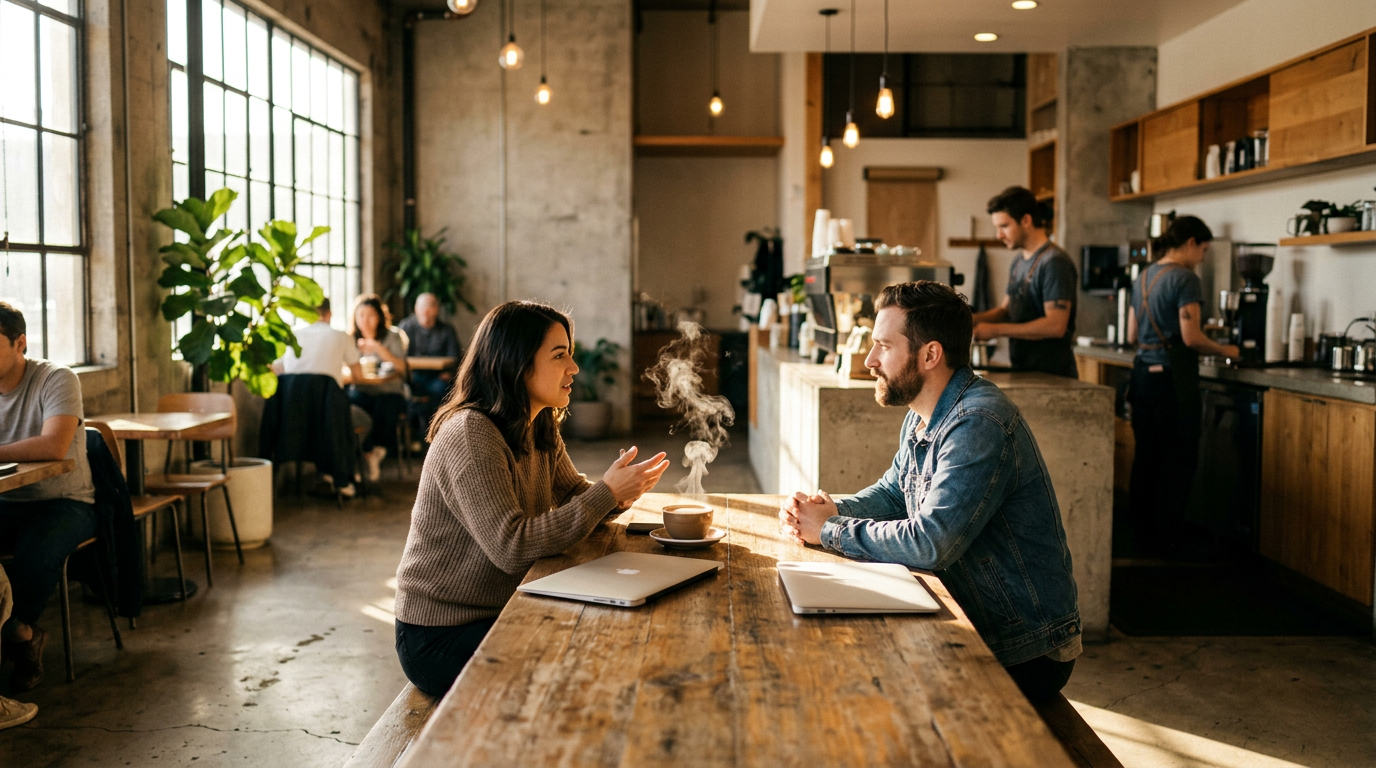
The easiest mistake is thinking the venue needs to be impressive. It needs to be legible. The other person should understand the format within ten seconds of arriving.
The third-wave coffee room with actual seating
This is the default for first meetings, loose referrals, light advisor chats, and founder-to-founder introductions. LA has plenty of serious coffee: Maru Coffee, Verve, Intelligentsia, Blue Bottle, Go Get Em Tiger, Canyon Coffee, Kumquat, and other single-origin pour-over or espresso-focused shops depending on neighborhood. The key is not the brand name. It is whether you can sit without hovering like a vulture.
Use this format when the ask is low-pressure. Keep it to 30 or 40 minutes. Do not bring a laptop unless you already agreed to review something.
The bakery-café or all-day counter
This is better when you need warmth. Gjusta, Republique, and similar counter-service breakfast rooms let the meeting breathe. You can talk product, hiring, fundraising, distribution, or a weird partnership idea without the mood turning transactional.
Counter service also removes the awkwardness of a long server cadence. You order, sit, talk, leave. Clean.
The hotel lobby breakfast
LA hotel lobbies are underrated for founder meetings because they create neutrality. Nobody owns the neighborhood. They are useful for out-of-town investors, visiting operators, and people stacking meetings before LAX or a studio day. Pick the lobby café or restaurant of a reputable hotel where seating, bathrooms, and valet or nearby parking are not mysteries.
The downside: hotel breakfasts can feel expensive and slightly formal. Use them for people who value convenience and quiet more than scene.
The coworking lounge morning slot
NeueHouse Hollywood, Industrious locations, Spaces, WeWork, and local coworking lounges can be strong when one person is already a member or has a day pass. The post-pandemic coworking market in LA is less about full-time desk culture and more about targeted use: a hot desk day, a dedicated desk for hybrid teams, a meeting room for a sprint, a founder breakfast before a work block.
Do not invite someone to a coworking space unless access is clear. Nothing kills momentum like a lobby check-in puzzle.
The member’s club breakfast
Soho House and NeueHouse can work, but only when the membership context is natural. If you are a member and the other person is comfortable there, fine. If you are using the room to signal status, everyone can smell it. Breakfast at a member’s club is strongest for warm relationships, not cold networking.
What to order / what to look for
Order like you have done this before. Breakfast meetings are not the moment to audition your personality through a complicated custom order.
Good defaults:
- Espresso, drip coffee, cold brew, or tea if it is a short meeting
- Cappuccino or flat white if you are sitting for 30 minutes
- Simple pastry or toast if the other person is eating
- Eggs, grain bowl, or breakfast sandwich only if the meeting is clearly a meal
- Water immediately, especially if you are coming from a workout or cross-town drive
Look for these room qualities before you suggest a place:
- Tables that turn over but do not rush you out in 22 minutes
- Enough ambient noise to protect privacy
- A line that moves fast enough to avoid wasting the first quarter of the meeting
- Outdoor or semi-outdoor seating when the weather is right
- Parking reality, not parking fantasy
- A layout where arriving first lets you choose a decent seat
A single-origin pour-over is fine if you are alone. In a meeting, do not make someone wait while a barista performs a slow ritual unless that is the shared point of the meeting. The coffee should support the conversation, not become the meeting.
Best time of day to go
!Two professionals having a quiet hotel lobby breakfast meeting in LA

LA breakfast has windows. Respect them.
The strongest founder slot is 8:00 to 9:15 a.m. It signals seriousness and usually beats the worst table competition. It also lets both people keep the day intact. If one person has kids, a shoot, a standup, or a commute, 8:30 is often the humane compromise.
Avoid 9:45 to 10:30 at the most popular cafés. That is when remote workers settle in, tourists wake up, and the room gets stickier. If you want an actual breakfast meeting at Republique or Gjusta, earlier is cleaner.
For Eastside coffee, 7:45 to 8:45 can be excellent. The room has focus. People are caffeinating before calls. You are less likely to compete with the laptop crowd.
For hotel lobbies, 8:30 to 10:00 works because the room is built for turnover. For coworking spaces, 9:00 can be better; the front desk is awake, guests can be checked in, and you are not fighting the first rush.
Never schedule a cross-basin breakfast casually. Santa Monica to Silver Lake, Highland Park to Venice, Studio City to Culver City: these are not neutral asks. If you requested the meeting, bias toward the other person’s side of town. LA notices that kind of respect.
Etiquette and unwritten rules
The LA founder breakfast code is simple: be easy to meet, be clear about why you are there, and do not perform importance.
Arrive five to ten minutes early. Get the table if the format allows. Text one useful note: "I grabbed the two-top outside near the side wall." Not "Here" with no context.
If there is a line, do not start the serious conversation in it. Use that time for human calibration: where they came from, what their morning looks like, whether they have a hard stop.
State the frame early. Try:
- "I thought breakfast made sense because this is more of a sanity check than a formal pitch."
- "I wanted to compare notes on distribution and see if there is a useful intro on either side."
- "No deck today. I mostly wanted your read on the market and whether I am missing something obvious."
Keep your phone face down unless you are expecting a truly urgent message. LA is tolerant of chaos, but not of fake busyness.
Do not name-drop for sport. If a name is relevant, explain why. "We heard something similar from a marketplace founder who scaled supply in LA" is useful. "I was just with so-and-so" is usually dead air.
If you run into someone you know, keep the drive-by short. Breakfast meetings are fragile. A three-minute interruption can derail the trust you were building.
Paying is easy: if you invited, offer. At counter-service spots, it is often simplest to say, "I’ve got this one," and move on. Do not turn an $18 breakfast into a values debate.
How to actually meet people there
The room helps, but it does not do the work for you. LA founder networks run on warm edges: investor intros, operator Slack groups, AngelList connections, founder dinners, Meetup groups, Lunchclub-style matches, On Deck alumni, South Park Commons orbit, coworking communities, and the friend-of-a-friend who has somehow worked at three companies you know.
Breakfast is where those weak ties become useful. Granovetter’s weak ties idea still applies: the person one ring outside your core circle often has the fresh information, the hiring lead, the investor read, or the customer intro you would not get from your closest friends.
Use the venue as the second step, not the first. Reach out with a precise reason:
- "I saw you scaled partnerships in a regulated category. I’m working through a similar channel problem and would value a 30-minute breakfast near you."
- "We are both talking to mid-market buyers in LA. I think there may be notes worth comparing. Coffee in Culver next week?"
- "Your comment at the founder dinner about paid acquisition stuck with me. Want to continue it over breakfast?"
At the table, ask questions that produce useful texture:
- "What would make this obviously not worth doing?"
- "Who has already tried this and learned the hard lesson?"
- "If you were hiring for this role in LA, where would you look first?"
- "What is the buyer saying privately that they are not saying on sales calls?"
- "Is there anyone I should not bother until we have more proof?"
Before leaving, create one clean next action. Not five. One.
- "I’ll send the one-page summary and you can tell me if the positioning is off."
- "You mentioned a potential design partner. I’ll draft a forwardable note under 120 words."
- "Let’s trade two founder dinner invites this month and see who is actually useful."
Follow up by 2 p.m. the same day. LA days scatter fast. Send a short note with context, the promised item, and no guilt-hook language. If they offered an intro, include a forwardable blurb they can send without editing.
Breakfast formats that work in 2026
The one-on-one coffee is still the backbone, but founders in LA are getting more intentional. The return of in-person networking has made people pickier. Nobody wants another vague mixer with warm white wine and a panel that should have been an email.
Better breakfast formats:
- Two founders and one operator who has solved the exact problem
- Three-person customer-development breakfast with a shared buyer type
- Investor office-hours breakfast at a neutral café, capped at two meetings
- Coworking breakfast before a focused hot desk day
- Small founder breakfast after a private dinner, for the people who actually had chemistry
- Neighborhood-based breakfasts: Venice consumer, Culver B2B, Silver Lake creator tools, Downtown logistics or commerce
Keep groups small. Four is usually the ceiling for a real conversation over breakfast. More than that becomes a table performance.
Mistakes to avoid
Do not pick a place because it looks good on Instagram. Pick it because the table, timing, and commute work.
Do not ask someone to meet at your favorite café if it is 55 minutes from them and 8 minutes from you. That is not hospitality. That is extraction.
Do not bring a full pitch deck to a breakfast café. If visuals matter, bring one page or use a tablet briefly. The meeting should feel like judgment and pattern recognition, not procurement.
Do not overstay. If you asked for 30 minutes, start landing the plane at 27. The easiest way to earn a second meeting is to respect the first hard stop.
Do not confuse proximity with connection. Sitting near founders at Maru or Gjusta does not mean you should interrupt them mid-conversation. If there is a natural moment at the counter, keep it light: "I heard you mention marketplace supply. I’m working on a related problem. No need to talk now, but could I send you a short note?" Then stop talking.
Do not make the follow-up vague. "Great meeting, let’s stay in touch" is where LA relationships go to die. Send the link, the intro blurb, the date option, the question, or the promised doc.
The local move
The best LA breakfast meeting feels unforced because the room already understands the behavior. People are there to talk before the day gets away from them. They are dressed for work, workouts, school drop-off, studio lots, investor calls, and whatever hybrid schedule their company invented last quarter.
Choose the right side of town. Choose the right format. Arrive early. Order simply. Make the ask clear. Leave before the energy curdles.
That is the LA move: not louder networking, just better rooms and cleaner follow-through.
Discussion (0)
Loading comments…