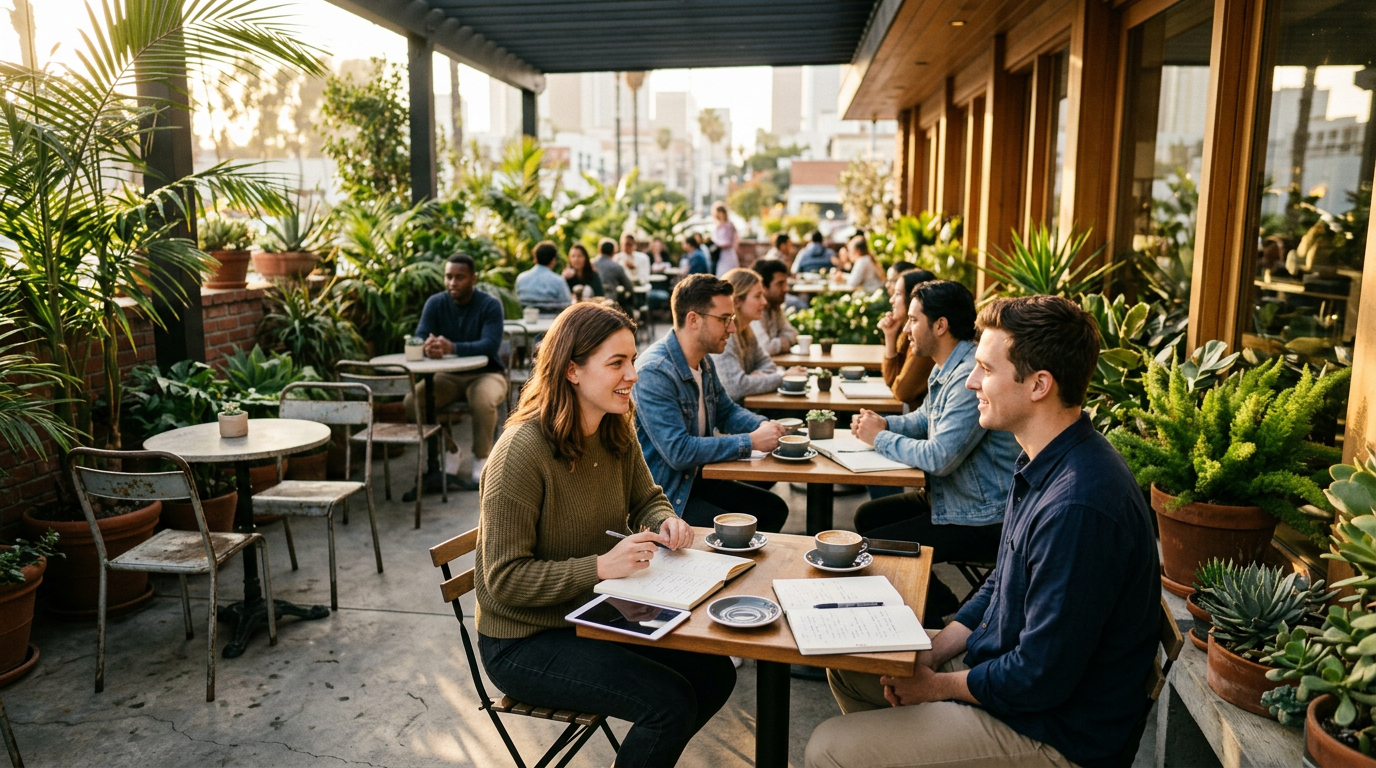
The LA breakfast rooms founders use before traffic turns
At 8:12 on a weekday in Los Angeles, the city has not decided what it is yet. Venice is already in Lycra. Silver Lake is ordering espresso like it has a deadline. Culver City is pretending the 10 will behave. Beverly Hills is doing quiet capital calls over eggs. This is the window when founder meetings in LA can feel easy instead of performative.
Breakfast works here because nobody wants another 6 p.m. mixer with warm white wine and vague panels. LA operators are spread across a hard-to-cross map, and the morning gives everyone a clean excuse: one hour, one neighborhood, one real reason to be there. If the meeting goes well, you still have the day. If it does not, you have a hard stop and traffic to blame.
The trick is choosing a room that matches the conversation. A funding intro does not belong at the same table as a creator partnership brainstorm. A cofounder coffee is different from a three-person operator swap. LA rewards specificity. Pick the wrong room and even a useful meeting feels like networking theater.
The LA breakfast map that actually matters
Forget the idea of one central founder scene. LA is a set of overlapping circles, and breakfast is one of the few ways those circles touch without a formal event.
On the Westside, Venice, Santa Monica, Playa Vista, and Culver City carry the highest density of startup, product, creator-economy, and venture-adjacent breakfast traffic. This is where a third-wave coffee bar with real food can double as an informal founder lobby. Think Gjusta in Venice for serious morning energy, Go Get Em Tiger for coffee-forward meetings, or a polished hotel lobby near Santa Monica when the conversation needs more privacy.
Silver Lake, Los Feliz, and Echo Park are better for creative operators, consumer brands, design-led founders, film-adjacent people, and the kind of builders who do not want to say they are networking. Intelligentsia in Silver Lake still works as a recognizable meeting point, though it is better for a short coffee than a long strategy session.
Hollywood and West Hollywood are useful when the person you are meeting crosses entertainment, talent, brand, or capital. NeueHouse Hollywood and Soho House remain known reference points for member-club meetings, but do not assume access or use them as a flex. If you are not already a member or invited by one, choose a nearby full-service breakfast room instead.
Downtown LA and the Arts District are more uneven in the morning, but still useful for civic tech, real estate, food, design, and operators who split time between LA and other markets. Blue Bottle and Verve locations can work for quick meetings, while hotel restaurants near DTLA are better when you need seating that does not feel like a scramble.
The rule: do not make someone cross the city before 9 a.m. unless the meeting has a clear payoff.
What to order / what to look for
!Morning founder breakfast meeting on a Los Angeles café patio
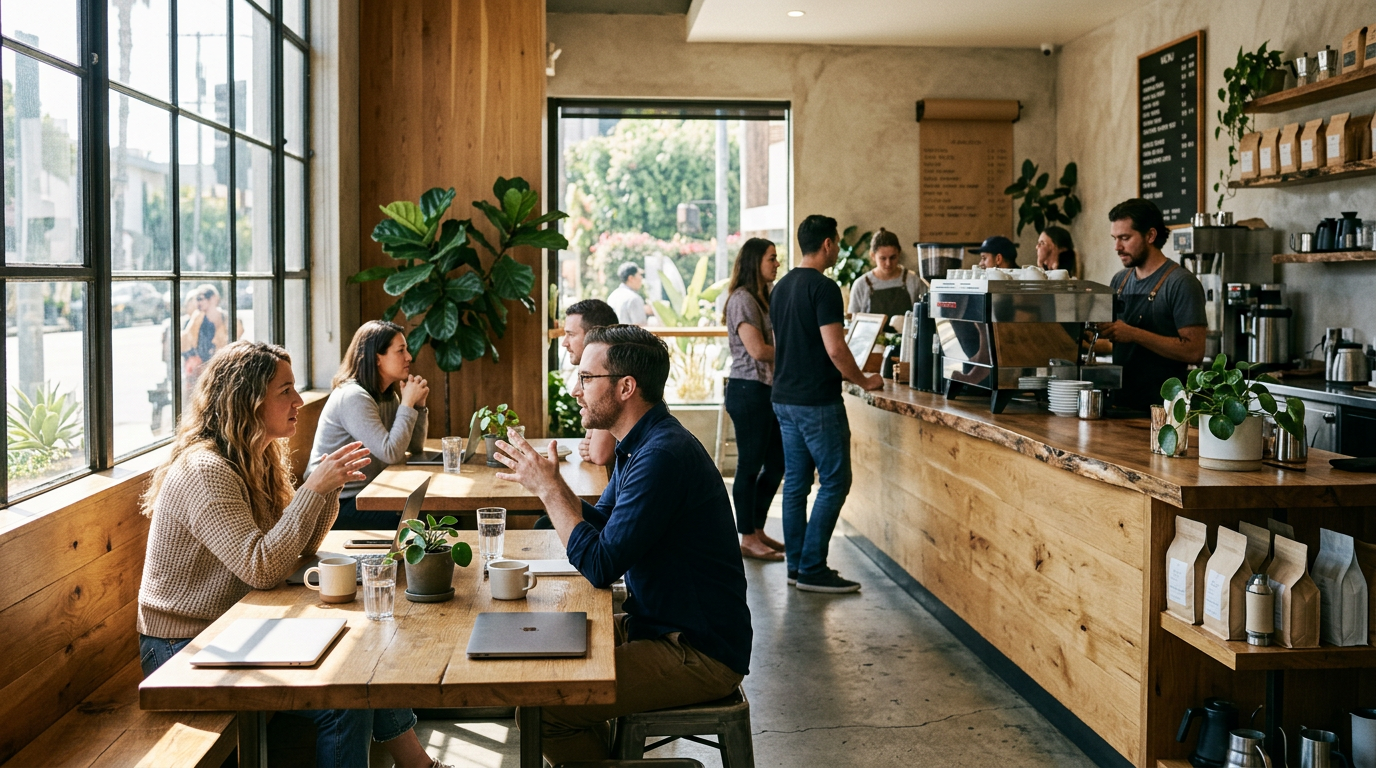
A good founder breakfast room is not about the most photographed plate. It is about pacing, acoustics, seating, and whether the room lets two ambitious people talk without feeling watched.
Look for:
- Counter-service coffee with enough tables to avoid hovering
- Full-service breakfast if the meeting is sensitive, senior, or longer than 40 minutes
- Outdoor seating with shade, not just a sidewalk table in direct sun
- A room with other working adults, not a line of people filming pastries
- Easy parking, validated parking, or at least predictable rideshare pickup
- Tables close enough for energy but not so close that your hiring issue becomes public content
Order simply. Coffee and one real food item if you are sitting more than 25 minutes. At a third-wave coffee spot, a single-origin pour-over is fine if you are early and not making someone wait through a ceremony. For a first meeting, drip coffee, espresso, tea, breakfast sandwich, yogurt, pastry, or eggs are all safer than building a custom production.
If you invited the person, offer to pay. Do it cleanly. No debate at the register. If they insist on splitting, let them. If they are more senior and invited you, do not perform gratitude for three minutes. Say thanks and keep the conversation useful.
For investor or advisor meetings, choose the room based on listening quality. For peer founder meetings, choose energy. For recruiting, choose calm. For creator partnerships, choose somewhere that signals taste without making the other person feel underdressed.
Best time of day to go
The best LA founder breakfast slot is 8:00 to 9:15 a.m. It is early enough to feel intentional and late enough that nobody has to wake up in Santa Monica at 5:40 just to make it from the Eastside.
Use 7:30 a.m. only for people who already live nearby, parents who need the early slot, or operators who clearly prefer it. A 7:30 breakfast in LA can be productive. It can also be passive-aggressive if you picked a spot 45 minutes from the other person.
The 9:30 a.m. slot works for creative founders, investors with packed mornings, and people coming off school drop-off. It is less crisp but more humane. After 10:00, you are not really doing breakfast networking anymore. You are doing a coffee meeting with breakfast props.
Neighborhood timing matters:
- Venice and Santa Monica: strong from 8:00 to 9:30, especially Tuesday through Thursday
- Culver City and Playa Vista: best when tied to an office, coworking day pass, or nearby investor meeting
- Silver Lake and Los Feliz: better around 8:30 to 10:00, with less suit energy and more creative operator overlap
- West Hollywood and Beverly Hills: good for 8:30 breakfast when the conversation involves capital, agencies, talent, or legal
- DTLA and Arts District: choose 9:00 or later unless both people are already downtown
Mondays are for existing relationships. Fridays are for friendlier, lower-stakes conversations. Tuesday, Wednesday, and Thursday are where the serious breakfast meetings happen.
Etiquette and unwritten rules
!Two founders walking after coffee near a Los Angeles coworking space
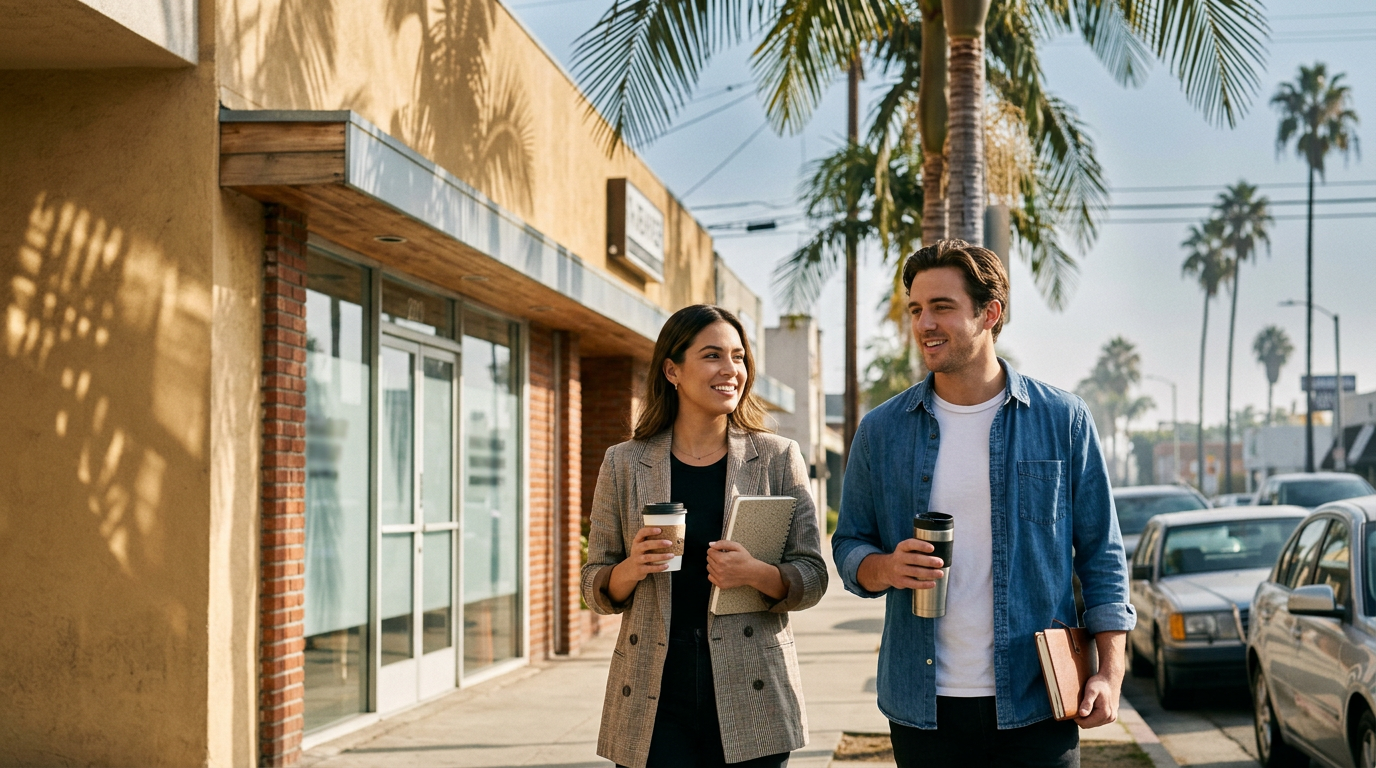
LA is casual, not careless. People may arrive in a hoodie, running shoes, or a cap, but they still notice whether you respect time, distance, and context.
Do not be vague. If you ask for breakfast, say why in one sentence: “I’m comparing notes with LA founders who have hired their first head of sales.” That works. “Would love to connect and jam” does not.
Do not turn a two-person breakfast into a surprise pitch. If you want feedback on a deck, say so before the meeting. If you want an intro, earn the context first. If you want money, do not hide it under “community.” LA people can smell that from across a patio.
Do not camp at a small coffee shop during peak breakfast with one espresso and an open laptop. If you need two hours, book a coworking day pass at Industrious, Spaces, or WeWork, or use a hotel lobby that can support longer stays. Hot desk culture has changed since the post-pandemic reset; people are more intentional now. They come in for concentrated days, investor meetings, and scheduled collisions, not vague desk presence.
Respect the table. If the room is packed, wrap in 45 minutes. If the person has another meeting, do not walk them to their car unless the conversation clearly continues. LA parking lots are not always the place for one more ask.
Also: be normal about famous-adjacent people. LA breakfast rooms mix founders, producers, athletes, creators, and investors. Staring around the room makes you look unserious.
How to actually meet people there
Breakfast is strongest when it is anchored to weak ties, the idea Mark Granovetter made useful for understanding opportunity networks. Your closest friends often know the same people you do. The founder you met once at a small dinner, the operator from a Meetup panel, the former On Deck peer, the AngelList scout, the South Park Commons contact visiting from San Francisco — those are the breakfast invites that move things.
Start with one clear reason and one easy neighborhood option.
Good openers:
- “I’m in Culver Wednesday morning and saw you’ve been hiring GTM in LA. Open to a 35-minute breakfast swap?”
- “I’m trying to understand what is actually working for creator-led commerce here. Coffee in Venice next week?”
- “You mentioned you’re moving between entertainment and software. I’m comparing notes with a few founders doing the same. Breakfast near West Hollywood?”
- “No pitch. I’m looking for two honest reads on LA fundraising right now and can share what I’m seeing on hiring.”
At the table, do not start with your origin story. Start with the present tense.
Try:
- “What are you trying to get done before the end of the quarter?”
- “Where are you seeing LA help the business, and where is it making things harder?”
- “Who here has been unusually useful to you lately?”
- “What kind of intro would be valuable if I come across the right person?”
That last question matters. It gives you permission to help without making a big performance of it.
The follow-up should land the same day, ideally before 2 p.m. Keep it short:
- One specific takeaway
- One promised link or intro
- One suggested next step, if there is one
Do not send a six-paragraph recap. Do not attach the deck unless they asked. If you offered an intro, write a clean forwardable blurb. LA follow-through is a reputation system. People remember who does the small thing quickly.
The breakfast formats that feel least forced
The worst founder breakfast is eight strangers at one long table pretending not to pitch. The best ones have structure but do not announce themselves as networking.
Use these formats:
The two-founder swap
One hour, same stage, different companies. Each person brings one live problem and one useful contact they can make if relevant. This is the highest signal format for early-stage founders.
The operator triangle
Three people maximum: one founder, one operator, one investor or advisor. The point is not to dominate the room. It is to make the conversation specific enough that everyone leaves smarter.
The neighborhood recurring breakfast
Same weekday, same area, rotating small group. Venice founders on Tuesdays. Eastside creative operators every other Thursday. Culver product and GTM people once a month. Do not brand it too hard. The minute it sounds like a formal club, the wrong people start optimizing for attendance.
The pre-coworking breakfast
Meet at 8:30, then move into a coworking space for a focused work block. This works near Santa Monica, Culver City, Hollywood, and DTLA where WeWork, Industrious, Spaces, or independent coworking rooms can support the second act. A day pass is often cleaner than pretending a café is your office.
The founder dinner follow-up breakfast
LA has plenty of founder dinners, supper clubs, and private salon-style meals. Breakfast is where the real follow-up happens. If you met someone at a dinner and had one useful thread, invite them for coffee within a week. Not three weeks later when both of you forget the context.
Mistakes to avoid
Do not choose a place because it looks good on Instagram. Choose it because it supports the job of the meeting.
Do not schedule across the 405 casually. “It is only nine miles” is not a sentence serious LA people respect.
Do not over-index on member’s clubs. Soho House and NeueHouse can be useful if the relationship already belongs there. They can also make a simple founder breakfast feel staged. A good neighborhood café often creates more trust.
Do not bring a laptop unless the meeting requires looking at something together. A notebook is better for most breakfasts. Phones stay down unless you are checking a specific detail, making an intro, or confirming a follow-up.
Do not ask for five introductions in the first meeting. Ask for advice on one category of person. If they volunteer names, great. If not, you still learned something.
Do not confuse friendliness with commitment. LA meetings can feel warm. That does not mean the person is investing, advising, hiring, or partnering. The follow-up tells you what was real.
Do not make the room do all the work. A great breakfast spot helps, but the meeting still needs a reason, a clean ask, and a graceful exit.
A simple LA breakfast playbook
If you are new to the LA founder scene, start with three breakfasts over two weeks, not fifteen. Pick one Westside, one Eastside, and one central meeting depending on your actual business.
For a software or AI founder, use Culver City, Santa Monica, or Venice as your default. For a consumer brand or creator-led company, add Silver Lake, West Hollywood, and Beverly Hills depending on partners and capital. For climate, mobility, food, design, or real estate, DTLA and the Arts District may be more useful than outsiders assume.
Send direct invites. Keep the meeting short. Order like an adult. Ask better questions than “So what do you do?” Make one useful follow-up within hours.
The LA breakfast scene is not about finding one magic table. It is about becoming a reliable person in a city where everyone is moving between neighborhoods, industries, and half-finished conversations. Breakfast gives you a clean opening. What you do after the check is the part that counts.
Discussion (0)
Loading comments…