The LA omakase dinner test for first-time founders
A 7:30 reservation in Beverly Hills means three different arrival times depending on where everyone lives. The Venice founder left at 6:15 and still cut it close. The Pasadena angel is already seated. The person coming from Culver City is pretending the 10 was normal.
That is LA founder dinner reality: logistics are part of the social signal. Omakase makes it even sharper. The room is small, the chef can hear everything, and you cannot hide behind a giant group table or a noisy natural wine bar. If you talk too much, arrive late, order badly, or pitch across toro, people notice.
For first-time founder dinners, omakase can work brilliantly. It creates focus. It caps the guest count. It forces everyone off their phones for stretches. It also punishes bad manners faster than almost any other dinner format in Los Angeles.
This is not about acting precious. It is about knowing the local rules before you sit at a counter where dinner costs real money and the person next to you might become an investor, customer, operator hire, or repeat dinner host.
The LA omakase room is not a steakhouse pitch table
LA has plenty of rooms where aggressive networking is tolerated: hotel lounges in West Hollywood, conference after-parties in Santa Monica, member's club corners, WeWork common areas, Soho House on an event night, NeueHouse when the crowd is in production mode. Omakase is different.
At a sushi counter, the center of gravity is the chef, not the loudest founder. You are a guest inside a performance with timing, temperature, pacing, and trust. That makes it a strong filter for founder dinners. People who can read the room at omakase usually read customers, boards, and hiring situations better too.
Good LA omakase founder dinners tend to be small:
- Four people if the goal is real conversation
- Six if there is already some shared context
- Eight only if the host knows the counter, the format, and every guest
The best format is not a random networking dinner pulled from AngelList, Lunchclub, or Meetup. Use those platforms for sourcing. Then curate hard. One AI infrastructure founder, one operator from a media company, one early-stage investor, one repeat founder, one technical customer. Enough overlap to create trust. Enough difference to create useful weak ties, the Granovetter idea that opportunity often travels through acquaintances rather than your closest circle.
In LA, those weak ties matter because scenes are split by geography and industry. Venice and Santa Monica skew venture, consumer, climate, defense-adjacent, and AI. Culver City brings media, entertainment tech, and agencies. Downtown and Arts District pull design, food, fashion, and crypto remnants. Pasadena adds deep tech and research energy. Omakase can put those worlds within two seats of each other.
Choosing the right venue type
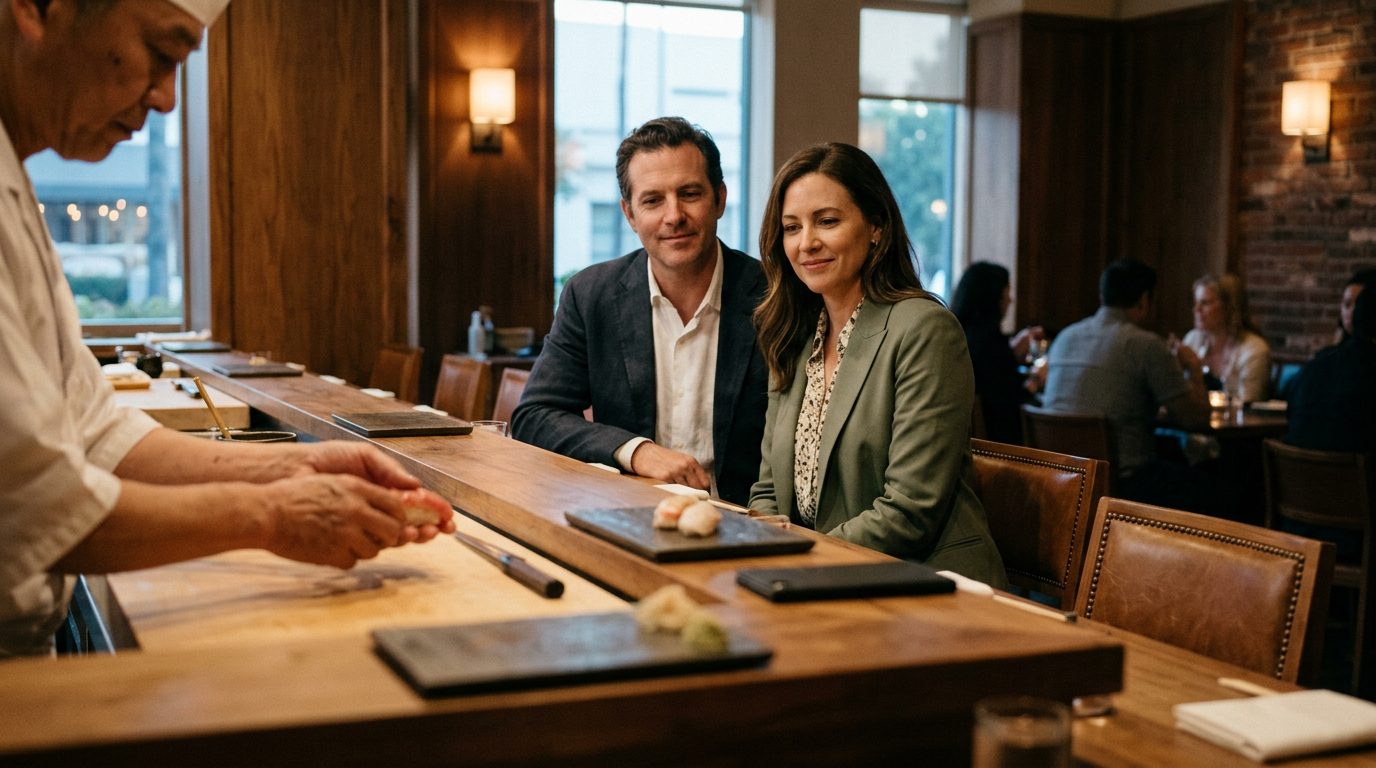
!Place setting at a Los Angeles omakase counter before dinner service

Do not pick the most expensive counter just to prove seriousness. That reads amateur in LA. The better move is to match the counter to the purpose of the dinner.
For a first-time founder dinner, look for:
- A true counter format with a set omakase or chef's choice menu
- A room quiet enough for two-seat conversations, not full-table speeches
- Clear reservation policies and cancellation rules
- Staff used to business diners but not dominated by expense-account energy
- A location that does not punish half the guest list with a brutal drive
Beverly Hills and West Hollywood are useful when guests are coming from both the Westside and central LA. Santa Monica and Brentwood work for venture-heavy Westside groups. Downtown can be smart for mixed creative and operator dinners if people understand parking and timing. Sawtelle and West LA can work well for sushi credibility without the full Beverly Hills theater.
Well-known LA-area omakase and sushi names people may recognize include Sushi Ginza Onodera, Sushi Park, Nozawa Bar, Sushi Gen, Morihiro, Shunji, and Urasawa. Each has its own price point, reservation culture, and room feel, so do not treat them as interchangeable. If you have not personally eaten there or confirmed the current format, do not make it the site of your first important founder dinner. Scout first or choose a less risky counter-style sushi restaurant with an omakase option.
A practical rule: if the dinner is mainly about relationship-building, choose comfort and acoustics over status. If the dinner is meant to thank a serious investor or close a strategic relationship, the higher-end counter may be justified. If you are gathering peers for the first time, do not bankrupt the room.
What to order / what to look for
At omakase, the main order is trust. You are saying yes to the chef's sequence. Do not sit down and immediately start redesigning the meal.
Before booking, ask privately about dietary restrictions. Not at the counter. Not when the first course lands. If someone does not eat shellfish, uni, roe, or raw fish, this may not be the right format. LA has excellent tasting-menu, izakaya, and kaiseki-leaning options for those groups. Use them.
What to look for in the meal:
- Rice temperature and texture, not just expensive fish
- Pacing that leaves room for conversation without dragging
- A chef and staff who communicate clearly without turning dinner into a lecture
- Beverage options that do not force everyone into heavy drinking
- A room where phones are socially discouraged, even if not formally banned
For drinks, keep it clean. Sake, beer, sparkling water, maybe a restrained white wine if the restaurant offers it. This is not the night to perform your natural wine bar personality unless the restaurant is built for it. One person hijacking the pairing conversation can derail the social rhythm.
If the chef offers add-ons, read the table before saying yes. In LA, money signals are complicated. Some founders are flush from a recent raise; others are pre-seed, bootstrapped, or between checks. If you are hosting and want add-ons, state clearly that you are covering them. If costs are split, ask softly and give people an easy out.
A useful host line: They have a few optional pieces later. I am happy to keep it to the set menu unless everyone wants to extend.
That one sentence prevents awkwardness.
Best time of day to go
!Founders arriving for an evening omakase dinner in Los Angeles
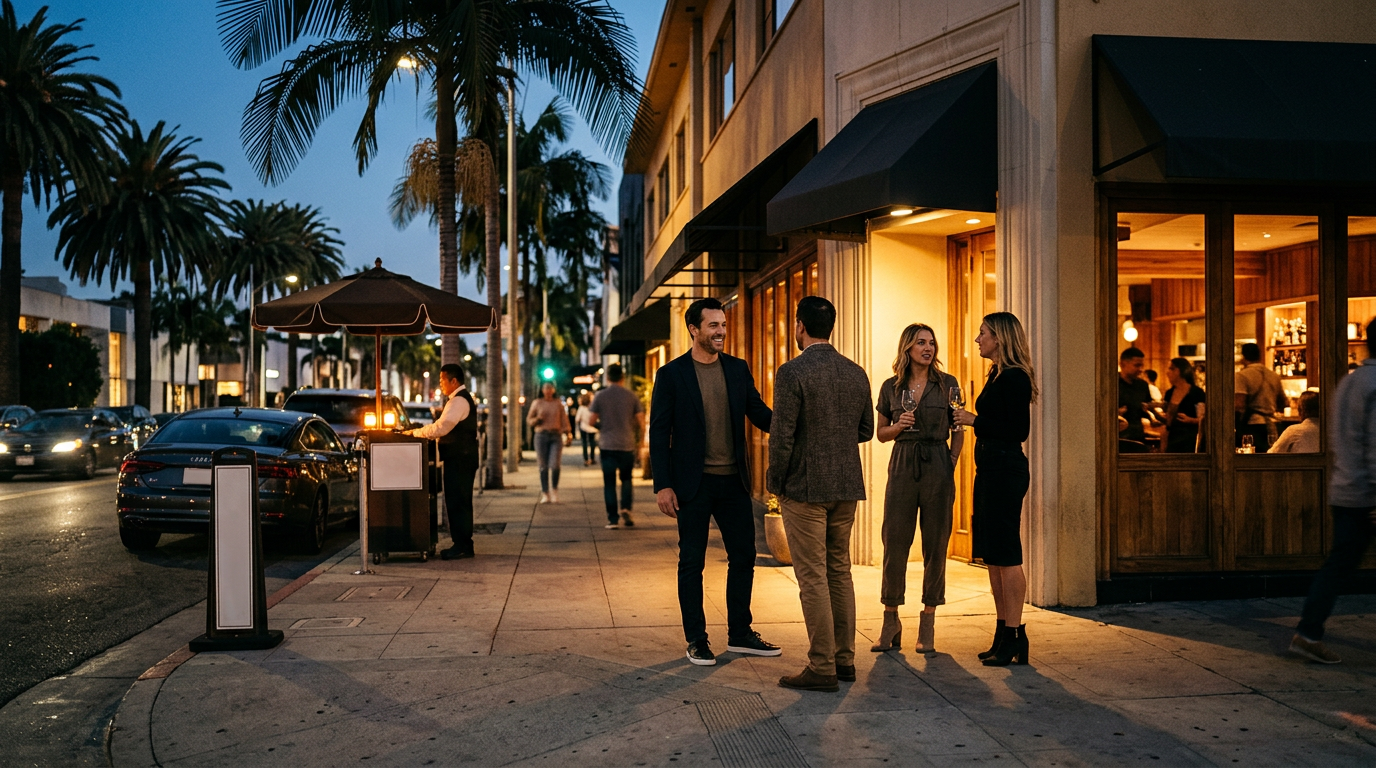
The best founder omakase slot in LA is usually early evening on a Tuesday, Wednesday, or Thursday. Not Friday at 9:15. Not Saturday prime time. Not Sunday when everyone is half-present and thinking about Monday.
Aim for:
- 6:00 or 6:30 for Westside-heavy groups
- 7:00 or 7:30 for mixed geography
- 8:00 only if the group is senior, flexible, and already knows one another
Earlier dinners work because LA traffic is bad but predictable in waves, and people are still mentally sharp. A 6:30 counter also lets the group do a short second stop if the chemistry is real: a quiet hotel bar, a nearby low-key lounge, or a natural wine bar where standing conversation is acceptable. Do not force the second location. Offer it as optional.
Send the calendar invite with the reservation time, arrival time, parking note, dress note, and cancellation policy. LA people are not offended by logistics. They are relieved.
A good invite says:
Reservation is at 7:00, please arrive by 6:50. Counter seating, small group, set omakase. Smart casual is fine. I will confirm final headcount 48 hours out because the cancellation policy is strict.
That is not fussy. That is competent.
Etiquette and unwritten rules
Omakase etiquette is mostly restraint. LA adds its own layer: nobody wants to feel trapped in a performative business dinner.
The rules:
- Arrive early. Ten minutes early is on time for a counter.
- Do not wear heavy fragrance. It interferes with the food and annoys the room.
- Put your phone away. One photo is fine if the room allows it; a content shoot is not.
- Do not ask the chef to make a roll you like from another restaurant.
- Eat pieces when served. Temperature matters.
- Keep the startup jargon down. The chef did not sign up for your TAM monologue.
- Tip properly if tipping is part of the restaurant's structure.
- Do not argue about the bill at the counter.
The biggest LA-specific rule: no hard pitching during the meal. People came to meet you, not get cornered. If someone asks what you are building, answer in 20 seconds and hand the conversation back.
Use this format:
We are building software for independent clinics to handle patient intake without adding admin headcount. Early customers are in Southern California. I am mostly here to compare notes with people selling into regulated markets.
That is enough. Clear, specific, not needy.
Also, do not name-drop your way through dinner. LA has heard every name. Investors, celebrities, studio executives, agency heads, founders who exited, founders who did not. If the relationship matters, describe the work, not the proximity.
How to actually meet people there
Omakase is not good for cold approaching strangers. It is excellent for converting loose contacts into real ones.
The host should seed the room before anyone arrives. Send a short guest note the day before:
- Name
- Company or current project
- One useful context point
- One reason they are in the room
Example:
Maya runs partnerships for a healthtech company selling into regional systems. She is sharp on long enterprise sales cycles and is looking for more founder peers in LA.
At the counter, do not do a formal round of intros that sounds like a demo day. Pair people naturally.
Good conversation openers:
- What part of LA is actually useful for your work right now?
- What customer segment has surprised you this year?
- Who in LA is hosting rooms worth showing up for?
- What is a dinner or event you left smarter than you arrived?
- What are you trying to learn before the end of the quarter?
These work because they create exchange without forcing anyone into a pitch. They also surface invitations: founder dinners, South Park Commons events, On Deck alumni gatherings, small AngelList syndicate circles, niche Meetup groups, coworking breakfasts at Industrious, Spaces, or the better-run WeWork locations.
The follow-up move matters more than the dinner.
Within 24 hours, send one clean note:
Good meeting you last night. Your point about clinic procurement was useful. I can introduce you to a founder selling into urgent care groups if helpful. Also happy to compare notes when you are next on the Westside.
Specific memory. Specific offer. Light next step.
If you promised an intro, make it within 48 hours. LA has a flaky reputation for a reason. Be the person who closes the loop.
Seating strategy for founder dinners
At a sushi counter, seating is strategy. Do not leave it to chance if you are hosting.
Put the two people with the most obvious overlap near each other, but not necessarily side by side for the whole night if the room allows any movement later. Put the quiet technical founder next to the operator who asks good questions. Do not put two loud fundraisers together unless you want a podcast episode to break out over the chef's work.
If there are six guests, the host should sit near the middle, not at the end. Your job is to modulate energy, pull quieter people in, and stop one person from dominating.
Useful host interventions:
- That is a useful thread. I want to hear Priya's view because she has been dealing with this in enterprise.
- Let's pause the fundraising war stories for a second. What are people seeing on hiring?
- We should let chef finish this sequence, then I want to come back to that.
Short. Calm. No schoolteacher energy.
Who pays without making it weird
Founder dinners get awkward fast when the payment norm is unclear. Decide before booking.
Common models:
- Host pays when inviting investors, customers, or senior operators as guests
- Company pays when there is a clear business development purpose
- Split evenly when it is a peer dinner and everyone agreed in advance
- Sponsor pays only if the sponsor is disclosed and does not turn dinner into a sales event
Do not surprise junior founders with a high fixed cost. LA has plenty of people who look funded and are not liquid. If the dinner will be expensive, say so privately in the invite. You do not need to list every dollar in a public thread, but you do need consent.
A clean line:
Set menu is on the higher side, and we will split unless noted. No pressure if this is not the right week.
That line protects the relationship.
Mistakes to avoid
The common failures are predictable.
- Booking a counter you have never visited for a high-stakes dinner
- Inviting too many people because you are afraid to curate
- Treating omakase like a networking mixer
- Showing up late and blaming traffic as if everyone else teleported
- Bringing a guest without asking the host
- Asking for major substitutions at the counter
- Turning every course into content
- Talking over the chef's explanation
- Pitching an investor who came socially
- Letting the bill become a group negotiation
- Following up with a generic great to connect message and nothing else
The worst mistake is using the dinner to look important instead of making the room useful. LA can smell that. The city rewards polish, but it punishes obvious social climbing.
The better after-dinner play
If the meal went well, do not stretch the counter past its natural end. Pay, thank the chef and staff, step outside, and give people an easy off-ramp.
Say:
I am going to grab one drink nearby if anyone wants to keep talking. No pressure at all.
This lets the people with early calls leave gracefully and gives the real threads space to continue. The second stop should be quieter than the dinner, not louder. A calm hotel bar, a low-key wine bar, or even a walk to the valet can do more than another formal round.
The next morning, make the room tangible. Send intros. Share the article, customer lead, candidate name, or event invite you mentioned. If there is a reason to gather again, propose it with a narrower theme.
Next one could be four people selling into healthcare ops. Early September, Westside, early dinner.
That is how founder dinner culture compounds in LA: not through giant rooms, but through repeat, well-edited tables where people behave like adults and leave with one real next step.
Discussion (0)
Loading comments…