The LA omakase dinner test for new founders
The worst seat at an LA omakase founder dinner is not the end of the counter. It is the seat held by the person who treats the meal like a podcast green room: loud thesis, long pitch, phone on the counter, no read on the chef, no read on the room.
Los Angeles has always mixed money, taste, and access in strange ways. A founder dinner here may happen at a serious omakase counter in Beverly Hills, a chef-led sushi room in West LA, a Sawtelle-adjacent spot with six operators and one investor, or a private dining room after a day at a Santa Monica hot desk. The room might include a media founder from Venice, a healthcare AI operator from Culver City, a gaming exec from Playa Vista, a crypto person who somehow still knows everyone, and one quiet angel who writes checks only after the second meeting.
Omakase works for founder dinners because it removes menu negotiation. It also exposes people fast. Can you be present? Can you listen? Can you handle a high-context room without trying to dominate it?
This is not about pretending to be a sushi scholar. It is about not embarrassing your host, respecting the restaurant, and turning a two-hour dinner into useful weak ties without making the meal feel transactional.
LA’s omakase founder dinner culture is not New York’s
New York founder dinners often run on density: walkable neighborhoods, post-work proximity, people stacking three events in one night. LA runs on intent. If someone drove from Silver Lake to Beverly Hills, from Venice to Downtown, or from Pasadena to Santa Monica, they made a choice. The calendar slot matters.
That changes the etiquette.
LA dinners tend to be smaller, more curated, and more socially coded. People care less about your loudest credential and more about whether you understand the tone of the table. Entertainment, consumer, wellness, climate, aerospace, AI, creator tools, and commerce all sit closer together here than outsiders expect. A founder working out of NeueHouse Hollywood, an Industrious in Century City, or a WeWork near Santa Monica may be in the same room as someone coming from a studio lot, a member’s club, or a late afternoon coffee at Blue Bottle, Verve, or La Colombe.
The dinner is rarely just dinner. It is the middle of a sequence:
- A warm intro from AngelList, an operator Slack, South Park Commons, On Deck alumni, or a trusted founder friend
- A coffee chat that went well enough to become a group meal
- A founder dinner before a demo day, conference week, or investor trip
- A post-panel regroup after an event in Santa Monica, Culver City, Hollywood, or Downtown
- A small supper club where food is the excuse and trust is the product
At an omakase counter, hierarchy gets flattened a little. Everyone receives the same piece at the same time. That is the point. Do not break the format by trying to turn the counter into your personal stage.
Picking the right room without overplaying it
!Founders seated respectfully at a Los Angeles omakase counter
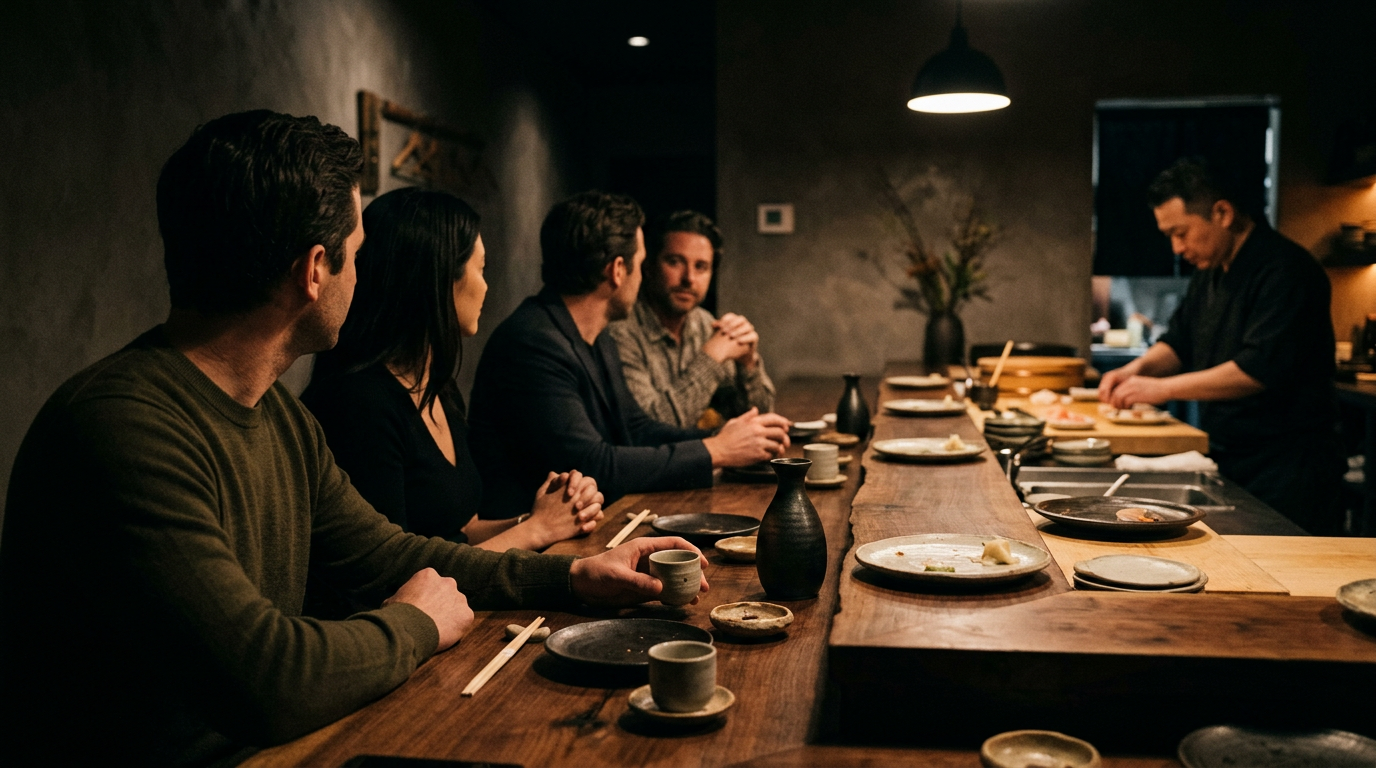
For first-time founder dinners, the right omakase room is not automatically the most expensive one. It is the room where conversation can breathe without disrespecting the chef or turning the meal into a conference call.
Venue type matters more than flex value.
Look for:
- A serious sushi counter with a calm room: Best for four to eight people who already have some reason to trust each other.
- A chef-led omakase spot with a private or semi-private table option: Better if the group includes first-time attendees, investors, or people who need to discuss sensitive company context.
- A Westside or Beverly Hills room with easy parking or valet: Useful when the guest list includes people coming from Santa Monica, Venice, Century City, and West Hollywood.
- A Downtown or Arts District-adjacent room: Strong if the group is tied to media, design, consumer, or a post-event crowd.
- A lower-pressure sushi bar or hand roll counter before the real dinner: Good for testing chemistry before committing to a higher-stakes omakase night.
Well-known LA sushi names like Sushi Gen, Sushi Park, Q Sushi, Nozawa Bar, and n/naka are part of the broader serious-Japanese-dining conversation in the city, though they serve different formats and levels of formality. Do not assume every famous name is right for a networking meal. Some rooms are better for quiet dining than founder chatter. Some are reservation projects, not casual calendar holds. Respect that.
If you are hosting, be clear in the invite:
- Start time and expected end time
- Whether it is counter seating or a table
- Whether the host is covering, splitting, or billing through a company
- Any dietary constraints the restaurant must know in advance
- Whether partners, co-founders, or plus-ones are included
LA people will forgive an ambitious venue. They will not forgive sloppy logistics.
What to order / what to look for
At true omakase, you are not really ordering. You are choosing to trust the chef. That trust is the social contract.
What to look for before you book:
- Counter pacing: You want a room where courses arrive with enough rhythm for short conversations, not long speeches.
- Noise level: Founder dinners fail when nobody can hear the person two seats away.
- Dietary flexibility stated upfront: Omakase is not the place to surprise the restaurant with five restrictions at 7:10 p.m.
- Beverage restraint: Sake pairings can be excellent, but first-time founder dinners do not need to become endurance tests.
- A reservation policy you actually understand: Deposits, cancellation windows, and late-arrival rules matter.
What to do at the meal:
- Let the chef lead. If a piece is served, eat it promptly unless instructed otherwise.
- Use your hands if the chef presents nigiri that way and the room’s style supports it. Chopsticks are fine when appropriate.
- Keep soy sauce use minimal. Many pieces are already seasoned.
- If there is a hand roll, eat it immediately. The texture is part of the dish.
- Ask one thoughtful food question, not ten performative ones.
Good questions:
- “Is this preparation typical for the season?”
- “Should this be eaten in one bite?”
- “Is there a preferred order for this course?”
Bad questions:
- “What’s your craziest fish?”
- “Can you make mine spicy?”
- “Do you have anything more like Sugarfish?”
Sugarfish and KazuNori have their place in LA’s sushi ecosystem, especially for efficient lunches and casual founder catch-ups. They are not the reference point to bring up at a serious omakase counter unless the chef does first.
Best time of day to go
!Small groups talking outside a Los Angeles restaurant after dinner
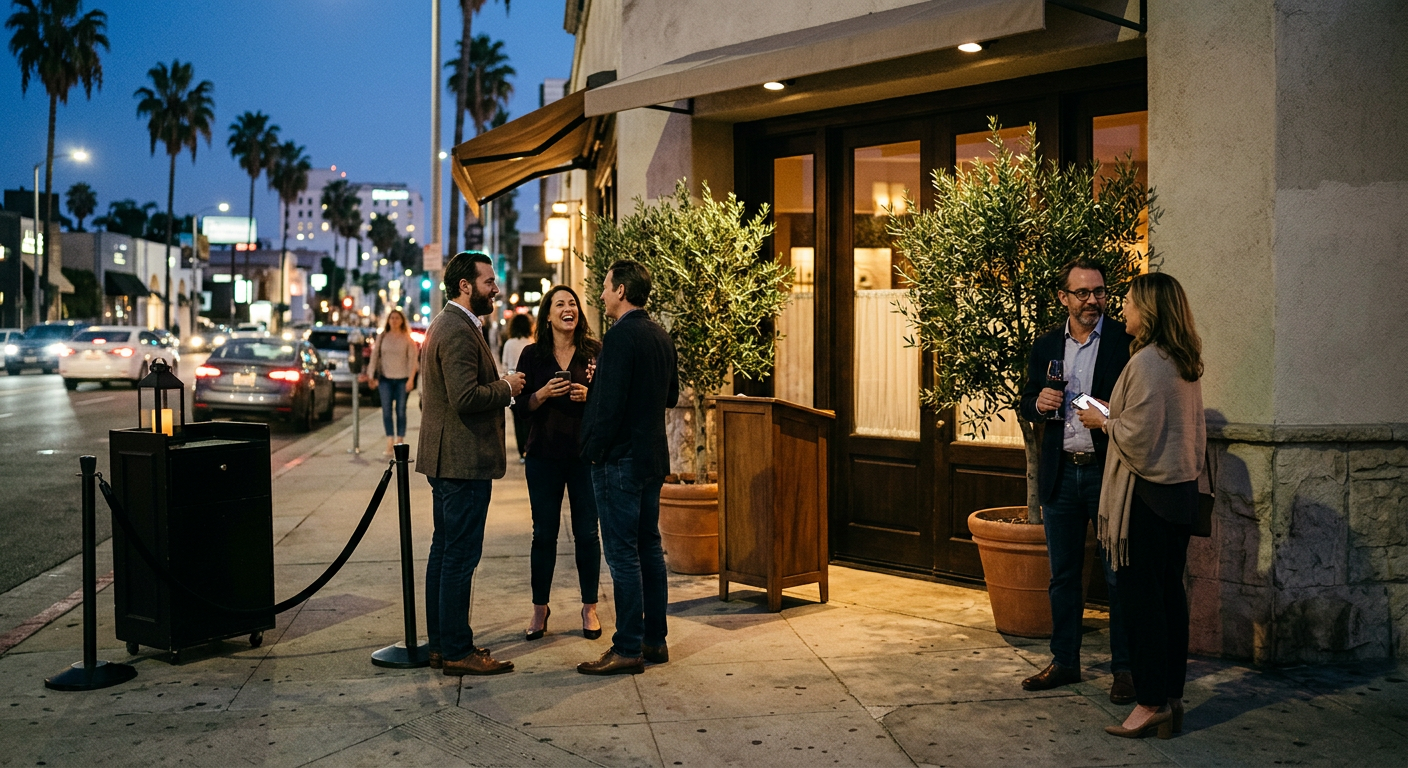
For founder dinners, the strongest reservation window is usually early evening: late enough that people have finished calls, early enough that nobody is exhausted or trying to escape to a second event.
A 6:00 or 6:30 p.m. start is underrated in LA. It gives Westside people a fighting chance with traffic and keeps the dinner from becoming a three-hour test of attention. It also allows a clean second location if the room has momentum: a quiet hotel bar, a natural wine bar, or a member’s club lounge where the group can split into smaller conversations.
Lunch omakase can work, but it has a different use case. It is sharper for investor-founder meetings, diligence conversations, or two founders comparing notes before fundraising. Dinner is better for community-building.
Avoid:
- Friday nights if the goal is serious connection. Too much social spillover.
- Late Saturday unless it is clearly a personal dinner, not a business one.
- Reservation times that collide with major LA traffic patterns without acknowledging drive time.
- Stacking the meal directly after an intense panel or demo day without a buffer.
If you are gathering people from Santa Monica, Venice, Culver City, and West Hollywood, pick geography honestly. LA punishes fantasy maps. A “central” location that is painful for everyone is not central; it is just indecisive.
Etiquette and unwritten rules
The easiest way to read the room: the chef controls the food, the host controls the pace, and guests control their volume.
Core rules:
- Arrive early, not on LA time. Ten minutes early is normal for the person who wants to be invited back.
- Do not put your phone on the counter. Keep it away unless there is a true need.
- Do not photograph every course. One discreet photo is usually enough, and some rooms prefer none.
- Do not discuss valuation while the chef is placing nigiri in front of you. Timing matters.
- Do not monopolize the investor. Everyone sees it. Everyone remembers.
- Do not ask the chef to remake the format around your preferences unless the restriction was disclosed in advance.
- Do not compare the restaurant to Tokyo unless you actually know what you are talking about. Even then, maybe don’t.
If you are the host, seat deliberately. Put the highest-context connector near the middle, not at the head. Pair quieter operators with generous conversationalists. Do not strand the newest founder next to the most socially aggressive guest.
If you are a guest, your job is to add signal without taking over. Share one crisp thing you are working on. Ask better follow-ups than the average conference person.
Try:
- “What are you seeing in LA right now that feels underpriced?”
- “Which customer conversation changed your roadmap recently?”
- “Who in this city is unusually good at community-led growth?”
- “What are you trying to learn this quarter?”
Skip:
- “So what do you do?” as your only opener
- “Are you raising?” in the first five minutes
- “Can I pick your brain?” at the counter
- Any monologue that starts with your deck narrative
How to actually meet people there
The point of a founder dinner is not to collect contacts. It is to create enough trust that the next interaction is easy.
Before the dinner, send the host a two-line context note if they ask for it:
- “I’m building in healthcare ops software, based in Culver City, currently talking to clinic groups.”
- “Useful intros for me: operators who have sold into multi-site healthcare or founders hiring their first enterprise AE.”
That gives the host something to work with. It also prevents the awkward table round where everyone gives a LinkedIn headline and no one remembers anything.
At the dinner, use the counter structure. Omakase naturally creates pauses. Do not force every silence full of business talk. Let the food reset the room, then restart with a more human question.
Good mid-meal moves:
- Ask the person next to you what brought them to LA, not just what they are building.
- Offer one useful introduction only if it is real and specific.
- If two people should meet, say why in one sentence.
- When a topic gets traction, invite one more person into it instead of forming a closed pair.
Founder dinners run on weak ties: the people who are not your closest friends but can open new information, rooms, and opportunities. The trick is not to force intimacy. It is to create enough clarity that a weak tie can become useful without becoming weird.
After dinner, follow up within 24 hours. Not a generic “great meeting you.” Send a note that proves you listened.
Examples:
- “Good meeting you at dinner last night. Your point about specialty clinics buying faster than hospital systems stuck with me. I can introduce you to a founder who sold into that motion if useful.”
- “You mentioned hiring a lifecycle marketer for a subscription product. I know one strong person coming out of a consumer health company. Want an intro?”
- “I liked your framing on LA as a better city for creator-commerce than people give it credit for. Coffee next week in Venice or Culver?”
If you promised an intro, make it within two days. LA networks are forgiving about traffic. They are not forgiving about fake helpfulness.
Mistakes to avoid
The first mistake is treating omakase like a status object. If the restaurant is just a prop for your fundraising personality, the room will feel it.
Other common errors:
- Inviting too many people: Six is often better than ten. At a counter, more guests can mean fewer real conversations.
- Mixing unclear intentions: Do not combine a fundraising dinner, a friend dinner, and a hiring dinner without telling people what room they are walking into.
- Ignoring dietary constraints: A sushi counter can handle some needs with notice. Last-minute surprises are unfair.
- Letting alcohol drive the night: One pairing may be fine. Three rounds after dinner can turn useful candor into cleanup work.
- Pitching across the chef: The staff is not background scenery.
- Underestimating the bill conversation: Payment ambiguity creates quiet resentment.
- Failing to close the loop: The dinner is only valuable if someone sends the recap, intro, or next invite.
Hosts should send a short post-dinner note to the group:
- Thank you
- One or two useful threads from the evening
- Permission-based intros
- A clear next gathering if there is one
Guests should thank the host directly. If the host paid, acknowledge it plainly. If you want to reciprocate, do not say “let me know how I can help.” Offer something real: a customer intro, a candidate, a venue suggestion, a founder dinner seat, or a coffee with someone relevant.
The LA move after the last course
The best LA founder dinners do not end with everyone hovering outside the restaurant checking rideshare apps. Have a soft landing.
That could be:
- A quiet hotel lobby bar where people can split into twos and threes
- A natural wine bar within a short drive
- A member’s club lounge if the host has access and the guest list fits
- A planned “hard stop” for people with early calls
Do not drag the whole group to a loud second location unless the dinner was explicitly social. Two focused follow-up conversations beat one messy afterparty.
If the dinner went well, the next move is smaller, not bigger. Coffee with one person at Verve in West Hollywood. A walk-and-talk in Venice. A dedicated desk neighbor intro at Industrious. A Lunchclub-style one-on-one that is actually curated. A founder breakfast after a Meetup or AngelList-adjacent event.
LA rewards people who can host without making hosting their identity. Choose the right room. Respect the counter. Keep your pitch short. Follow up like an operator.
That is the dinner test.
Discussion (0)
Loading comments…