Miami investor tables are not on Ocean Drive
The investor dinner in Miami usually starts late, ends later, and does not look like a demo day. It looks like two operators at the bar at Michael’s Genuine, a fund partner doing an early reservation at COTE before heading to a member’s club, or a fintech founder stretching one espresso into a 30-minute catch-up in Brickell.
Miami is not San Francisco with palm trees. The city runs on hospitality, proximity, status signals, and repeat presence. The money is real: family offices, crypto survivors, Latin American capital, real estate operators, New York transplants, venture partners with second homes, and founders who moved here for tax reasons and stayed for the calendar. But the room is harder to read than people expect.
If your job is to find investors in 2026, the restaurant is not the pitch venue. It is the trust venue. Use it that way.
The Miami investor map in 2026
Miami’s investor scene clusters around a few patterns, not one single street.
Brickell is still the daytime capital stack: private equity, fintech, wealth management, and corporate operators. Lunch matters here. So do early drinks. The dress code is sharper, the pace is transactional, and people are often squeezing meetings between calls.
Wynwood and the Design District are better for founder gravity. You get venture people, agency owners, consumer brands, crypto infrastructure, AI startups, and out-of-town operators testing the Miami scene. The rooms are louder and more social. Dinner can turn into a second location.
Miami Beach is where capital relaxes but also performs. Soho House, Faena-adjacent rooms, Casa Tua energy, The Surf Club Restaurant crowd, and late tables at high-visibility restaurants can put you near serious people. The catch: Beach networking punishes obvious hunger. If you look like you came to collect business cards, you are done.
Coral Gables and Coconut Grove are underrated for quieter capital. Lawyers, family offices, doctors writing angel checks, real estate families, and older wealth tend to prefer polished neighborhood restaurants over scene-heavy rooms. Less noise. Better conversations.
The through line: Miami rewards repeated sightings. One dinner rarely changes your company. Being the person people recognize from three good rooms over six weeks does.
Restaurant types that actually work
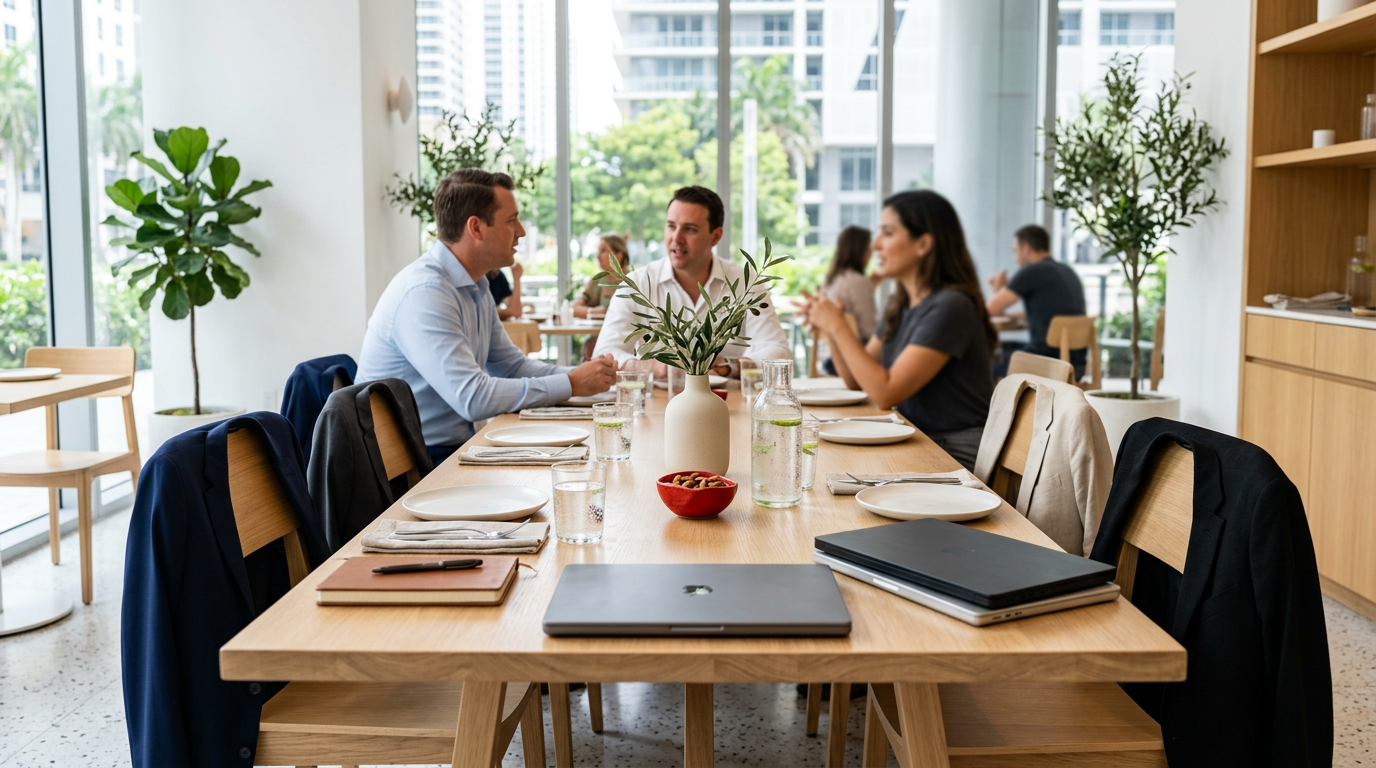
!Brickell lunch table set for a focused investor meeting
You do not need a spreadsheet of venues. You need the right room type for your ask.
The serious lunch room
Use this for warm introductions, first investor coffees that became lunch, and operator-to-operator meetings. Look for restaurants with reservations, sane acoustics, strong service, and a clientele that includes lawyers, fund managers, and founders. In Brickell, this often means polished hotel restaurants, steakhouses, and power-lunch spots near offices. In Coral Gables, it means grown-up restaurants where nobody is filming the table.
Your goal is not to be seen. Your goal is to be easy to talk to.
The bar seat restaurant
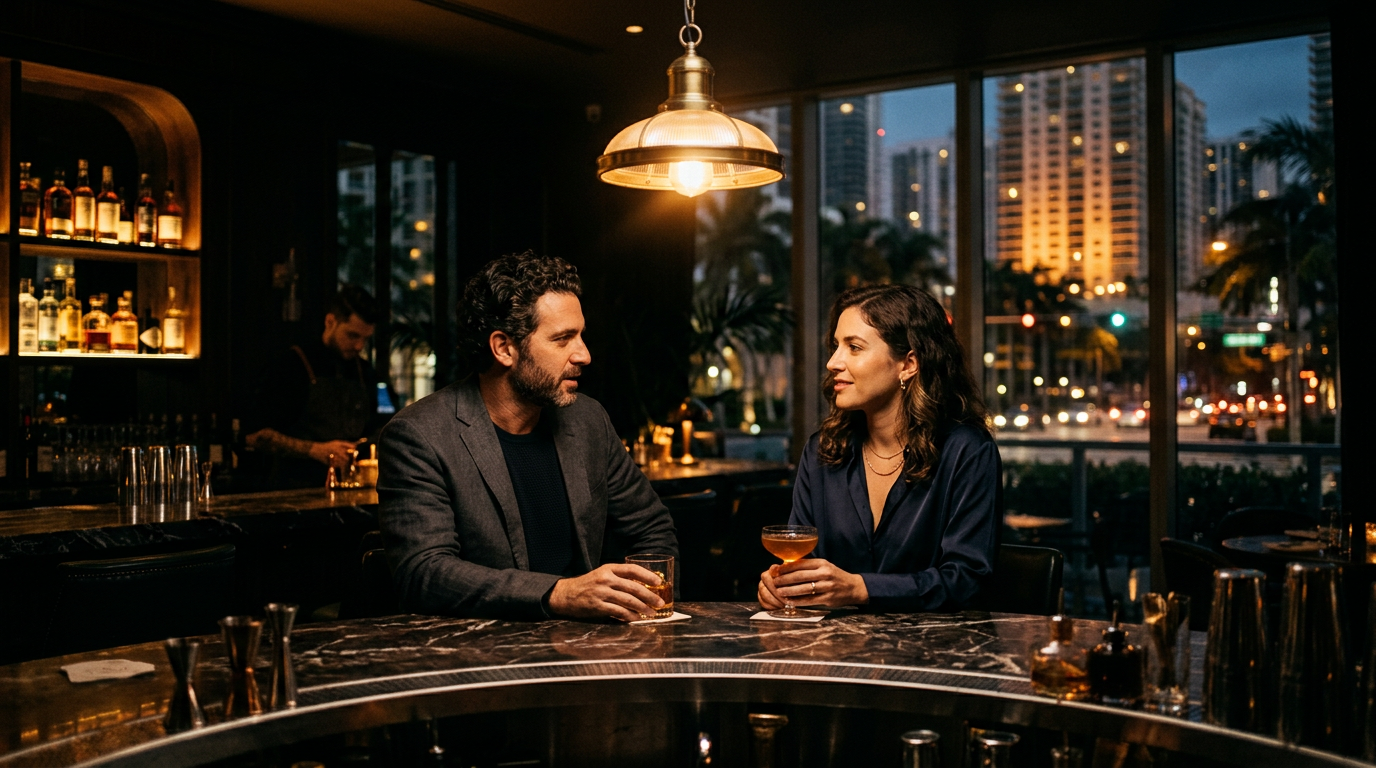
The bar is often better than a table. You can arrive alone without looking stranded, order lightly, and have a natural opening with the person next to you. Michael’s Genuine in the Design District, Mandolin Aegean Bistro in Buena Vista, and well-known hotel bars attached to serious restaurants can work because the crowd is mixed: locals, founders, investors, visiting operators, and people with enough taste to avoid the loudest room in town.
Sit at the corner of the bar if you can. It gives you peripheral awareness without staring.
The high-signal dinner room
Carbone Miami, COTE Miami, Casa Tua, The Surf Club Restaurant, and certain Design District rooms are not cheap prospecting tools. They are relationship accelerators when you already have a reason to be there. These rooms work when you are hosting an investor who is already interested, joining a founder dinner, or anchoring a night around a strong guest list.
Cold approaching at an expensive table is tacky. Saying hello to someone you have met twice before is normal.
The member’s club and restaurant crossover
Soho House Miami Beach, ZZ’s Club in the Design District, and other member-driven rooms matter because they create repeat encounters. Investors like places where the social filter is already done for them. If you are not a member, do not force it. Get invited by doing something useful, not by begging for access.
Member’s clubs are not magic. They are Schelling points: obvious places where a certain class of people expects to run into each other. That only helps if you belong in the conversation once you arrive.
The post-event dinner table
This is where Miami’s founder scene gets real. After eMerge Americas, Miami Tech Week programming, Art Basel week side events, fintech meetups, AI salons, AngelList-adjacent gatherings, On Deck alumni dinners, South Park Commons friends-of-friends events, and Meetup groups that moved offline, the actual relationship often forms at dinner.
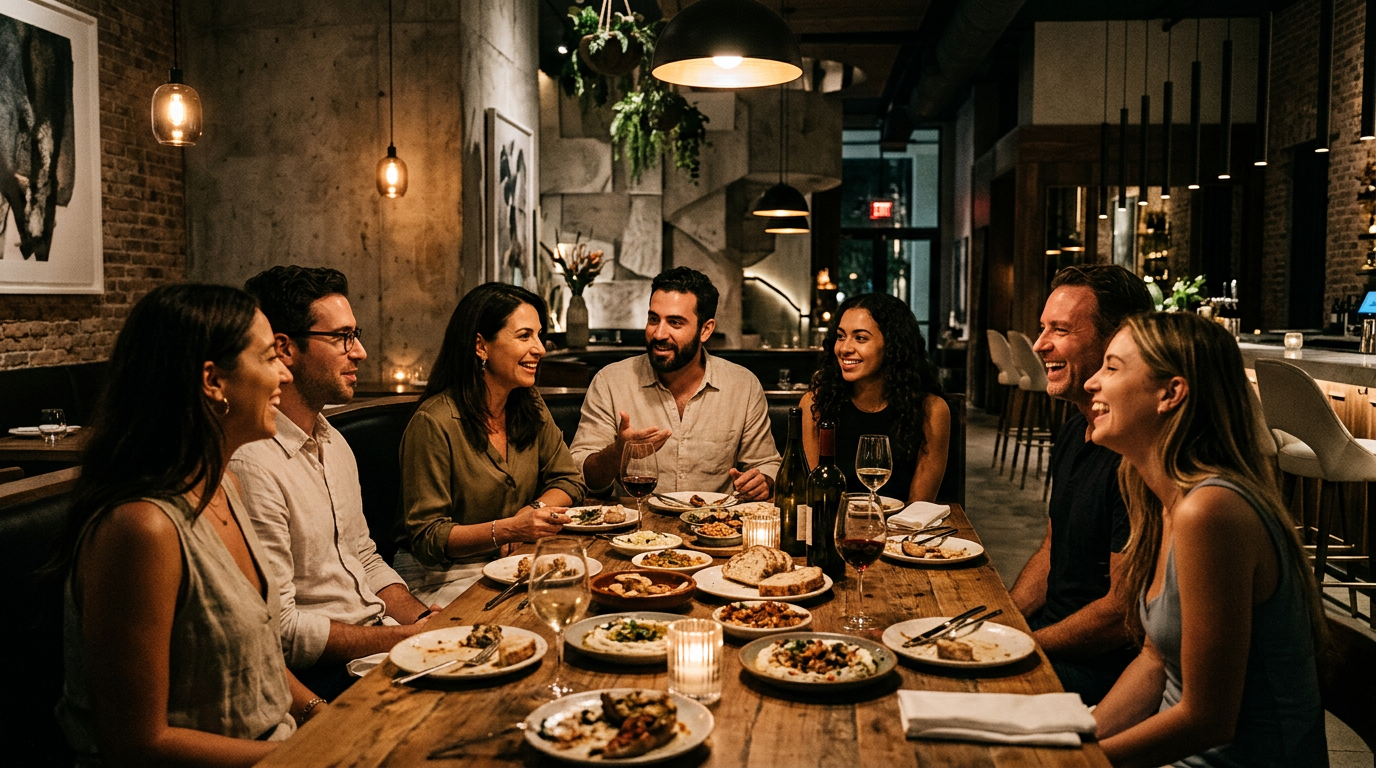
If you are choosing the restaurant, optimize for a round table, moderate noise, and food that shares well. Natural wine bars, izakaya-style rooms, modern Mediterranean spots, and omakase counters can work depending on the group. The format matters more than the cuisine.
What to order / what to look for
Order like you plan to have a conversation.
At lunch, keep it clean: fish, salad, a composed bowl, steak if the room calls for it, sparkling water, maybe one espresso. Do not order anything that requires surgery. Stone crab, whole fish, massive shellfish towers, and sauce-heavy plates are better for existing relationships than first investor meetings.
At dinner, shared plates beat individual performance. In Miami, Mediterranean, Japanese, steakhouse, and modern American formats all work because they let the table move. If someone else is hosting, follow their pace. If you are hosting, order enough to remove friction but not so much that the table becomes a spectacle.
At the bar, order one real drink or a thoughtful nonalcoholic option. Miami has no patience for fake austerity, but you also do not need to cosplay nightlife. A martini, a glass of white Burgundy, a mezcal soda, sparkling water with bitters, or espresso after dinner all read fine depending on the room.
Look for these signals:
- A bar where solo diners are normal
- Tables with laptops closed and phones face down
- Service that recognizes regulars without making a show of it
- A crowd that arrives in waves after office hours or events
- Noise level low enough for names, funds, and numbers to be heard
- People greeting staff by name
Avoid rooms where every table is filming. If the restaurant is performing for TikTok, the investors are probably not talking freely.
Best time of day to go
!Small Miami founder dinner with shared plates and quiet conversation
Miami timing is its own language.
Breakfast meetings are possible, especially in Brickell and Coconut Grove, but they are less culturally dominant than in New York or San Francisco. Use breakfast for disciplined operators, not social discovery.
Lunch from 12:15 to 2:00 is strong in Brickell, Coral Gables, and Downtown. This is when finance and legal people are easiest to meet through a warm intro. Keep it tight. A 75-minute lunch is respectable. A two-hour lunch needs a reason.
The 5:30 to 7:15 bar window is the most useful slot for founders. You catch people before dinner, before the night gets loud, and before groups become closed circles. This is when a casual hello can become a real follow-up.
Dinner in Miami starts later than many founders expect. Serious tables often sit at 8:30 or 9:00. If you are hosting investors from New York, book earlier unless they already understand Miami rhythm. If you are joining locals, do not complain about the late reservation.
Late-night can work during major weeks, but it is high variance. After 10:30, the signal-to-noise ratio drops unless you are already inside a curated group. The club-adjacent version of Miami is good for bonding, weak for diligence.
Etiquette and unwritten rules
Miami is warm, but it is not casual in the way outsiders think. People notice presentation. They also notice desperation.
Dress one notch better than the room requires. For men, that often means a good shirt, clean sneakers or loafers, no conference backpack at dinner. For women, Miami gives more range, but founder polish still matters. Looking expensive is less important than looking intentional.
Do not lead with your raise. Lead with context.
Bad opener: “I’m raising a $2 million seed round.”
Better opener: “We’re building workflow software for independent med spas. Miami has been useful because so much of the customer base is here.”
Do not interrupt a table. Ever. If someone is seated with a guest, your entire interaction should be a quick hello if you already know them. If you do not know them, leave it alone.
Respect staff. Investors watch this. In Miami, hospitality workers often know more about the room than you do. Being rude to a host, bartender, server, or valet is social self-sabotage.
Do not over-explain your move to Miami. Locals have heard every version. If you relocated, say it plainly and then talk about what you are building here.
Pay cleanly. If you invited someone, you pay. If an investor insists, accept with grace and send a thoughtful follow-up. Do not perform a five-minute credit card fight.
How to actually meet people there
The highest-yield path is not cold approaching investors in restaurants. It is using restaurants as the second touch after a lighter first touch.
Start with the calendar. Go to founder events, fintech meetups, AI gatherings, coworking happy hours at Industrious, Spaces, or WeWork locations, and smaller dinners connected to AngelList, Lunchclub, On Deck alumni, or South Park Commons networks when they surface in Miami. Meet five people. Pick two worth continuing.
Then move the relationship to a restaurant.
Use simple invites:
- “I liked your point about Latin America distribution. Want to grab a quick drink in Brickell next week?”
- “I’m pulling together four founders working around healthcare and payments. Small dinner, no panel. Want in?”
- “You mentioned family offices are looking at boring infrastructure again. I’d love to compare notes over lunch.”
- “I’m meeting a couple of operators after the event near the Design District. Come by for one drink if your night stays loose.”
At the restaurant, make it easy for people to place you. Your one-line description should include customer, problem, and traction signal.
Example: “We help multi-location med spas handle intake and payments. We’re live with 18 locations in Florida and Texas.”
Then stop. Let them ask.
The best founder dinner format in Miami is six people: two founders, one investor, one operator with customer insight, one connector, and one wildcard who makes the table less stiff. Eight can work. Ten becomes a banquet. Four can feel too intense unless everyone already knows each other.
Use weak ties on purpose. Granovetter’s point still holds: your next useful investor is often not your closest friend but the person one ring out who knows a different pool of capital. In Miami, that might be a real estate lawyer, a hospitality group operator, a family office analyst, or a founder who sold into Latin America.
Follow-up within 24 hours, before the night becomes a blur.
Send:
- One sentence recalling the conversation
- One useful link or intro if promised
- One specific next step
Example: “Good meeting you at COTE last night. Your point about clinics buying through consultants was sharp. I’ll send the two Florida operator intros tomorrow; if useful, I’d also like to show you our 12-month retention cohort next week.”
That is better than “Great connecting.” Everyone sends that. Nobody remembers it.
Mistakes to avoid
Do not treat Miami like a conference floor. Restaurants are social environments first. If your body language says you are scanning for capital, people will feel it.
Do not chase only celebrity rooms. A high-profile reservation can help with hosting, but it will not compensate for a weak company or awkward manners. Many useful checks in Miami are written after quiet lunches, not flashbulb dinners.
Do not confuse nightlife proximity with investor access. Being near wealthy people is not the same as being trusted by them.
Do not bring a deck to dinner unless someone asked. Have it ready on your phone or send it later. At the table, tell the story.
Do not split attention. If you are hosting, host. Introduce people properly. Manage ordering. Notice who is left out. Keep the conversation moving without turning it into a pitch circle.
Do not make every conversation about fundraising. Ask investors what they are seeing. Ask operators what customers are buying. Ask founders what has changed in hiring, CAC, or regulation. The best capital conversations often start sideways.
Do not skip the second touch. Miami is full of warm first meetings that never become anything. The founder who sends the clean follow-up, makes the useful intro, and shows up again next week usually beats the founder with the louder dinner.
A practical three-week plan
Week one: pick one neighborhood lane. Brickell for finance and fintech. Design District or Wynwood for founders and venture. Coral Gables or Coconut Grove for quieter capital. Go to two events and one early bar seating. Do not ask for money. Map the room.
Week two: invite three people from week one to separate coffees, drinks, or one small dinner. Choose restaurants where conversation is easy. Your goal is to learn who actually writes checks, who advises funds, and who simply likes being near the scene.
Week three: host one six-person dinner with a reason. Not “networking.” A reason. AI in healthcare ops. Cross-border payments. Consumer brands selling into Florida and Latin America. Real estate tech after the insurance shock. Miami people show up for a point of view.
After the dinner, send every person one tailored follow-up. Introduce two of them to each other if it is genuinely useful. Invite one investor into a formal meeting only after there is interest.
The restaurant did its job if you leave with context, trust, and a next conversation. Not if you leave with a stack of business cards.
Miami capital moves through rooms, but it does not reward room-chasing. Pick the right table. Behave like someone who will be here next season. Then make the follow-up sharper than the outfit.
Discussion (0)
Loading comments…