
Nashville founder dinners beyond the obvious circuit
The good Nashville founder dinner usually starts somewhere you can hear the person across the table without performing for a room full of tourists. Not a Broadway rooftop. Not a hotel lobby where everyone is half-networking, half-checking who just walked in. More often, it is a six-top in Germantown, a quiet corner in East Nashville, a private room with low light and real service, or a bar seat before a reservation where two people who should know each other finally get introduced.
Nashville’s startup scene is not trying to be San Francisco with pedal taverns. The serious local energy sits at the overlap of healthcare, music rights, creator businesses, hospitality, real estate, logistics, consumer brands, and a growing group of remote operators who moved here after 2020 and decided to stay. People are friendly, but not naive. The city rewards warm intros, reputation, consistency, and not acting like you discovered it last Tuesday.
For founder dinners, the room matters. So does the guest mix. So does whether you can exit the night with three clean follow-ups instead of twelve vague “we should connect” promises.
The Nashville dinner room that actually works
A founder dinner in Nashville should feel intentional without feeling like a demo day got trapped in a restaurant. The right room does three jobs:
- It keeps the table small enough for one conversation.
- It gives guests a reason to linger without forcing a three-hour tasting menu.
- It signals taste without begging for attention.
For most dinners, six to eight people is the sweet spot. Ten is possible if you have a private room or a host who can direct the room. Twelve is where the table breaks into factions and someone spends the night talking only to the person they already knew.
Nashville also has a specific rhythm. Dinner at 6:30 can feel early, but it works here, especially on weeknights. People have school pickup, studio sessions, investor calls across time zones, and early flights to New York, Austin, or Miami. The local move is to book early, let the dinner breathe, and send people home before the night turns into a bar crawl.
The rooms that work best tend to be:
- Chef-owned neighborhood restaurants with shareable plates.
- Germantown dining rooms where business dinners do not feel stiff.
- East Nashville restaurants with good service and less corporate energy.
- Natural wine bars or small-plate spots where ordering can be communal.
- A private dining room at a serious restaurant, if the group is senior enough.
- A quiet izakaya-style or omakase counter only when the group is small and already somewhat warm.
The point is not obscurity. It is fit.
Places and venue types I would actually consider
!Founder dinner table set with shared plates in a Nashville restaurant
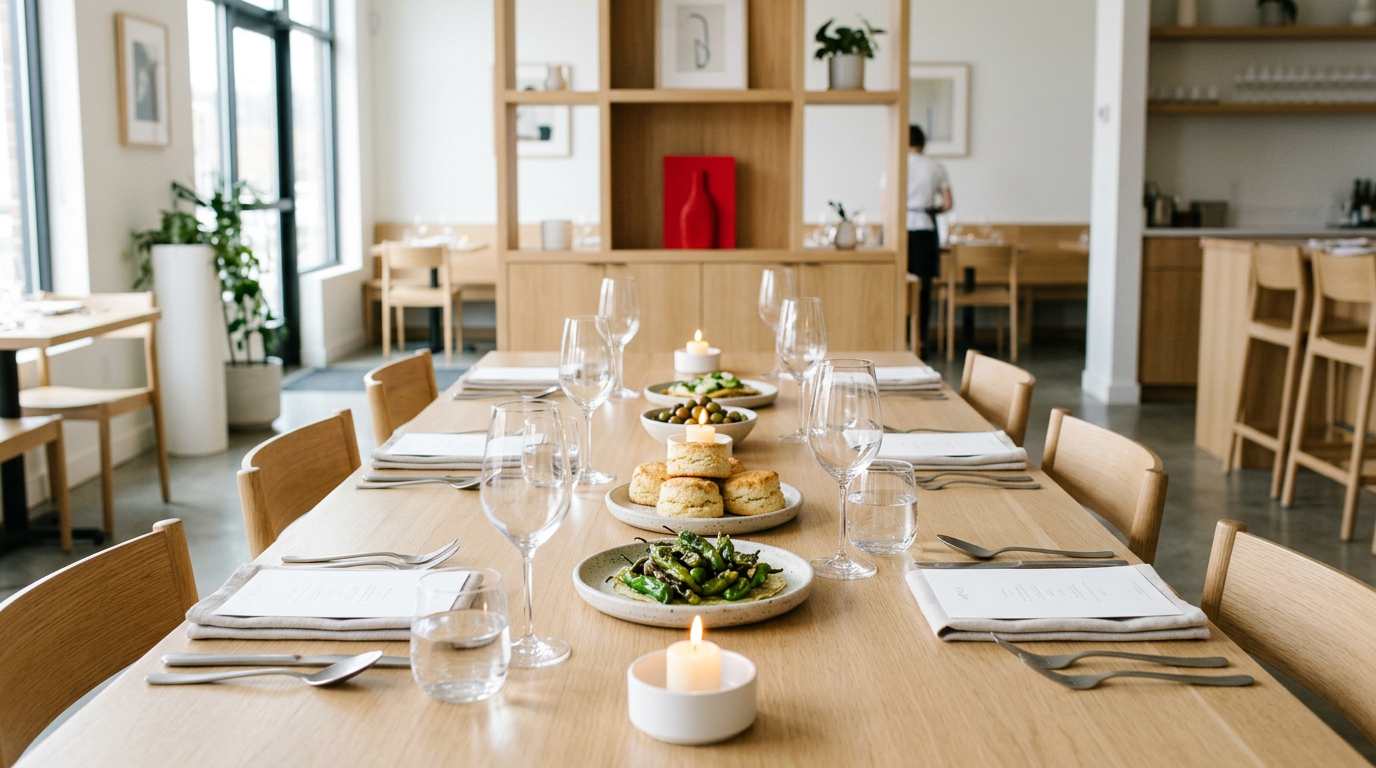
Start with Germantown when the guest list includes investors, healthcare operators, visiting founders, or people coming from different parts of the city. It is central enough, polished enough, and not as scene-heavy as the obvious hotel circuit.
Rolf and Daughters remains one of the better Nashville rooms for a founder dinner that wants taste without formality. The food is shareable, the room has energy, and the neighborhood works for people coming from downtown, East Nashville, or the west side. It is not a secret, but it is still more useful than another loud rooftop.
City House is another strong Germantown choice when you want the dinner to feel local and relaxed. It is especially good for mixed groups: one investor, one healthcare founder, one music-tech operator, one consumer brand builder, and a couple of high-agency locals. Pizza and shared dishes make the table less precious.
Henrietta Red works when you want seafood, oysters, lighter ordering, and a room that feels adult without sliding into steakhouse theater. It is good for earlier dinners and for groups where half the table may continue somewhere else after.
East Nashville is better when the guest list leans creative, product-minded, hospitality-aware, or founder-operator rather than banker-heavy. Margot Café & Bar has the kind of neighborhood credibility that says you know Nashville past the obvious map. Lockeland Table is strong for a warm, relationship-first dinner, especially when the group includes locals who value neighborhood restaurants over flash. Lyra gives you a different flavor profile and a more interesting shared-table setup than the standard American small-plate script. Folk can work for a tighter group that wants seasonal food, wine, and a little more edge without making dinner feel performative.
Wedgewood-Houston is useful for a slightly younger operator crowd, creative founders, brand people, and anyone connected to design, media, or the city’s studio-adjacent work. Bastion can be excellent, but be honest about the format. A highly structured tasting-menu experience is better for four people who already have trust than for eight strangers who need to talk.
For larger groups, stop hunting for the “coolest” room and ask about private dining at a good neighborhood restaurant. A closed door and a dedicated server often beat the better-known restaurant with a bad table.
What to order / what to look for
Founder dinners die when ordering becomes a second meeting. The host should make it easy.
Look for menus with:
- Shared starters that arrive quickly.
- Two or three larger dishes that can anchor the table.
- Vegetarian options that are not an afterthought.
- A wine list with by-the-bottle range, not just trophy bottles.
- Good zero-proof options, because plenty of serious operators are drinking less in 2026.
- Enough table space for plates, water, and the occasional phone check without chaos.
The best host move is to pre-order a few starters if the restaurant allows it. Not the whole meal. Just enough to remove the awkward first 15 minutes where everyone is hungry and pretending not to be.
At a place like Rolf and Daughters, City House, Lyra, Margot, or Folk, order for the table and keep it flexible. Ask about two bottles in a reasonable range instead of making a show of the wine list. If someone is sober, do not make it a table topic. Just make sure they have something good in front of them.
Avoid foods that make conversation harder: giant bone-in mains for everyone, messy individual dishes, and anything requiring a long explanation from the host. This is not the night to prove you read the whole menu online.
For a first-time founder dinner, I prefer a shared-table format over omakase. Omakase can be great for two or three founders who already know each other, but it tends to orient everyone toward the counter instead of the conversation. Same with a supper club format: useful if the host is skilled, risky if the guest mix needs steering.
Best time of day to go
!Small groups talking outside a Germantown restaurant at night
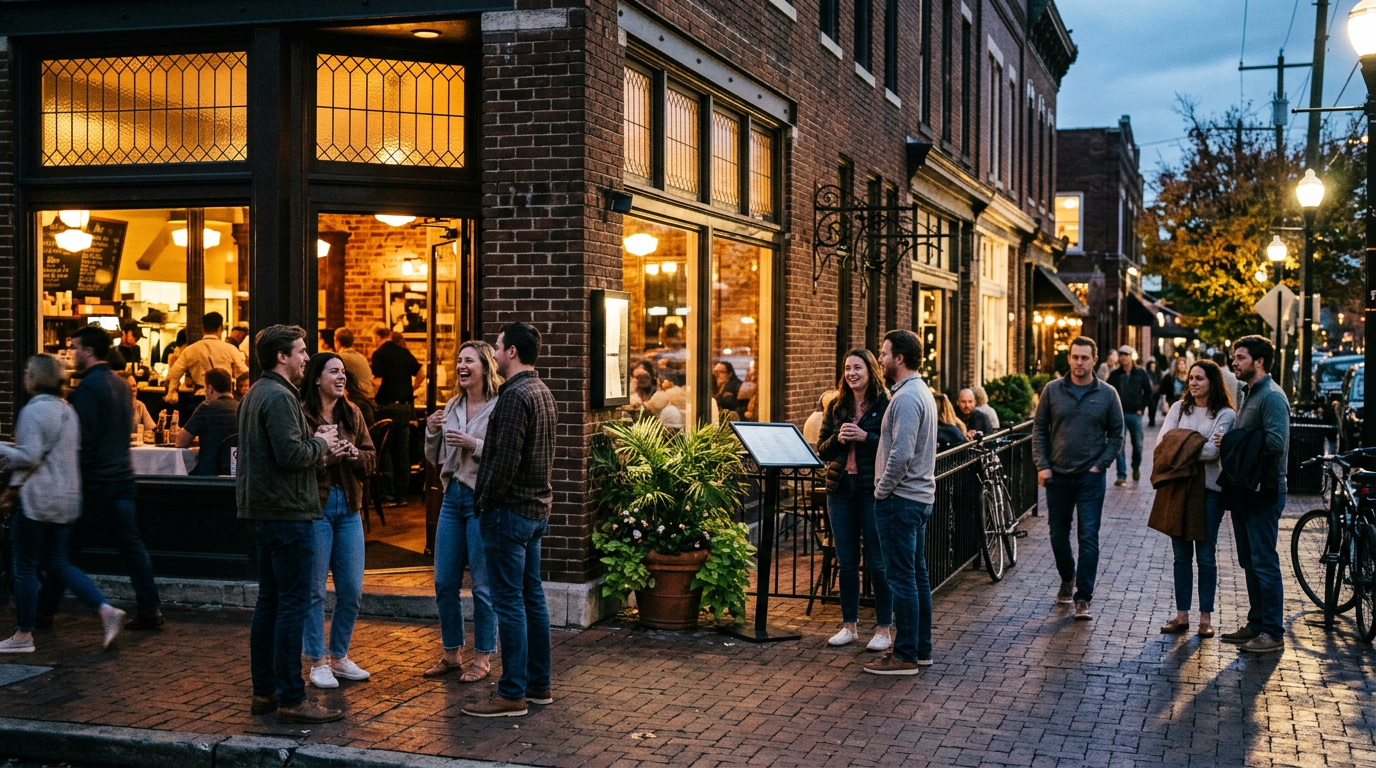
Tuesday and Wednesday are the strongest founder-dinner nights in Nashville. Restaurants are more manageable, locals are available, and you avoid the weekend visitor wave. Thursday works if you want a little more social energy, but it also raises the odds that people arrive late, overbook, or peel off to another event.
Book 6:15 or 6:30 for a dinner that includes senior people. Book 7:00 if the group is mostly founders and operators without family logistics. Anything later than 7:30 starts to feel like a social night, which can be fine, but it changes the room.
The pre-dinner drink matters more than people admit. Have the host arrive 20 minutes early and take the first bar conversation seriously. That is where the best weak-tie work happens: the investor meets the healthcare operator before the table forms, the creator founder finds the payments person, the newcomer gets one local anchor. Granovetter’s weak ties idea is not academic trivia here. Nashville runs on second-degree trust.
Do not schedule a founder dinner after a massive conference happy hour unless the goal is purely casual. Tired people perform. Fed, calm people connect.
Etiquette and unwritten rules
Nashville is warm, but it is not loose. People remember who talks over the table, who only speaks to the highest-status guest, and who treats local relationships as a growth hack.
A few rules hold:
- Do not open with a fundraising pitch.
- Do not call Nashville “the next Austin.” People have heard it and do not need it.
- Do not name-drop country artists, venture funds, or private clubs as social currency.
- Do not assume everyone is in music, healthcare, or real estate just because those industries are visible.
- Do not ask invasive questions about where someone lives or what they paid for a house.
- Do not split the check into accounting homework unless the group agreed in advance.
If you are hosting, pay or set expectations clearly before the dinner. “I’ve got dinner tonight” is clean. “We’ll split evenly” is also clean if said ahead of time. What is not clean is letting eight people negotiate Venmo at the table while the server waits.
Dress depends on the room, but Nashville founder dinner attire has settled into polished casual: good denim, clean sneakers or boots, a jacket if the place calls for it, no costume cowboy energy unless that is genuinely you. The city can smell cosplay.
And be kind to the staff. Obvious, but not optional. A founder who is rude to a server in Nashville is telling the whole table how they operate under mild stress.
How to actually meet people there
A restaurant is not a networking platform. The host has to design the connections.
Before the dinner, send a short guest note. Not a long bio deck. Something like:
- “Six people around healthcare ops, creator tools, and local capital.”
- “No pitches tonight. Good questions, useful intros, dinner on me.”
- “If there is one person you want to meet in Nashville this quarter, bring the name.”
At the table, do not run formal introductions that sound like LinkedIn summaries. Use prompts that reveal useful context:
- “What are you building that people here might not know about yet?”
- “What part of Nashville has been surprisingly useful for your work?”
- “What is one intro that would actually move the needle this month?”
- “What are you seeing in your corner that most people are misreading?”
- “Who in town deserves more attention than they get?”
The host should seat deliberately. Put the loudest person next to someone grounded, not across from another loud person. Put the investor beside an operator they would not meet at a standard pitch event. Keep co-founders apart unless they are new to the group and need support.
The best follow-up happens within 24 hours. Send one message per connection, not a giant group recap. Example:
- “Good meeting you at dinner last night. Your point about revenue-cycle pain in specialty clinics stuck with me. I know one founder working on that from the provider side. Want me to connect you both?”
Specificity beats speed, but speed helps.
Mistakes to avoid
The most common mistake is picking a restaurant because it photographs well. Founder dinners are not content shoots. If the room is too loud, too cramped, too sceney, or too rigid, the table will underperform no matter how good the food is.
Other mistakes:
- Inviting too many people “just in case.” Scarcity makes the room better.
- Mixing strangers without a clear reason they should meet.
- Booking a tasting menu for people who need to talk across disciplines.
- Letting one person dominate the first 30 minutes.
- Seating all locals on one side and newcomers on the other.
- Choosing a weekend night when service and traffic are less predictable.
- Turning the dinner into a pitch practice session.
- Failing to make one concrete intro after the meal.
Be careful with status stacking. If you invite three investors and five founders, the founders may perform instead of connect. A better table often has one investor, three operators, one domain expert, one local connector, and one wildcard with strong taste.
Also avoid the Broadway-adjacent trap unless your guest specifically wants that version of Nashville. For serious dinners, downtown hotel restaurants and rooftop bars can work for convenience, but they rarely create the kind of trust that turns into real collaboration.
A practical host playbook for Nashville
For six people, I would book a Tuesday 6:30 dinner in Germantown or East Nashville, arrive early, pre-order starters, and tell the server the table is there to talk, not rush. I would keep the guest mix tight: one person from healthcare or music rights, one founder building software or services, one capital allocator, one creator-economy operator, one hospitality or brand person, and one trusted local who knows the city’s real texture.
For eight to ten people, I would ask for a private or semi-private setup and simplify the menu. Family-style if possible. Two hours. Maybe a nearby second location for anyone who wants to continue, but do not make it mandatory.
For four people, I would consider a more intimate room, bar seating before dinner, or even a tasting-menu spot if the relationships are already warm. That is where places with more structure can shine.
The Nashville move is not to chase exclusivity. It is to create a room where people feel vouched for. If you do that well, the restaurant becomes the container, not the point. The point is leaving with two real conversations, one useful intro, and enough trust to meet again without needing another event as cover.
Discussion (0)
Loading comments…