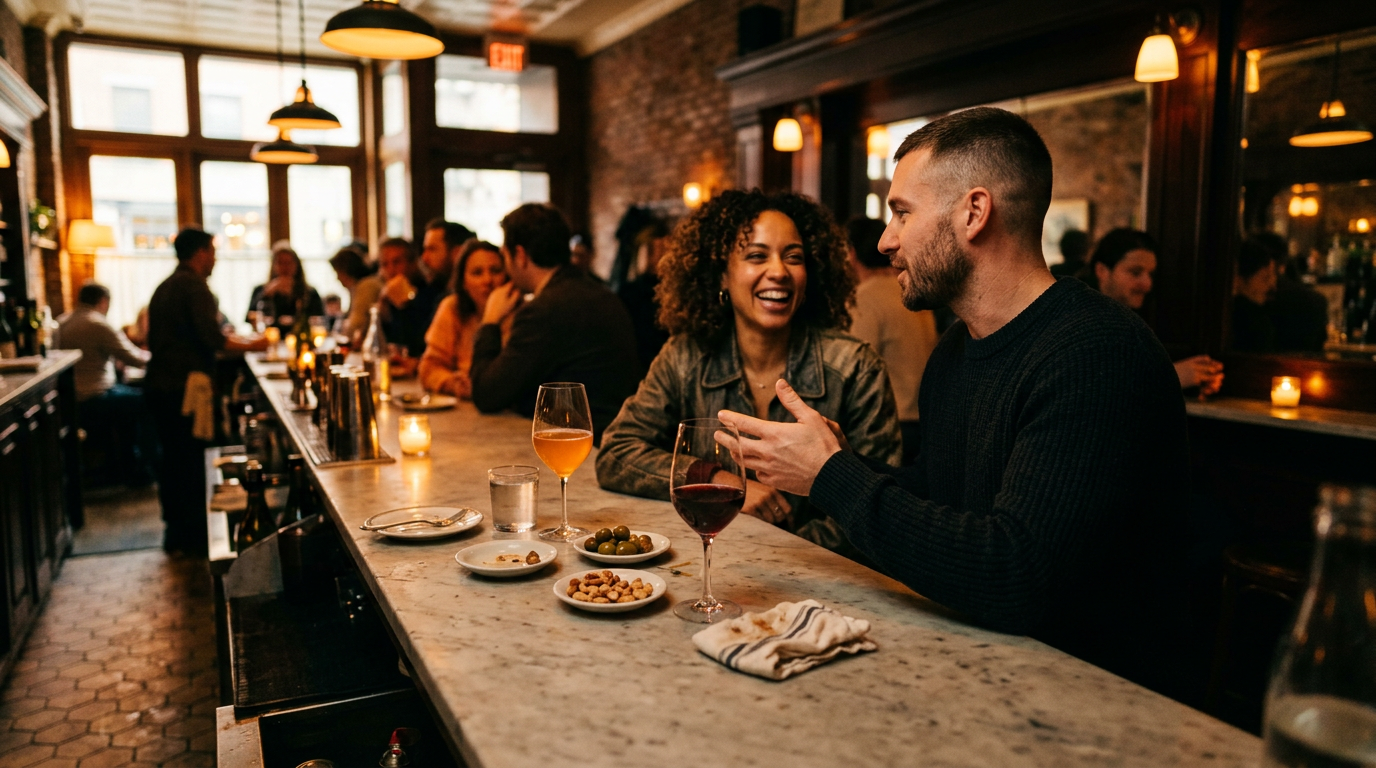
Networking at New York natural wine bars without the cringe
A Tuesday at 6:40 p.m. in the East Village is not a networking event. It just happens to be full of people who build apps, run small studios, book pop-ups, write checks, hire freelancers, and know which group chat has the thing you need next week.
That is the New York natural wine bar opportunity. Not the wine, exactly. The room.
Natural wine bars in New York have become one of the city’s better offline rooms for weak-tie networking: loose, repeat exposure to people outside your normal work circle. That matters in 2026 because everyone is tired of performative LinkedIn posts, over-programmed founder breakfasts, and coworking mixers with laminated name tags. The better introductions now happen in side conversations, at the bar, after a friend says, “You two should talk.”
But the line is thin. Done well, you become a normal person in a good room. Done badly, you are the guy turning someone’s orange wine into a cold outbound funnel.
Pick the right kind of room
Not every wine bar is built for meeting people. Some are date rooms. Some are restaurant rooms. Some are industry rooms where everyone knows each other and nobody wants a stranger opening with a pitch.
For networking, you want a bar with a few specific traits:
- A real bar counter, not only two-tops
- Staff who can talk without performing a 12-minute tasting lecture
- A crowd that includes regulars, not just reservation-chasers
- Enough noise for privacy, not so much that every sentence becomes shouting
- A menu that allows one glass and one small plate without making you feel like you are occupying a full dinner table
In Manhattan, that often means downtown: East Village, Lower East Side, Chinatown edge, Nolita, parts of the West Village on the right night. The Ten Bells has long been part of the natural wine conversation on the Lower East Side. Ruffian in the East Village is more intimate and food-serious. Parcelle has a polished wine-world crowd. In Brooklyn, Williamsburg, Greenpoint, Fort Greene, and Clinton Hill can be stronger if your world is design, media, restaurants, music, brands, or early-stage startups. The Four Horsemen is famous for a reason, though it is more of a serious dining room than a casual “float in and network” room.
The better move: think by type, not trophy venue. A neighborhood natural wine bar with a bar counter and regulars will beat the place everyone on TikTok saved last month.
What to order / what to look for
!Bartender pouring orange wine at a crowded New York wine bar
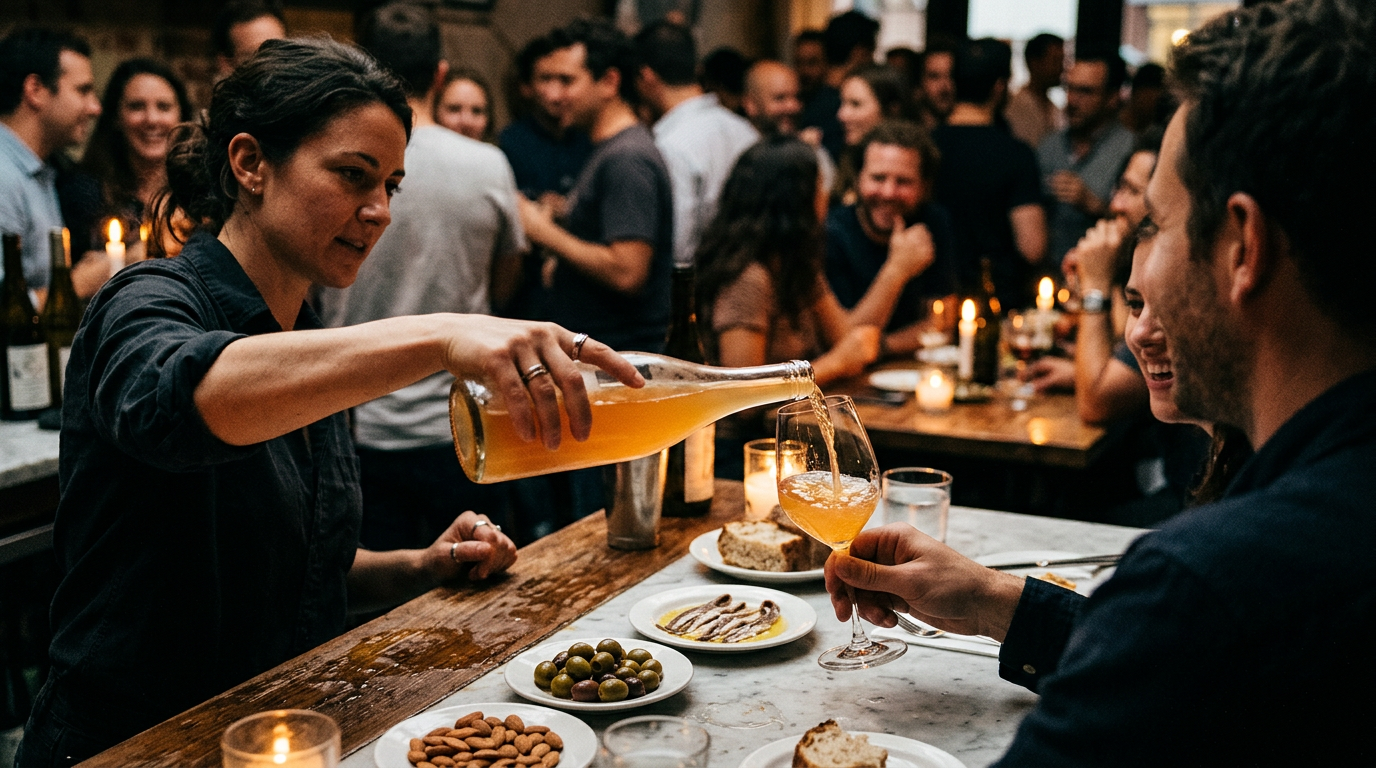
Order like someone who plans to be present, not like someone auditioning for a sommelier job.
Good first orders:
- A glass of sparkling or skin-contact white if you want something easy to hold and not too heavy
- A lighter red if you are staying for more than one conversation
- A vermouth, cider, or lower-ABV option if you want to keep your head clear
- One small plate that can sit on the bar without becoming a full production
Ask the bartender one useful question: “What’s drinking well by the glass tonight that is not too funky?” That signals curiosity without making the staff unpack their entire cellar.
What to look for in the room:
- Solo people seated at the bar, not buried in a laptop
- Two-person groups with open body language, angled outward rather than locked in
- Friends greeting friends near the entrance
- Regulars who know staff but are not monopolizing them
- A bar seat near the service path, where short exchanges happen naturally
Avoid posting up with your phone flat on the bar and your AirPods in. That says “do not talk to me.” Also avoid hovering behind groups waiting for an opening. New Yorkers can feel that from ten feet away.
If you do not know wine, that is fine. You do not need to fake fluency about Jura, volcanic soil, or carbonic maceration. A natural wine bar rewards taste and curiosity more than vocabulary. “I usually like bright, dry, not sweet” is better than pretending you can identify a Loire producer from across the room.
Best time of day to go
The best networking window is usually early evening on a weekday, before the room turns into dates and birthdays.
Useful windows:
- Tuesday through Thursday, 5:30 to 7:30 p.m.
- Sunday late afternoon if the bar has neighborhood regulars
- The first hour of a pop-up, tasting, or winemaker night
- After a nearby panel, gallery opening, book event, Meetup, or founder dinner
Weak windows:
- Friday after 8 p.m., when everyone is either on a date or decompressing
- Saturday prime time, unless you already know people there
- Any night where the place is slammed and staff are in survival mode
- The last hour before close, when nobody wants a fresh introduction
New York rewards repeat presence more than grand entrances. Pick two or three bars that fit your orbit and return at the same time every other week. You do not need to become “a regular” in the sitcom sense. You just want enough ambient familiarity that staff recognize your face and the room stops feeling random.
The city’s useful rooms run on pattern recognition. If people have seen you before and you behaved well, the second conversation is easier.
Etiquette and unwritten rules
!People talking outside a Brooklyn wine bar at dusk

The core rule: do not make the bar responsible for your ambition.
Natural wine bars are social rooms, not coworking spaces with better lighting. People are there to relax, flirt, catch up, eat, complain about clients, talk about a film, avoid Slack, and maybe meet someone interesting. Your job is to fit into that energy before you try to get anything from it.
Unwritten rules that matter in New York:
- Do not open with “What do you do?” It feels like sorting.
- Do not pitch in the first five minutes. Ever.
- Do not interrupt staff banter to ask for an introduction.
- Do not treat the bartender like your personal concierge.
- Do not ask someone’s follower count, funding status, or employer before you have earned normal rapport.
- Do not make wine knowledge a dominance game.
- Do not camp at a four-top alone with one glass.
- Tip properly, especially if you are asking questions or staying awhile.
Better openings are observational and low-pressure:
- “That bottle looked interesting. Did you like it?”
- “I’m trying to find something bright and not too weird. What did you get?”
- “Is this usually a neighborhood crowd or did I walk into an industry night?”
- “I’ve been looking for more early-evening rooms that aren’t formal networking events. This one seems close.”
- “Are you here for the pop-up, or is this your regular spot?”
Then stop talking. Let the other person choose whether the door opens.
The best New York conversationalists give people exits. “Anyway, I won’t interrupt your night” is powerful because it proves you are not cornering them. Oddly, that often keeps the conversation going.
How to actually meet people there
Networking at a wine bar works through adjacency, not extraction.
Start with the staff, but lightly. Learn names if the interaction is natural. Ask one specific question. Be easy. If the bar is busy, do not force conversation. Staff are often the social map of the room, but they only connect people who are not going to embarrass them.
A good first-night goal is not “meet five investors.” It is:
- Have one decent conversation
- Learn one upcoming event or room
- Leave one person with a clean reason to remember you
- Become someone the staff would not mind seeing again
If you are attending a tasting, pop-up, or winemaker night, you have built-in context. Use it. Ask what brought someone there. Ask if they follow that importer, chef, or restaurant group. Ask what other events they actually like. These questions lead to the city’s offline calendar: small supper clubs, gallery openings, On Deck alumni dinners, AngelList-adjacent founder drinks, South Park Commons gatherings, niche Meetup groups, and friend-of-friend tables that never make public event listings.
When work comes up, keep your self-description short:
- “I run ops for a small consumer startup.”
- “I’m a freelance brand strategist, mostly food and wellness clients.”
- “I build internal tools for early-stage teams.”
- “I’m between projects and looking at climate software roles.”
Then ask something better than “What about you?” Try:
- “What kind of work has your attention right now?”
- “Are you in build mode or client mode this month?”
- “What are people in your corner of the city talking about that is not obvious online?”
That last one is useful because New York is full of people with local intelligence: which coworking floor has the serious operators, which member’s club is all scene and no substance, which founder dinner is worth skipping, which gallery crowd overlaps with brand money, which natural wine bar has the chefs on Mondays.
If the conversation clicks, make the follow-up specific before you leave:
- “You mentioned looking for a product-minded designer. I know two. Want me to send names tomorrow?”
- “That event in Greenpoint sounds aligned. If you forward it, I’ll take a look.”
- “I’m at NeueHouse some mornings and Industrious near Union Square some afternoons. If you ever want a 25-minute coffee, easy.”
- “I’ll send you that piece we talked about. No need to reply tonight.”
Do not collect contacts like receipts. One real follow-up beats six dead Instagram exchanges.
The NYC natural wine networking map
Think of New York as overlapping circuits, not one scene.
Downtown Manhattan is good for media, fashion-adjacent tech, restaurants, design, art, venture people who do not dress like venture people, and freelancers who know everyone. The energy can be sharp. People are open, but allergic to neediness.
North Brooklyn is stronger for creative operators, founders with taste, music and nightlife people, independent food businesses, product designers, writers, and brand teams. Conversations may start softer and become more useful later.
Fort Greene, Clinton Hill, and Bed-Stuy edges tend to reward neighborhood consistency. If you live nearby, this is where repeat visits pay off.
West Village and Tribeca can have money in the room, but the social barrier is higher. Better if you arrive through a friend or after a private dinner.
Midtown and Flatiron are less natural-wine-core but useful when you bridge from coworking. A day pass at WeWork, Spaces, Industrious, or a dedicated desk near Union Square can turn into early drinks downtown if you invite one person, not twelve.
The move is not “go where rich people drink.” The move is “go where your kind of weak ties already spend time.” A freelance photographer and a seed-stage AI founder do not need the same room. A CPG operator should care about chefs, buyers, designers, and neighborhood regulars. A B2B SaaS founder may get more from a small founder dinner, then a post-dinner glass at a nearby bar.
Follow-up that does not feel transactional
Send the follow-up by noon the next day. Not immediately at 11:48 p.m. from the bar. Not three weeks later with “circling back.”
Good follow-ups are short and tied to the conversation:
- “Good meeting you at Ruffian last night. Here’s the studio I mentioned. The founder is thoughtful and not spammy.”
- “You asked about small founder rooms downtown. I’ll send two when I confirm they’re still active.”
- “That importer conversation was useful. If you want to compare notes on food-brand events, I’m around Tuesday afternoon.”
If you promised an intro, ask permission on both sides. New York people remember clean operators.
If you connected on Instagram, do not immediately like 19 posts. Reply to one relevant story later with something normal. If you exchanged numbers, do not add them to a newsletter, investor update, WhatsApp group, or event blast without consent.
The win is becoming part of someone’s mental map: “smart, normal, useful, good taste, not weird.” That is the whole game.
Mistakes to avoid
The most common mistake is treating a natural wine bar like a startup conference without badges.
Avoid these:
- Opening with your company before you have had a human exchange
- Asking “Are there investors here?” within earshot of anyone
- Turning every wine comment into proof that you know more
- Sitting at the bar with a laptop open during social hours
- Cornering someone who is clearly on a date
- Asking staff to introduce you to “interesting people”
- Going to the most hyped room once, deciding it is cliquey, and quitting
- Getting sloppy because the wine feels lighter than cocktails
- Mistaking proximity to cool people for an actual relationship
Also avoid the fake-casual pitch. New Yorkers can hear it immediately. “I’m just curious, who handles your growth stack?” is not casual. It is a sales motion wearing a linen jacket.
If you want business, earn context first. If you want friends, behave like a friend of the room. If you want access, become someone who adds signal.
A simple night plan
Here is the clean version.
Choose a weekday. Arrive around 6 p.m. Sit at the bar if there is space. Order one glass and one small plate. Ask the bartender one useful question, then let them work. Put your phone away.
Have one low-pressure exchange with someone near you. If it opens, continue. If not, let it go. Mention your work only when it naturally fits, and keep it to one sentence. Ask what they are paying attention to in the city. Listen for events, rooms, people, and problems.
If there is a real reason to stay connected, name it before the night ends. Send the follow-up the next morning. Return another week without expecting the same outcome.
That is how New York works at its best: repeated presence, useful restraint, and the occasional conversation that changes your month because you were in the right room and did not act like you owned it.
Discussion (0)
Loading comments…