New York’s natural wine bar networking code
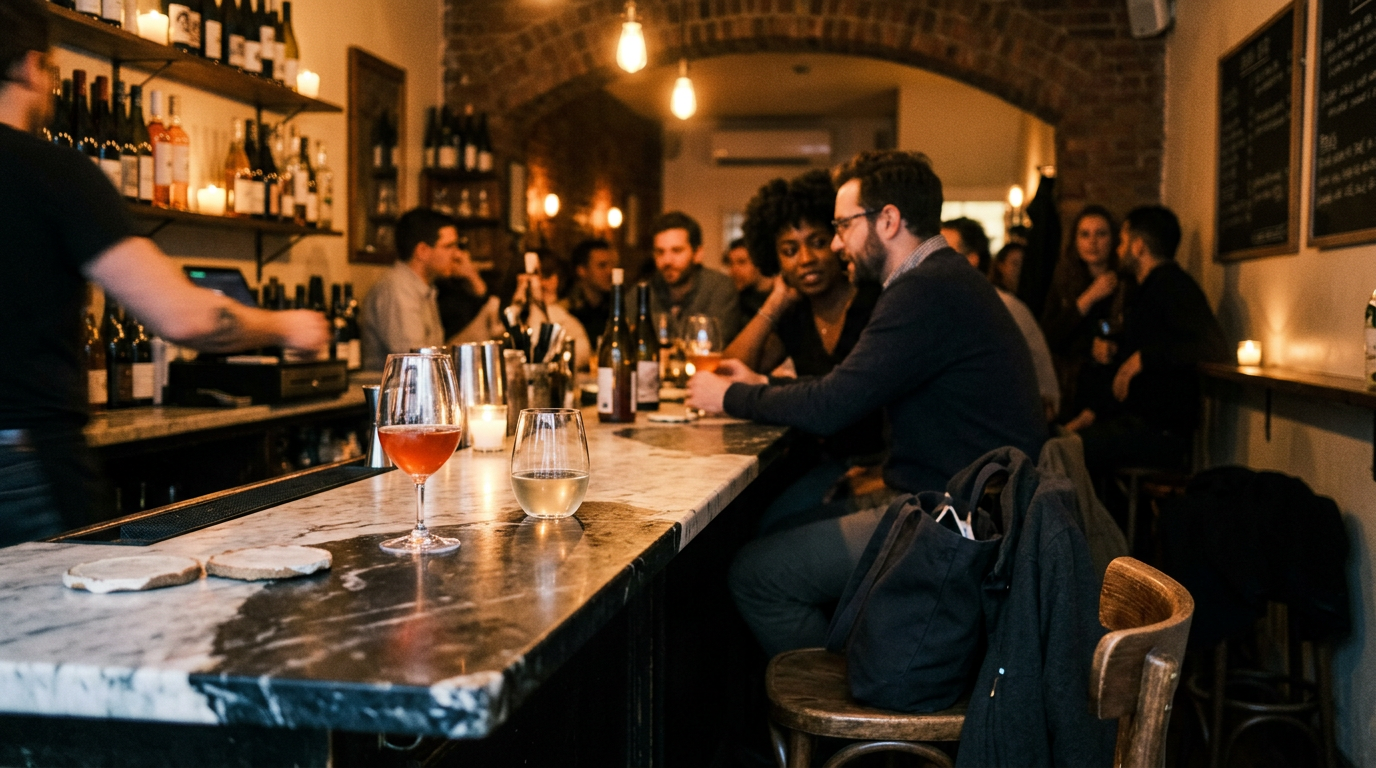
At 6:17 on a Thursday in the East Village, the bar is still half-empty, the bartender is opening something cloudy from the Loire, and two people at the corner are comparing notes on a seed round that did not close. This is the window. Not 9:45, when the room is shoulder-to-shoulder and everyone is performing. Not midnight, when nobody remembers your name. Early evening is when New York’s natural wine bars still function as rooms where work and social life can overlap without feeling like a conference badge got lost on Avenue A.
Natural wine bars in New York are useful because they sit between scenes. Founders, designers, chefs, writers, climate people, agency operators, venture scouts, architects, and off-duty hospitality workers all end up in the same room. The wine is not the point. The wine is the excuse.
The trick is not to “network” in the obvious way. That word makes New Yorkers brace for a pitch. The better version is lighter: become a regular enough presence, ask better questions, don’t trap anyone, and leave with one or two real follow-ups instead of six dead Instagram handles.
The room you want is not the loudest one
New York has plenty of natural wine bars where the room is more useful than the reservation list. The right room for meeting people has a few tells:
- A real bar, not only two-tops and date-night seating
- Staff who can talk through bottles without turning it into a lecture
- A by-the-glass list that changes often enough to create conversation
- A crowd that includes locals, not only people who booked from a saved TikTok folder
- Enough light and space at 5:30 or 6:00 to stand without looking stranded
The Lower East Side and East Village are strong for crossover energy: media, food, fashion, early-stage tech, nightlife-adjacent operators. The Ten Bells has long been part of that conversation. Ruffian in the East Village is tiny, serious, and better for one or two sharp interactions than broad mingling. In Brooklyn, Williamsburg still has founder and creative density, with The Four Horsemen operating at the polished end of the spectrum. June in Cobble Hill and Rhodora in Fort Greene pull a slightly more neighborhood-driven crowd: good for repeat visits, less good if you want instant velocity.
Do not treat these places like coworking lounges with better glassware. A natural wine bar is not WeWork, Industrious, Spaces, NeueHouse, or Soho House. You are in someone else’s hospitality space. The operator’s job is to run a room, not host your founder dinner for free.
What to order / what to look for
!Bartender pouring natural wine at a narrow New York bar
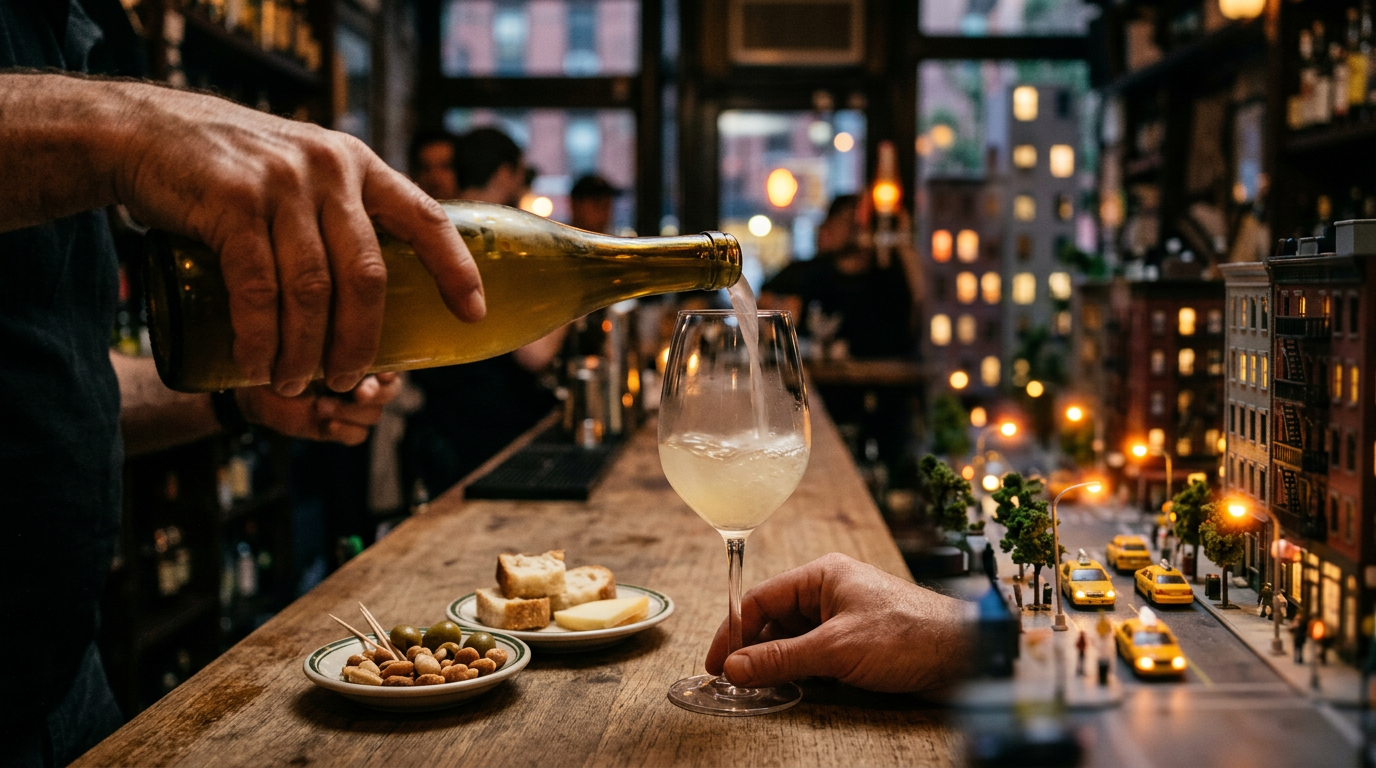
Order in a way that signals curiosity without making the bartender your unpaid sommelier for fifteen minutes.
Good first lines:
- “I’m in the mood for something bright and not too funky. What’s drinking well by the glass?”
- “Anything open that you’re excited about tonight?”
- “I usually like Loire whites and lighter reds. Where would you steer me?”
- “I’m having one glass before dinner, so I’d rather get something interesting than safe.”
Bad first lines:
- “What’s your weirdest wine?”
- “Do you have orange wine?” with no other context
- “I don’t like natural wine, convince me”
- “What’s the cheapest thing?” if you are saying it loudly enough for the room to hear
You do not need to flex. In New York, flexing reads as insecurity. Ask for a single-origin pour-over at a third-wave coffee bar if you want to talk extraction. At a natural wine bar, you can be precise but relaxed. Say you like high-acid whites, chillable reds, skin-contact whites, or something clean with texture. If you do not know, say that. Competence is attractive. Fake expertise is not.
Look for bar seats with diagonal access. The worst seat is a trapped middle position between two couples. The best is one end of the bar, where you can talk to staff, watch the room, and enter conversations without leaning over someone’s plate.
If the food menu is serious, order something. Not a whole dinner if you are moving later, but enough to participate in the place as intended. Tinned fish, olives, bread, a small plate, whatever fits the bar. You are not renting oxygen with one glass for two hours.
Best time of day to go
For networking, timing beats venue hunting.
The most useful windows in New York:
- Tuesday through Thursday, 5:30 to 7:30 p.m.
- Sunday late afternoon in neighborhood spots
- The first hour after a nearby gallery opening, panel, book event, or industry meetup
- Early seatings before people split to dinner, shows, or parties
Friday and Saturday nights are worse for professional serendipity. People are on dates, with friends, or guarding their tiny patch of space. You can still meet people, but the room is louder and the social permissions are narrower.
Monday can work if the bar is open and the crowd is industry-heavy. Hospitality people, freelancers, and founders with control over their schedules show up when the city is slightly less combative.
Do not arrive at 8:45 with a laptop bag, scan the room like a recruiter, and start asking strangers what they do. That is not networking. That is social trespassing.
The move: pick a place you can revisit. One bar in the East Village, one in Williamsburg or Fort Greene, one near where your actual work already happens. Repetition matters more than novelty. Weak ties, the sociologist Mark Granovetter’s term for acquaintances outside your core circle, are where a lot of useful opportunity travels. Natural wine bars create those weak ties only if people recognize you over time.
Etiquette and unwritten rules
!People talking outside a Lower Manhattan wine bar at dusk
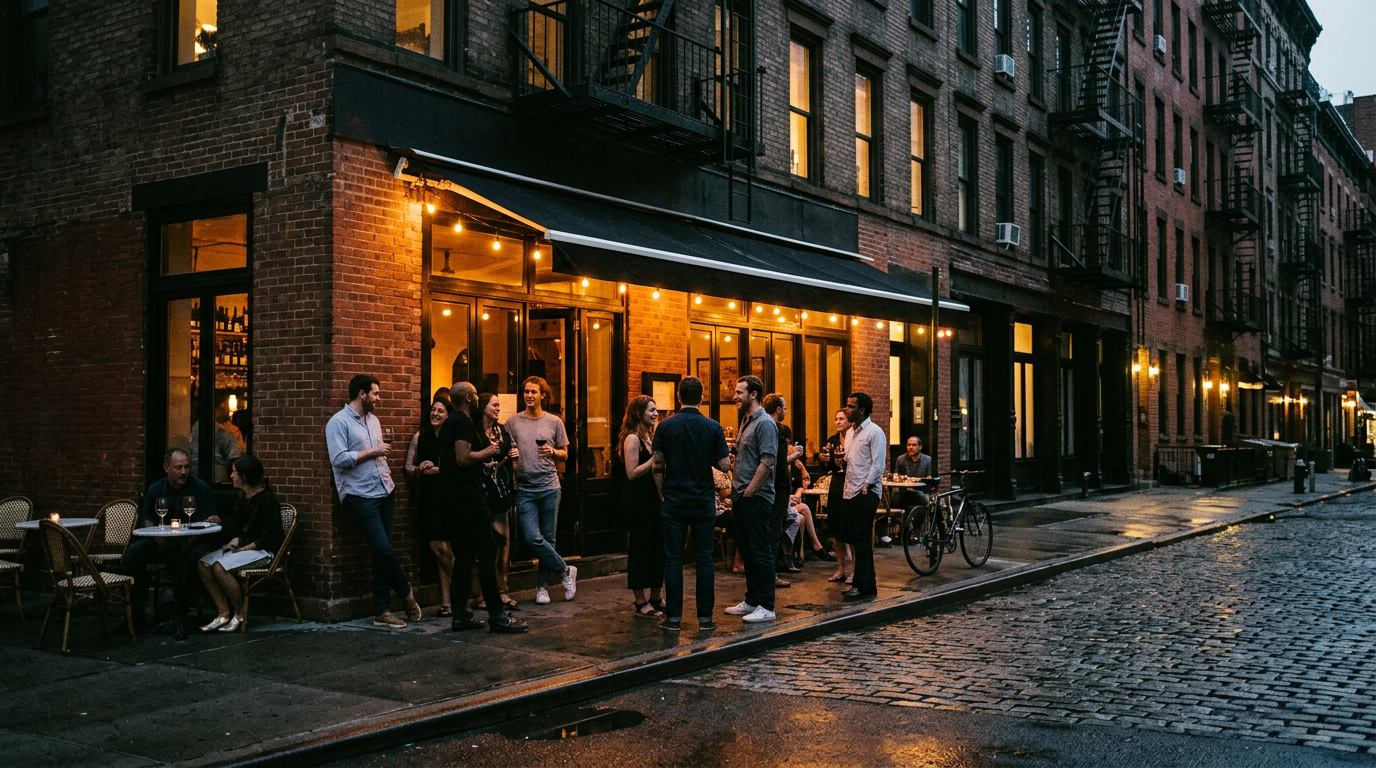
New York’s natural wine scene has its own code. It is not complicated, but it is enforced socially.
- Do not interrupt staff when they are in the weeds.
- Do not ask to taste five wines if you already know you are buying one glass.
- Do not turn every topic back to your startup.
- Do not pitch someone while they are eating.
- Do not monopolize a bar seat with your laptop during peak hours.
- Do not treat the bartender as your social concierge.
- Do not comment on someone’s order as an opening line unless the energy is clearly playful.
- Do not assume a solo woman at the bar is there to be approached.
A good rule: enter sideways. Comment on the wine list, the music, the neighborhood, the event everyone just came from. Keep it low-pressure. If the person answers with one-word replies, release them immediately.
New Yorkers are not unfriendly. They are over-approached. The difference matters. A person may be open to conversation and still allergic to neediness.
If you are with a group, keep it porous. Three people standing in a closed triangle are a wall. Two people facing the bar with room for another person to join are an invitation. If someone you know walks in, introduce people cleanly: name, context, one useful hook.
Example: “Maya, this is Chris. He’s building procurement software for restaurants. Chris, Maya runs ops for a small hospitality group in Brooklyn.” Then stop. Let them decide if there is a thread.
How to actually meet people there
The first goal is not to collect contacts. It is to earn a second sentence.
Start with the room, not your resume.
Good openers:
- “Have you been here before, or is tonight an experiment?”
- “I’m trying to learn this part of the list. What did you order?”
- “Did you come from the talk down the street, or is everyone here coincidentally dressed like architects?”
- “I’m between this glass and the lighter red. Any strong opinions?”
- “Is this a good early-evening bar, or does it get chaotic later?”
Once the conversation is moving, ask better work questions than “What do you do?”
Try:
- “What are you spending most of your week on right now?”
- “What kind of people are you trying to meet in the city?”
- “What’s been harder than it should be lately?”
- “Are you building, operating, investing, or escaping all three tonight?”
That last one works because it gives people room to joke. New York likes competence, but it also likes speed.
If you are a founder, do not lead with your deck. Lead with the problem you are close to. “I’m working on scheduling for independent restaurants” is better than “We’re building an AI platform for hospitality operations.” The first sounds like you talk to customers. The second sounds like you talk to LinkedIn.
If you are a freelancer or creator, be equally concrete. “I shoot short-form food and beverage campaigns for independent brands” beats “I help brands tell stories.” Nobody in New York needs another abstract storyteller at the bar.
Conversation openers that do not feel like a pitch
Natural wine bars give you built-in context. Use it.
If someone is holding a glass of something unusual: “That looks like it has opinions. Good ones?”
If the room is filling up: “This place changes personality fast after 7.”
If they mention a neighborhood: “Are you based there, or just loyal to the train line?”
If they work in tech: “Are you mostly in person again, or still doing the Slack-and-calendar thing?”
If they mention investing: “Are people back to founder dinners, or is everyone pretending coffee chats still work?”
This is where New York is different from Austin, Miami, or LA. Austin will give you a full founder backstory at a taco truck. Miami may turn into a WhatsApp group before the second drink. LA often routes through status and mutual friends. New York tests for usefulness and pace. Be clear, be funny if you can, and do not overstay.
You can mention platforms and communities when relevant: AngelList, Lunchclub, Meetup, On Deck alumni circles, South Park Commons people passing through, operator groups, climate meetups, design salons. But do not name-drop as a substitute for being interesting. The bar is not a panel bio.
Follow-up moves before the subway
The follow-up should happen while the conversation is still warm, not three days later when neither of you remembers the bottle.
Good closing lines:
- “I’m going to let you get back to your night, but this was useful. Want to swap info?”
- “You mentioned you’re looking for restaurant operators. I know two who might be relevant. Send me a note?”
- “I’d actually like to continue this when we’re not shouting over the bar. Coffee next week?”
- “If you’re open to it, I’ll send the name of that event series tomorrow.”
Use the channel that fits the person. Some New Yorkers prefer email. Some use Instagram for social-professional overlap. Founders may default to LinkedIn, but LinkedIn can feel stiff if you just shared wine at 7 p.m. Ask: “What’s the easiest way to send you that?”
Your follow-up should be specific and short.
Example:
“Good meeting you at Ruffian last night. You mentioned hiring a part-time ops lead for the pop-up series. I know someone who has done that for two Brooklyn restaurants. Want an intro?”
That is useful. “Great connecting, let’s stay in touch” is fog.
If you promised something, send it by noon the next day. New York rewards fast, clean execution. It also remembers flakes.
Mistakes to avoid
The biggest mistake is arriving with extraction energy. You can feel it immediately: the person who is scanning for value, ranking the room, and asking questions only to locate opportunity. People recoil.
Other common misses:
- Going too late and mistaking party energy for networking energy
- Asking someone’s job before you have any rapport
- Talking at staff to prove wine knowledge
- Posting the room constantly instead of being in it
- Bringing a five-person crew and expecting strangers to approach
- Staying after the conversation has clearly ended
- Turning a casual exchange into a calendar invite too fast
- Assuming every natural wine bar is a founder room
Also: do not make natural wine your whole personality. The scene has matured. The old script of “funky, cloudy, weird” is tired. Many serious bars now pour clean, precise bottles alongside more experimental producers. Treat the category with respect, not costume energy.
If someone says they do not drink, do not make it strange. Many New York rooms now include people who are drinking less, alternating with nonalcoholic options, or showing up for food and friends. The networking tactic is presence, not alcohol intake.
A simple one-night playbook
Here is the clean version.
Pick one neighborhood where you already have a reason to be. East Village after a panel. LES before dinner. Williamsburg after a coworking day. Fort Greene on a Sunday. Go alone or with one socially generous friend.
Arrive between 5:30 and 6:15. Sit at the bar if possible. Ask the bartender for one thoughtful recommendation. Order food if you are staying more than one glass. Put your phone away except for logistics.
Talk to staff when they have time. Talk to the person next to you only if the opening is natural. Keep the first exchange under two minutes unless they extend it. If the conversation gets real, ask what they are working on now, not what their title is.
Make one useful offer. An intro, a place, an event, a resource, a restaurant recommendation, a founder dinner that is actually relevant. Then leave before the room turns sloppy.
The win is not walking out with ten new contacts. The win is one person who replies tomorrow, one bartender who recognizes you next week, and one room in New York that starts to feel less random.
That is the code. Not loud. Not thirsty. Useful, specific, and gone before you become the weird networking person at the wine bar.
Discussion (0)
Loading comments…