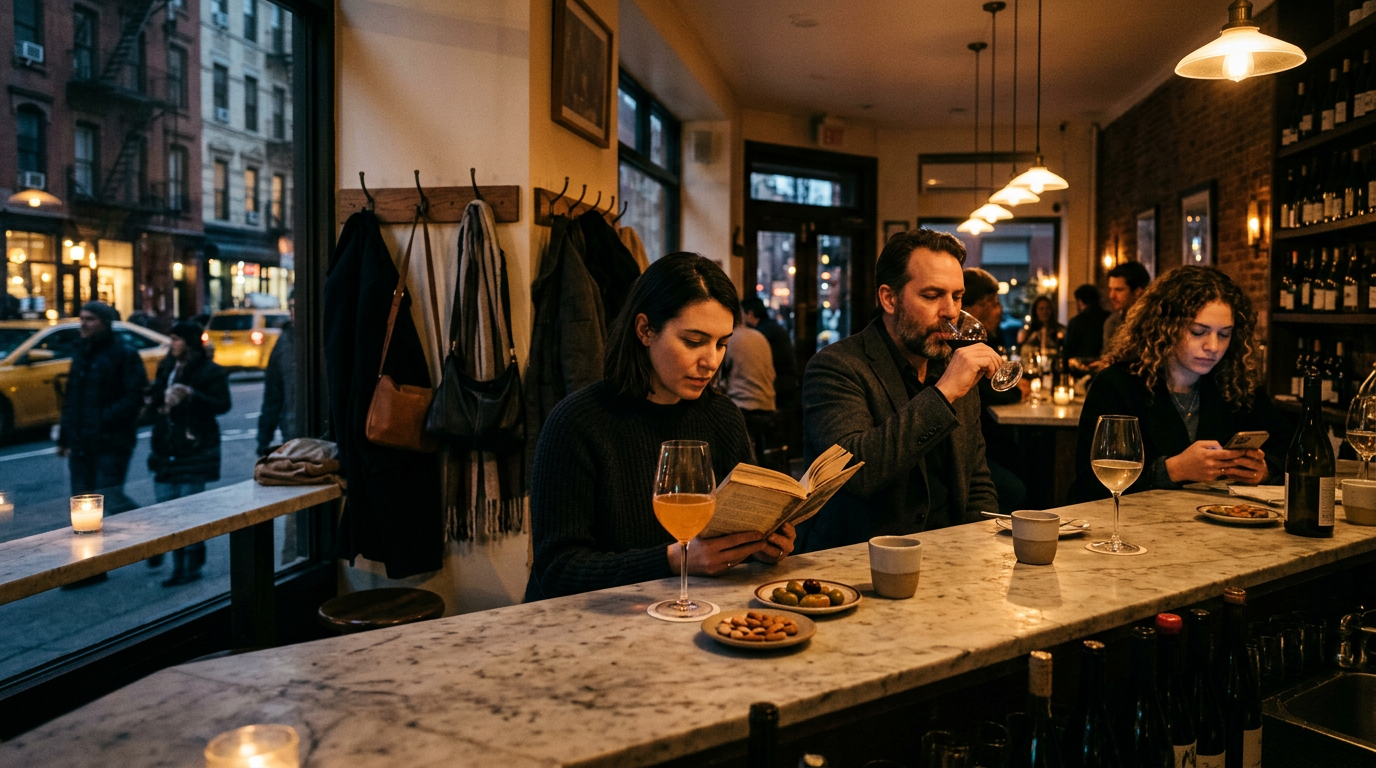
The New York wine-bar networker’s code
At 6:12 p.m. on a Thursday in the Lower East Side, the person beside you at the bar is either waiting for a date, killing time before a dinner, decompressing after a fund call, or avoiding a coworking happy hour that got too loud. New York gives you openings. It does not give you permission to be clumsy.
That is the whole trick with networking at a natural wine bar here. The room can be full of founders, designers, editors, hospitality people, angel investors, agents, architects, product leads, and freelance operators. But nobody came to be trapped by a stranger with a pitch deck in human form.
Done well, a New York wine bar is a better room than many formal networking events. Lower pressure. Better taste. More honest conversation. The bar itself becomes a filter: if someone knows what pét-nat is, has an opinion about skin-contact whites, or understands why a 20-seat room in Brooklyn is not the place for speakerphone, you already have social context.
Done badly, it is creepy. Or thirsty. Or both.
Here is the operator’s version: pick the right room, sit in the right place, order like an adult, open lightly, follow up cleanly, and do not confuse friendliness with access.
Why natural wine bars work in New York
New York’s natural wine scene is not a novelty anymore. By 2026, it is mature enough that you can find a serious glass list in Williamsburg, Clinton Hill, the East Village, the Lower East Side, Nolita, Ridgewood, Greenpoint, Fort Greene, Crown Heights, and parts of the Upper West Side without acting like you discovered anything.
That maturity matters. The room is no longer just wine obsessives and restaurant people. It is now part of the city’s after-work operating system.
A good natural wine bar does three things that formal networking spaces often fail to do:
- It creates low-stakes proximity. You can stand near people without requesting their LinkedIn.
- It gives you a real object to discuss. The wine, the producer, the food, the playlist, the neighborhood.
- It attracts people who are already moving through the city with intent.
This is especially true in New York because professional and social life overlap constantly. The person at the bar may have come from a WeWork near Union Square, a dedicated desk at Industrious, a studio in Dumbo, a media office in Soho, a founder dinner in NoHo, or a South Park Commons-style salon in Brooklyn. They may be on AngelList, off AngelList, tired of AngelList, or raising quietly through friends of friends.
Natural wine bars are not magic. They are Schelling points: obvious-enough meeting places for people who do not want the stiffness of a conference badge. That is why they work.
Pick the right room, not the loudest room
!Bartender pouring natural wine at a small New York bar
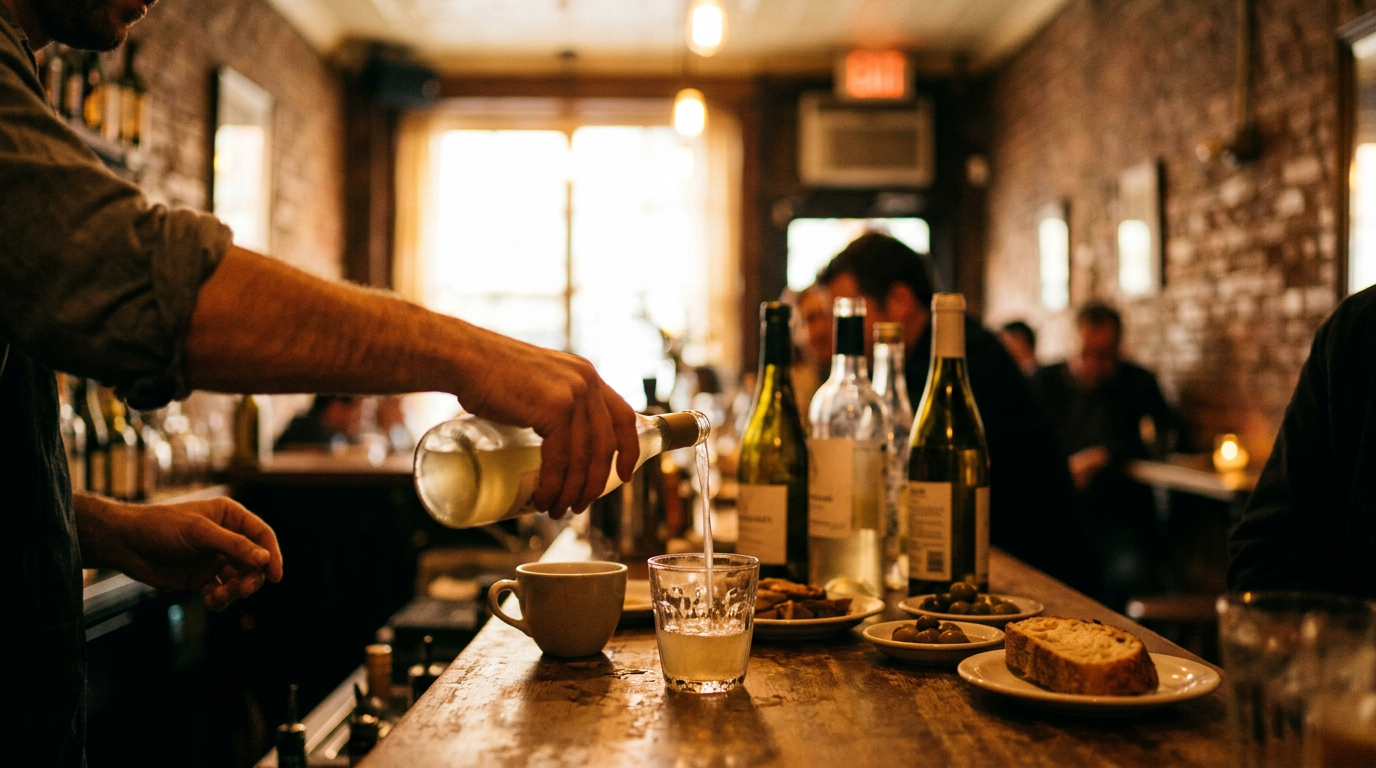
The wrong wine bar for networking is any room where everyone is seated in tight two-tops, the staff is slammed, the music is too high, and every group has already closed its circle. You are not networking there. You are hovering.
Look for a room with one or more of these features:
- A real bar with solo seating
- A standing rail or narrow counter
- Communal tables that do not feel like family-style dinner
- A by-the-glass list that changes often
- Light food that keeps people moving: anchovies, tinned fish, olives, bread, small plates
- Staff who can talk about the wine without turning every pour into a lecture
- A neighborhood crowd, not a destination-only crowd
Specific rooms that have long carried the right kind of New York wine gravity include The Four Horsemen in Williamsburg, Ruffian in the East Village, The Ten Bells on the Lower East Side, Compagnie des Vins Surnaturels in Nolita, Rhodora in Fort Greene, and Wildair on the Lower East Side. Do not treat those names as a checklist. Treat them as models.
The type matters more than the brand name. A tiny LES natural wine bar at 10 p.m. on Saturday is often useless for meeting new people unless you already know the room. A quieter Brooklyn wine bar at 5:45 p.m. on Wednesday can be gold.
For Manhattan, aim early and precise. East Village, Nolita, LES, Chinatown-adjacent, and Soho work when you want media, design, fashion, venture, hospitality, and startup spillover.
For Brooklyn, Williamsburg, Greenpoint, Fort Greene, Clinton Hill, Cobble Hill, Crown Heights, and Ridgewood lean more creative-operator: founders, agencies, architects, film people, writers, product consultants, and food-world regulars.
Queens is less performative and more neighborhood-driven. If you do not live nearby or have a reason to be there, tread lightly. New York can smell social tourism.
What to order / what to look for
Do not start with a monologue about how you only drink zero-zero natural wine from volcanic soil. Nobody asked.
Order in a way that signals curiosity and self-control:
- Ask for one glass, not a tasting flight disguised as indecision.
- Give the bartender a direction: “Something bright and mineral,” “a chilled red that is not too funky,” “a skin-contact white with grip,” “a sparkling that is dry, not cider-y.”
- If you do not know natural wine, say so plainly: “I’m still learning this category. What are you excited to pour tonight?”
- Order food if you are staying more than one drink.
- Tip well and close loops with staff before trying to become the mayor of the room.
Good networking orders are not about status. They are about pace. A single-origin pour-over at a third-wave coffee bar says one thing at 9 a.m.; a thoughtful glass of Loire chenin or a chilled gamay says another at 6 p.m. Neither should become a personality.
Look for people who are open to the room:
- Sitting solo at the bar, not buried in AirPods
- Reading a menu slowly, not texting furiously
- Chatting casually with staff, not monopolizing them
- Standing near the rail with one open shoulder
- Waiting for a friend but not yet locked into the night
Avoid people in date posture: two people angled inward, low voices, one phone face down between them, intense eye contact. Leave them alone.
Avoid groups in reunion posture: coats piled, multiple bottles open, inside jokes flying. You are not entering that room unless invited.
Best time of day to go
!People talking outside a Brooklyn wine bar at dusk
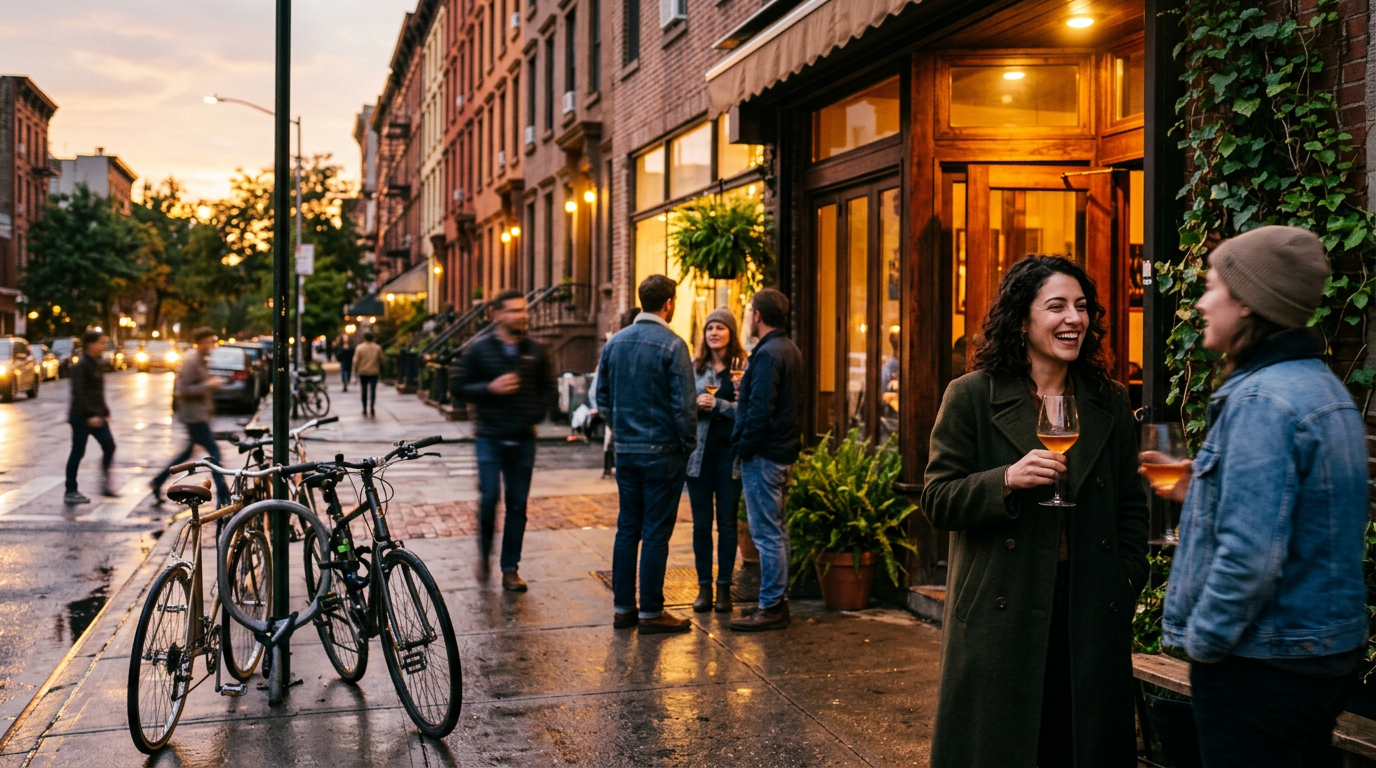
The best networking window at a New York natural wine bar is not prime time. It is the seam before prime time.
Aim for:
- Tuesday through Thursday, 5:15 p.m. to 7:15 p.m.
- Sunday late afternoon, especially in Brooklyn
- Early evening before a nearby gallery opening, panel, supper club, or founder dinner
- Post-event decompression, but only if you arrive with one person and keep the energy low
Avoid:
- Friday after 8 p.m.
- Saturday date-night hours
- Any night when the bar is three-deep and staff are fighting for oxygen
- Showing up late and trying to create professional intimacy with people who are two drinks ahead of you
New York’s useful conversations often happen before the official plan. Someone has 35 minutes before dinner. Someone took the subway early. Someone is waiting out traffic before heading to a member’s club, a NeueHouse event, a Soho House dinner, or a private salon. That small gap is where you can meet without forcing it.
If you are coming from a coworking day pass or hot desk, do not bring the office with you. No laptop spread. No charger hunt. No Zoom voice. A notebook is fine. A laptop at a wine bar after 6 p.m. reads as either performative or desperate unless the room is explicitly daytime-café casual.
Etiquette and unwritten rules
New York rewards directness and punishes neediness.
That means you can talk to strangers. You just cannot corner them.
The rules:
- Start with the room, not yourself.
- Keep the first exchange under 60 seconds unless they clearly extend it.
- Never open with your job title.
- Do not pitch across the bar.
- Do not ask for an intro before there is rapport.
- Do not make the bartender your concierge to other people.
- Do not interrupt someone eating.
- Do not neg anyone’s wine choice. Ever.
- Do not photograph strangers or their table setup.
- If someone gives short answers twice, exit.
A clean opener sounds like this:
- “Have you had that orange by the glass yet? I’m choosing between that and the chilled red.”
- “Is this seat taken, or are you saving it for someone?”
- “I’m trying not to order the exact same thing I always order. Anything on the list working tonight?”
- “You look like you know this place better than I do. Is the food move here small plates or one proper dish?”
Notice what is missing: “So what do you do?”
That question is not illegal in New York, but it is lazy. Let it arrive naturally. Better versions:
- “Are you coming from work around here or just in the neighborhood?”
- “Is this your after-office spot or your pre-dinner spot?”
- “Do you work nearby, or is this a destination for you?”
If they answer with a field, not a company, follow the field:
- “What kind of design work?”
- “Early-stage or later-stage?”
- “Restaurant side or wine side?”
- “Client work or your own thing?”
The goal is not to extract credentials. It is to see if there is conversational voltage.
How to actually meet people there
Go alone sometimes. Not every time, but enough that you are available to the room. Two people can also work if both of you understand the assignment: sit side by side at the bar, not face to face in a closed bubble.
Your best seat is a corner at the bar or the last open stool before a standing area. You want adjacency without pressure.
A simple sequence:
1. Arrive early.
2. Greet staff normally.
3. Order one glass and food if appropriate.
4. Put your phone away between uses.
5. Make one low-stakes comment to the person next to you.
6. Let silence do some work.
7. If they re-engage, continue.
8. If they do not, enjoy your wine and stop performing.
The strongest networking often comes through weak ties, not the obvious big-name person across the room. Mark Granovetter’s weak ties idea still holds in New York: loose acquaintances are often better sources of new opportunities than close friends because they sit in different circles. At a wine bar, that might be the freelance producer who knows three founders hiring, the restaurant partner who hosts private dinners, or the designer who just left a venture-backed company and knows who is quietly building.
Do not chase the most important-looking person. Talk to the person who is open, specific, and generous.
Good conversation paths:
- Wine to neighborhood: “Do you usually drink around here?”
- Neighborhood to work rhythm: “Are you hybrid, studio-based, or fully floating?”
- Work rhythm to community: “Where are people actually meeting in your world right now?”
- Community to follow-up: “That sounds aligned with what I’m building. Want to trade info?”
If you host anything, mention it lightly:
- “I put together small founder dinners every few weeks, usually eight people, no panel. If that is your kind of room, I can send you the next one.”
If you do not host anything, do not pretend. You can still be useful:
- “I know two people working on that same problem. If it would be helpful, I can make a low-pressure intro.”
Use the phrase “low-pressure” in New York and mean it.
The follow-up that does not feel gross
Do not connect on every platform while standing there. Pick one.
For professional follow-up, LinkedIn is fine. For founders and operators, email is cleaner. Instagram can work if the relationship is more creative, hospitality, media, or food-world. Do not ask for a phone number unless the conversation clearly earned it.
Before exchanging details, name the reason:
- “I’d like to send you that event we mentioned.”
- “I can introduce you to the person working on restaurant ops software.”
- “Send me the name of that wine shop and I’ll send you the coworking space I mentioned.”
Send the follow-up within 24 hours. Keep it short:
Subject: Good meeting you at the wine bar
Message: “Good meeting you last night. I liked your point about smaller founder rooms replacing big panel events. Here’s the dinner series I mentioned. No pressure, but I think you’d like the crowd. Also happy to intro you to Maya, who is working on hospitality hiring.”
That is enough. No life story. No attachment. No calendar link unless they asked for one.
If they do not respond, do not send three bumps. New York has memory. Be normal now so you are welcome later.
Mistakes to avoid
The fastest way to become “that person from the wine bar” is to treat a social room like a sales floor.
Avoid these moves:
- Opening with “I’m building a startup” before anyone asks.
- Asking “Are there any investors here?” within five minutes.
- Turning a wine question into a ten-minute lecture.
- Hovering near a group without entering or leaving.
- Buying someone a drink as a tactic. It creates pressure.
- Mistaking staff friendliness for personal friendship.
- Getting drunk and calling it networking.
- Assuming Brooklyn equals casual access.
- Treating women alone at the bar as default conversation targets.
- Asking someone to scan your QR code.
Also avoid over-optimizing the venue. The question is not “Where are the richest people drinking?” It is “Where can I have a real conversation without making the room worse?”
Some nights you will meet no one. That is fine. You still learned a list, a neighborhood pattern, a room’s rhythm, and maybe which nights are too date-heavy. That is fieldwork.
The best New York networkers are not the loudest. They are consistent, specific, and easy to re-encounter. They become familiar without becoming invasive. They know when to enter, when to exit, and when to send the one useful follow-up that makes the next conversation easier.
A natural wine bar will not do the work for you. It will only put you close enough to begin. The rest is taste, restraint, and a little courage.
Discussion (0)
Loading comments…