
The NYC coffee meeting rule that saves everyone's time
At 9:17 on a Tuesday in Flatiron, the line moves fast, the stools are half full, and someone at the two-top next to you is trying to raise a pre-seed round without saying the word raise. That is the New York coffee meeting in its natural state: brief, transactional on the surface, and more useful than a lot of formal networking if you know how to handle it.
The mistake newcomers make is treating coffee like a casual hang. In NYC, coffee is a work format. Not a date. Not a therapy session. Not an unpaid consulting sprint. Done well, it gives both people a clean 25 minutes, one sharp ask, and a reason to keep the thread alive.
This is the operating playbook for founders, freelancers, creators, recruiters, investors, and operators using coffee meetings in New York in 2026.
Why NYC coffee meetings have their own logic
New York is dense enough that weak ties matter. Mark Granovetter's idea was simple: your most useful opportunities often come through looser connections, not your closest friends. NYC turns that into a daily habit. The person you meet for coffee in NoMad might not hire you, fund you, or introduce you today. But they may remember you in six weeks when someone asks for a product marketer, a climate founder, a restaurant designer, or a fractional CFO.
The city also punishes vagueness. People here are willing to help, but they are allergic to meetings that do not know what they are for.
A good NYC coffee meeting has three traits:
- It is geographically sane for both sides.
- It has one clear reason to exist.
- It ends before anyone starts checking Slack under the table.
Your goal is not to impress someone with how busy you are. Everyone is busy. Your goal is to make the other person feel that saying yes was a good use of a sliver of their day.
Pick the right room, not the trendiest room
!Two professionals having a focused coffee meeting at a small NYC cafe table
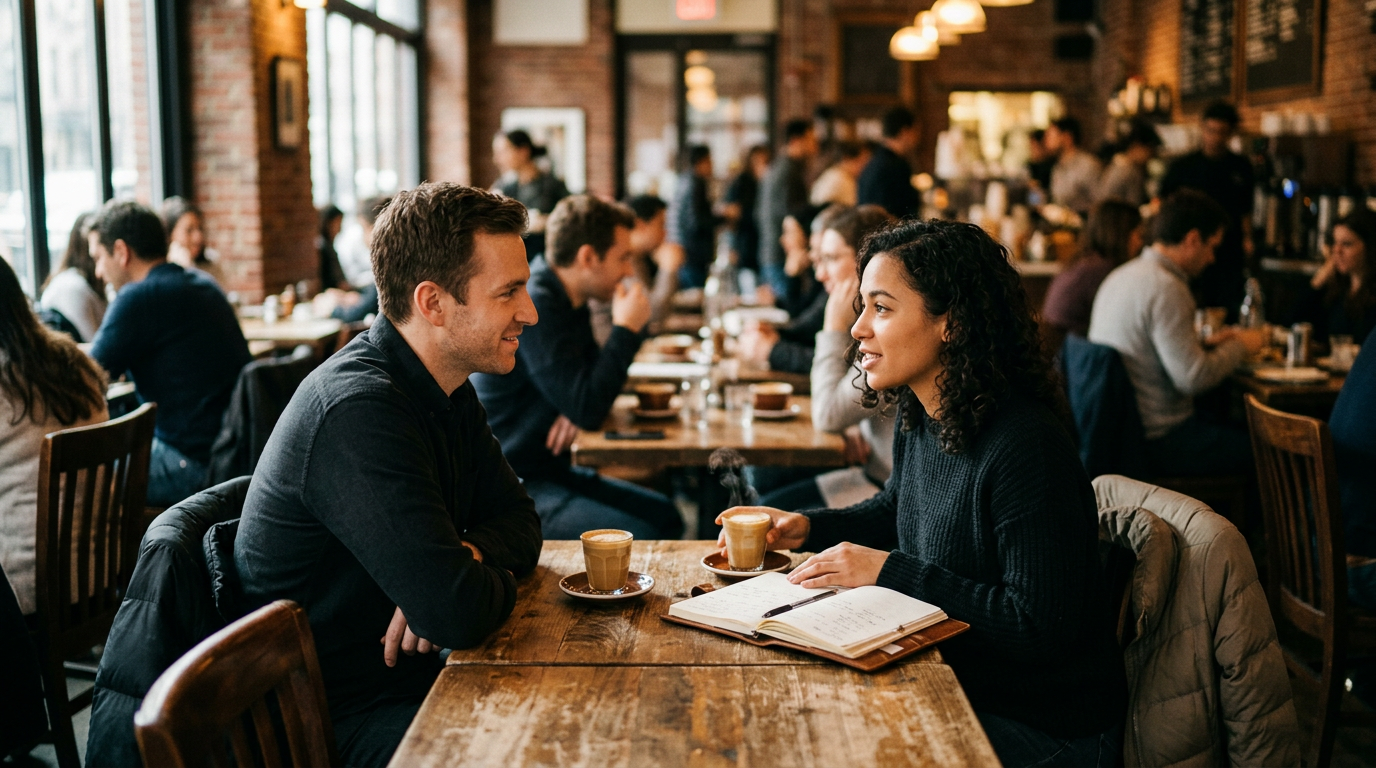
The room does half the work. Choose wrong and you spend the meeting shouting over grinders, hunting for a seat, or apologizing for the outlet situation.
For most NYC coffee meetings, think in venue types first:
- Third-wave coffee bar with table turnover: Good for first meetings, short investor chats, quick founder intros, and creator collaborations. Look for serious espresso, single-origin pour-over, and enough standing room that you are not trapped if every seat is taken.
- Hotel lobby cafe: Better for senior people, out-of-town investors, talent interviews, and conversations that need a calmer tone. Use discretion and do not camp without buying something.
- Coworking lounge or day-pass space: Best when you need Wi-Fi, follow-up work, or a second meeting right after. WeWork, Industrious, Spaces, and similar operators still matter in 2026, but check the current day pass or guest policy before promising access.
- Neighborhood cafe with regulars: Good for relationship-building if you actually live or work nearby. Bad if you are using it as free office space during the lunch rush.
- Natural wine bar before service or early afternoon cafe-bar: Useful for later-day creative meetings, brand partnerships, and hospitality people. Not the move for a first investor chat unless the other person suggested it.
Specific names can help, but do not build your whole plan around a logo. Devoción, Joe Coffee, Cafe Grumpy, Blue Bottle, La Colombe, Birch Coffee, Stumptown, and Ralph's Coffee are known quantities in the city. Some locations are better for laptop work, others are better for a stand-up espresso and a fast exchange. Scout the specific location if the meeting matters.
My rule: if the person is doing you the favor, meet near them. If you are peers, pick a place between both of your next commitments. If you are asking for money, advice, hiring help, press, or introductions, remove friction for the other person.
What to order / what to look for
Order quickly. That sounds small. It is not. Nothing kills the pace like a five-minute menu negotiation while the other person is trying to remember why they agreed to meet.
Good default orders:
- Drip coffee if the line is long.
- Espresso or cortado if you want to be fast.
- Cappuccino if you have time but do not want a production.
- Iced coffee when you are walking after.
- Sparkling water if you are already over-caffeinated.
Save the slow single-origin pour-over for solo work or a meeting where both people are coffee people. If you order one, acknowledge the timing. Say, Mine may take a few minutes, so let's grab a seat and start.
What to look for in the room:
- Tables close enough for normal speaking, not stage voice.
- At least one standing ledge in case seats disappear.
- A bathroom if the meeting sits between other appointments.
- Staff moving people through without chaos.
- A noise level that hides private details but allows names and numbers to be heard.
- No aggressive laptop culture if the point is conversation.
If you are discussing confidential details, do not choose a packed startup cafe at 10 a.m. in Union Square. Half the room knows someone who knows your competitor.
Best time of day to go
!People with laptops and coffee cups outside a Manhattan workday cafe

NYC coffee timing is a social signal.
8:00 to 9:00 a.m. is serious. This is for founders, operators, finance people, and anyone who wants to get the meeting done before the calendar turns into a collision. Great if both people are morning types. Terrible if one person has school drop-off or a commute from Brooklyn that you ignored.
9:30 to 11:00 a.m. is the sweet spot. The first rush has softened, people are caffeinated, and a 25-minute meeting can still produce action before lunch.
11:30 a.m. to 1:30 p.m. is risky. Lines get strange, people are hungry, and cafes become informal lunchrooms. If the meeting matters, avoid this window unless the place is known to handle volume.
2:30 to 4:30 p.m. is underrated. Good for creative work, founder catch-ups, and conversations that do not need peak morning energy. Many NYC operators are more available after the lunch-hour churn.
After 5:00 p.m. is no longer really coffee. At that point, suggest a walk, a hotel lobby, a natural wine bar, or a low-pressure drink depending on the relationship.
My preferred booking language: I can do 9:40 or 2:45 near Union Square, whichever is easier on your route. That tells the other person you understand time, geography, and the fact that nobody wants a 10:00 sharp meeting that starts late because of a subway delay.
The agenda that does not feel like a calendar invite
Do not send a corporate agenda for coffee. Do send context.
Before the meeting, your note should answer four questions:
- Why this person?
- Why now?
- What do you want their take on?
- How long will it take?
A strong pre-meeting note looks like this:
Hi Maya — looking forward to Thursday. I mainly want your read on whether our first sales hire should be enterprise or mid-market. I will keep it to 25 minutes and can share the two options in person.
That is enough. It gives the meeting a spine.
For the meeting itself, use this shape:
- Minutes 0-3: Quick arrival, order, one human note. Keep it real but short.
- Minutes 3-8: Your context. No life story. Just the relevant facts.
- Minutes 8-18: The other person's read. Listen harder than you pitch.
- Minutes 18-23: Specific ask. One ask, not six.
- Minutes 23-25: Recap, permission for follow-up, clean exit.
Useful lines:
- I will give you the short version so we can spend more time on your read.
- The decision I am stuck on is this.
- If you were in my seat, what would you do next week?
- Is there anyone you think I should not talk to yet?
- What would make this sound more credible?
That last question is underrated. It invites honesty without asking the other person to fix your whole business.
Etiquette and unwritten rules
NYC coffee has manners, even when the room feels casual.
Arrive seven minutes early. Not twenty. Twenty makes you look like you are camping. Seven lets you check the line, claim a reasonable spot, and text if seating is bad.
Buy your own drink unless you clearly invited someone as a guest. If you asked for the meeting and the other person is senior, offer to get theirs. Do not make it weird if they decline.
Do not open your laptop unless the meeting requires looking at a deck, prototype, portfolio, or numbers. A phone note is fine. A laptop wall changes the energy.
Keep your bag off the second chair unless the room is empty. New Yorkers notice space hogging.
Never assume a cafe is your office because you bought one cortado. If you need a hot desk, buy a day pass at a coworking space. The post-pandemic coworking market has shifted, but the basic deal is clear: pay for workspace when you need workspace.
Watch the volume. Talking about a layoff plan, investor terms, creator rates, or a restaurant lease in a crowded cafe is amateur hour.
End on time. If the conversation is strong, say: I want to respect your next thing. I would happily continue this another time if useful. That line does two jobs: it shows discipline and leaves the door open.
How to actually meet people there
Coffee meetings are not only for people already on your calendar. In NYC, the right room can create useful overlap if you are not awkward about it.
Do not roam the cafe pitching strangers. That is not networking; that is bothering people who are trying to work.
Better moves:
- Become a regular at one or two places near your actual work path.
- Go at the same time twice a week so faces repeat.
- Learn the room before you try to work the room.
- Use soft openers tied to the moment, not canned personal-brand lines.
Conversation openers that do not make people brace themselves:
- Are you waiting for this table, or is it open?
- I have seen you here a few times — are you based nearby?
- Quick one: do you know if this place gets impossible after ten?
- That notebook setup is serious. Are you designing, writing, or avoiding email?
- I heard you mention hiring. I am not pitching, just curious what roles are hardest right now.
If they give short answers, let it die. If they turn toward you, ask one clean follow-up. The point is not to collect contacts. It is to create enough familiarity that a later message does not feel random.
The strongest rooms in 2026 are often hybrids: a cafe near a coworking space, a founder breakfast that spills into coffee, a Meetup that ends with four people walking to espresso, a South Park Commons-style community event where the real conversation happens before and after the formal programming. AngelList, Lunchclub, On Deck alumni circles, founder dinners, and niche Slack or Discord groups still feed these meetings, but the durable relationship usually starts offline.
Follow-up that earns another conversation
Follow-up is where most coffee meetings either become real or disappear.
Send the note within 24 hours. Same day is better if they gave you advice, a name, or a next step.
Good follow-up has five parts:
- A specific thank-you.
- One thing you heard clearly.
- The action you are taking.
- Any promised link or context.
- A low-friction next step, if appropriate.
Example:
Maya — thanks again for the time this morning. Your point about hiring for the sales motion we want, not the one we have, was the clearest takeaway. I am going to rewrite the role around mid-market expansion and pressure-test it with two operators this week. Here is the one-page role draft I mentioned. If it becomes sharper after those calls, I will send the revised version.
Notice what is not there: no flattery pile-on, no request for three introductions, no giant recap.
If they offered an introduction, make it easy:
- Send a forwardable blurb of five sentences or less.
- Include your site or LinkedIn.
- State why the intro makes sense.
- Give the other person permission to pass.
The phrase permission to pass is powerful because it protects their social capital. Try: Totally fine to skip if this is not a fit.
Then report back. If someone introduces you and it turns into a useful call, tell them. If their advice saved you from a bad hire, tell them. People remember the person who closes the loop.
Mistakes to avoid
The biggest coffee meeting mistakes are not dramatic. They are small signals that you do not understand the format.
Avoid these:
- Asking to pick someone's brain with no specific topic.
- Choosing a cafe 35 minutes from their next meeting because you like the vibe.
- Sending a calendar hold without location details.
- Arriving late and blaming the train for a route you should have checked.
- Ordering food that takes attention away from the conversation.
- Pitching for 22 minutes and leaving two minutes for feedback.
- Asking for investor intros before the person knows if you can execute.
- Turning a first coffee into unpaid therapy about your cofounder conflict.
- Forgetting to follow up after someone gave you real advice.
- Sitting for two hours in a crowded cafe with one empty cup and a charger stretched across the floor.
Also avoid over-networking. If every day has four coffees, none of them will be thoughtful. Two sharp meetings beat six vague ones.
The practical NYC coffee meeting template
Use this when you want the meeting to work without overthinking it.
Before:
- Pick a place near the other person's route.
- Offer two time windows, not nine.
- Send one-sentence context.
- Check the cafe's seating reality if the meeting matters.
- Prepare one ask and one backup question.
During:
- Arrive seven minutes early.
- Order fast.
- Start with the short version.
- Ask for a read, not a rescue.
- Take notes only on the useful parts.
- End on time.
After:
- Send a same-day thank-you.
- Name the advice you are acting on.
- Share any promised link.
- Make intro requests forwardable.
- Close the loop when something happens.
That is the rule that saves everyone's time: treat coffee as a small professional container, not a loose social fog. NYC rewards that. The city has plenty of rooms, plenty of caffeine, and plenty of people who can help if you make the ask clean. The people who win at coffee meetings are not the loudest networkers. They are the ones who make a short conversation easy to say yes to, easy to remember, and easy to continue.
Discussion (0)
Loading comments…