
The NYC coffee meeting rule that saves everyone time
At 8:47 on a Tuesday, the tables near the window at a Flatiron espresso bar are already claimed by people wearing good headphones and not looking up. One founder is taking a call outside because the grinder is too loud. A VC associate is five minutes late from the L train. Someone has a cappuccino cooling while they explain their marketplace to a person who agreed to 25 minutes and meant it.
That is the New York coffee meeting in 2026: useful, compressed, socially coded, and very easy to waste.
Coffee is still the default low-friction room for founders, freelancers, creators, operators, recruiters, investors, editors, and agency people who do not yet have enough reason to book lunch. It is cheaper than dinner, more intentional than a DM thread, and more forgiving than a conference badge scan. But NYC does not reward wandering energy. If you treat coffee like an open-ended hang, people remember. Not in a good way.
The rule: make the meeting easy to say yes to, easy to participate in, and easy to end.
The NYC coffee meeting is not a tiny lunch
A coffee meeting here is usually a 20-to-30-minute exchange with one clear reason to exist. It is not a therapy session, a pitch deck reading, or a vague networking slot.
The best version has three parts:
- A precise ask before the meeting
- A short live conversation with a real agenda
- A follow-up that gives the other person less work, not more
New York runs on proximity and weak ties. Mark Granovetter's weak ties idea still explains half the city: the person who is not your close friend may be the one who points you toward a hiring lead, studio space, angel check, podcast slot, or client. Coffee keeps those weak ties warm without pretending they are intimate.
That means the bar is simple. Be useful. Be specific. Leave before the room turns against you.
Picking the right room
!Two coffee cups and notebooks on a small Brooklyn cafe table
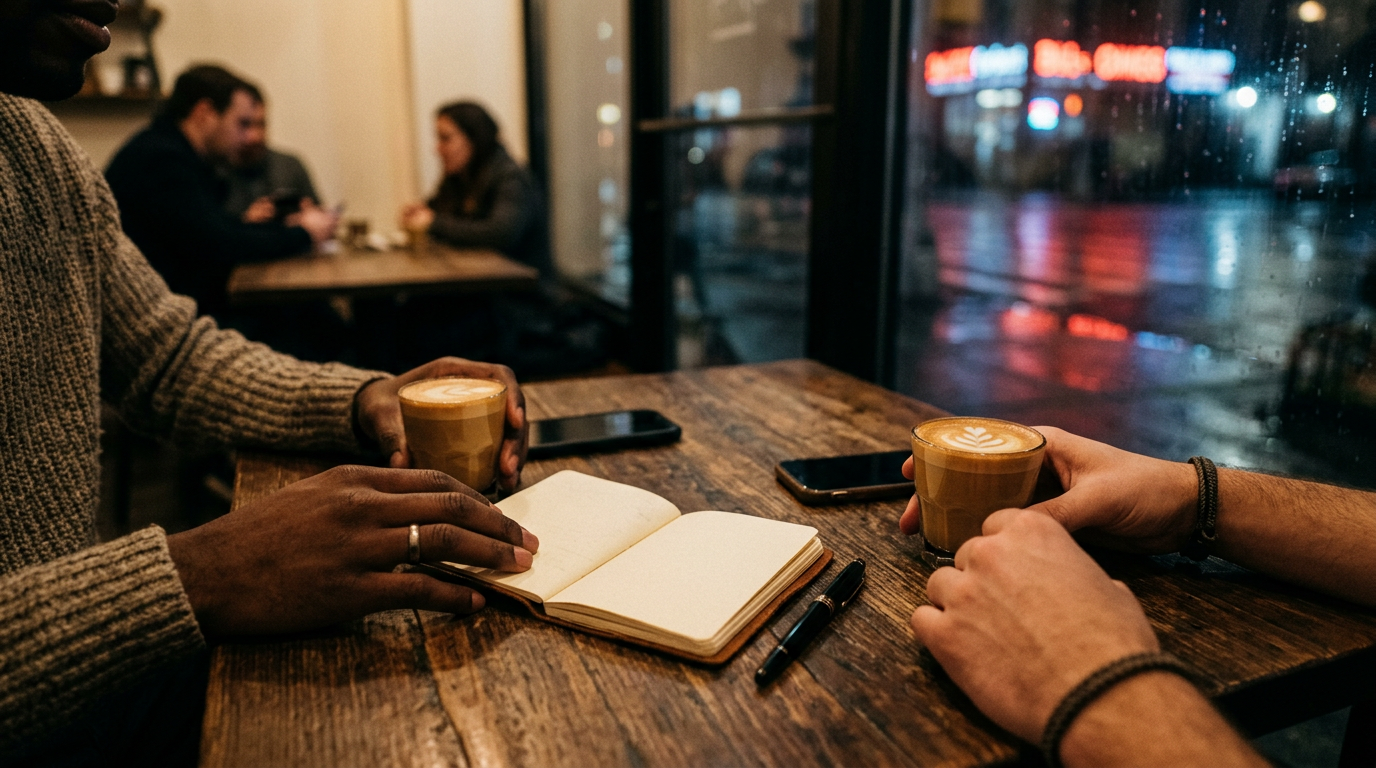
The venue should match the job of the meeting. Do not pick the prettiest cafe if the acoustics are terrible. Do not pick a laptop-heavy room if you need emotional nuance. Do not drag someone from Midtown to Williamsburg unless the neighborhood is part of the reason.
For first-time professional coffees, look for:
- A third-wave coffee shop with real seating, not a pure grab-and-go counter
- Tables that turn over without staff glaring at everyone
- Noise that creates privacy but does not kill conversation
- A location within two subway lines of both people
- A counter flow that does not make ordering take 12 minutes
Safe NYC categories:
- Flatiron or Union Square espresso bar for founder, investor, recruiter, and operator meetings
- SoHo or NoHo cafe for creator, fashion, media, design, and agency conversations
- Williamsburg third-wave cafe for product, design, music, and startup-adjacent people who actually live in Brooklyn
- Midtown hotel lobby cafe when someone is between meetings and needs predictable seating
- Upper West Side or Upper East Side neighborhood cafe for academics, nonprofit people, publishing, health, and older-money networks
Specific names are not magic, but some have earned trust. Devoción is known for polished coffee and strong Brooklyn work energy. Joe Coffee, Cafe Grumpy, Birch Coffee, La Colombe, Blue Bottle, and Ralph's Coffee are recognizable enough that nobody has to decode the invite. That matters. A coffee spot can function as a Schelling point: an obvious meeting place both people can understand without extra explanation.
If the conversation involves sensitive numbers, hiring issues, a cap table, or a messy founder conflict, do not choose a tiny room where every table is six inches apart. Use a hotel lobby, a quieter cafe off the main retail drag, or book a small meeting room at Industrious, Spaces, WeWork, or another coworking operator if one person already has access.
What to order / what to look for
Order fast. That is the first courtesy.
For most meetings, a drip coffee, espresso, cortado, cappuccino, tea, or sparkling water is enough. A single-origin pour-over can be great if both people are relaxed and the bar is not slammed. It is a bad move if the other person has a hard stop and you just added eight minutes to the clock.
Look for signals before you sit:
- Are people holding conversations, or is everyone locked into laptops?
- Are outlets attracting campers who will not move?
- Is music at a level where you will both lean forward the entire time?
- Is there a two-top away from the pickup counter?
- Can you leave without climbing over three tote bags?
If you invited the person, offer to buy. Keep it casual: I have this one, thanks for making the time. If they insist on paying for themselves, do not perform a little payment negotiation at the register. Let it go.
Food is situational. A croissant is fine. A full plate that requires a fork shifts the meeting into brunch energy, which is not what most New Yorkers signed up for at 10 a.m. If you need a meal, say that in advance and book lunch.
Best time of day to go
!Rainy New York sidewalk outside a warm cafe before a meeting

The strongest windows in NYC are not random.
8:15 to 9:15 a.m. works for founders, finance people, senior operators, and anyone stacking meetings before the office. It is efficient, but unforgiving. Be on time.
10:00 to 11:15 a.m. is the sweet spot for creative, freelance, and investor-adjacent meetings. The morning rush has thinned, people are awake, and you can usually get a table.
2:00 to 3:30 p.m. is underrated for agency owners, editors, consultants, fractional executives, and coworking people. The lunch wave is gone. The post-work crowd has not arrived.
Avoid 12:15 to 1:30 unless you know the cafe has space. Avoid 4:30 if the other person has kids, a commute, or evening events. Avoid Friday after 2 unless the relationship already has warmth; too many people are mentally gone.
For Brooklyn meetings, pad subway time. For Midtown meetings, assume elevators and lobby security will eat minutes. For SoHo, assume a ten-minute walk can become fifteen because sidewalks are clogged with retail traffic and delivery bikes.
Etiquette and unwritten rules
New York coffee etiquette is not about being formal. It is about respecting compression.
- Send the calendar invite. Include the cafe name, neighborhood, and one-line purpose.
- Arrive five minutes early. If you are late, text before the meeting time, not after.
- Claim a table if you can. Message: I grabbed the small table near the back.
- Do not open with your resume. Start with context, then the reason you asked to meet.
- Keep your bag off the second chair if the room is full. Space is social currency here.
- Do not take a loud call at the table. Step outside or reschedule.
- Do not turn the table into your office. A laptop is fine for showing one thing. It is not fine as a wall.
- Respect the hard stop. At minute 24, name it: I know you have a stop at 10:30, so I will land the plane.
The strongest opening is simple:
- Thanks for making time. I wanted to keep this tight. I am working on X, and I thought you would have a sharper read than most people because of Y.
That sentence tells them why they are there. It flatters without syrup. It gives the conversation a spine.
A simple agenda that does not feel like an agenda
You do not need to announce an agenda like a board meeting. You do need one.
Use this structure:
- Minute 0 to 3: Warm start. Neighborhood, mutual context, quick personal note.
- Minute 3 to 8: Frame. What you are building, deciding, hiring for, selling, or trying to understand.
- Minute 8 to 18: The actual exchange. Ask two or three prepared questions.
- Minute 18 to 23: Reciprocity. Ask what would be useful for them.
- Minute 23 to 25: Close. Confirm next step, thank them, release the table.
Good questions:
- What would you pressure-test first if you were in my seat?
- Who is already doing this well in New York?
- Where do people in this market waste time?
- What would make this more credible to a buyer, investor, or partner?
- Is there anyone you think I should not talk to yet because I am too early?
That last question is very New York. It respects reputation risk. People are more likely to make introductions when you show that you understand timing.
If you are the more senior person, help structure the room. Ask: What would make this coffee useful by the time we walk out? It saves both of you from vague biography trading.
How to actually meet people there
A coffee shop is not a networking event. Do not roam tables like you are at a Meetup happy hour. Still, NYC cafes create ambient awareness. You notice the founder dinner organizer from last week. You recognize someone from AngelList, Lunchclub, On Deck alumni Slack, South Park Commons circles, or a Soho House panel. You see the same operator three Wednesdays in a row.
The move is light, not needy.
If you recognize someone:
- Hey, I think we were both at the climate tech dinner in Dumbo last month. I am Alex. No need to talk now, just wanted to connect the dots.
If you share a mutual contact:
- I think we both know Priya from the fintech Meetup circuit. I have seen your posts around hiring design partners.
If they are clearly working, stop there. If they turn their body toward you and ask a question back, you have permission to continue for one minute. Not ten.
Better still: use the cafe as the second touch, not the first. Meet someone at a founder dinner, a coworking breakfast, an AngelList-adjacent event, a Lunchclub match, a Meetup panel, a natural wine bar gathering, or a member's club salon. Then follow up with a coffee near their office. The room becomes easier because the trust already has a seed.
Conversation openers that work:
- I liked your point about sales cycles last night. Have you seen that changing in NYC specifically?
- You mentioned hiring a fractional operator. I have compared a few setups if useful.
- I am trying to understand who actually buys this in New York, not who says it is interesting.
Notice the pattern: specific, local, useful.
The follow-up that gets answered
Send it the same day. Not a week later with false urgency.
A strong follow-up has four parts:
- Thanks tied to a specific point
- One useful artifact, link, intro offer, or next step
- Any promised ask, made easy
- A clean close
Template:
Hi Maya — thanks again for meeting at Joe Coffee. Your point about selling to ops leaders before finance buyers was the clearest thing I heard this week. I am going to rewrite the outreach around that. Here is the one-pager I mentioned, in case useful. If you are still open to introducing me to Sam, I pasted a two-line blurb below so you can forward or ignore. Either way, appreciated.
The forwardable blurb matters. Never make someone compose your intro from scratch. Give them:
- Who you are
- Why the intro makes sense
- The specific ask
- A graceful out
Example:
Alex runs a small tool for multi-location hospitality operators to track vendor issues. He is looking for candid feedback from operators who manage more than three locations, not a sales call. Thought of you because your team has been through that pain. No pressure if timing is bad.
If they gave advice, report back later. Two weeks is often enough. The best networkers in NYC do not just ask. They close the loop: I tried what you suggested. Here is what happened. That makes people want to help again.
Mistakes to avoid
The common failures are painfully fixable.
- Asking for coffee with no reason. Can I pick your brain is weak. Try: I am deciding between two distribution paths and think your experience with enterprise buyers would help.
- Choosing a cafe for aesthetics over function. If you cannot hear, you cannot build trust.
- Booking a 60-minute coffee by default. Ask for 25 or 30. Earn more time later.
- Pitching before context. People need to know why the thing matters before they can care about the product.
- Bringing a deck nobody requested. Send it after, or show one slide only if the conversation calls for it.
- Ignoring neighborhood gravity. A Tribeca investor may not cross to Bushwick for a speculative intro. Meet near them first.
- Overstaying at a crowded independent cafe. Buy something, tip, and move if the room needs the table.
- Confusing friendliness with commitment. A warm coffee is not a signed check, referral, partnership, or job offer.
- Following up with a wall of text. Short wins.
The best NYC coffee meetings feel almost underplayed. A clear ask. A good table. One or two real insights. A specific next step. Then everybody gets back to work.
That is the point. Coffee is not the relationship. It is the hinge.
Discussion (0)
Loading comments…