
The NYC coffee meeting rules people learn too late
At 9:17 on a Tuesday in Flatiron, half the room is pretending not to hear half the room. A founder is pitching a seed investor over a cortado. A freelance strategist is doing a soft close on a retainer. Two operators who met at a South Park Commons event are comparing notes before walking to a nearby coworking day pass. Nobody says it out loud, but everyone knows the coffee meeting is still one of New York's core work formats.
The mistake is treating it like a casual hang. In NYC, coffee is short, compressed, and status-sensitive. The city rewards people who arrive prepared, read the room, respect the other person's calendar, and follow up before the subway ride home is over.
This is the playbook for founders, freelancers, creators, and operators using coffee meetings to build real local momentum in 2026.
Pick the right room before you send the invite
A good NYC coffee meeting starts before the calendar hold. The venue tells the other person what kind of meeting this is.
For first-time professional coffees, skip any place that forces a 20-minute line, shared tables only, or music loud enough to make you lean in like it is a first date. The point is not to prove you know the most precious single-origin pour-over bar in Brooklyn. The point is to create a clean 25-minute container where both people can talk without friction.
Reliable venue types in New York:
- Third-wave coffee shops with enough seating: Joe Coffee, Devoción, Cafe Grumpy, La Colombe, Blue Bottle, and Birch are known quantities in many neighborhoods. Not every location is meeting-friendly at every hour, so think in terms of layout, not brand worship.
- Hotel lobby cafés during quiet windows: useful for investor, executive, or client conversations where the other person values comfort and discretion.
- Coworking common areas with guest access: Industrious, Spaces, and WeWork locations can work if one person is already a member or using a day pass. Do not assume you can bring someone through security without registering them.
- Member's club coffee areas: Soho House and NeueHouse can be effective when the context is creative, media, or investor-adjacent, but only if access is natural. A forced flex reads badly.
- Bakery-café hybrids: good for warmer, longer conversations, especially with collaborators rather than investors.
Match neighborhood to the other person's day. If they work in Midtown, do not suggest Williamsburg because you like the light. If they are coming from Dumbo to meet you in NoMad, acknowledge the trip and make the location easy.
The best coffee meeting venue has four traits: seats, audibility, reliable service, and an easy exit.
The agenda that does not feel like an agenda
!Two professionals having a quiet coffee meeting in a New York lobby café
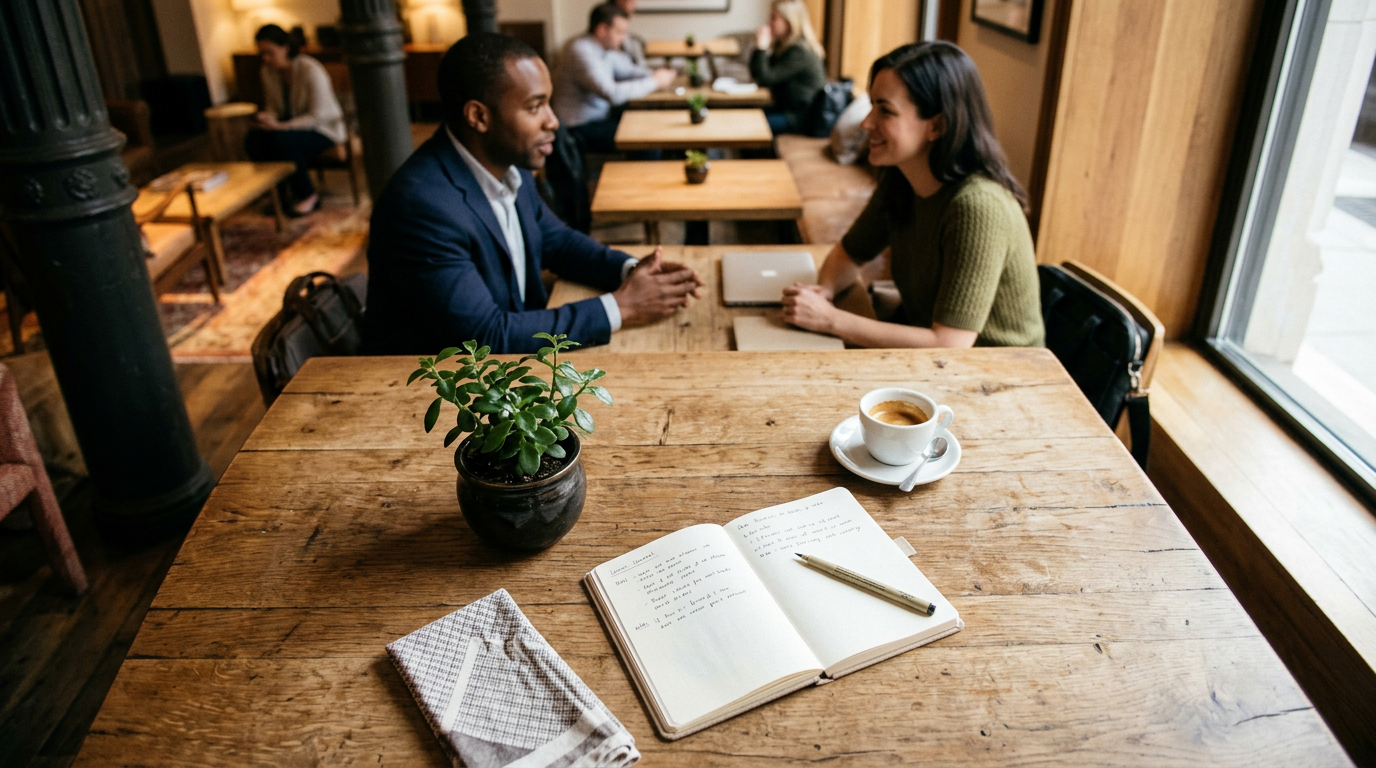
A coffee meeting in NYC should have a shape. Not a corporate agenda document. A shape.
The clean version is 25 to 35 minutes:
- Minutes 0-5: context and rapport
- Minutes 5-15: the actual topic
- Minutes 15-25: specific asks, ideas, or connections
- Minutes 25-30: next steps and graceful exit
Open with a sentence that proves you are not there to wander.
Good openers:
- “Thanks for making the time. I thought it would be useful to compare notes on early-stage GTM in New York, and I have two specific things I wanted to ask you.”
- “I know you are tight today, so I will keep this useful. I am trying to sanity-check a move before I make it.”
- “I liked your point at the Meetup about enterprise pilots. I wanted to ask what you are seeing outside the panel version of that conversation.”
Bad openers:
- “So, tell me your story.”
- “I just wanted to pick your brain.”
- “I thought we could vibe and see what happens.”
New Yorkers are not allergic to warmth. They are allergic to unclear demands on their time.
Bring one clear reason for the meeting. Bring one useful thing for them. That second part matters. It might be a relevant intro, a sharper view of a market, a candidate lead, a venue recommendation for a founder dinner, or a pattern you are seeing from customers.
If you are the one who asked for the meeting, your job is to carry the structure without making it stiff.
What to order / what to look for
Order fast. This is not the moment to ask the barista seven questions about anaerobic processing unless the meeting is specifically about coffee. NYC cafés in work neighborhoods run on flow.
Safe orders:
- Drip coffee if the line is moving and the meeting is short.
- Espresso, cortado, cappuccino, or iced coffee if you want something simple.
- Tea or sparkling water if you are already over-caffeinated.
- A pastry only if the other person is eating or the meeting is more social than transactional.
If the café is known for single-origin pour-over and the bar is not backed up, fine. Otherwise, do not turn your meeting into a performance of taste.
What to look for in the room:
- Two-tops with enough spacing to discuss work without broadcasting confidential details.
- A clear place to stand if you arrive early and seats are full.
- Natural light, not because it is pretty, but because people stay more alert.
- Outlets only if this is a working session, not a get-to-know-you coffee.
- A bathroom if the other person is coming from another meeting across town.
- Low enough noise for names, numbers, and nuance.
If you need to review a deck, pick a coworking lounge, hotel lobby, or quiet café table with enough depth for a laptop. Do not open a laptop in a cramped espresso bar and annex the table like you pay rent there.
One quiet power move: arrive ten minutes early, buy your drink, and scout seating before the other person gets there. Text a simple note if the room is crowded: “I am here and grabbing the two-top near the back.” That removes friction immediately.
Best time of day to go
!People with coffee outside a Manhattan café after rain near the subway

The strongest NYC coffee windows are not random.
8:00 to 9:15 a.m. works for founders, executives, and operators who want the meeting before Slack starts shouting. It signals seriousness. It also punishes anyone with a long commute, so use it carefully.
10:00 to 11:30 a.m. is the sweet spot for most professional coffees. The morning rush has thinned, people have handled urgent messages, and cafés are not yet lunch-adjacent.
2:00 to 4:00 p.m. works for freelancers, creators, agency people, and investors stacking meetings between calls. It is also when many cafés are calmer, especially outside Midtown.
Avoid:
- Monday before 10 a.m., unless both people are intense calendar people.
- Friday late afternoon, unless the relationship is already warm.
- Lunch rush in coffee shops that also sell real food.
- Peak tourist corridors if you need a serious conversation.
- Rainy-day chaos near major subway hubs.
For neighborhoods, be practical. Flatiron, NoMad, Union Square, SoHo, Williamsburg, Dumbo, Chelsea, and Midtown South all make sense depending on the person's orbit. The best location is usually near the more senior or busier person's next commitment. That is not deference. It is operational intelligence.
Etiquette and unwritten rules
NYC coffee etiquette is direct, but it is not cold.
Show up early. Five minutes is enough. Fifteen can be awkward in a small room. If you are late, text before the meeting time, not after. Subway delays are real; silent lateness is still rude.
The person who asked usually pays. Do not make a theatrical fight over a $6 coffee. If they insist, let them. If you are meeting someone more junior, buy. If you are asking for advice, buy. If this is a peer catch-up, either way is fine.
Keep the first meeting short. A 25-minute coffee that ends well is more valuable than a 70-minute sprawl that leaves both people behind on work. If the conversation has real energy, say: “I want to be respectful of your time. We can either wrap here or keep going for ten if you have room.”
Do not pitch through their whole drink. Ask questions. Use specifics. If you want funding, say you are fundraising. If you want clients, say what kind. If you want advice, define the decision.
Confidentiality matters. NYC rooms are full of adjacent people. Do not name clients loudly. Do not discuss layoffs, investor terms, acquisition rumors, or someone's private career move at full volume. Lower your voice or move the conversation elsewhere.
Also: do not camp. If the café is packed and you finished 30 minutes ago, either order again or leave. Third-wave coffee shops are not free offices with espresso aesthetics. The post-pandemic coworking reset pushed more work back into cafés, and staff can tell who respects the room.
How to actually meet people there
Most coffee meetings are scheduled elsewhere: AngelList messages, Lunchclub matches, Meetup conversations, On Deck alumni threads, Slack groups, founder dinners, coworking intros, or the sidewalk after a panel. The café is where the weak tie becomes real. Granovetter's old point still holds: weak ties often carry opportunity because they connect you to circles you do not already live inside.
Your job is to make that weak tie easy to trust.
Before the meeting, send a short confirmation:
- “Looking forward to tomorrow. I booked 30 minutes. Main thing I would love your take on: whether founder-led sales still works for our buyer at this stage.”
During the meeting, listen for three types of openings:
- A problem they are actively solving: hiring, distribution, venue, vendor, investor, community, positioning.
- A person they mention twice: that is likely someone important in their current orbit.
- A decision with a deadline: deadlines create useful follow-up.
Good conversation openers once seated:
- “What are you seeing in New York right now that people outside the city are misreading?”
- “Where are you spending time in person this year that is actually worth it?”
- “What kind of introductions are useful to you right now, and what should I not send?”
- “What is one room you think more operators should be in?”
If you meet someone organically in a café, keep it light. Do not interrupt headphones. Do not cold-pitch someone mid-email. The only acceptable cold open is situational and low-pressure:
- “Quick question, are you here for the fintech Meetup too, or just working?”
- “I heard you mention hiring a lifecycle marketer. I know someone strong there. Happy to send a name if useful.”
Then stop talking. Let them opt in.
The follow-up that separates pros from collectors
Follow up the same day. Not three days later. Not after you have “had time to process.” Same day.
A strong follow-up has four parts:
- Thanks without gushing.
- One specific thing from the conversation.
- One promised item.
- One clean next step, if there is one.
Example:
“Thanks again for meeting this morning. Your point about selling to ops before finance was useful. I am sending the hiring community I mentioned and the name of the founder dinner host in Brooklyn. If it is useful, I can also introduce you to Maya, who is selling into a similar buyer.”
If you promised an intro, ask permission from both sides unless the relationship norms are already clear. Use a forwardable blurb. Make it easy.
If there is no next step, do not invent one. Send a useful note and let the relationship breathe. Not every coffee has to become a pipeline item.
Create a simple personal CRM if you take a lot of meetings. It can be Notion, Airtable, a notes app, or your actual CRM. Track:
- Name and context.
- Where you met.
- What they care about.
- One personal detail that is not creepy.
- Promised follow-up.
- When to reconnect.
The goal is not to collect people. It is to remember enough to be useful later.
Mistakes to avoid
The biggest mistake is using coffee as a vague ask. “Would love to connect” is weak. “I am deciding whether to open a New York sales motion before hiring a VP, and I would value your read” is strong.
Other avoidable errors:
- Picking a café because it looks good on Instagram, then shouting over grinders for 30 minutes.
- Asking for 60 minutes when 25 would do.
- Bringing a laptop deck to a tiny table without warning.
- Treating a senior person's time like free consulting.
- Waiting a week to send the intro you promised.
- Turning the conversation into therapy about your startup, client roster, or career uncertainty.
- Name-dropping member's clubs, investors, or founders as a substitute for substance.
- Sitting at a four-top during a rush when there are two of you.
- Forgetting that baristas are working, not background characters in your networking scene.
One more: do not over-optimize. The point of a coffee meeting is not to perform perfect local fluency. It is to create enough trust for the next useful exchange.
The NYC version of a good coffee meeting
A good New York coffee meeting has pace. It has a reason. It respects the room. You show up with a clear ask, a useful give, and enough awareness to end on time.
The city is full of rooms where something can happen: a Devoción table in Williamsburg, a Joe Coffee near an office cluster, a quiet hotel lobby in NoMad, a hot desk lounge at Industrious, a post-panel walk from a Meetup to the nearest decent espresso bar. The venue matters, but only as a container.
What matters more is the behavior.
Be specific. Be early. Buy the coffee if you asked. Keep the meeting tight. Send the follow-up before the day ends. Make one useful introduction when you can. Then keep showing up in the same circles until people know what you are about.
That is how coffee in New York turns from a calendar block into actual local capital.
Discussion (0)
Loading comments…