
The NYC coffee order that doesn’t mark you as new
The line at Devoción in Williamsburg moves fast until someone asks for “whatever is popular” while the barista is already tamping espresso, steaming milk, and clocking the next three people. New York coffee is not unfriendly. It is allergic to indecision at the register.
That matters if you use cafés as a second office, a pre-meeting holding pattern, or a soft networking room between coworking days at WeWork, Industrious, Spaces, or a member’s club. In 2026, the serious coffee shop is still one of the most useful rooms in the city. Not because it replaces a founder dinner, Lunchclub intro, Meetup, or AngelList DM. Because it gives you low-stakes proximity to operators, designers, engineers, agents, editors, and freelancers who are also between calls.
The trick is not sounding like you learned third-wave coffee from a menu board five minutes ago. Order cleanly. Sit correctly. Talk rarely but well. Leave a reason for someone to remember you.
The New York coffee room is not one room
NYC third-wave coffee has matured past the phase where every café wanted to educate you for fifteen minutes. The best places now have distinct jobs.
A tiny East Village espresso bar is for standing, ordering fast, and moving on. A Brooklyn roaster café with communal tables can handle a single-origin pour-over and a 30-minute email session. A Midtown specialty shop near offices is a high-throughput caffeine stop, not your personality showroom. A neighborhood café in Fort Greene, Greenpoint, or the Upper West Side may tolerate laptops in the morning and quietly resent them after lunch.
Well-known names set different expectations. Devoción is serious about Colombian coffee and usually feels like a room people deliberately chose. Sey Coffee in Brooklyn attracts coffee people who notice processing methods. Joe Coffee and Cafe Grumpy are reliable New York working cafés, depending on the location and hour. Blue Bottle and La Colombe are familiar enough that you can order without ceremony. Abraço in the East Village is more about the counter, espresso, and rhythm than camping out.
The local move is matching the order to the room. Do not make a fast espresso bar perform a tasting ritual. Do not treat a roaster café like a drive-through. Do not drag a laptop into a place with eight seats and act surprised when the staff goes cold.
What to order / what to look for
!Cappuccino and coffee on a small café table beside a laptop
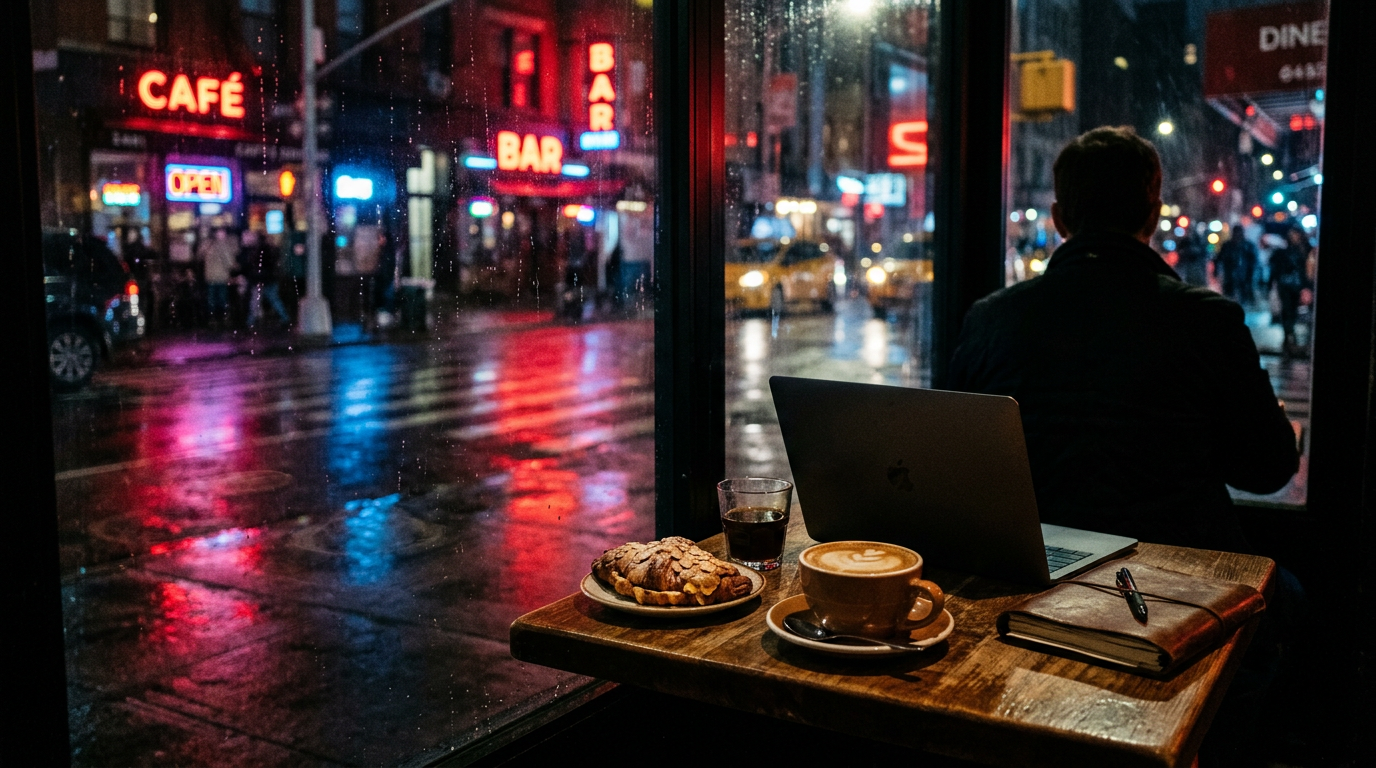
If you want to sound competent, ask for something specific but not theatrical. You do not need to recite origin notes. You need to show you understand the format.
Good orders in most NYC third-wave shops:
- “A cappuccino for here.” Clean, normal, respected. If the shop is espresso-led, this is never wrong.
- “An espresso and a sparkling water, if you have it.” Direct. Good at standing bars and tiny shops.
- “A batch brew, whatever you’re serving.” This is the underrated adult order. Serious shops often dial in batch brew well, and it keeps the line moving.
- “A pour-over of the washed coffee, if that’s the brighter one.” Specific enough to be useful, not performative.
- “An iced americano.” Better than inventing an off-menu cold drink during a rush.
- “A flat white, if that’s on your menu.” Do not demand it if it is not listed.
What to look for before ordering:
- Is there a separate pour-over menu, or just espresso and batch brew?
- Are people waiting behind you with commuter energy?
- Is the pastry case part of the operation, or clearly secondary?
- Are laptops open, or is the room mostly conversation and quick turnover?
- Is the barista inviting questions, or moving at peak-hour speed?
If you want milk, order milk. New Yorkers do not care that you “usually drink it black.” If you want oat milk, say oat milk. The amateur move is apologizing for your own drink.
If you want a single-origin pour-over, ask one useful question: “Which coffee is drinking cleaner today?” or “Which one is more fruit-forward?” That gives the barista something concrete. “What’s your favorite?” is fine when the shop is slow. During a rush, it makes you another task.
Food order? Keep it simple. At serious coffee bars, the pastry program may be excellent or merely present. If the room smells like laminated dough and everyone has the same pastry, order one. If food looks like an afterthought, do not build your morning around it.
Best time of day to go
New York cafés run on waves. If you hit the wrong one, you will misread the place.
7:30 to 9:30 a.m.
This is commuter compression. Order fast. No long questions. No laptop unless the room is clearly built for it. This is the right time for espresso, cappuccino, batch brew, or drip coffee. It is the wrong time to ask for a guided tour of anaerobic processing.
10:00 to 11:30 a.m.
The best window for working operators. The rush thins, tables turn, and baristas have a little more bandwidth. If you want a pour-over and a quiet seat before a call, this is your slot.
1:30 to 3:30 p.m.
Good for loose networking. Freelancers reappear. Founders between meetings kill time before heading to a coworking space, investor coffee, or late lunch. The room is less transactional. You can start a short conversation without violating the city’s immune system.
After 4:00 p.m.
Be careful. Some cafés feel tired. Others become ideal for a final espresso before a gallery opening, founder dinner, natural wine bar meetup, or supper club. If the staff is cleaning around you, do not settle in.
The best single move: become a regular in one 90-minute window, not a random face at every café in the city. Ambient awareness does work. People start recognizing your face before they know your name, which makes the first conversation less awkward.
Etiquette and unwritten rules
!People waiting outside a Brooklyn specialty coffee shop
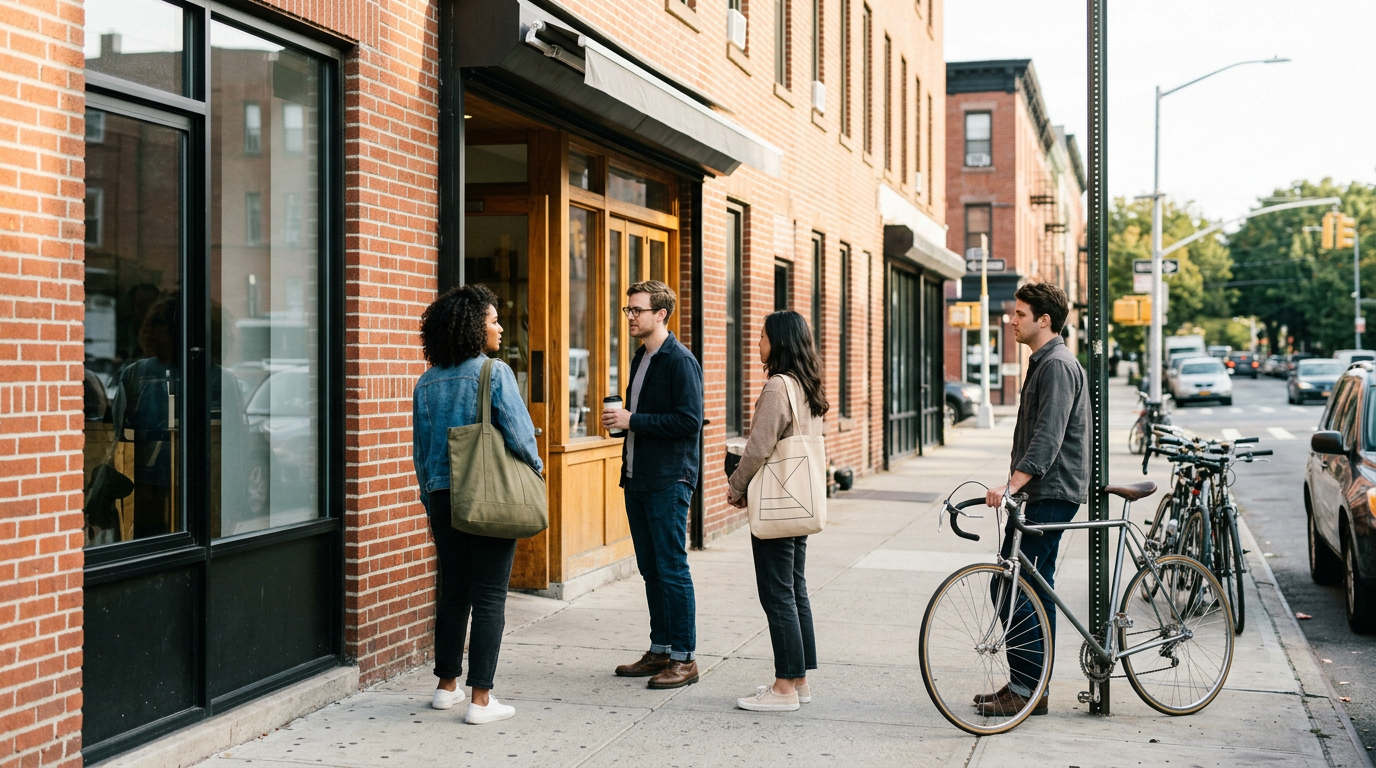
New York café etiquette is mostly about not taking more than your share of the room.
- Order before sitting unless signage or layout clearly says otherwise.
- If you take a table during peak hours, buy more than one small coffee if you stay past an hour.
- Do not conduct investor calls on speaker. Ever.
- Use headphones for calls, and keep your voice below pitch-deck volume.
- Do not spread across a four-top because your tote bag has feelings.
- If outlets are scarce, charge briefly and move on.
- Tip like you plan to come back.
- Ask before photographing the bar, staff, or other customers.
- If there is a laptop policy, respect it without negotiating.
Post-pandemic coworking shifts changed café behavior. More people work remotely, but cafés did not magically become free offices with espresso machines. Many owners now use soft controls: tiny tables, limited outlets, Wi-Fi passwords that change, laptop-free weekends, or pointed silence when someone overstays.
Read those signals. A hot desk at Industrious or WeWork is for four hours of work. A café table is for a short work block, a meeting, or a reset. Confuse the two and you become the person everyone notices for the wrong reason.
How to actually meet people there
You do not meet people in New York cafés by scanning the room like a recruiter at a conference. You meet them through small, context-aware openings.
Good conversation openers:
- “Is this seat open, or are you holding it for someone?” Simple, useful, normal.
- “Have you had the batch brew here lately?” Works if you are both near the bar, not if they are typing hard.
- “Quick question — is this a good place for a 20-minute call, or does it get loud?” Practical and noninvasive.
- “I see you’re using that portable stand. Is it actually worth carrying?” Works with freelancers and operators because gear is neutral territory.
- “Are you coming from the coworking space nearby, or is this your usual office today?” Use only when the context supports it.
Bad openers:
- “What do you do?” Too abrupt.
- “Are you a founder?” Too thirsty.
- “Can I pick your brain?” No.
- “I’m building something that will change coffee/networking/AI.” Nobody asked.
The strongest café networking is based on weak ties, the Granovetter idea that looser connections often bring new information. You are not trying to make a best friend over a cortado. You are trying to create a light connection that can become a warmer intro later.
Follow-up moves that do not feel forced:
- If you had a real exchange, say, “Good talking — want to swap LinkedIn? No pressure.”
- If they mentioned an event, ask for the name, not a personal invite.
- If you promised a link, send it the same day with one sentence of context.
- If you both work nearby, suggest a specific low-commitment repeat: “I’m usually here late mornings on Wednesdays.”
- If they are clearly busy, end first. “I’ll let you get back to it” is a power move.
Do not pitch in the café. Earn the second room. The pitch belongs at a scheduled coffee, a founder dinner, a Meetup after-party, a South Park Commons-style salon, or a direct intro where the other person opted in.
What not to say at the register
Some phrases are harmless in other cities and oddly exposing in New York.
Avoid:
- “What’s your most Instagrammable drink?”
- “Can you make it not taste like coffee?”
- “I saw this on TikTok.”
- “What’s the least acidic thing?” when you really mean less bitter.
- “Can I get a macchiato?” if you mean a large caramel drink from a chain.
- “Surprise me” during a line.
- “I’m a coffee snob.” Actual coffee people rarely announce this.
Better replacements:
- “What’s the smoothest milk drink on the menu?”
- “Do you have a darker espresso option today?”
- “Is the batch brew more chocolatey or more floral?”
- “I’m looking for something bright but not too wild.”
- “Can you do that iced, or should I order something else?”
The point is precision. Baristas can help when you give them a direction. They cannot read your fantasy drink from three adjectives you picked up online.
Mistakes to avoid
The biggest mistake is treating third-wave coffee as a performance. New York punishes performance quickly.
- Do not over-order. A rare single-origin pour-over is wasted if you are taking a call while it cools.
- Do not correct the barista’s pronunciation unless you roast coffee for a living, and even then, probably do not.
- Do not ask for ten modifications in a shop that clearly does not operate that way.
- Do not camp at a two-top through breakfast and lunch with one drink.
- Do not bring a large team meeting into a small café because the office vibe felt stale.
- Do not assume every café wants laptop workers. Some want neighborhood turnover.
- Do not mistake a polite barista for a networking lead.
- Do not crowd the handoff plane. Step aside after ordering.
Also: stop apologizing for not knowing everything. A clean question is fine. The awkward part is turning your uncertainty into a whole scene.
The local order that works almost anywhere
If you are unsure, order this: “A cappuccino for here, please.” If it is hot out: “An iced americano, please.” If the shop has a serious brewed coffee setup: “Batch brew, whatever you’re serving.”
Those orders say you know where you are. They let the staff do their job. They do not slow the room down. From there, you can learn the place over repeat visits.
That is the real New York move. Pick one or two cafés near your actual life, not the one with the loudest online following. Learn when the room works. Order without drama. Be generous with space. Start one useful conversation a week. Follow up cleanly.
A third-wave coffee shop is not a networking hack. It is a room with rules, taste, labor, rent pressure, and regulars. Respect that, and you will sound less like a tourist before the first sip.
Discussion (0)
Loading comments…