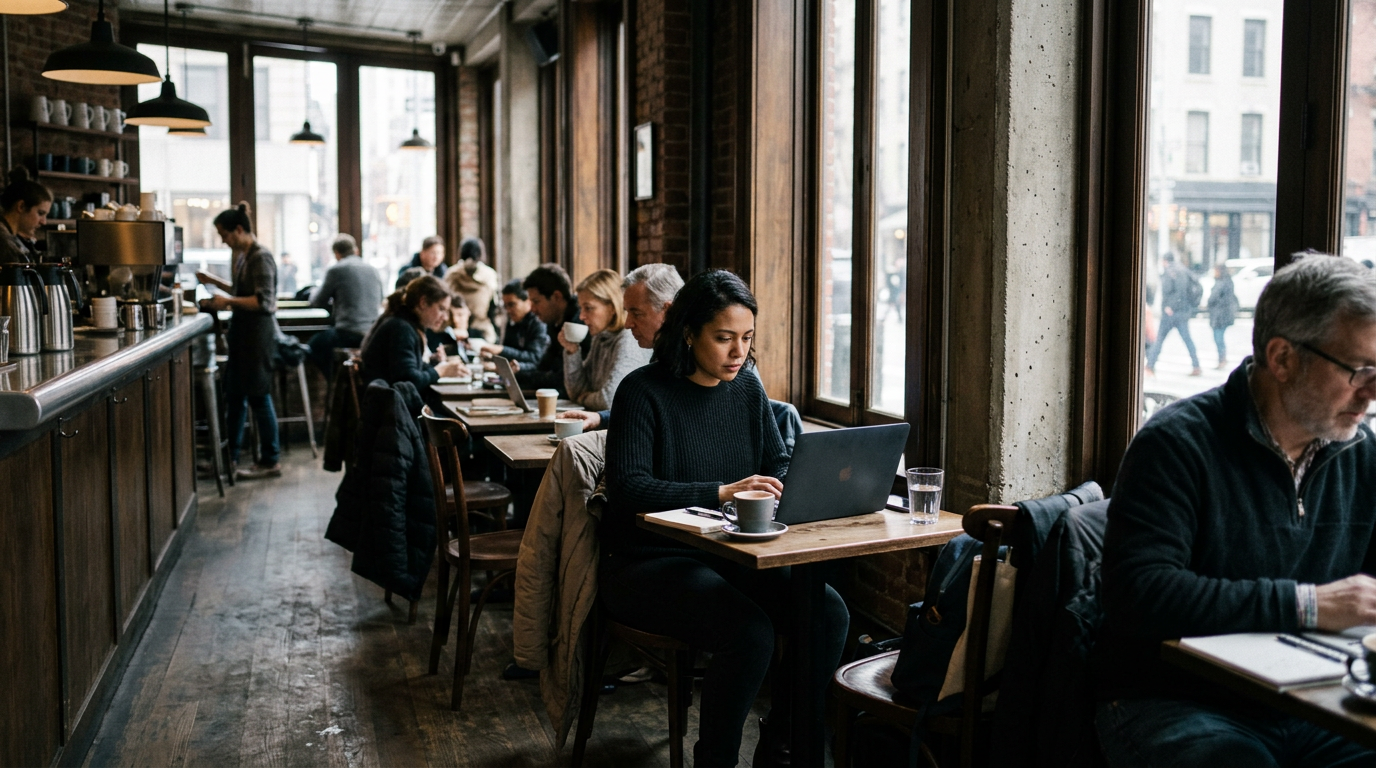
NYC coffee shops where laptops still make sense
At 9:20 on a Tuesday in Flatiron, the room tells you everything. One founder is editing a pitch deck with AirPods in. A designer is guarding the one outlet like rent-stabilized real estate. Two people who clearly met on Lunchclub are doing the soft networking voice over cortados. The barista has already moved three abandoned laptops off a four-top with zero drama.
That is the NYC coffee work scene in 2026: useful, stricter, and not pretending to be coworking. The city still has excellent coffee shops for getting real work done, but the old move of camping for five hours on one drip coffee is dead in any room with rent, staff, and a line out the door.
The best coffee shops in NYC for work now are not always the prettiest ones. They are the rooms with enough tables, tolerable sound, reliable staff rhythm, and a customer base that understands the deal. You are looking for a place that can hold your laptop session without making you the problem.
The NYC coffee work map has changed
Third-wave coffee is mature here. Single-origin pour-over, good espresso, natural-process beans, and proper milk texture are no longer rare enough to determine where you should work. The practical stuff matters more.
Look for:
- Tables that are not packed shoulder-to-shoulder
- At least a few outlets, even if you should arrive fully charged
- Staff who do not flinch when they see laptops
- Noise that sits below full restaurant volume
- A bathroom policy you can live with
- Enough foot traffic to feel alive, not so much that you are blocking revenue
NYC cafés have also absorbed the post-pandemic coworking shift. WeWork, Industrious, Spaces, NeueHouse, and member’s club rooms still handle calls, teams, and long stays better than cafés. Coffee shops now sit in a narrower lane: two to three hours of heads-down work, a first meeting, a pre-event reset, or a low-stakes founder catch-up before a dinner or Meetup.
The strongest categories in 2026:
- Large-format third-wave cafés: Devoción, La Colombe, Think Coffee, and some Joe Coffee locations can work when the room is built for lingering.
- Neighborhood workhorse cafés: Birch Coffee, Variety Coffee, Cafe Grumpy, and Partners Coffee are better for repeat local routines than one-off all-day camping.
- Hotel lobby coffee setups: useful for meetings when you need a more neutral room and can buy properly, but do not treat them like a free office.
- Campus-edge cafés: near NYU, Columbia, and downtown Brooklyn, laptop culture is expected, though turnover can be intense.
The trick is matching the room to the job.
The rooms that work by neighborhood
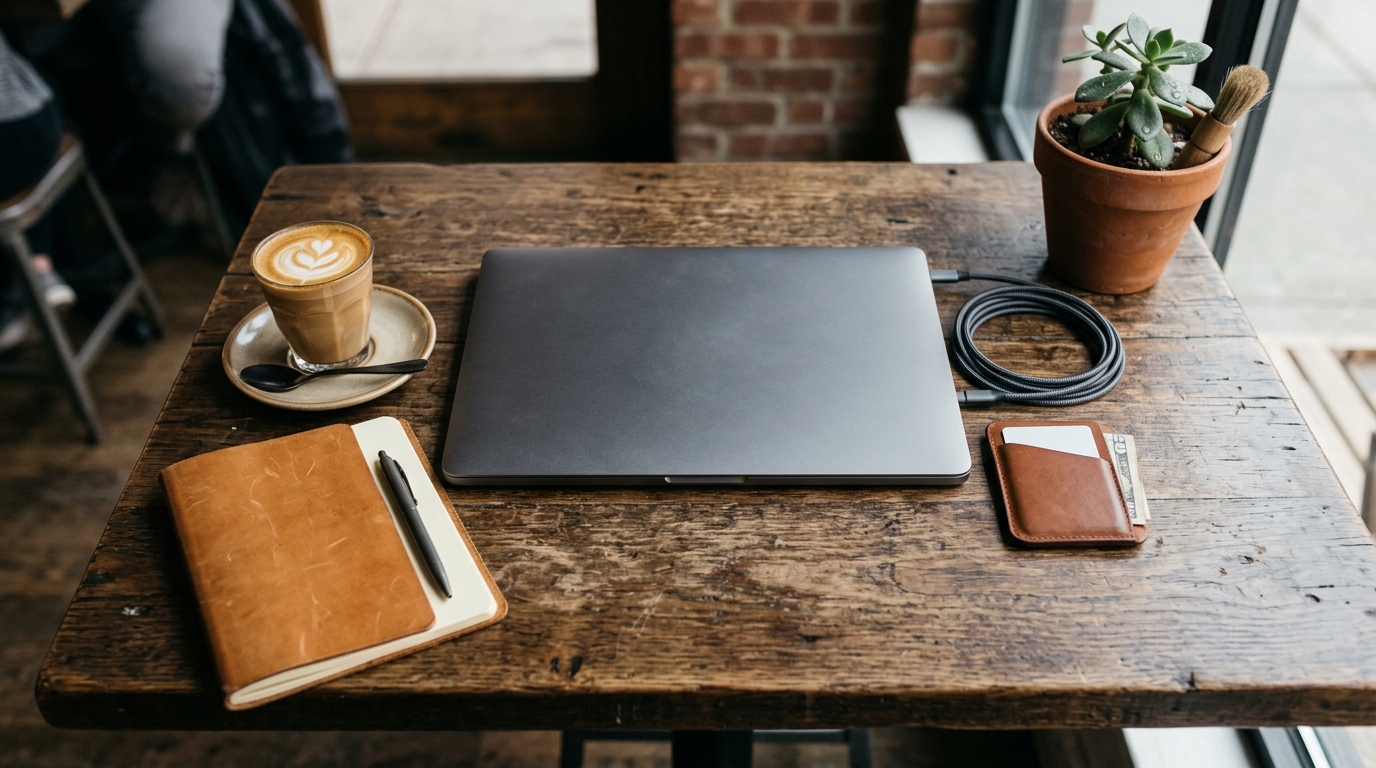
!Laptop, cortado, and notebook on a small NYC cafe table
Manhattan
Flatiron, NoMad, Union Square, and Greenwich Village are still the most practical zones if you are hopping between investor meetings, agency offices, and coworking spaces. La Colombe and Joe Coffee are often better for short, focused blocks than tiny espresso bars with six stools. Think Coffee remains a classic student-and-operator room in the NYU orbit, which means laptops are normal but seats can disappear fast.
SoHo and Nolita are harder. The coffee is strong, the rooms are often beautiful, and the laptop tolerance can be low because tourist traffic and shopping breaks crush the floor plan. If you need to edit a deck, do not choose the most photogenic room on a retail block. Choose the slightly less glamorous café with back tables and customers who look like they live nearby.
Midtown is underrated for functional work if you stop expecting personality from every room. Around Bryant Park, Grand Central, and Rockefeller Center, you will find corporate-adjacent cafés where a 45-minute email sprint makes sense. Longer stays are better handled by a day pass at a coworking space.
Brooklyn
Williamsburg still has the density: Devoción, Partners Coffee, Variety Coffee, and plenty of serious espresso rooms with a laptop population. The catch is timing. By late morning, some cafés become social rooms, meeting rooms, stroller routes, and remote-work spillover all at once.
Greenpoint is calmer if you choose well. Park Slope and Carroll Gardens are good for solo writing blocks, but many neighborhood cafés are not built for long calls or full-screen spreadsheet marathons. Respect that. Brooklyn coffee shops are often community rooms first and laptop rooms second.
Downtown Brooklyn and Fort Greene can be strong if you are moving between transit, court buildings, startups, and cultural offices. Look for larger tables, not just better espresso.
Queens
Long Island City works for people splitting time between Midtown and home. Astoria is better for neighborhood regularity than one-off laptop hunting. Jackson Heights and Flushing have excellent food and café culture, but not every room is designed for MacBook work. If your task is email triage or reading, you can do well. If your task is three hours of uninterrupted production, pick your seat carefully or use coworking.
What to order / what to look for
Order for the amount of space and time you are using. That sounds basic. In NYC, it is the whole social contract.
For a short session:
- Espresso, cortado, cappuccino, or batch brew
- Sit at a counter, bar rail, or small two-top
- Leave before the room turns over for lunch
For a two-to-three-hour work block:
- Coffee plus food, or a second drink after 90 minutes
- Batch brew or cold brew if you do not want to wait through a slow bar
- A pastry, toast, or sandwich if the café has a kitchen program
For taste-first mornings:
- Single-origin pour-over when you are not in a hurry
- Ask what is drinking clean or fruit-forward without turning it into a lecture
- Tip like you understand the labor behind a slow bar
What to look for before you unpack:
- Are laptops already open on more than two tables?
- Are people taking calls, or stepping outside for them?
- Are outlets visible, taped over, or clearly not part of the deal?
- Is there a host-like staff presence managing tables?
- Is the music workable or engineered to keep people moving?
If the room is all marble two-tops, no outlets, and couples ordering full brunch, your laptop is the wrong tool for that room.
Best time of day to go
!People working inside a Brooklyn coffee shop in late afternoon light
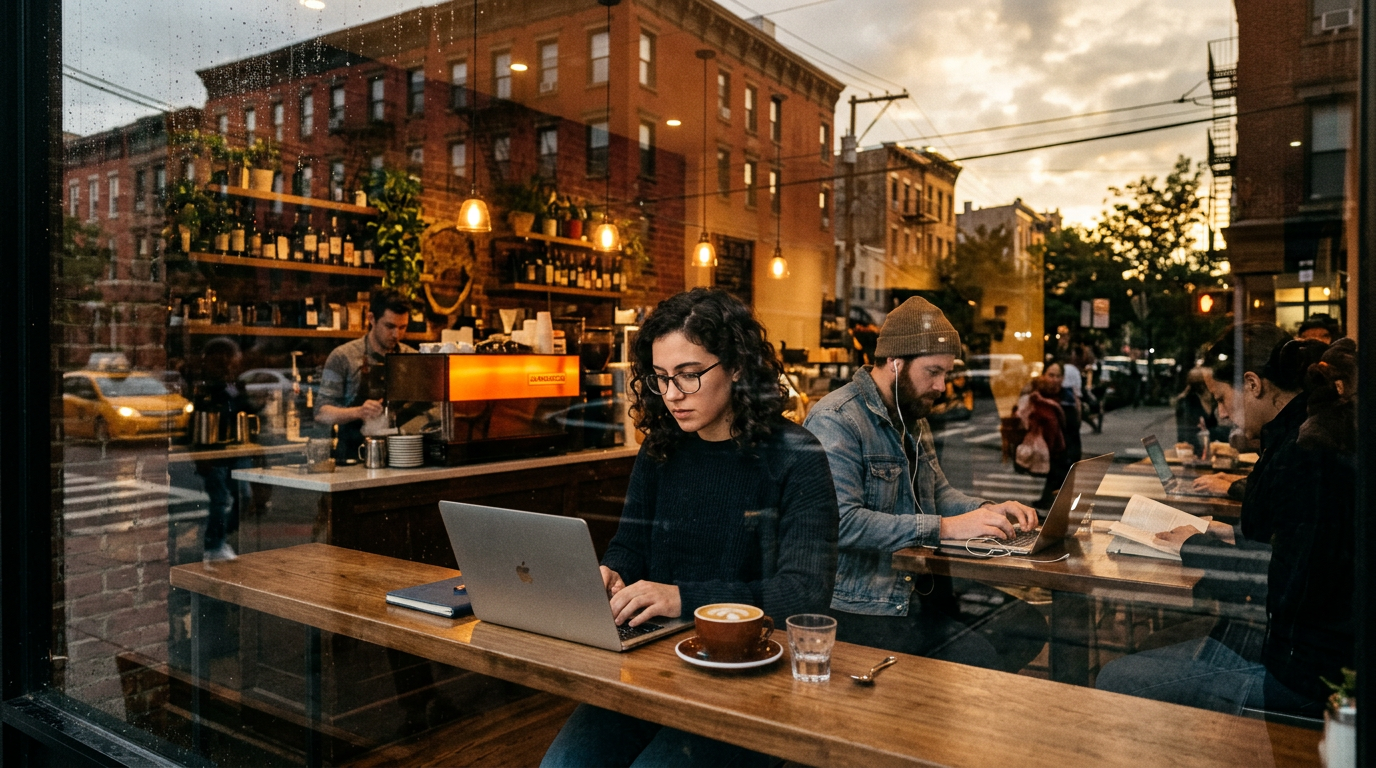
NYC rewards people who arrive before the obvious rush.
- 7:30 to 9:00 a.m.: best for serious solo work if the café opens early. You get clean tables, calm staff, and first pick of seating.
- 9:30 to 11:30 a.m.: best for casual coffee meetings. The room has energy, but it has not fully turned into lunch overflow.
- 1:30 to 3:30 p.m.: best for admin, inbox work, and short creative blocks. Lunch has cleared, and many cafés reset.
- After 4:00 p.m.: inconsistent. Some places become date spots, wine bars, or pre-dinner holding rooms. Others empty out nicely.
Monday mornings are quieter than Tuesday through Thursday. Friday afternoons can be excellent if you are not trying to meet anyone. Sunday is usually bad for laptop work in neighborhood cafés. Brunch traffic does not care about your Notion board.
Etiquette and unwritten rules
NYC is direct, but not cruel. If you are behaving reasonably, staff will usually let you be. If you are treating a coffee shop like a private office, the room will correct you.
Rules that matter:
- Do not take a four-top alone unless the room is empty.
- Do not join a video call without headphones.
- Do not talk through a sales call at normal voice in a packed café.
- Do not leave your laptop to save a seat for 20 minutes.
- Do not spread across two seats with a charger, notebook, bag, jacket, and emotional support water bottle.
- Do not ask the barista to watch your stuff.
- Do not complain when a café has no Wi-Fi. That is a choice, not a service failure.
- Buy again if you stay through a second service rhythm.
- Bus your dishes when the room is busy, even if no sign asks you to.
The best move is simple: ask early. Try, “Is it okay if I work here for a bit, or do you keep laptops to certain tables?” Staff appreciate the question because it gives them a clean way to set terms.
If a café has laptop-free tables, believe the sign. If outlets are covered, that is not a puzzle. If the Wi-Fi password is not offered, do not make it weird.
How to actually meet people there
Coffee shops are not networking events, but they are good at weak ties. Granovetter’s weak-ties idea still holds: loose connections often carry new information, intros, and opportunities better than your tight circle does. NYC is built on that kind of ambient proximity.
Do not cold-pitch the room. Become familiar.
Useful openers:
- “I’ve seen you working here a few mornings. Are you nearby or just using this as your office today?”
- “That looks like a product deck. Are you building something in SaaS or am I projecting?”
- “I’m between meetings near Union Square. Do you know a better room around here for calls?”
- “I’m trying to find a decent Tuesday founder dinner that is not just crypto noise. Heard of any good ones lately?”
- “I saw the AngelList tab. Are you hiring, fundraising, or just doing market research?”
Keep it light. One question, not a monologue. If they answer warmly, continue. If they put headphones back on, that is the answer.
Follow-up moves that work:
- Send a LinkedIn note the same day with one specific reminder.
- Offer one useful intro, article, venue tip, or event link.
- Suggest a 20-minute coffee the following week, not a vague someday.
- If you met before a Meetup, founder dinner, On Deck alumni hang, or South Park Commons-adjacent event, reference the context.
Baristas can also be useful local nodes, but do not mine them for contacts while they are working a line. Be a regular. Tip. Learn names. Ask for one recommendation at a slow moment, not ten.
Mistakes to avoid
The biggest mistake is choosing coffee based on Instagram instead of task fit. A beautiful espresso bar can be terrible for work. A plain room with good drip and normal chairs can save your day.
Avoid these:
- Planning a Zoom-heavy day around cafés instead of booking a phone booth or day pass.
- Assuming every third-wave coffee shop wants laptops.
- Arriving at 10:45 a.m. and expecting the best seat.
- Bringing a full monitor stand, mouse pad, and office setup.
- Taking meetings in cafés that involve confidential hiring, fundraising, legal, or client details.
- Ordering the cheapest item and staying through breakfast, lunch, and afternoon service.
- Treating Brooklyn neighborhood cafés like Midtown hotel lobbies.
- Ignoring staff signals because no one explicitly asked you to leave.
Also avoid over-optimizing. The point is not to find one perfect café forever. NYC changes by hour, block, season, and staff shift. Build a rotation.
A practical 2026 NYC coffee work rotation
For founders, freelancers, creators, and operators, the smart rotation looks like this:
- One reliable morning café near home for writing, inbox, and planning.
- One Manhattan meeting café near transit for first coffees and quick intros.
- One Brooklyn or Queens neighborhood room where you can become a recognizable regular.
- One coworking day-pass option for calls, investor updates, and long sessions.
- One evening social room that is not really for work: a natural wine bar, izakaya, supper club, or founder dinner where the laptop stays closed.
Coffee shops are strongest when you use them for what they are good at: focus, proximity, light meetings, and social surface area. They are not your office lease. They are not your therapist. They are not a free phone booth.
But used well, they still beat working alone in an apartment all week. Bring a charged laptop. Buy properly. Read the room. Leave before you become the cautionary example.
Discussion (0)
Loading comments…