NYC founders need better rooms, not bigger memberships
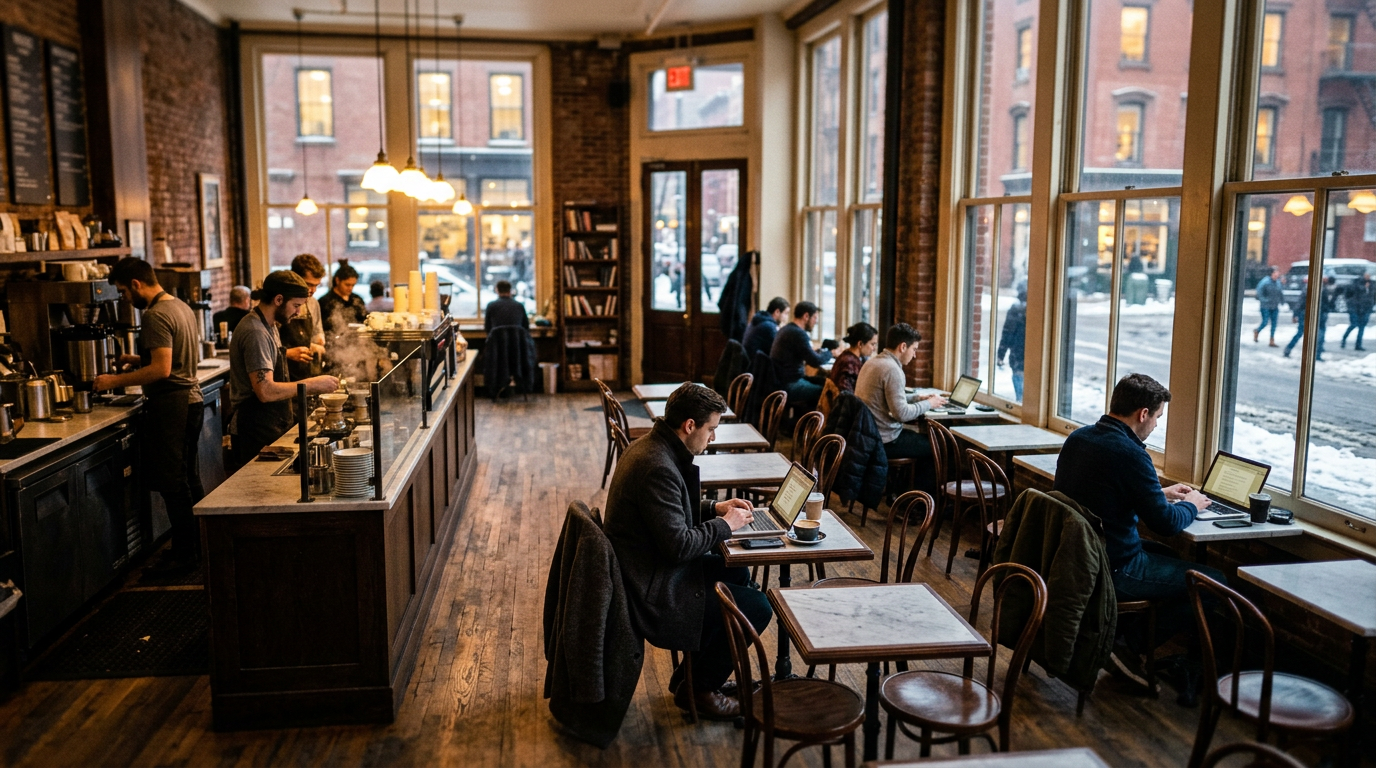
At 9:18 on a Tuesday morning in Flatiron, the useful room is not always the glassy coworking floor above you. It is often the coffee bar downstairs: one founder taking a call outside, a fractional CFO reading a deck on an iPad, two product leads doing the careful half-whisper that means they are not friends yet.
That is New York in 2026. The city is back to in-person, but not back to the old coworking fantasy where a hot desk automatically meant community. WeWork, Industrious, Spaces, NeueHouse, and Soho House still have a role. If you need a predictable desk, phone rooms, mail handling, guest check-in, or a conference room that does not smell like cold brew, buy the membership. No shame.
But for solo founders, especially pre-seed operators, consultants building a product, independent creators, and ex-startup people testing the next thing, the higher-value room is often a third place: a third-wave coffee shop, a hotel lobby, a natural wine bar before dinner service, a bookstore café, an izakaya counter, a run club cooldown, a standing founder dinner.
Coworking gives you infrastructure. Third places give you signal.
The NYC reality: membership is not the same as access
The promise of coworking was proximity. Sit near ambitious people, absorb opportunity, leave with a collaborator. The 2026 version is more mixed.
Post-pandemic coworking has become more operational and less social. Many companies use coworking as satellite office space. Many individuals use it as a quiet utility. People arrive with headphones, take calls, eat a salad from a Sweetgreen bag, and leave. The member app is not a room. The pantry is not a community just because five people are standing near sparkling water.
New York also has a specific social problem: nobody wants to be trapped. A founder will talk to you at a bar seat because both of you can exit naturally. They may not want to be pitched in a dedicated desk area where they have to see you again tomorrow. The city rewards low-friction contact.
That is why third places outperform memberships for certain jobs:
- Finding peers before you need them
- Testing your idea in normal language
- Meeting operators outside your exact startup bubble
- Building trust through repeated low-stakes contact
- Creating reasons to follow up that are not fake
This is Granovetter’s weak ties idea in street clothes. The person who changes your trajectory is often not your closest friend. It is the adjacent person you see twice a month at the same coffee bar, investor breakfast, gallery opening, or industry-adjacent meetup.
What counts as a useful third place in New York
!Founders working and meeting inside a New York coffee shop
Not every café is a founder room. Not every bar is worth your time. The room matters.
A good solo-founder third place has three qualities: dwell time, mixed professional traffic, and permission to be present without buying the whole menu. In NYC, the strongest categories are usually:
- Third-wave coffee shops near work clusters. Think Flatiron, Union Square, SoHo, NoHo, Williamsburg, Dumbo, and parts of Greenpoint. Blue Bottle, Devoción, Joe Coffee, Cafe Grumpy, Birch, La Colombe, and Stumptown are known quantities. The exact brand matters less than the table geometry and crowd.
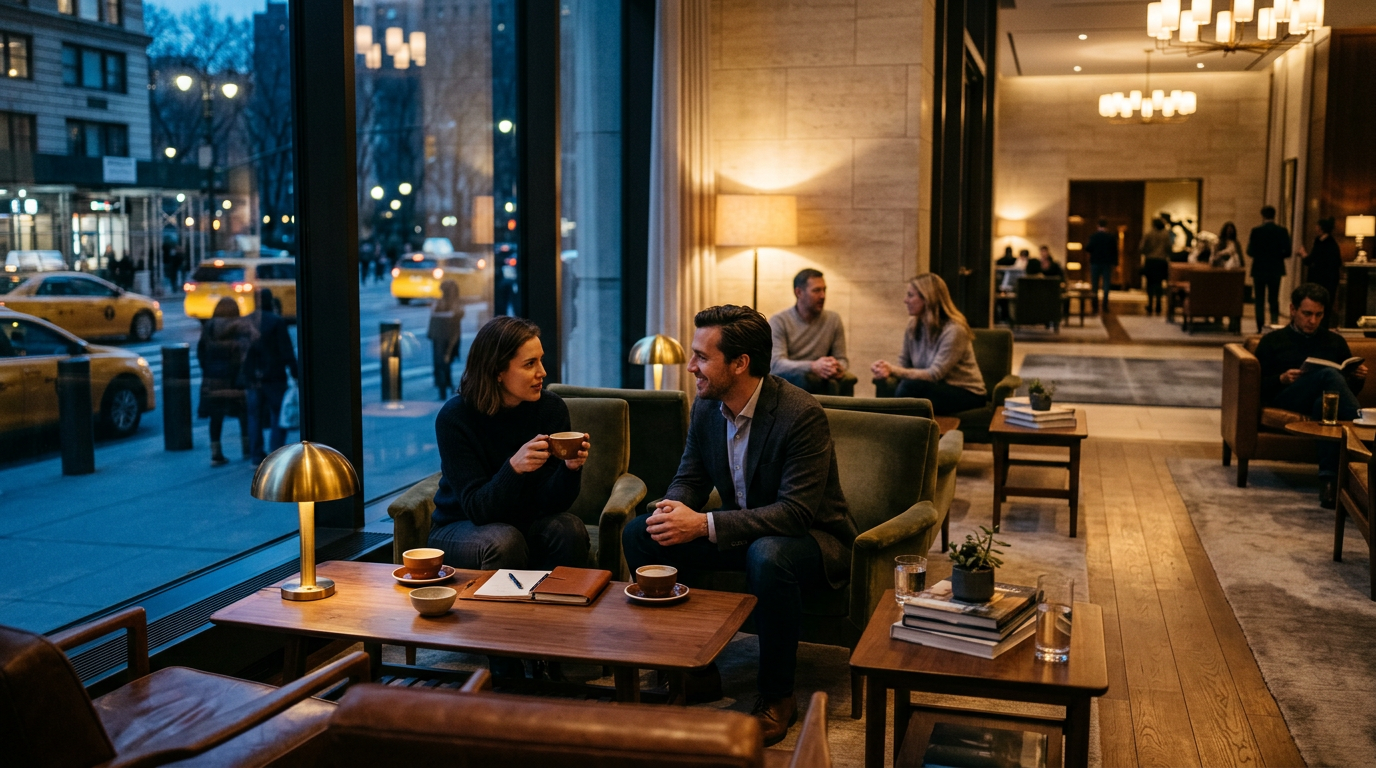
- Hotel lobbies with real seating. The right lobby lets people arrive early, take a casual meeting, and leave without ceremony. Avoid spaces where staff clearly need table turnover or where every seat is treated like a restaurant reservation.
- Natural wine bars at 5 p.m. Before the dinner rush, bar seats are unusually good for first meetings, founder decompression, and warm introductions. You are not doing a three-hour tasting. You are creating a softer room than a conference room.
- Bookstore cafés and cultural spaces. These work well for creator-founders, media people, design operators, and consultants. The conversation is less likely to start with ARR and more likely to start with what someone is actually building.
- Counters: izakaya, ramen, omakase-adjacent, and solo dining rooms. A counter removes the awkwardness of sitting alone. It also makes side conversations normal when handled with restraint.
- Recurring community rooms. Meetup still matters when the host is serious. So do AngelList-adjacent gatherings, Lunchclub-style intros, On Deck alumni circles, South Park Commons events when accessible, and small founder dinners hosted by operators rather than professional networkers.
The best room is not the fanciest one. It is the room where the same kind of person returns.
What to order / what to look for
Order for the room you are in. That sounds basic. It is not.
At a coffee shop, if you plan to stay more than 45 minutes, order like an adult. A single-origin pour-over is fine if the bar is not slammed. Espresso or drip is better during a line. Add food if you are occupying a table through the mid-morning meeting window. Tip. Bus your own mess if the place is set up that way.
At a wine bar, ask for something by the glass and give the bartender a lane: lighter red, high-acid white, something savory, something low-intervention but not funky for sport. Do not turn the staff into your private sommelier while you scan the room for prospects.
At a hotel lobby, look for seating that permits conversation without broadcasting it. Low tables near the edge of the room beat central sofas. If there is table service, order promptly. If there is not, do not treat the lobby like your rent-free office.
At a counter, order efficiently and read the pace. The bartender or server is not your networking assistant. If the room is moving fast, keep your laptop away.
Look for these signals before you settle in:
- Tables close enough for ambient awareness, not so close that every sentence is public
- A mix of laptops and live conversation
- People arriving for short meetings, not camping all day
- Staff who are calm rather than visibly annoyed by dwellers
- Repeat faces over two or three visits
- Natural exit points: coffee finished, glass empty, event ending, check dropped
The wrong room feels like extraction. The right room feels like you are adding to the normal rhythm.
Best time of day to go
!Early evening conversations at a New York wine bar counter

New York rewards timing more than charisma.
8:15 to 9:30 a.m. is strong near transit and office clusters. People are caffeinated enough to speak and not yet buried. Good for brief hellos, not long pitches.
10:00 to 11:30 a.m. is the prime coffee meeting window. If you want to invite someone for a first conversation, this is usually safer than lunch. It has a natural cap.
2:30 to 4:00 p.m. is underrated. Coffee shops clear out, operators take thinking breaks, and the mood is less performative. This is when you can actually write, then have one decent conversation.
5:00 to 6:30 p.m. is the third-place sweet spot for bars and lobbies. People are between work and dinner. The room has energy but not chaos.
Tuesday through Thursday still beats Monday and Friday for chance encounters. Monday is internal reset. Friday is scattered. Sunday evening can work for creator communities, supper clubs, and founder dinners, but only if the host has a real point of view.
One NYC-specific note: do not schedule across town casually. Williamsburg to Flatiron is reasonable. Greenpoint to FiDi at 4:30 is a tax on everyone. If you ask for the meeting, make the geography easy for the other person.
Etiquette and unwritten rules
The fastest way to lose a third place is to treat it like a free coworking membership.
Do not take calls inside a quiet café unless the room clearly permits it. Step outside. Do not spread a laptop, notebook, battery pack, jacket, and tote across a four-top at 10 a.m. Do not ask a stranger what they do before you have given them any reason to believe you are normal.
New York is direct, but it is not an excuse to be crude. The city respects precision. Try this instead:
- “I see you here a lot on Tuesdays. I’m usually working on product calls around this time. I’m Alex.”
- “That sounded like a marketplace problem, unless I’m completely misreading it. I’m building in a related lane.”
- “I’m not trying to interrupt your work. Quick question, then I’ll leave you alone.”
- “A friend and I are pulling together six solo founders for coffee next week. Low-key, no pitch night. Want the note?”
The move is not to dominate the room. It is to become a familiar, useful presence.
Also: protect people’s privacy. If you overhear company names, fundraising details, layoffs, or personal drama, keep it to yourself. Third places run on trust because the walls are thin.
How to actually meet people there
Most founders are bad at this because they jump from silence to pitch. There is a better sequence.
First, become visible without being needy. Pick two or three rooms and return at the same times for a month. Same coffee shop on Tuesday mornings. Same wine bar once every other Thursday. Same Meetup host when the topic is actually relevant. Familiarity lowers the cost of conversation.
Second, use context, not identity. “What are you working on?” can feel like a status trap. Better openers are tied to the room:
- “Have you found any café around here that is good for a 30-minute call?”
- “Is this event usually operator-heavy or mostly service providers?”
- “I’m trying to find a decent room for six founders who hate panels. Any ideas?”
- “Are you here for the AI tooling meetup or just escaping Midtown?”
Third, offer a small useful thing before asking for anything. A relevant intro. A short note on a tool. A warning that a certain event is mostly vendors. A link to a founder dinner signup. A coffee recommendation near their office.
Fourth, follow up within 24 hours with a note that proves you were listening:
- “Good meeting you at Devoción this morning. Sending the payments consultant I mentioned. No need to reply fast.”
- “You said you were looking for design partners in healthcare ops. I know one person who might be worth a 15-minute call.”
- “I’m hosting four solo founders next Wednesday morning near Union Square. No panel, just what’s working. Want in?”
Do not add everyone to a newsletter. Do not send a deck unless they asked. Do not turn a pleasant seven-minute conversation into a CRM campaign.
Where coworking still wins
This is not an anti-coworking argument. It is an anti-lazy-membership argument.
Coworking wins when you need consistency. A dedicated desk can stabilize your week. A day pass can save you between meetings. Phone rooms matter if you sell, hire, coach, interview, or fundraise. A polished conference room still beats a café table for legal, finance, and enterprise conversations.
The better strategy is to use coworking as your operating base and third places as your network layer.
A practical NYC week might look like this:
- Monday: coworking day for build work and calls
- Tuesday morning: same coffee bar near Flatiron or Union Square
- Wednesday: customer meetings in a hotel lobby or quiet café
- Thursday 5 p.m.: bar-seat catch-up or founder dinner
- Friday: no networking unless it is with someone you already like
If you can only afford one, start with the rooms, not the membership. A laptop, a good pair of headphones, and disciplined venue selection can take you further than a badge you barely use.
Mistakes to avoid
The common mistakes are not subtle.
Camping without spending. If a place is full and you are on your third hour with an empty cup, you are the problem.
Pitching staff. Baristas and bartenders know everyone, but they are working. Be kind, be consistent, tip, and let trust build. Do not ask them to introduce you to “startup people.”
Chasing famous rooms. Soho House and NeueHouse can be useful if your industry is already there. They are not magic. A modest coffee shop with five repeat operators may be better than a room full of people performing importance.
Confusing events with community. A 300-person panel can make you feel busy and leave you with nothing. Smaller rooms with repeat attendance beat big rooms with badge energy.
Overexplaining your company. Your first description should fit into one clean sentence. If they ask more, continue. If not, stop.
Ignoring geography. New York relationships are built along routes. Pick rooms near your actual life: subway line, gym, school drop-off, studio, client zone. If the habit requires heroics, it dies.
Treating every conversation as a lead. Some people are just good citizens of the room. That is enough.
The better founder membership is a weekly circuit
Solo founders do not need more places to sit. They need a circuit that produces trust.
Choose one serious work base, even if it is your apartment. Choose two third places where you can return without forcing it. Choose one recurring community room where the host filters for quality. Then show up with restraint, curiosity, and a clear follow-up habit.
New York is unusually good for this because density does half the work. The other half is behavior. You cannot buy your way into being remembered. You can become the person who knows the room, respects the pace, makes clean introductions, and leaves before the energy turns stale.
That beats another unused coworking membership every time.
Discussion (0)
Loading comments…