NYC founders need a third place before a hot desk
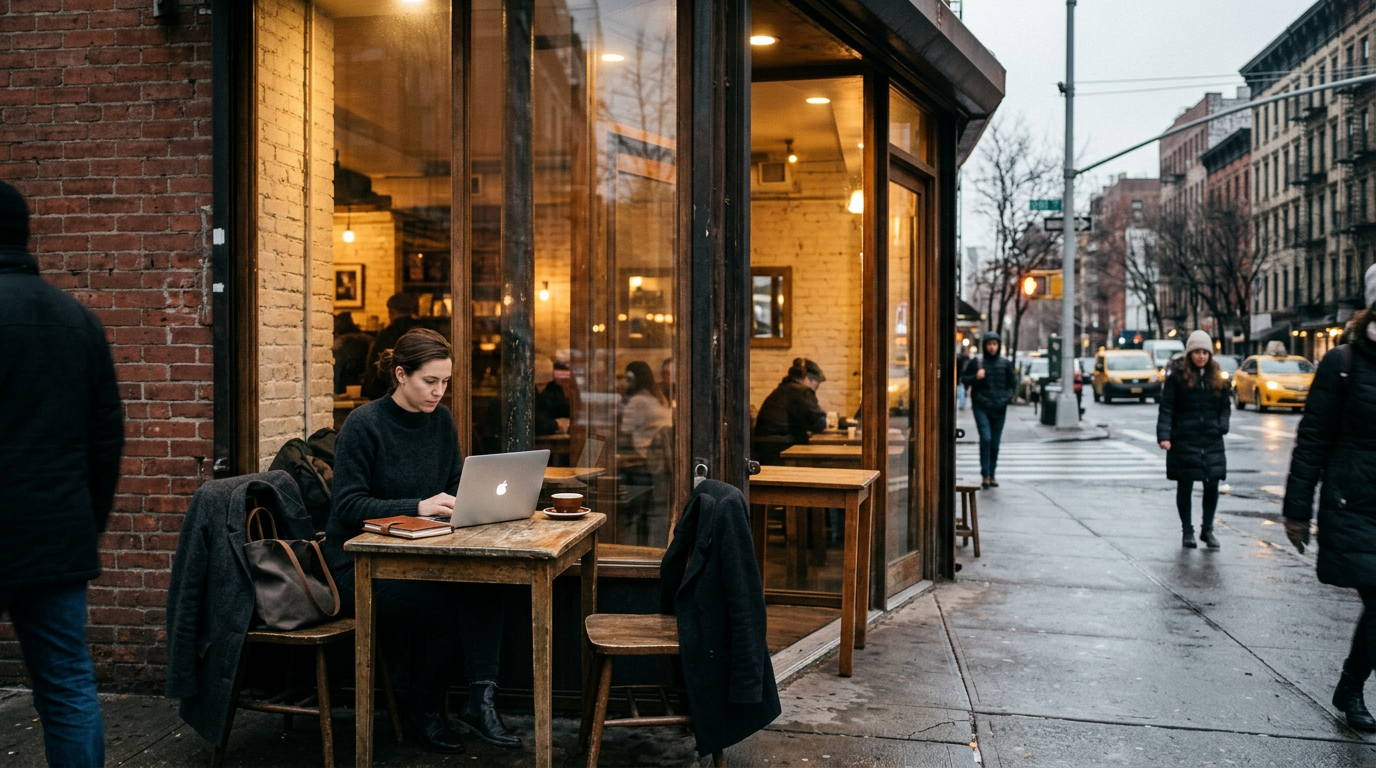
At 9:17 on a Tuesday morning in Williamsburg, the useful table is not the prettiest one. It is the two-top near the outlet, close enough to hear the investor coffee happening behind you, far enough from the bar that the staff will not hate your laptop by 10.
That is the real NYC founder workspace decision in 2026. Not whether WeWork, Industrious, Spaces, or a boutique member's club has the better app. The sharper question is whether you have a repeatable third place: a room where you are not at home, not officially at work, and not trapped in a networking event wearing a name tag.
Coworking still has a job. Take the day pass when you need calls, a real chair, whiteboards, and a printer that does not require prayer. Pay for a dedicated desk if your nervous system needs routine. But for solo founders, the next customer, operator friend, first hire, design partner, or angel intro often comes from a softer asset: being seen in the same local rooms often enough that conversation becomes normal.
In New York, that matters more than it does in most cities. People are busy, skeptical, and allergic to forced community. They will still talk. They just need context.
The coworking membership is not the community
Post-pandemic coworking matured. The fantasy version was: buy a hot desk, inherit a network. The 2026 version is less romantic and more useful. Coworking is infrastructure.
It gives you:
- A clean place for Zoom calls
- A business address or mail handling, depending on plan
- Meeting rooms that do not look like your bedroom
- Predictable Wi-Fi
- Other people working, which helps when your apartment starts to feel like a cave
It does not automatically give you:
- Trust
- Taste
- Repeated low-pressure contact
- People who understand your exact market
- A reason for someone to introduce you to their friend
That last category is where third places win. A third place lets weak ties form without making everyone declare intent. Mark Granovetter's weak-ties idea still explains half of NYC networking: your closest friends already know the same people you do; the useful new information often comes from loose acquaintances, regulars, baristas, event hosts, and that founder you see every Thursday but only properly meet in week four.
The trick is not to wander the city collecting cafés. It is to pick a small circuit and become lightly recognizable.
What counts as a founder third place in NYC
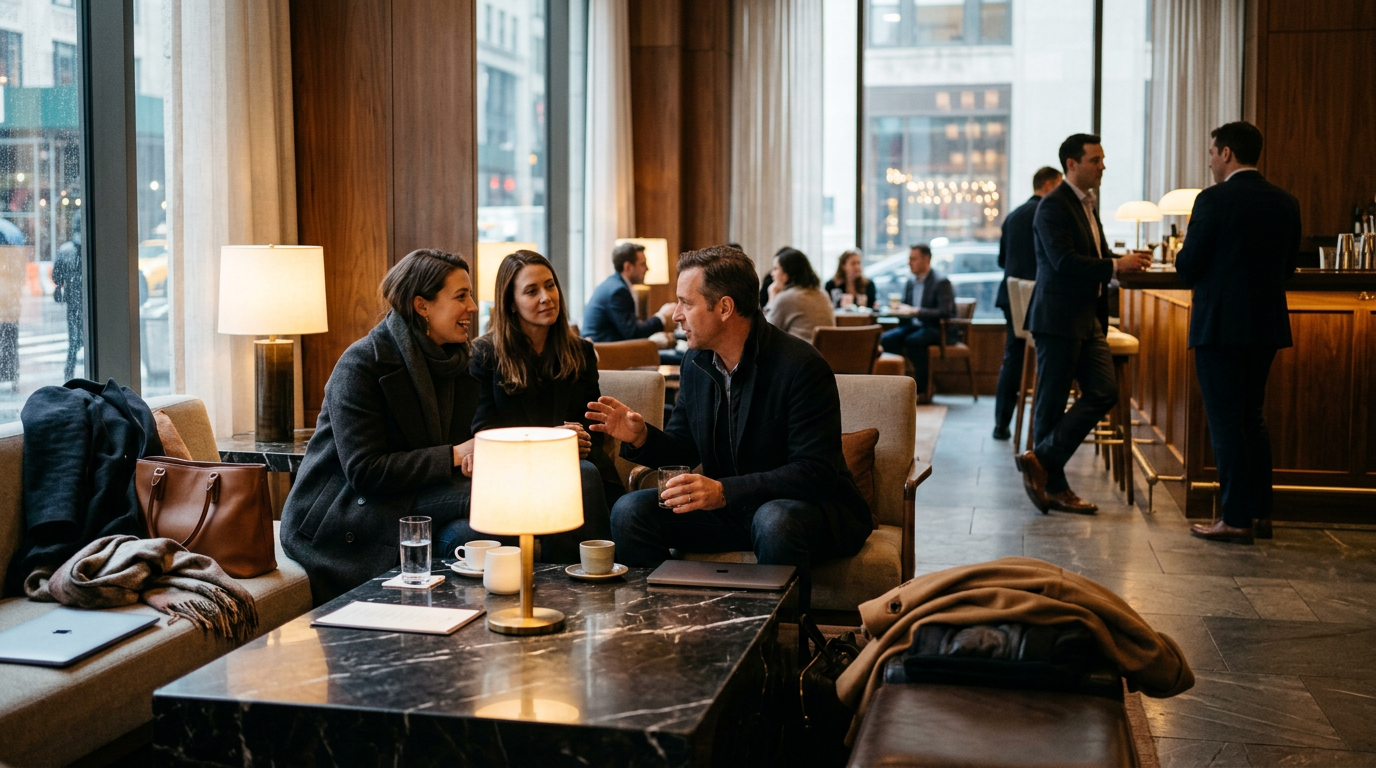
!Solo workers and small meetings in a calm Manhattan hotel lobby
A real third place has three qualities: repeat attendance, low friction, and social permission. You can show up alone without looking stranded. You can stay long enough for patterns to form. You can talk without making the room weird.
In NYC, the strongest third-place categories for solo founders are:
- Third-wave coffee bars with serious regulars. Think Devoción, Joe Coffee, Cafe Grumpy, La Colombe, Blue Bottle, or a neighborhood single-origin pour-over spot with actual seating and steady weekday traffic. Not every café wants laptops. Read the room.
- Hotel lobbies that function as daytime work rooms. The Ace Hotel lobby in NoMad and The Marlton lobby near Washington Square have long served this role for writers, startup people, designers, and visiting operators. Buy something. Do not camp like furniture.
- Natural wine bars before they get loud. Early evening is underrated. The room is relaxed, people are off Slack, and a founder dinner can start as two glasses at the bar.
- Bookstores with cafés or author-event calendars. The point is not literary cosplay. It is density of thoughtful people who still leave the house.
- Founder dinners and recurring small-format meetups. Meetup, Lunchclub-style matching, AngelList-adjacent circles, On Deck alumni groups, South Park Commons events when they surface in NYC, operator Slack communities that host in-person nights. Recurrence beats scale.
- Member's clubs used sparingly. Soho House and NeueHouse can be useful if your market overlaps with media, design, entertainment, or brand. They can also become expensive procrastination rooms. Treat them as access, not identity.
The wrong third place is a room where everyone is wearing headphones, nobody returns, and staff tense up when a laptop appears. That is not community. That is a charging station with espresso.
What to order / what to look for
Order like a grown-up and observe before you settle in.
At a coffee bar:
- If you are staying under 45 minutes, an espresso, drip coffee, or cortado is fine.
- If you are opening the laptop and taking a table, order food or a second drink.
- If the shop does single-origin pour-over and you actually care, ask what is tasting clean that week. Do not perform expertise.
- If every table has one person on a laptop and no one is speaking, it is a workroom, not a networking room. Useful, but different.
At a hotel lobby:
- Buy coffee, tea, or lunch from the property.
- Choose a seat that does not block traffic or occupy a couch meant for four.
- Keep calls short and quiet. Better yet, take calls outside.
- Look for semi-public seating where people naturally pause, not isolated corners.
At a natural wine bar or izakaya-style counter:
- Sit at the bar if you are alone. Tables isolate you.
- Ask for a glass recommendation in plain English: “Something dry, not funky for the sake of being funky.”
- Keep your phone face down unless you are exchanging contact info.
- Do not pitch the bartender. Be a regular before you ask for social intelligence.
At founder dinners:
- Look for a clear host, limited headcount, and a specific theme.
- Good signs: operators in the room, not just service providers hunting clients.
- Bad signs: 80-person “founder mixer” with no curation and a sponsor pitch before anyone has eaten.
The best rooms have a slight point of view. AI builders near Union Square. Creative operators in SoHo. Climate and hardware people orbiting Brooklyn Navy Yard-adjacent circles. Media and consumer brand people downtown. Fintech and B2B around Flatiron and FiDi. None of this is fixed, but the patterns are real.
Best time of day to go
!Two people talking at a Brooklyn wine bar counter before the evening rush

Timing is the difference between “I got work done” and “I met someone useful without forcing it.”
8:00 to 9:30 a.m. is for quiet momentum. Good for coffee, writing, and seeing who else is serious. Conversation is possible but brief. Keep it light.
10:30 a.m. to noon is the best café window for solo founders. The commuter rush is over. Lunch has not started. People are settled but not fried. If you want to become a recognizable regular, pick two mornings a week and hold the pattern.
2:00 to 4:30 p.m. is strong for hotel lobbies and coworking day passes. People take informal meetings then. You will overhear industry clusters. Do not eavesdrop like a creep; do notice context.
5:30 to 7:15 p.m. is the underused networking slot. Natural wine bars, hotel bars, and member's club lounges are still calm. You can meet one person before dinner and leave with dignity.
After 8:30 p.m. is not for laptop founders. It is social. If you are still talking TAM at a crowded bar while people are trying to enjoy their lives, you have missed the room.
Etiquette and unwritten rules
NYC gives you access if you do not act entitled to it.
- Do not occupy a four-top alone at peak hours.
- Do not take video calls in cafés unless the room clearly tolerates it.
- Do not ask someone “What do you do?” as your first line. It sounds like you are sorting them.
- Do not lead with fundraising. Even if you are fundraising.
- Do not treat baristas, hosts, and bartenders as NPCs. They know the room better than you do.
- Tip properly. Especially if you are turning a hospitality business into your office.
- Leave before staff have to manage you.
- If a place has no-laptop hours, respect them without arguing.
The local rule is simple: pay rent to the room in some form. Money, attention, manners, consistency. Ideally all four.
Also, be careful with the “regular” identity. You are not trying to become the mayor of a café. You are trying to build ambient familiarity. Two or three short visits per week beats one six-hour squat.
How to actually meet people there
Most founders are bad at this because they swing between isolation and pitching. The middle path is better.
Use context-based openers:
- “Are you here often enough to know if afternoons get loud?”
- “I saw you at the climate meetup last week, right?”
- “I’m trying to find a decent room for small founder dinners downtown. Have you found one that works?”
- “That notebook setup looks serious. Are you writing or designing?”
- “I’m new to this particular room, not New York. Is it usually this laptop-heavy?”
Keep the first exchange short. The win is not a 40-minute monologue. The win is permission for a second conversation.
A good pattern:
1. Make a low-pressure comment tied to the room.
2. Ask one specific question.
3. Offer one useful detail, not your entire backstory.
4. Exit cleanly: “Good luck with the call. I’ll probably be here Thursday morning.”
That final line matters. It creates a future without demanding one.
If the conversation has real energy, make the follow-up concrete:
- “Want me to send you that operator dinner list?”
- “I know two people hiring fractional growth help. Should I intro you?”
- “We are both dealing with founder-led sales. Coffee next Tuesday before 10?”
- “Send me your deck only if you want blunt feedback. I’m better on positioning than fundraising theater.”
Follow up within 24 hours. Keep it human:
“Good meeting you at the Marlton lobby. Sending the two event links I mentioned. No need to reply fast. If you end up testing that pricing page, I’d be curious what you learn.”
That is better than adding someone on LinkedIn with no note and calling it networking.
Mistakes to avoid
The big mistake is outsourcing your social life to a membership fee.
Other common errors:
- Buying the annual coworking plan before testing the neighborhood. Use day passes first. Try Monday, Wednesday, and Friday. The room changes.
- Confusing expensive with useful. A member's club can be full of people avoiding hard work. A plain café can hold three excellent operators before noon.
- Over-indexing on founders. Customers, recruiters, journalists, accountants, designers, chefs, and nonprofit operators may be more useful than another seed-stage founder with the same anxieties.
- Showing up only when you need something. Third places reward consistency. Neediness has a smell.
- Taking calls everywhere. A room that works for writing may be terrible for sales calls. Separate your work modes.
- Mistaking proximity for permission. Just because you overheard someone mention AngelList does not mean you should interrupt with your raise.
- Letting “community” become avoidance. If you had five coffees and shipped nothing, the room was not the problem.
There is also a subtler mistake: trying to be known everywhere. New York punishes that. Pick a borough base, one cross-town room, and one recurring event. That is enough.
A simple weekly circuit for a solo founder
If you are starting from zero, do not overbuild it. Try this for four weeks:
- Monday morning: same third-wave coffee shop near home. No meetings. Work in public for 90 minutes.
- Tuesday late afternoon: one hotel lobby or calm bar for an informal catch-up.
- Wednesday: coworking day pass only if you need calls, meeting rooms, or heads-down structure.
- Thursday morning: return to the same coffee shop. Say hello to one familiar face.
- Friday early evening: small founder dinner, operator meetup, natural wine bar catch-up, or community event with a real host.
Track outcomes that matter:
- Did you meet one person you would gladly speak to again?
- Did you learn about an event, customer segment, hire, or market shift?
- Did the room make it easier to do your actual work?
- Did you behave in a way that would make staff and regulars welcome you back?
If the answer is no for two weeks, switch rooms. If the answer is yes, stay boringly consistent.
The real advantage is being locally legible
Solo founders do not need more places to sit. They need rooms that make them legible to the right people. Coworking solves occupancy. Third places solve context.
In NYC, context is currency. The person who sees you twice at Joe Coffee, once at a founder dinner, and again at a small AI meetup now has a story for you. Not a big one. Just enough: serious, around, not weird, working on something specific. That is how introductions start.
Keep the coworking tools. Use the hot desk when it earns its keep. But build your third-place circuit first. The city opens through repeated rooms, not rented desks.
Discussion (0)
Loading comments…