
The NYC Lunchclub filter that saves founders hours
At 8:42 a.m. in Flatiron, the coffee line is already half laptops, half Patagonia vests, and nobody has patience for a vague networking pitch. That is the whole NYC rule in miniature. If you cannot explain why you are meeting, who you want to meet, and what happens after, the city will eat your calendar.
Lunchclub, Meetup, Slack communities, founder dinners, coworking events, AngelList intros, On Deck alumni circles, and the occasional South Park Commons-adjacent salon all have a place here. None of them work if you treat them like a slot machine.
The goal is not more meetings. The goal is better rooms, cleaner asks, and a follow-up system that turns one useful conversation into three useful weak ties. NYC rewards people who are specific, prepared, and respectful of time. It is less forgiving to people who show up hoping the room will do the work.
The NYC filter: use platforms for selection, not social proof
Lunchclub’s value in 2026 is not that an algorithm can magically choose your next investor, cofounder, client, or operator friend. The value is that it forces a prompt: who do you want in your network this month?
In NYC, answer that by lane, not identity.
Bad targeting:
- “I want to meet founders.”
- “I’m open to interesting people.”
- “Looking to network in tech.”
Useful targeting:
- “Seed-stage B2B SaaS founders selling into finance teams.”
- “Operators who have scaled creator subscriptions past $1M ARR.”
- “AI product leads dealing with enterprise procurement.”
- “Independent consultants who sell retainers to healthcare or fintech clients.”
Use Lunchclub for one-to-one matching when your ask is narrow. Use Meetup for topical rooms with enough density to test a market. Use coworking events when you need proximity and repetition. Use founder dinners when the guest list is curated and the host has taste. Use AngelList, On Deck, and South Park Commons networks when you already have context and can write a direct note that does not sound mass-produced.
The mental model is a Schelling point: a place or format people choose because everyone expects the right people to choose it. In NYC, a Tuesday evening AI operators meetup near Union Square can be a Schelling point. So can a Thursday breakfast roundtable in a NoMad coworking lounge. Random drinks with “builders” is usually not.
What to order / what to look for
!Two people having a focused coffee meeting in a New York cafe

Coffee meetings still dominate NYC because they are fast, neutral, and easy to exit. Look for places with real seating, steady volume, and a staff that will not hate you for holding a table for 35 minutes. A third-wave coffee bar with single-origin pour-over is great if the room has space; a tiny espresso counter is not a meeting venue just because the coffee is excellent.
Reliable categories:
- Third-wave coffee shops with tables, not just bar seating.
- Hotel lobbies with enough ambient noise for privacy.
- Coworking lounges that offer a day pass or guest access.
- Natural wine bars before the dinner rush.
- Casual izakaya or small-plate spots for second meetings.
- Member’s clubs only when the host has a reason to host you there.
Well-known NYC options like Devoción, Joe Coffee, Cafe Grumpy, La Colombe, and Blue Bottle can work depending on the location and hour. Do not assume every location is meeting-friendly. Williamsburg, Flatiron, SoHo, Dumbo, and NoMad all have useful rooms, but the exact block matters.
For Lunchclub or first-time platform meetings, keep the order simple:
- Coffee, cold brew, tea, sparkling water.
- No full meal unless there is already a strong reason.
- No messy pastry that makes the conversation awkward.
- If the other person picked the spot, offer to buy the first round.
For IRL meetups, look for signals before you commit:
- The event description names the audience clearly.
- The host has a real profile and prior events.
- The attendee list is visible or partially visible.
- The format includes structured moments, not just “mingle.”
- The room is capped or intentionally scoped.
A 40-person founder dinner with a clear theme usually beats a 300-person mixer with sponsored drinks and no host behavior.
Best time of day to go
NYC networking has time zones inside the day.
8:00 to 10:00 a.m. is the operator slot. Breakfast meetings attract people with actual calendars. The conversation is crisp. Nobody wants to linger. This is ideal for Lunchclub matches, warm intros, and high-signal founder coffees.
11:30 a.m. to 1:30 p.m. works for consultants, investors, and people between meetings in Midtown, Flatiron, or SoHo. It can get noisy fast. If lunch is involved, set expectations: “Thirty-five minutes is perfect on my side.”
3:00 to 5:00 p.m. is underrated. Coffee shops thin out, coworking lounges calm down, and people are more candid after the day’s first wave of calls. Good for advisor chats and partnership conversations.
6:00 to 8:30 p.m. is meetup time. Pick events with a strong reason to exist: AI demo night, fintech operator salon, climate founder roundtable, creator economy dinner, product leaders working session. If the event starts at 6:00, arrive at 6:10, not 7:15. The best conversations often happen before the room gets loud.
After 9:00 p.m. is for bonding, not prospecting. Natural wine bars, izakayas, and member’s club lounges can be useful after an event, but only if there is already rapport. Do not corner a founder at 10:30 p.m. with your deck.
Etiquette and unwritten rules
!Small founder meetup with conversation circles in a NYC event space
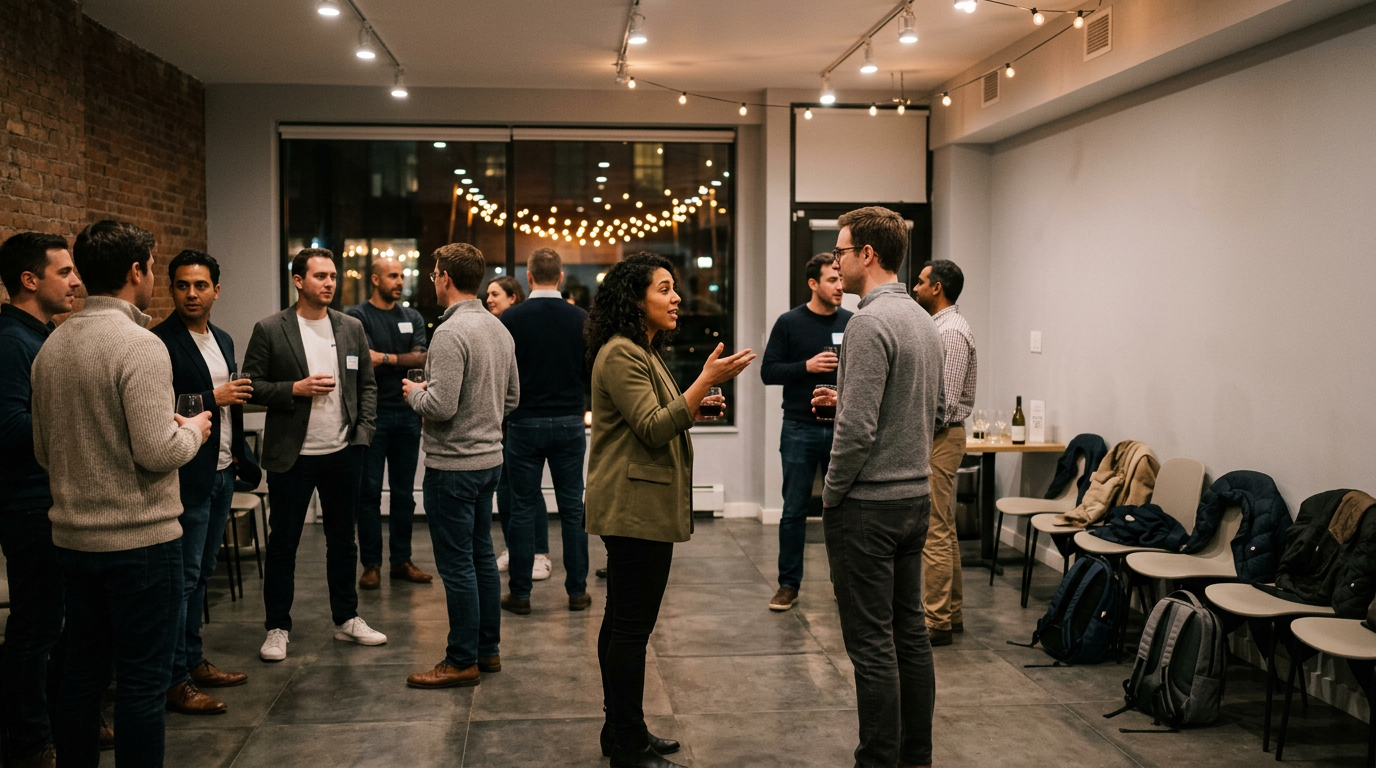
New York is direct, not rude. The city respects brevity because everyone is paying rent in time and money.
For Lunchclub-style meetings, send a note before the meeting:
“Looking forward to meeting. I’m focused on distribution for a seed-stage B2B product selling into finance teams. Happy to trade notes on outbound, partnerships, or early customer calls.”
That one note saves ten minutes.
Unwritten rules:
- Confirm the meeting the morning of, especially if rain is bad or subway delays are ugly.
- Pick a place near the person with the tighter schedule.
- Do not open with your full biography.
- Do not ask for funding, hiring help, or client referrals in the first five minutes.
- Do not scan the room while someone is speaking.
- Leave on time unless both people clearly want to continue.
At Meetups and coworking events, talk to the host early. Not to flatter them. To understand the room.
Try:
“Who in the room is working on go-to-market for technical products?”
Or:
“I’m trying to meet two founders selling into regulated industries. Anyone I should make sure to say hello to?”
Hosts know the map. Good hosts want the room to work.
At member’s clubs like Soho House or NeueHouse, remember that the setting is not the point. The person inviting you is taking a social risk. Be easy to host. Show up on time, order normally, do not wander around like you are auditing the room, and do not turn the evening into a pitch parade.
How to actually meet people there
The best opener in NYC is specific and low-pressure.
Bad:
“Tell me about yourself.”
Better:
“What are you working on this quarter that brought you here?”
Better still:
“I saw this event is mostly AI product people. Are you here for model evals, enterprise adoption, or something else?”
At a Meetup, aim for three real conversations, not 18 business cards. The room is not a buffet. It is a sorting mechanism.
Use this sequence:
- Talk to the host.
- Ask for one relevant intro.
- Have a 7- to 10-minute conversation.
- Ask one sharp follow-up question.
- Offer one useful thing before making any ask.
- Move on cleanly.
Clean exits matter.
Try:
“I’m going to say hello to a few more people before the panel starts, but this was useful. I’ll send you that pricing teardown tomorrow.”
Or:
“I don’t want to monopolize you. If it’s useful, I can introduce you to a founder dealing with the same procurement issue.”
For Lunchclub, treat the meeting like a two-person working session. Bring one concrete topic. If the match is weak, do not force friendship. Ask one useful question, share one useful resource, and close politely.
Conversation openers that work:
- “What kind of intro would actually be useful for you this month?”
- “What part of your funnel is most annoying right now?”
- “Which event in NYC has been worth your time lately?”
- “Are you looking for customers, talent, capital, or peers right now?”
- “What are you seeing that LinkedIn is getting wrong?”
The last one is especially good. People in NYC usually have opinions.
Follow-up that does not die in the inbox
Most networking fails after the room. People collect names and then send dead-end messages.
Send follow-up within 24 hours. Not a novel. Not a “great to connect” nothing-message.
Use this format:
“Good meeting you at the Flatiron AI operators event. Your point about procurement champions was sharp. Here’s the enterprise onboarding checklist I mentioned. If useful, I can also intro you to a founder selling into insurance teams.”
That works because it includes context, memory, value, and an optional next step.
For Lunchclub meetings:
“Thanks for the conversation this morning. I’m going to test your suggestion on narrowing the ICP to controller-led teams. I’ll report back if it changes reply rates. Also happy to send over the outbound script we discussed.”
For a potential investor or senior operator, do not ask for a second meeting immediately unless there is a reason. Send proof first. A result, a memo, a customer quote, a short update. NYC people remember momentum.
Build a simple follow-up board:
- Name.
- Context.
- Their current priority.
- What you promised.
- Date sent.
- Next useful touch.
The “next useful touch” is the whole game. A relevant article, a buyer intro, an event invite, a note when you shipped what you discussed. Not a monthly check-in with no substance.
Mistakes to avoid
The first mistake is using Lunchclub as calendar decoration. If you accept every match, you train the system and yourself toward noise. Decline politely. Tighten your profile. Change your stated goals monthly.
The second mistake is chasing famous rooms. A large founder event in SoHo with cameras and sponsor signage may be less useful than eight operators around a table in a coworking conference room at Industrious, Spaces, or a post-WeWork-era flexible office. In 2026, the better coworking communities are less about endless hot desks and more about programming: breakfast roundtables, office hours, demo sessions, and member-led dinners.
The third mistake is over-pitching. Your first job is to be placed correctly in someone’s mental map. If they know what you do and who you help, they can route you later.
The fourth mistake is ignoring neighborhood fit. Brooklyn founder coffees are often more product-and-creative heavy. Flatiron and NoMad skew SaaS, venture, and operator meetings. Midtown is useful for enterprise, finance, legal, and consulting. SoHo mixes brand, creator, commerce, and media. Dumbo has design, startup, and agency energy. Pick the terrain that matches the work.
The fifth mistake is staying too long. A 30-minute meeting that ends with one strong next step beats a 75-minute ramble. Leave a little tension in the line.
The weekly rhythm that actually works
Here is a sane NYC cadence for a founder, freelancer, creator, or operator who wants real network growth without losing the week.
- One Lunchclub or matched intro per week, tightly scoped.
- One IRL event every other week, chosen by audience quality.
- One coworking day pass or guest day per month in a neighborhood you want to understand.
- One small dinner or coffee cluster per month that you organize yourself.
- Ten minutes every Friday to send follow-ups and useful touches.
If you organize, keep it small. Four to six people is enough. Theme it clearly: “B2B founders selling into finance,” “independent operators building paid newsletters,” “AI product leads dealing with evals.” Invite people who should know each other. That is how you become a node instead of another attendee.
NYC still runs on rooms. The better ones are just harder to identify because the public calendar is crowded. Use Lunchclub to find targeted one-on-ones. Use Meetup to sample communities. Use coworking spaces for repetition. Use dinners for trust. Then follow up like a serious person.
That is the filter. Less volume. Better rooms. Cleaner asks. Faster trust.
Discussion (0)
Loading comments…