
The NYC room that beats a coworking membership
At 8:42 on a Tuesday in Flatiron, the founder with the cracked MacBook is not at a hot desk. She is at a two-top near the espresso bar, jacket still on, half-listening to two product people argue about churn while she finishes a deck before a 10 a.m. call. Nobody booked the room. Nobody added her to a community Slack. She came because the same kinds of people come here every week.
That is the part coworking sales pages still undersell in 2026. A desk is useful. Phone booths are useful. A mail address can be useful. But for solo founders in NYC, the highest-value room is often not the room with unlimited cold brew and a podcast studio. It is the repeatable third place: the coffee bar, hotel lobby, natural wine bar, neighborhood café, operator breakfast, or low-key founder dinner where people show up without needing a calendar invite from a community manager.
NYC rewards repetition. It is not a city where one impressive entrance gets you far. The room starts recognizing you after the fourth Tuesday.
Coworking solves focus, not belonging
Coworking is not dead. WeWork, Industrious, Spaces, NeueHouse, and Soho House still serve real needs. If you need a professional address, steady phone booths, team-day logistics, or a place to take investor calls without your radiator clanking in the background, pay for it. A proper dedicated desk can also create routine when your apartment has become a snack-lined trap.
But the post-pandemic coworking market shifted. Many locations now feel more like flexible office inventory than founder culture. Some are excellent for execution and weak for serendipity. The person next to you may be a remote employee avoiding their roommate, not a potential design partner. The community calendar may have a breakfast, but it often competes with everyone’s Zoom-heavy day.
Third places do something different. They create ambient awareness. You notice who shows up, what they are reading, who takes meetings, who seems to know everyone, who is hiring, who is fundraising, who is quietly building something useful. That is not networking in the badge-and-lanyard sense. It is pattern recognition.
For a solo founder, that matters because the job is not only to work. The job is to keep getting pulled into rooms where information moves early.
What counts as a useful third place in NYC
!Solo founder working from a New York coffee shop in the morning
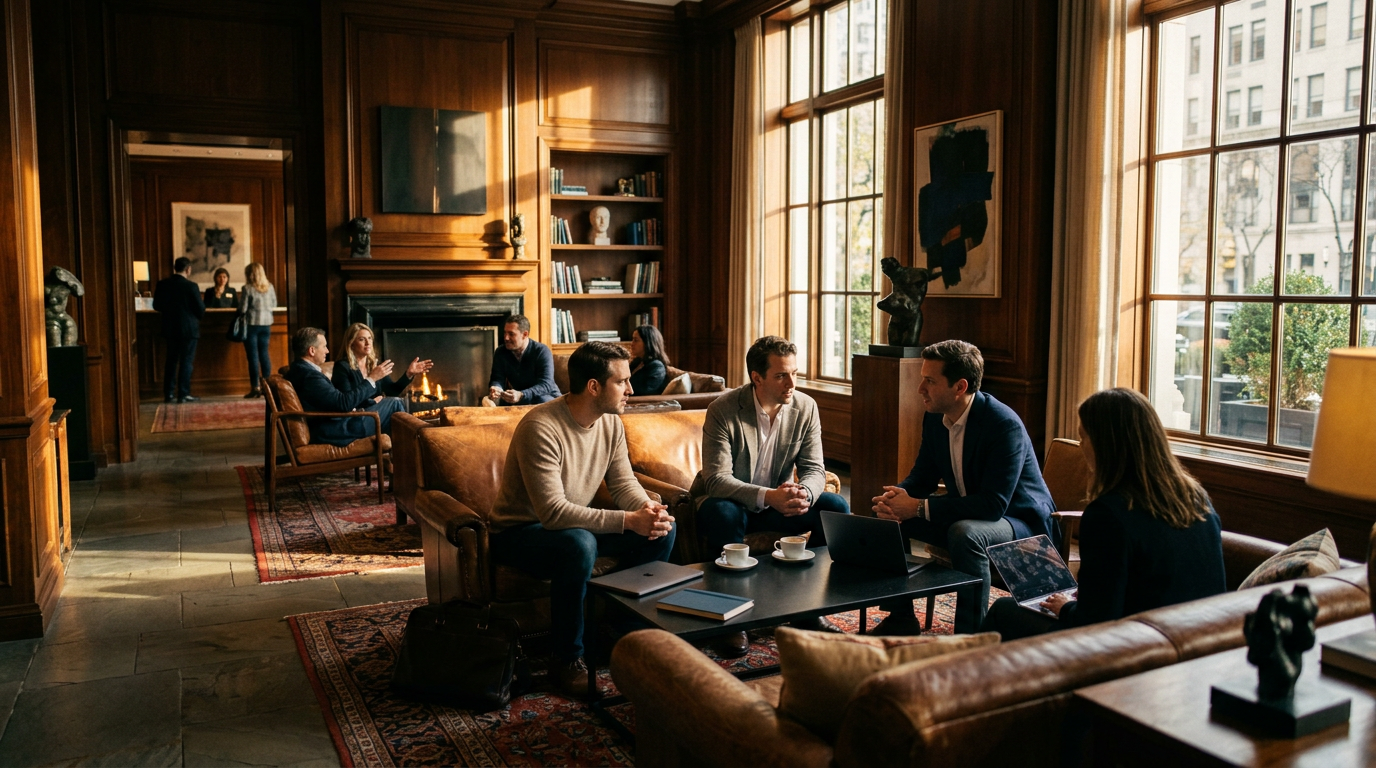
A third place is not just any room with Wi-Fi. In NYC founder life, the good ones have three traits: repeat attendance, permission to linger, and enough social friction that people are aware of one another without being trapped.
Look for these venue types:
- Third-wave coffee bars with a real regular crowd. Think the Devoción, Joe Coffee, Cafe Grumpy, La Colombe, Blue Bottle, Birch, or Stumptown category, depending on neighborhood and laptop policy. Not every location is work-friendly. That is the point. You are looking for a room where working is accepted during certain hours, not a free office.
- Hotel lobbies that function as daytime meeting rooms. In Manhattan and Brooklyn, some hotel lobbies are de facto neutral ground for founders, agency owners, investors, and media people. Buy something. Do not colonize the best seats for five hours.
- Natural wine bars before they get loud. The first hour after opening can be a strong operator window. Not a party. A shoulder-season place for a one-on-one, a warm intro, or a founder who does not want another coffee.
- Neighborhood cafés with owner presence. Especially in Brooklyn, the person behind the counter often knows who is building what nearby. Respect that social map.
- Recurring founder dinners, small meetups, and alumni circles. AngelList, Meetup, On Deck alumni groups, South Park Commons friends, and niche Slack communities can all point you toward real rooms. The internet is the index. The room is the asset.
The room does not need to be famous. It needs to be consistent.
What to order / what to look for
Order like someone who understands the economics of the room.
At a coffee bar, start with one real drink. A cortado, drip, single-origin pour-over, or espresso tonic if that is the house’s lane. If you are staying past 90 minutes, order again or add food. If the place is packed, shorten your stay. A founder who buys one small coffee and camps through lunch is not a regular. He is overhead.
At a wine bar, do not perform. Ask for a glass of something dry and low-intervention if you want natural wine without a lecture. If you are meeting someone, offer to close the tab or split cleanly. The point is ease, not sophistication.
What to look for:
- A few communal seats, but not a room dominated by laptops.
- Staff who are calm, not visibly managing a laptop problem every ten minutes.
- Regulars who greet each other without making the room feel closed.
- Tables close enough for light awareness, not so close that every call is public.
- A neighborhood match. Williamsburg and Greenpoint skew founder-creative. Flatiron and SoHo skew investor, commerce, brand, and agency. Lower Manhattan can be finance and crypto-adjacent. Upper West and Upper East Side rooms can be surprisingly good for serious operators who do not need to look busy.
Your order is also a signal. Not status. Consideration.
Best time of day to go
!Two founders meeting at a quiet Brooklyn wine bar
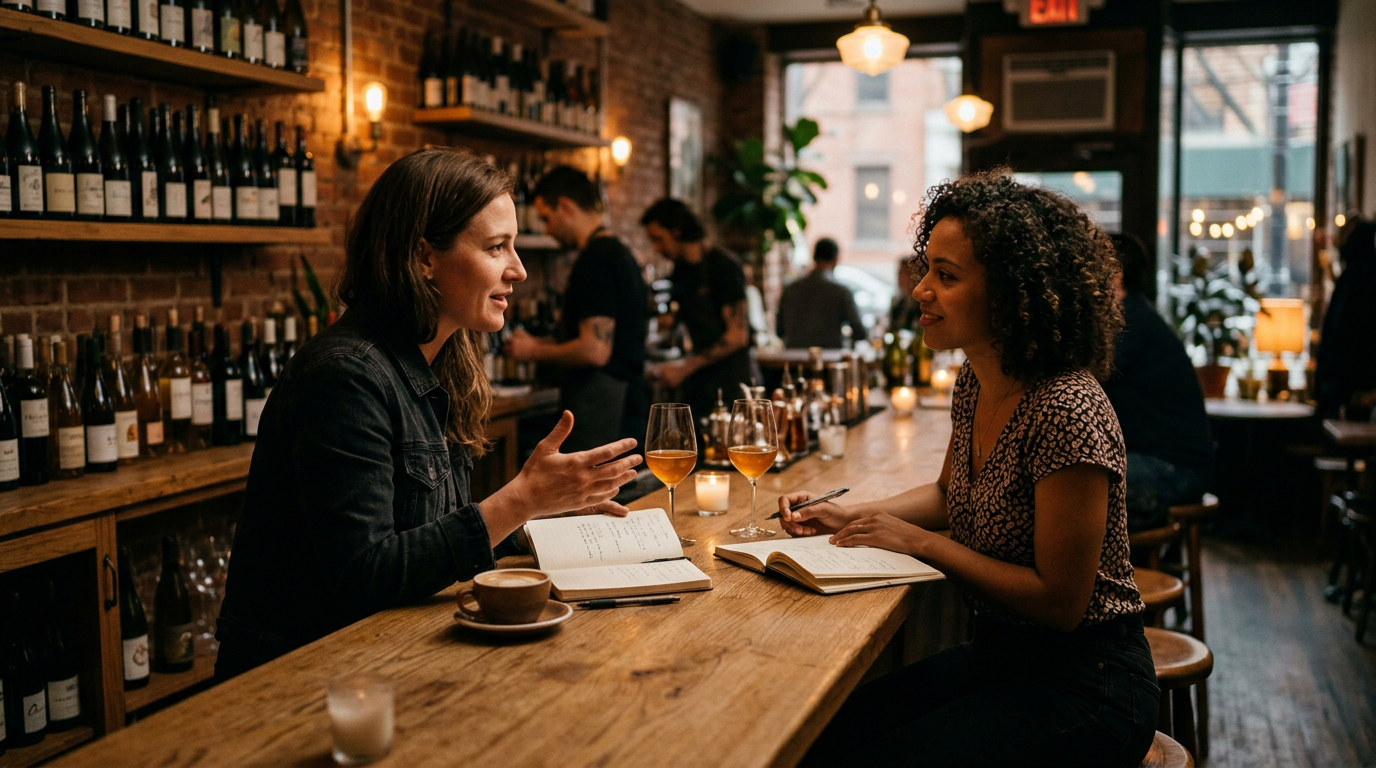
The best third-place schedule in NYC is not romantic. It is operational.
7:45 to 9:30 a.m. is the founder window. People are sharp, pre-call, and not yet buried. This is when you become familiar without asking for anything.
10:30 a.m. to noon works for planned coffees. If you are trying to meet an investor, advisor, or potential customer, this window keeps the conversation clean and bounded.
2:30 to 4:30 p.m. is underrated. The lunch rush is gone, the laptop crowd thins, and people are more open to casual conversation. Good for customer discovery if you are not interrupting.
5:00 to 6:30 p.m. at a wine bar or hotel lobby is strong for second-degree introductions. Not pitch mode. More like: “I’m meeting two other healthcare ops people for a drink if you want to swing by for twenty.”
Avoid the obvious crunch points. Saturday brunch is useless for founder networking unless your product serves parents or restaurants. Monday mornings are often heads-down. Thursday evenings get socially noisy fast. Friday can work, but only with people who already know you.
Pick two rooms and two time slots. Repeat for six weeks. That beats buying a membership and hoping the community manager manufactures your network.
Etiquette and unwritten rules
NYC has a blunt but fair third-place code.
Do not take calls in a café unless the room clearly allows it and your voice is low. Nobody wants your pipeline review with a side of milk steaming. If you need to talk, step outside or use a coworking phone booth.
Do not spread out like a junior partner at a law firm. One laptop, one notebook, one drink. Bag off the neighboring chair when space tightens.
Do not ask the staff for “the best place to work all day.” Ask, “Is it okay if I use a laptop here for an hour?” That sentence changes the whole exchange.
Do not pitch strangers cold while they are eating. Do not scan the room like a recruiter at demo day. Do not mention your fundraise in the first thirty seconds unless someone directly asks.
The better move is to become lightly known. Same day. Same seat if available. Same respectful order. Tip. Learn names if the exchange is natural. Leave when the room needs the table back.
In New York, being considerate is not softness. It is how you get invited back into the informal circuit.
How to actually meet people there
This is where most solo founders overcomplicate it. They either hide behind headphones or arrive with a pitch deck in their face. Neither works.
Start with low-pressure recognition:
- “I think I’ve seen you here a few Tuesdays. Are you working nearby or building something?”
- “Quick question, since you look like you’ve taken a lot of founder coffees here: is this place calmer before nine?”
- “I’m comparing notes with other solo founders on early customer calls. Are you in software, or am I guessing wrong?”
- “That looked like a product roadmap, but I won’t ask unless you want to talk about it.”
Then stop talking. Let the other person choose the depth.
Your goal is not to collect contacts. Your goal is to create weak ties, the kind Mark Granovetter wrote about: people outside your tight circle who carry different information. In NYC, weak ties are how you hear about an opening at a design partner, a founder dinner in someone’s apartment, a scout writing small checks, or an operator who just left a company and wants the next thing.
When the conversation has energy, make the follow-up specific:
- “I’m here most Tuesdays before ten. Want me to send the customer interview template I mentioned?”
- “You said you know two marketplace founders. If one is open to a 15-minute question, I’ll keep it tight.”
- “I’m hosting three solo founders for a no-speaker breakfast next week. Want an invite if the mix is relevant?”
Send the note within two hours. Short. Context first. No essay.
A good follow-up looks like this: “Good meeting you at Joe this morning. You mentioned hiring your first fractional ops person. I can intro one person who helped a seed-stage team clean up onboarding. Want me to send?”
That is how a room becomes a network.
Mistakes to avoid
The most common mistake is treating a third place like a cheaper coworking office. If you need six hours of desk time, use a coworking day pass, library, apartment, or dedicated desk. Third places are for rhythm, signal, and contact. Not all-day extraction.
Second mistake: chasing famous rooms. A recognizable café in SoHo may look right on Instagram and be wrong for your actual work. The right room is the one you can repeat without friction.
Third: going too broad. “I want to meet founders” is weak. “I want to meet solo B2B founders selling into clinics” gives people a reason to help.
Fourth: over-indexing on events. Large Meetup nights and startup panels have a place, but many of the best NYC connections happen adjacent to the event: the coffee before, the walk to the subway after, the second drink with three people who actually listened.
Fifth: confusing proximity with permission. Seeing someone often does not mean they owe you attention. Earn the first conversation by being brief, useful, and easy to exit.
Sixth: ignoring neighborhood fit. If you are building enterprise compliance software, your ideal third place may not be the coolest café in Williamsburg. It may be a Midtown hotel lobby near your buyer’s office. If you are building for creators, the opposite may be true.
A weekly loop that works for solo founders
Try this for six weeks before signing another membership tier.
- Tuesday, 8:00 to 9:30 a.m.: same third-wave coffee bar, light work, no headphones for the first 20 minutes.
- Wednesday, 10:30 a.m.: one scheduled founder coffee with a clear ask and a hard stop.
- Thursday, 5:30 p.m.: natural wine bar or hotel lobby for one warm intro, not a loose hang.
- Friday, 2:00 p.m.: send follow-ups, make two intros, invite one useful person into next week’s loop.
Keep a simple note: name, context, what they care about, next useful action. Do not build a creepy spreadsheet of strangers. Just remember enough to be competent.
Coworking memberships still have a place. Use them for infrastructure. Use third places for surface area.
The solo founder advantage in NYC is not having the fanciest office. It is being findable in the right rooms, at the right times, with enough consistency that the city starts routing people through you.
Discussion (0)
Loading comments…