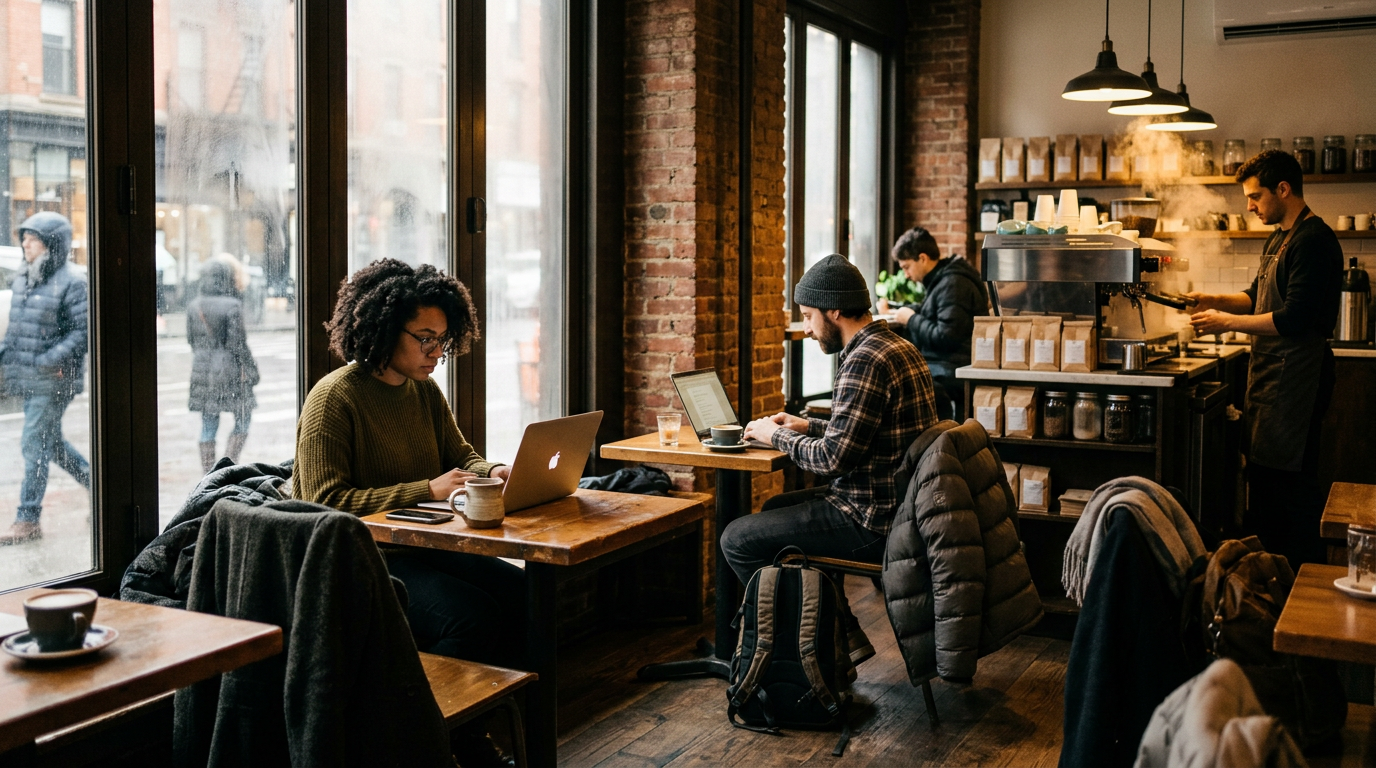
The NYC rooms solo founders need more than a desk
At 9:12 on a Tuesday morning in NoMad, the founder with the overstuffed tote is not looking for an ergonomic chair. She is looking for permission to exist around other people without booking a conference room, explaining her company twice, or paying for another monthly membership she will use three days a week.
That is the real New York solo founder problem in 2026. Not Wi-Fi. Not coffee. Not “community” printed on a wall. It is finding rooms where the right weak ties can form without the forced cheer of a networking mixer.
Coworking still has a place. WeWork, Industrious, Spaces, and the nicer boutique operators solve basic needs: reliable desk, phone booth, mailing address, meeting room. If your apartment is too loud or your team needs a home base, fine. Buy the day pass or the dedicated desk.
But for solo founders, especially pre-seed operators, fractional executives, indie hackers, consultants, and creator-led businesses, the more useful room is often a third place: a coffee bar, hotel lobby, public atrium, natural wine bar, bookstore café, or gym-adjacent lounge where repeat presence turns strangers into familiar faces.
New York rewards proximity, not declarations. Show up in the same few rooms often enough, behave like an adult, and the city starts handing you edges.
Why third places beat another coworking badge
A coworking membership gives you access. A third place gives you social texture.
That distinction matters. In a coworking space, everyone is technically working, but most people are also defending their attention. Headphones on. Calendar stacked. Slack open. A stranger approaching your hot desk can feel like an interruption unless the room has a clear social ritual attached to it.
Third places are different because they create low-stakes repetition. You see the same product designer at Joe Coffee before investor calls. The same agency owner at a hotel lobby table after school drop-off. The same fintech operator ordering a seltzer at a natural wine bar before a founder dinner nearby. No pitch deck required.
This is where Mark Granovetter’s “weak ties” idea still earns its keep. Your close friends often know the same people you know. The casual acquaintances from recurring rooms are more likely to bring new information: an angel check, a beta customer, a contractor who is actually available, a dinner invite that does not appear on Meetup.
New York’s founder scene runs on those loose bridges. AngelList profiles, Lunchclub intros, On Deck alumni chats, South Park Commons circles, and old-school Meetup groups all help, but the follow-through usually happens in physical rooms. The online intro gets warmer when someone has already seen you be normal in public.
The mistake is treating third places like cheaper coworking. They are not offices with espresso. They are social infrastructure. Use them that way.
What to order / what to look for
!Solo founders working and talking in a New York hotel lobby
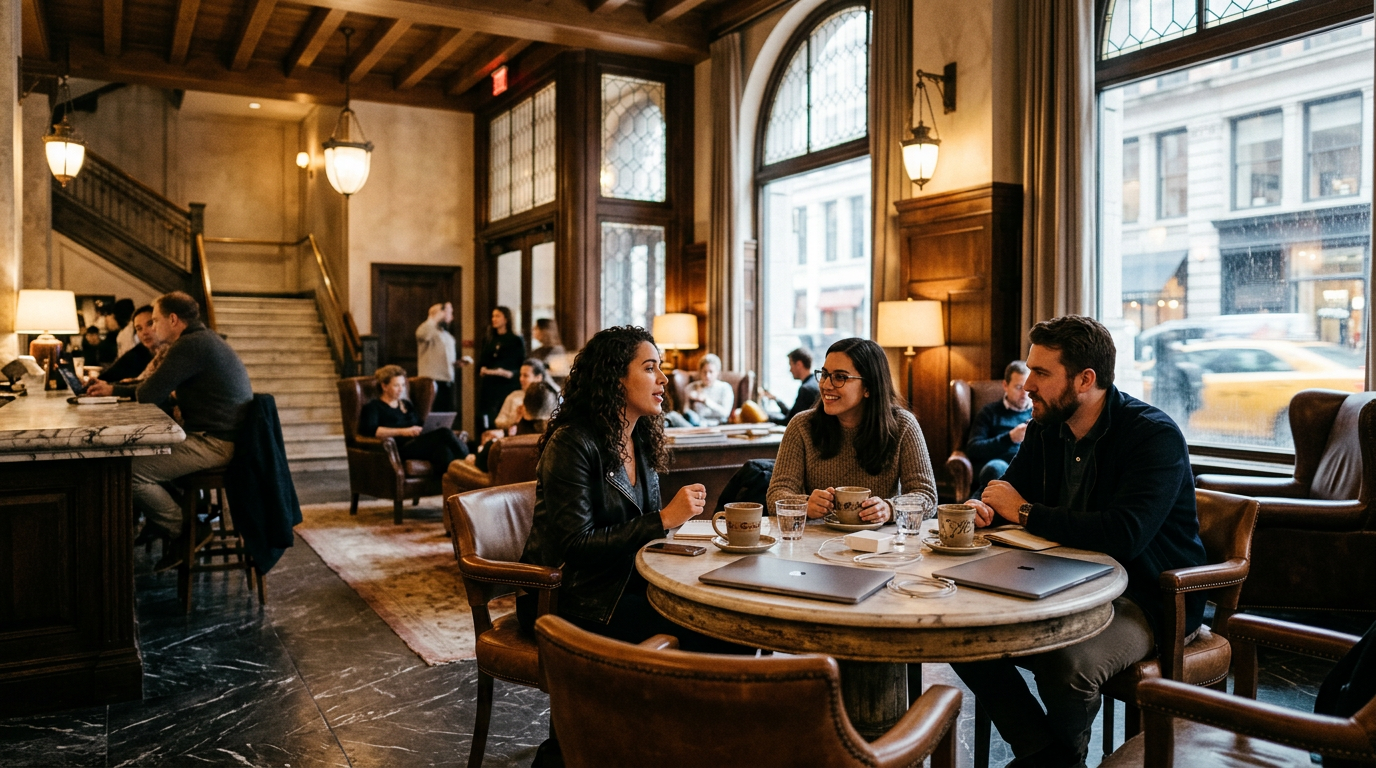
Do not optimize for the fanciest coffee. Optimize for a room you can return to without feeling trapped.
For daytime, look for mature third-wave coffee shops with enough turnover that laptops are normal but not so much chaos that every table feels contested. In New York, the reliable category includes places in the orbit of Devoción, Joe Coffee, Cafe Grumpy, Blue Bottle, La Colombe, and Birch-style neighborhood cafés. You are not looking for novelty. You are looking for consistency.
Order like someone who understands the business you are occupying:
- Morning work block: drip coffee, espresso, or a single-origin pour-over if the bar is set up for it and the line is calm.
- Longer stay: coffee plus food, then a second drink after 90 minutes.
- Meeting: two coffees, pastries if you are taking a four-top, and tip properly.
- Afternoon reset: tea, sparkling water, or a low-sugar drink if you need to stay sharp.
For evening, the better third places are not loud cocktail bars. They are natural wine bars, izakaya counters, hotel lobby bars, low-key restaurants with bar seating, and supper club-adjacent rooms where people can talk without yelling. Omakase is usually too structured for casual founder networking unless you already know the person. A bar seat at a Japanese restaurant can be more useful than a $300 tasting menu.
What to look for in any third place:
- Bar seating or communal tables where light conversation is socially acceptable.
- A visible regular crowd, not only tourists or one-time dates.
- Staff who recognize repeat customers.
- Enough ambient noise for privacy, not so much that you cannot hear names.
- A natural reason to come back weekly.
- A location near where operators already move: Flatiron, NoMad, Union Square, Williamsburg, Greenpoint, DUMBO, SoHo, the West Village, and parts of the Lower East Side.
A member’s club can count too, but only if you already use it. Soho House and NeueHouse can be useful rooms for media, design, and entertainment-adjacent founders. They can also become expensive waiting rooms where everyone performs busyness. Be honest about which one you are in.
Best time of day to go
The useful hours are narrower than people think.
For coffee shops, the founder window is usually 8:00 to 10:30 a.m. or 2:00 to 4:30 p.m. The first window catches people before meetings harden the day. The second catches freelancers, investors between calls, and operators who left the office for a softer room.
Avoid the lunch crush if you want to meet people. Everyone is hungry, tables are scarce, and the staff needs you to move. Also avoid the deep laptop swamp from 11:00 to 1:00 unless you are there strictly to work.
For hotel lobbies, 7:30 to 9:30 a.m. is good for breakfast meetings; 4:00 to 6:30 p.m. is better for casual overlap. After 7:00, many lobbies shift into date-night or travel mode. Different energy.
For natural wine bars and restaurant counters, aim for early. 5:30 to 7:00 p.m. on Tuesday or Wednesday is the sweet spot. You can talk to the bartender, sit without pressure, and actually hear another person. Thursday after 8:00 is often too social to be useful unless you already have a plan.
For coworking day passes, use them tactically. Buy a day pass when you need four hours of heads-down work and a phone booth. Do not buy one because you are lonely and hoping community will happen by accident. That is an expensive mood fix.
Etiquette and unwritten rules
!Early evening conversations at a Brooklyn natural wine bar counter

New York tolerates ambition. It does not tolerate neediness for long.
The room owes you nothing. The staff is not your office manager. The other customers are not attendees at your event. If you treat a third place with respect, you can become part of its rhythm. If you treat it like free real estate, you will be remembered for the wrong reason.
Rules that matter:
- Buy something within five minutes of arriving.
- Do not take a four-person table alone during peak hours.
- Keep calls short, quiet, and preferably outside.
- Never run a sales demo on speaker.
- Do not camp for four hours on one drip coffee.
- Tip like you plan to come back.
- Learn staff names only if they offer them naturally; do not force intimacy.
- Pack up when the room changes from work mode to meal mode.
- If someone is wearing headphones and typing hard, leave them alone.
The biggest unwritten rule: earn the micro-nod before the conversation. Regulars clock each other. A nod on week one, a small comment on week two, a two-minute exchange on week three. That cadence feels slow if you came from growth marketing. It works because it is not extractive.
At wine bars and counters, do not open with “What do you do?” It sounds like a badge scan. Start with the room:
- “Have you been coming here a while?”
- “Is Tuesday usually this calm here?”
- “That looks like the right order. What did you get?”
- “I am trying to find a good early-evening work-adjacent spot around here. Is this yours?”
If they answer with one sentence and turn away, release it. If they ask you something back, you have permission to continue.
How to actually meet people there
You need a simple field system. Not a networking persona. A system.
Pick three recurring rooms:
- One morning coffee shop near where you live.
- One afternoon work room near where founders and operators cluster.
- One evening counter or wine bar where conversation is normal.
Go weekly for six weeks. Same days if possible. Do not rotate endlessly because TikTok found a new café. Familiarity compounds only when people can place you.
Your opening line should be situational, not self-promotional. Good New York openers are short:
- “Are you also hiding between calls?”
- “Is the Wi-Fi holding up for you?”
- “I keep seeing founders take meetings here. Smart or terrible idea?”
- “You look like you know the outlet politics in this room.”
- “I am trying to stop defaulting to WeWork for every meeting. Is this place reliable in the afternoon?”
Once the conversation starts, give a compact identity:
“I’m building a workflow tool for boutique agencies.”
“I run paid acquisition for health startups, mostly fractional.”
“I’m a solo founder testing a B2B product before raising.”
Then stop. Let the other person decide whether to ask more.
The follow-up move is where most founders get sloppy. Do not send a three-paragraph pitch at 11:40 p.m. Send a clean note within 24 hours:
“Good meeting you at Devoción this morning. I liked your point about agency owners still buying through referrals. If useful, I can send the contractor list I mentioned. No rush.”
Or:
“Good talking at the bar last night. I’m going to the fintech Meetup near Union Square next Wednesday with one other founder. You’d fit the conversation if you want to join.”
Make the next step specific and light. Coffee in two weeks. A relevant intro. A founder dinner with a real reason. A link they asked for. Not “let’s connect sometime.” That phrase dies in New York because everyone already has too many loose ends.
Where coworking still wins
Do not turn this into a moral stance. Coworking is useful when the job is clear.
Use WeWork, Industrious, Spaces, or a boutique coworking operator when you need:
- A reliable phone booth for investor calls.
- A meeting room that will not embarrass you.
- A business address.
- A dedicated desk for hardware, monitors, or compliance-heavy work.
- A team rhythm that requires people in the same room.
- A day pass between meetings when you cannot risk café Wi-Fi.
Coworking fails when founders expect proximity to become relationships without effort. Most shared offices are not automatically communities anymore. Post-pandemic coworking shifted toward flexibility, enterprise overflow, and hybrid teams that appear on different days. The old promise of serendipity is weaker unless the operator actively programs breakfasts, demo nights, office hours, or member dinners.
If you join, ask specific questions before paying:
- Which days are actually active?
- Are there founder dinners or just generic happy hours?
- Who hosts introductions?
- How many members are solo operators versus company employees?
- Can I try two different days before committing?
A hot desk can solve your calendar. It will not solve your network by itself.
Mistakes to avoid
The first mistake is confusing aesthetic with usefulness. A beautiful room with bad seating, weak coffee, and no repeat crowd is a photo set. You need a room that works on an ordinary Tuesday.
The second mistake is being too transactional too early. New York founders can smell the funnel. If every conversation bends toward your product, newsletter, fundraise, or advisory ask, people will avoid you even if they like your idea.
The third mistake is ignoring staff. Baristas, bartenders, hosts, and managers understand the room better than you do. They know who comes in, which hours are civilized, and when laptop use becomes annoying. Treat them well. Not because they are “useful.” Because you are operating in their workplace.
The fourth mistake is over-indexing on founder-only rooms. Founder dinners, AngelList-adjacent gatherings, On Deck alumni meetups, South Park Commons events, and startup Meetups can be productive. They can also become rooms full of people selling to each other. Mix them with rooms where designers, recruiters, journalists, chefs, real estate people, and nonprofit operators pass through. Customers rarely wear founder badges.
The fifth mistake is staying in Manhattan by default. Brooklyn is not a side quest. Williamsburg, Greenpoint, Fort Greene, and DUMBO all hold serious operator density, especially for creative technology, commerce, media, design, and independent studios. If your customers live there, your third places should too.
The sixth mistake is treating every outing as a networking mission. Some days you should just work, pay, and leave. Regularity does not require constant outreach. Ambient presence is part of the asset.
A practical weekly rhythm for solo founders
Here is the rhythm I would use if I were solo in New York and trying to build both company and network without buying another membership out of panic.
Monday morning: neighborhood coffee shop. No meetings. Two-hour planning block. Become a regular where you live.
Tuesday afternoon: founder-dense work room near Flatiron, NoMad, Union Square, or SoHo. One planned coffee with a peer, then stay for a work block.
Wednesday evening: early seat at a natural wine bar, izakaya counter, or low-key restaurant bar. Invite one operator you already know and leave space for one new conversation.
Thursday: coworking day pass only if calls demand it. Otherwise use a public atrium, library-adjacent workspace, or hotel lobby for short blocks.
Friday morning: follow-up hour. Send the intro, the link, the calendar hold, the thank-you. Weak ties decay when you make people do the administrative work.
That rhythm costs less than many full coworking memberships and produces a broader map of the city. More important, it puts you in rooms where people are not only performing productivity. They are between things. That is when New York is most useful.
The right third place will not build your company for you. It will not replace product discipline, sales calls, or a clean P&L. But it can change the surface area of your week. More familiar faces. More casual intelligence. More reasons to leave the apartment before your own thoughts get stale.
For a solo founder, that can be worth more than a badge, a desk, and a phone booth you booked because you did not know where else to go.
Discussion (0)
Loading comments…