The NYC coffee order that gets you taken seriously
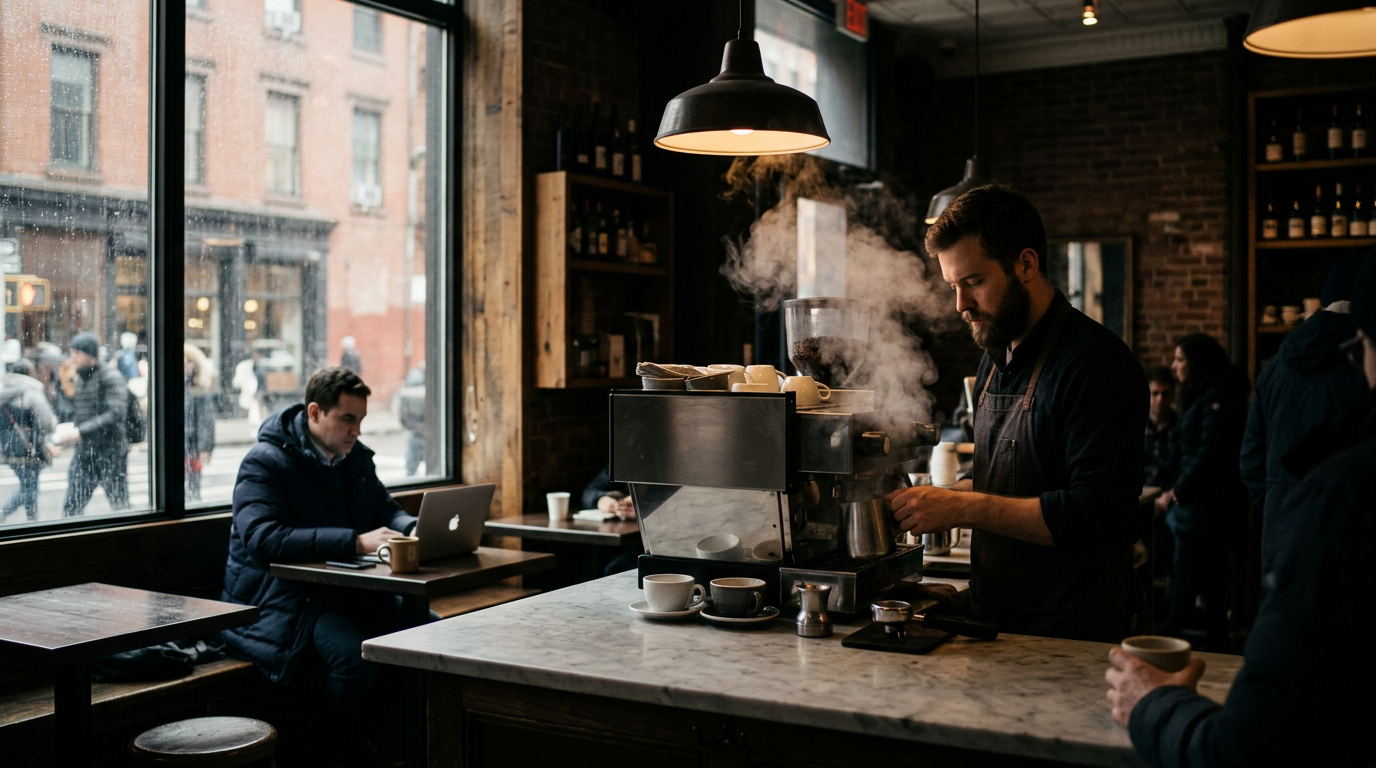
At 9:12 a.m. in SoHo, the line has already sorted itself. One person is late for a seed-stage standup. One is pretending not to read Slack on a cracked phone. Someone has a canvas tote from a conference at Newlab or NYU, and the barista is moving fast enough that any extra explanation becomes a tax on the whole room.
This is where newcomers get exposed. Not because they order the wrong drink. Because they order like the room is there to perform coffee culture for them.
New York’s third-wave coffee scene is mature now. Blue Bottle is mainstream. La Colombe feels almost corporate in parts of Manhattan. Devoción still has that lush Colombian-greenhouse energy. Joe Coffee, Cafe Grumpy, Stumptown, Birch, and Everyman Espresso have trained a generation of locals to know the difference between a quick counter order and a sit-down laptop session. The point in 2026 is not to prove you know the most terms. The point is to order clearly, take up the right amount of space, and leave room for the small social openings that make coffee shops useful to founders, freelancers, creators, and operators.
A good order says: I know where I am. I know what I want. I am not going to hold the line hostage.
The local rule: order for the room, not your identity
NYC coffee shops are not all the same room. A third-wave counter near Union Square at 8:30 a.m. is a transaction. A Williamsburg cafe at 2:00 p.m. can be a soft coworking floor. A West Village spot after lunch may be mostly dates, investor calls, and people writing decks they should have finished last night.
Read the room before you read the menu.
If there is a long line and one barista, order something that moves: drip coffee, espresso, cortado, cappuccino, cold brew, or an iced Americano. If the shop has a slower brew bar and nobody is waiting, that is when a single-origin pour-over makes sense. If there are tasting notes posted, you do not need to recite them back. Ask one precise question if you need help.
Say: 'Which one is brighter today, the washed or the natural?'
Do not say: 'What’s good here?'
That question sounds innocent, but it makes the barista do all the work. Better: 'I usually like lighter, fruitier coffees. What’s pulling well as espresso today?' That tells them your lane and lets them be useful.
The NYC version of confidence is not loud expertise. It is compression. Short, clear, prepared.
What to order / what to look for
!Cortado on a Brooklyn cafe counter with a barista working behind it
If you want to sound like you belong, stop treating the menu like a quiz. Order based on the job the drink needs to do.
If you are staying ten minutes
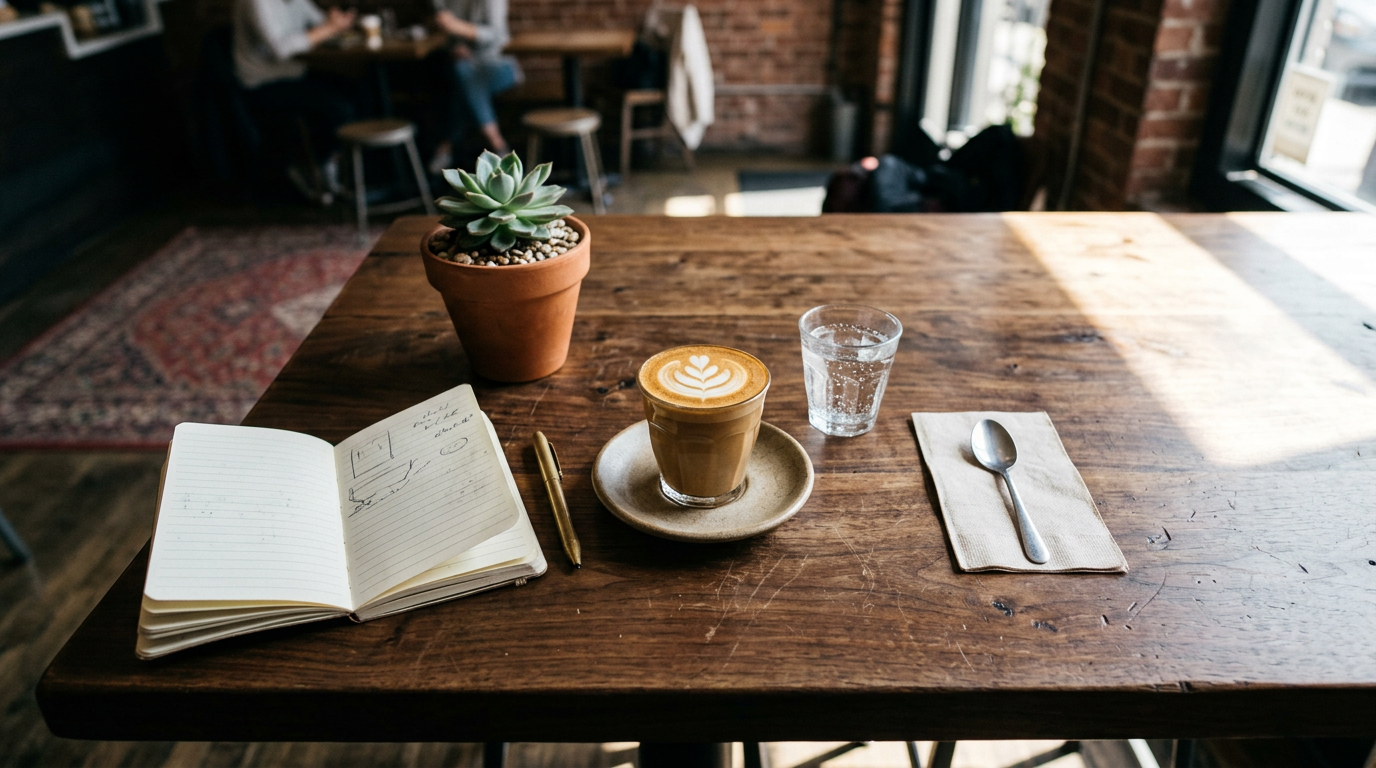
Get a drip coffee, espresso, macchiato, cortado, or cappuccino. These are clean orders. They do not require a performance. A cortado is especially useful in New York because it reads as coffee-literate without being fussy: equal-ish parts espresso and steamed milk, small enough to drink before your next meeting.
Good line: 'Cortado for here, please.'
If they ask about milk, answer quickly. Whole milk if you want the drink as designed. Oat milk if that is your preference. No speech needed.
If you are working for an hour
Get a drip coffee first, then buy a second drink or pastry if you stay. This matters. A $4 coffee does not rent you a two-top for the afternoon in Manhattan. If the shop has real food, order it. If it is pastry-only, buy something on your second round.
Look for:
- Available outlets without hovering over someone
- Tables that are clearly work-friendly, not date-sized two-tops in the front window
- A posted laptop policy
- Steady ambient noise, not a room where every call becomes public theater
If a shop is full and you need to work, do not turn it into a coworking grievance. Go to a hot desk, a day pass at Industrious, Spaces, or WeWork, or a hotel lobby that tolerates laptop traffic. Coffee shops are not obligated to be your office.
If you want the coffee itself
Order a single-origin pour-over when the room is slow and the shop clearly has a brew setup. Ask for the coffee by origin or profile, not by pretending you are judging a cupping table.
Good line: 'I’ll do the Ethiopian pour-over if it’s still available.'
Better if you need guidance: 'I like something clean and citrusy. Which pour-over would you pick today?'
Avoid asking for extra-hot single-origin coffee. Avoid adding four modifications to a delicate brew. If you want a flavored, sweet drink, order that proudly where it is offered. Just do not ask a serious espresso bar to remake itself as a dessert counter during rush.
If you are meeting someone new
Order something simple before they arrive. You do not want the first five minutes of a founder intro or freelance referral meeting to happen while you are debating milk texture. A cappuccino, iced coffee, or drip gives you a prop and gets you out of the line.
For a first professional coffee, avoid messy pastries, loud blender drinks, and anything that takes both hands to manage. You are there to listen.
Best time of day to go
The best coffee order changes by hour.
7:30 to 9:30 a.m.
This is commuter coffee. Keep it tight. Drip, espresso, cappuccino, cold brew. No long questions unless the place is empty. Tip. Move.
If you are trying to meet people, this is not the richest window. New Yorkers are in execution mode. The only real openings are with people you already know or with someone in your immediate orbit: the person you keep seeing at the same counter before heading to a Flatiron office, the founder from your building, the designer from your gym.
10:00 a.m. to noon
This is the operator window. Meetings begin. Freelancers settle in. Founders take early investor calls before the lunch calendar hits. If you want to use a third-wave shop as a light networking room, this is the first good stretch.
Order a real drink and choose your seat carefully. Corners are for work. Communal tables are for soft contact. The bar is for quick talk, not a board meeting.
2:00 to 4:30 p.m.
This is the best time for pour-overs, slower questions, and accidental weak ties. Mark Granovetter’s weak-ties idea applies here without making it academic: the loose acquaintances you see repeatedly often bring better new information than your close circle. Coffee shops are good at creating those repeat, low-pressure sightings.
If you want to become a recognizable regular, pick two afternoons a week and show up at the same kind of time. Same neighborhood. Same general order. Same decent behavior. That beats spraying LinkedIn messages into the void.
After 5:00 p.m.
Some shops empty out. Others flip into pre-dinner social traffic, especially near natural wine bars, restaurants, galleries, and member’s clubs. Coffee meetings after 5 can feel slightly cheap if the other person expected a drink. Be clear: 'Coffee is easier for me than a bar this week.' That line saves confusion.
Etiquette and unwritten rules
!Freelancers working at a communal table in a Manhattan coffee shop
NYC baristas have heard every possible coffee monologue. Respect shows up in speed, not ceremony.
- Know your order before you reach the register.
- If you need help, ask one specific question.
- Do not take a phone call in a small cafe unless the room clearly allows it.
- Never camp at a four-top alone during peak hours.
- If you use a laptop for more than 60 to 90 minutes, buy again.
- Do not ask the barista to watch your laptop.
- Do not film the bar without asking.
- If there is no public restroom, do not make it a moral crisis.
- Tip better when your order is slow, modified, or repeated.
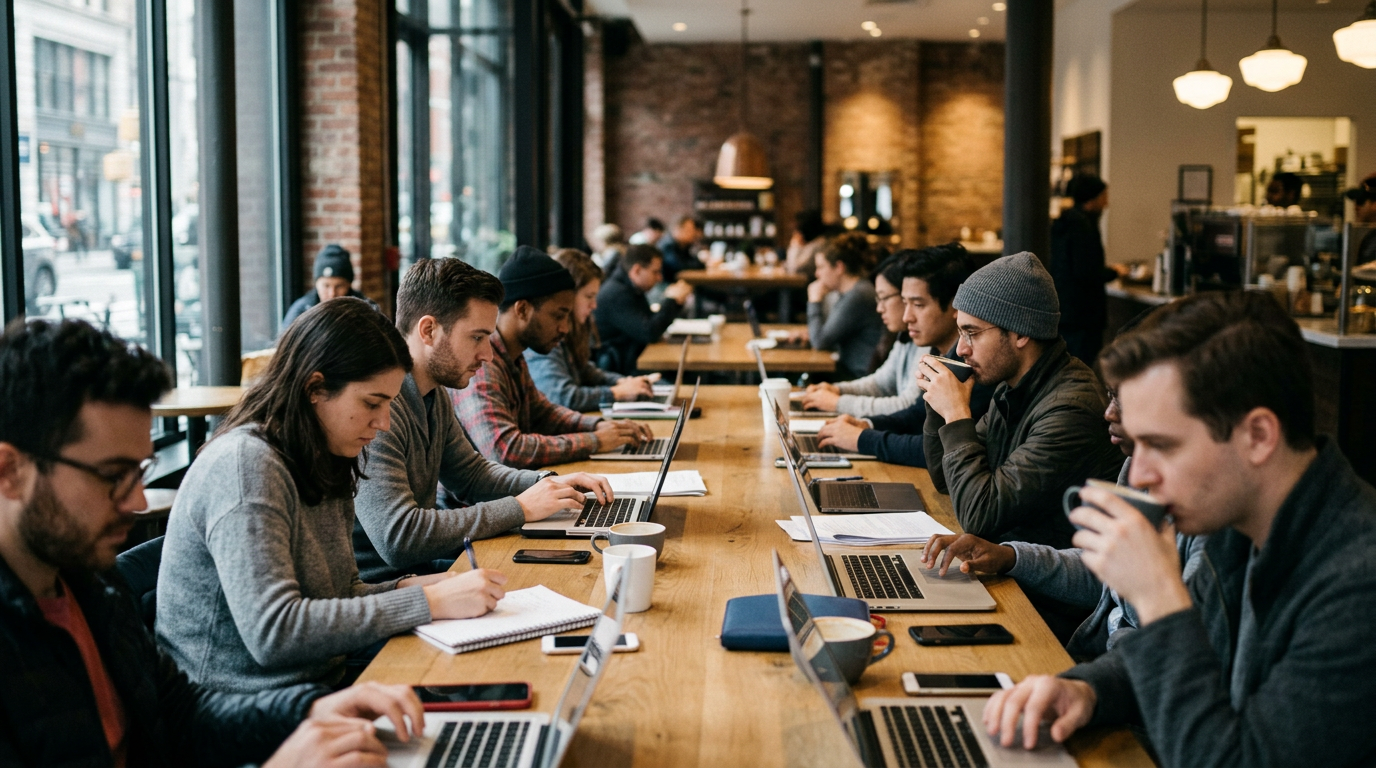
The laptop rule matters most. Post-pandemic coworking shifted the burden onto cafes, and many operators quietly resent it. A cafe can welcome laptop workers and still need table turnover. If you need reliable calls, privacy, and outlets, pay for a day pass. If you need a 45-minute email sprint, a cafe is fine.
Also: do not perform expertise at the counter. You can know coffee and still be normal. The worst order in a New York third-wave shop is not a vanilla latte. It is a ten-minute identity statement delivered to a line of people who all have places to be.
How to actually meet people there
You are not going to build a network by interrupting strangers with a pitch. The coffee shop play is lighter than that.
Start with recognition. Become a regular in a specific neighborhood scene: Williamsburg for design and media operators, Flatiron and Union Square for startup traffic, SoHo for brand and retail people, Greenpoint for freelancers and founders who do not want Midtown energy, the West Village for money-adjacent meetings that pretend to be casual.
Then use low-friction openers.
Good openers:
- 'Are you working from here often, or just between meetings?'
- 'I keep seeing people take calls from this corner. Is the Wi-Fi actually holding up?'
- 'That notebook setup looks serious. Are you designing, writing, or avoiding email?'
- 'I’m trying to find a decent afternoon work spot around here. Is this one usually manageable?'
Keep it short. If they answer warmly, continue. If they give one-word replies, leave them alone.
For founder and operator conversations, context beats pitch. Try:
- 'I’m working on a small ops problem around hiring part-time support. Curious if you’ve seen anyone handle that well.'
- 'I’m comparing coworking options nearby. Have you used Industrious or WeWork around here lately?'
- 'I’m trying to get better about in-person founder dinners instead of another Slack group. Any rooms you like?'
Mention real gathering points only if relevant: Meetup for public events, Lunchclub-style one-on-ones when they are active in your circle, AngelList for investor context, South Park Commons if the person is in that orbit, On Deck alumni if they bring it up. Do not name-drop communities as a status display.
The follow-up move is simple. If the conversation lasts more than three minutes and there is a clear reason to continue, say: 'Good talking. Want to swap LinkedIn? I’ll send over that place I mentioned.' Then actually send it within 24 hours.
Useful follow-up template:
'Good meeting you at coffee today. Here’s the coworking day-pass option I mentioned. If you end up checking it out, I’d be curious what you think.'
No pitch deck. No calendar link unless they ask. Let the second contact earn the meeting.
Ordering scripts that do not sound touristy
Use these when you want precision without theater.
For espresso:
- 'Espresso for here, please.'
- 'Cortado with whole milk, for here.'
- 'Cappuccino to go.'
For brewed coffee:
- 'Small drip, black.'
- 'I’ll do the batch brew. Which one is on today?'
- 'If the pour-over bar is open, I’ll take the Kenyan.'
For preference:
- 'I like lighter and cleaner, not too chocolatey. What would you steer me toward?'
- 'I’m not picky on origin. I just want something bright.'
- 'I usually drink espresso, but I’m open if something is tasting especially good today.'
For milk drinks:
- 'Flat white if you do it, otherwise a cortado is fine.'
- 'Iced latte with oat milk.'
- 'Regular cappuccino, no sugar.'
Notice what is missing: apologies, speeches, and fake expertise. You are allowed to ask questions. Just do not make the staff audition for your approval.
Mistakes to avoid
The obvious mistake is ordering like a tourist. The deeper mistake is using coffee culture to signal sophistication instead of reading the room.
Avoid these:
- Asking for the 'least acidic' light roast, then rejecting every option. Light roasts often taste brighter. Say you want rounder, nuttier, or more chocolate-forward.
- Ordering a pour-over during a rush and acting surprised it takes time.
- Sitting before ordering when the shop is busy and table space is scarce.
- Taking Zoom calls from a quiet room without headphones.
- Asking for extensive customization, then complaining that the drink does not taste balanced.
- Turning a first coffee meeting into a 70-minute monologue.
- Treating the barista as a networking target while they are working.
- Posting a laptop at a tiny neighborhood cafe all day and buying one espresso.
Also avoid the false binary. You do not have to choose between being a coffee nerd and ordering an iced latte. The local move is to be clear about what you want. If you like sweet cold coffee, order it. If you care about washed-process single-origin coffee, order that when the room supports it. Taste is personal. Etiquette is not.
The order I would make in NYC
If I am walking into a serious Manhattan or Brooklyn third-wave shop and I do not know the room yet, I order a cortado for here. It is small, fast, and honest. If I am staying to work, I add a drip or pastry later. If I am there for the coffee itself and the counter is calm, I ask what single-origin pour-over is tasting best and give one preference: bright, clean, fruit-forward, or chocolate-forward.
That is enough.
The goal is not to win the counter. The goal is to become someone the room can tolerate seeing again. In New York, that is more valuable than sounding educated for ninety seconds. Order cleanly. Tip. Take the right seat. Buy again if you stay. Talk to people like you might see them next week.
Because if you pick the right cafe, you probably will.
Discussion (0)
Loading comments…