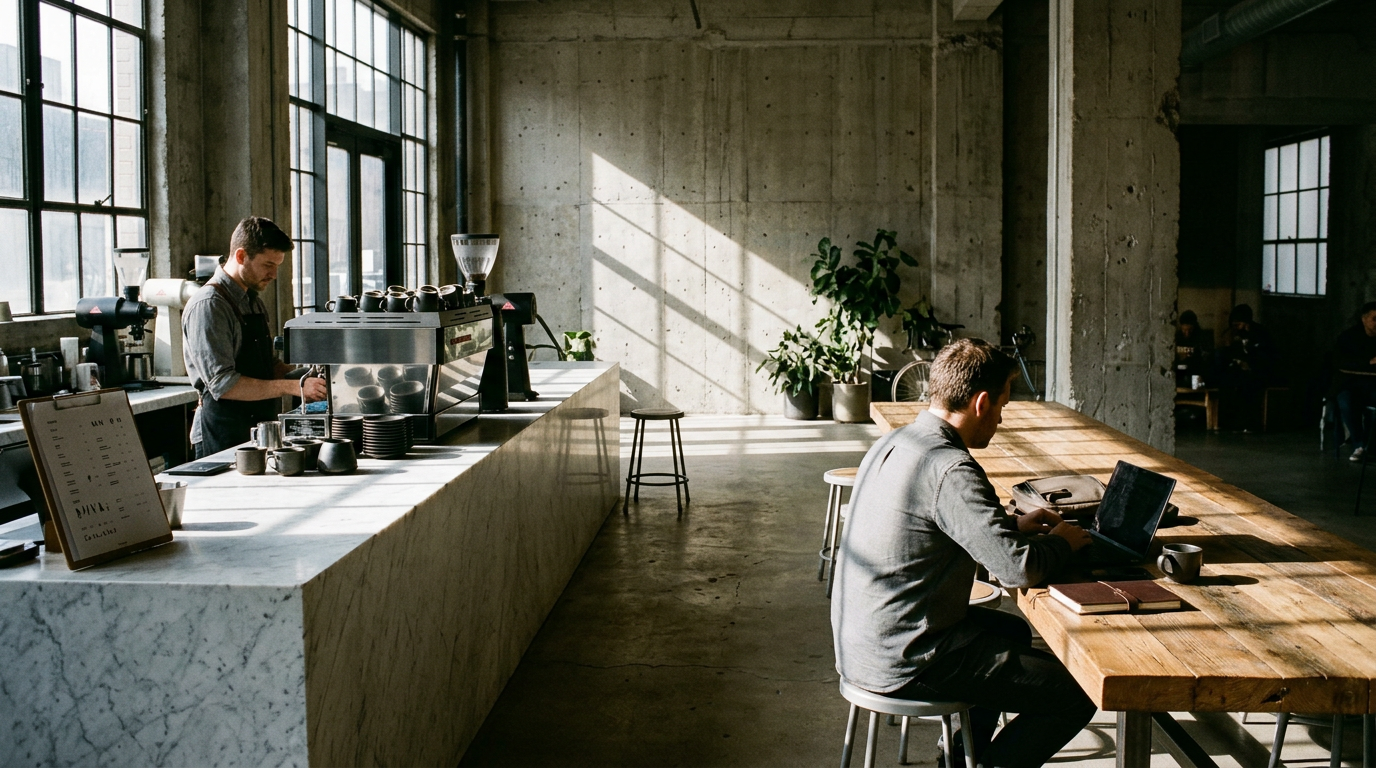
The NYC coffee order that doesn’t mark you as new
The line at a serious Brooklyn coffee bar moves faster than the menu reads. Someone in front of you orders a cortado, pays, steps aside, and is already answering Slack before the receipt printer stops. The barista is not rude. They are triaging a room full of founders, designers, producers, grad students, and people pretending their calendar is lighter than it is.
This is the part newcomers miss: third-wave coffee in New York is not just about taste. It is a social interface. Order badly and you slow the room down. Order well and you get a better drink, a smoother seat, and maybe a conversation with the person next to you who is also dodging their office.
You do not need to perform expertise. You do need to understand the house style, the rush rhythm, and what your order says about why you are there.
The NYC third-wave room has matured
New York is past the phase where every single-origin pour-over felt like a revelation. The good shops have settled into roles.
A place like Devoción in Brooklyn reads as a serious coffee room with design gravity. Joe Coffee is the dependable citywide pro. Cafe Grumpy still feels local and workday-oriented. Blue Bottle, for all the debates around scale, trained a lot of New Yorkers to expect clean espresso and clear menus. La Colombe works when you need consistency and room to stand with a cold coffee before a meeting.
Then there are the smaller neighborhood shops: the narrow espresso bar near a subway stop, the natural wine-adjacent cafe that becomes a laptop room by noon, the roaster-owned spot where the barista can actually talk about processing methods without sounding scripted.
In 2026, the strongest coffee rooms in NYC are not trying to impress you with complexity. They are trying to run well. The regulars know this. They order with context.
What to order / what to look for
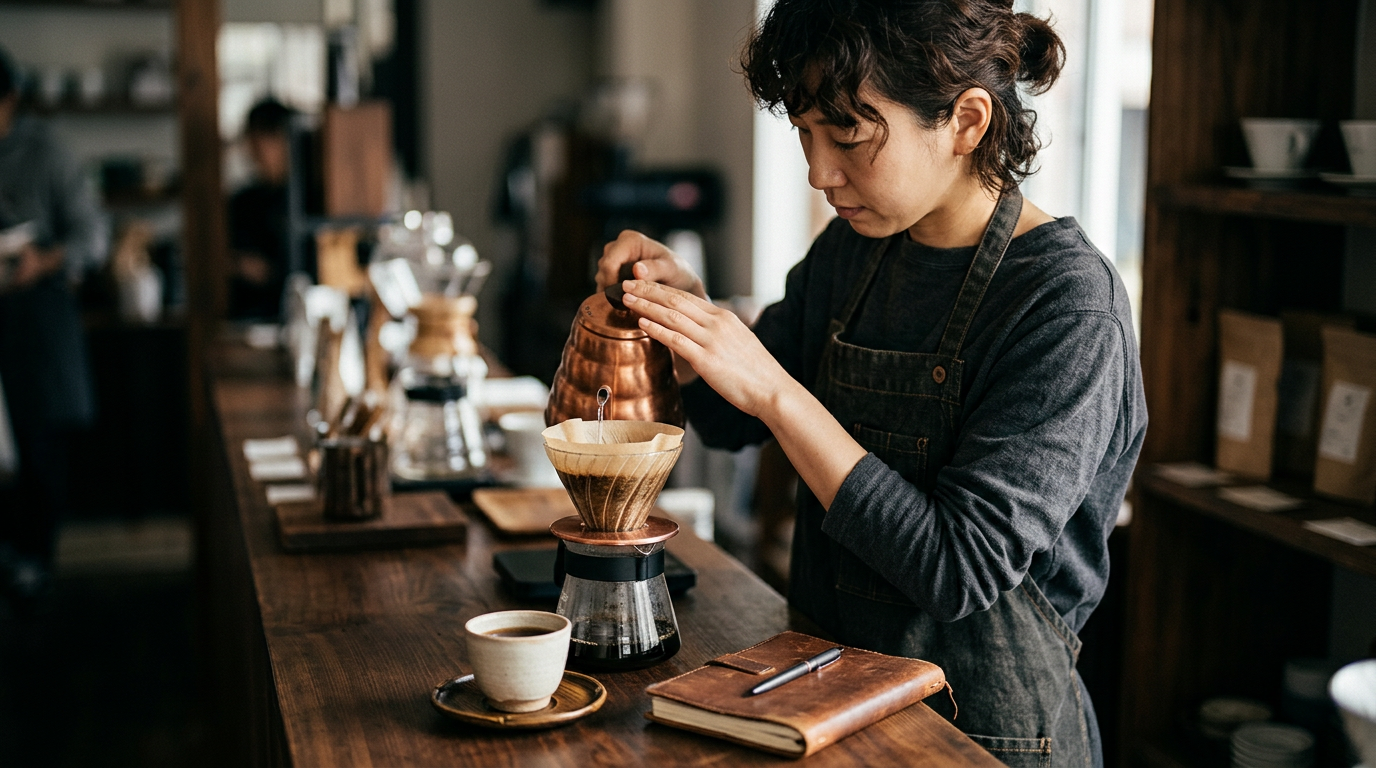
!Barista preparing a pour-over coffee beside a notebook
If you want to sound like you belong, order for the moment, not for the fantasy version of yourself who has twenty minutes to discuss altitude.
If the line is long
Order one of these:
- Drip coffee or batch brew, black or with a small splash of milk
- Espresso if you actually like espresso
- Cappuccino if you want milk but still want the coffee to show
- Cortado if you want a short milk drink and plan to stand or move soon
- Iced coffee or cold brew if you are in motion
The most local-sounding order is often the simplest: “Batch brew, whatever’s on today.” That tells the barista you understand the shop likely brewed something intentionally, not just filled an urn.
If you want milk, say it plainly. “Cappuccino with whole milk” is fine. “Oat milk cortado” is fine. What makes you sound new is over-customizing a drink the shop has designed to be balanced.
If the shop is quiet
This is when you can ask a real question.
Try:
- “What’s tasting better today, the batch or the pour-over?”
- “Do you have a filter coffee that’s more washed and clean than fruity?”
- “If I usually like chocolatey coffee, which one should I get?”
- “Is the espresso pulling brighter or more classic today?”
These questions work because they give the barista something usable. You are not asking them to perform a lecture. You are giving them a taste direction.
If you want a pour-over
A single-origin pour-over is not wrong. Ordering it at the wrong time is the issue.
Do not order a pour-over during a slammed morning rush unless the cafe clearly has a separate slow bar and staff to handle it. In a tight NYC room, a pour-over is a tiny production. It takes time, attention, and counter space.
Order it when:
- The shop is calm
- You are staying for at least fifteen minutes
- You are actually curious about the coffee
- You can wait without staring at the barista like they owe you theater
A good line: “I’ve got time. Which pour-over is drinking best today?”
That sentence does a lot. It signals patience, interest, and trust.
If you want something sweet
Seasonal drinks are not unserious. Plenty of smart coffee bars now run sharp seasonal menus: citrus espresso tonics, lightly sweetened cold drinks, spice syrups that do not taste like dessert sauce.
The move is to ask how sweet it is. “Is the seasonal latte pretty sweet, or more restrained?” That is normal. Asking for six modifications is not.
Best time of day to go
Coffee shops in New York have different personalities by hour.
7:30 to 9:30 a.m.
This is the commuter lane. Order fast. Do not ask big questions. Do not camp at a four-top with a laptop and one espresso. If you are meeting someone, arrive early and decide your order before they walk in.
Good order: batch brew, cappuccino, cortado, iced coffee.
Bad behavior: standing at the register reading every origin note while ten people wait behind you.
10 a.m. to noon
This is the best window for work and light conversation. The first rush has cleared, the staff has oxygen, and the room still has energy. If you want to ask about a single-origin pour-over, this is your window.
This is also when solo operators show up: freelance strategists, early-stage founders, editors, engineers between jobs, people building decks before investor calls. You can make contact without it feeling like a networking event.
1 to 3 p.m.
The room gets more mixed. Lunch meetings spill in. The laptop crowd settles. Some cafes quietly resent the all-day workstation behavior, especially in Manhattan and brownstone Brooklyn where rent is punishing.
If you are staying, buy again. A second coffee, tea, sparkling water, pastry. Something.
4 p.m. onward
Coffee becomes a hinge. Some rooms empty out. Others turn into pre-dinner meeting spots, especially cafes near natural wine bars, studios, coworking spaces, or subway transfer points.
This is a good time for a quick founder catch-up: thirty minutes, one drink each, no laptop fortress.
Etiquette and unwritten rules
!Two people talking over coffee at a New York cafe window counter

The drink matters. The behavior matters more.
Know your order before the register
Step aside if you are undecided. It is not dramatic. It is considerate. In NYC, competence is a love language.
Do not narrate your coffee education
No one needs to hear that you “discovered third-wave coffee in Portland” or that you “usually only drink Ethiopian naturals.” If it matters, ask a precise question. Otherwise, order.
Respect the small table economy
A two-top is not your private office for four hours unless the room is empty and you keep buying. A four-top is for groups. If the shop has a laptop-free zone, believe it.
Tip like you understand the labor
You are not just paying for liquid. You are paying for speed, calibration, cleaning, emotional restraint, and a room you want to use. Tip accordingly.
Do not turn the barista into your concierge
Asking “what’s good nearby?” is fine when the room is slow. Asking for a full itinerary while they are pulling shots is amateur hour.
Keep calls short or outside
A coffee shop is not a phone booth. If you need to pitch, close, fire, negotiate, or rehearse investor anxiety, take it outside. Everyone can hear you.
How to actually meet people there
A third-wave coffee shop is not a conference badge room. You meet people through low-friction signals.
The useful concept here is weak ties, from sociologist Mark Granovetter: many opportunities come from people who are not your closest friends. Coffee shops are good weak-tie rooms because the same people return on repeat schedules.
Your job is not to work the room. Your job is to become a familiar, normal presence.
Sit at the right kind of seat
If you want to be open to conversation, avoid hiding in the deepest corner with headphones on. Sit at a communal table, counter, or window rail. Keep your setup small: laptop, coffee, notebook. No full desktop ecosystem.
Use context-based openers
Good openers:
- “Do you know if this table usually turns into a laptop zone, or do they clear it for lunch?”
- “Have you had the batch here today?”
- “Is the Wi-Fi usually steady enough for a short Zoom, or should I not risk it?”
- “That bag from the roaster shelf — have you brewed it at home?”
- “I see you’re working in Figma. Are you product-side or design-side?”
Bad openers:
- “So what do you do?” as the first sentence
- “Are you an investor?”
- “Can I pick your brain?”
- A pitch disguised as a compliment
The best opener asks for local knowledge, not status.
Make the follow-up clean
If the conversation has real energy, keep the ask small.
Try:
- “Good talking. Want to swap emails? I can send you that workspace list.”
- “I’m usually here Tuesday late mornings. If you’re around, say hi.”
- “You mentioned hiring a freelance producer. I know two good ones. Want me to send names?”
- “No pitch, but your marketplace problem sounds close to something I worked on. Happy to send a note.”
Then actually follow up within twenty-four hours. One clean email. No five-paragraph life story. Mention the cafe, the topic, and the promised thing.
Ordering scripts that work in real life
You do not need special vocabulary. You need useful language.
The efficient regular
“Batch brew, black, please.”
This is the city uniform. Fast, confident, low-maintenance.
The curious but sane customer
“What’s tasting better today, the batch or the pour-over?”
This lets the barista steer you without trapping them.
The milk drink person with standards
“Cappuccino with whole milk.”
No apology. No speech. A well-made cappuccino is still one of the best tests of a coffee bar.
The iced drink person
“Iced coffee, light ice if that’s okay.”
Ask once. If the shop does not customize ice, move on with your life.
The espresso person
“Espresso here, please.”
Only order this if you enjoy espresso. Do not order it because you think it makes you look serious. A bad poker face over a bright shot is visible from space.
The pour-over person
“I’ve got time. Which filter option would you choose today?”
That is the line. Use it.
Mistakes to avoid
Asking for a “regular coffee” in the wrong tone
There is nothing wrong with wanting drip coffee. The issue is acting annoyed that the shop has options. Say “batch brew” or “drip coffee,” then specify size if needed.
Treating origin notes like a personality test
You do not have to pretend you taste jasmine, bergamot, red currant, or panela. Coffee notes are reference points, not a moral exam.
A better line: “I like cleaner coffees, less funky.” Or: “I’m more into round, chocolatey cups.”
Ordering a macchiato and expecting a caramel dessert
In a third-wave shop, a macchiato usually means espresso marked with a little milk, not a large sweet drink. If you want a flavored latte, order that. No shame. Just be clear.
Camping without buying
The rent is real. Staff notice. Other customers notice. Buy something every couple of hours if you stay. If you cannot afford that today, use a library, coworking day pass, or public atrium instead.
Bringing coworking expectations into a cafe
A cafe is not WeWork, Industrious, Spaces, or a member’s club. You do not get guaranteed power, privacy, or meeting-room behavior with a four-dollar drink. If you need a hot desk, buy a day pass somewhere built for it.
Correcting the barista’s terminology
Do not be that person. If the shop calls it drip, say drip. If they say batch, say batch. The point is communication, not winning a glossary fight.
The order behind the order
The best NYC coffee order is not always the rarest bean or the most technical brew method. It is the order that fits the room.
Morning rush? Batch brew. Quick meeting? Cappuccino or cortado. Slow hour with a seat? Single-origin pour-over. Hot afternoon between calls? Iced coffee or espresso tonic if the shop makes one well. Need to work for two hours? Buy accordingly and keep your footprint small.
That is the real local move: read the counter, read the line, read your own purpose. Coffee shops are still among the easiest third places in New York for people building things, but they only work if everyone treats them like shared rooms.
Order cleanly. Be decent. Return at the same time next week. That is how you stop sounding like a tourist and start becoming someone the room recognizes.
Discussion (0)
Loading comments…