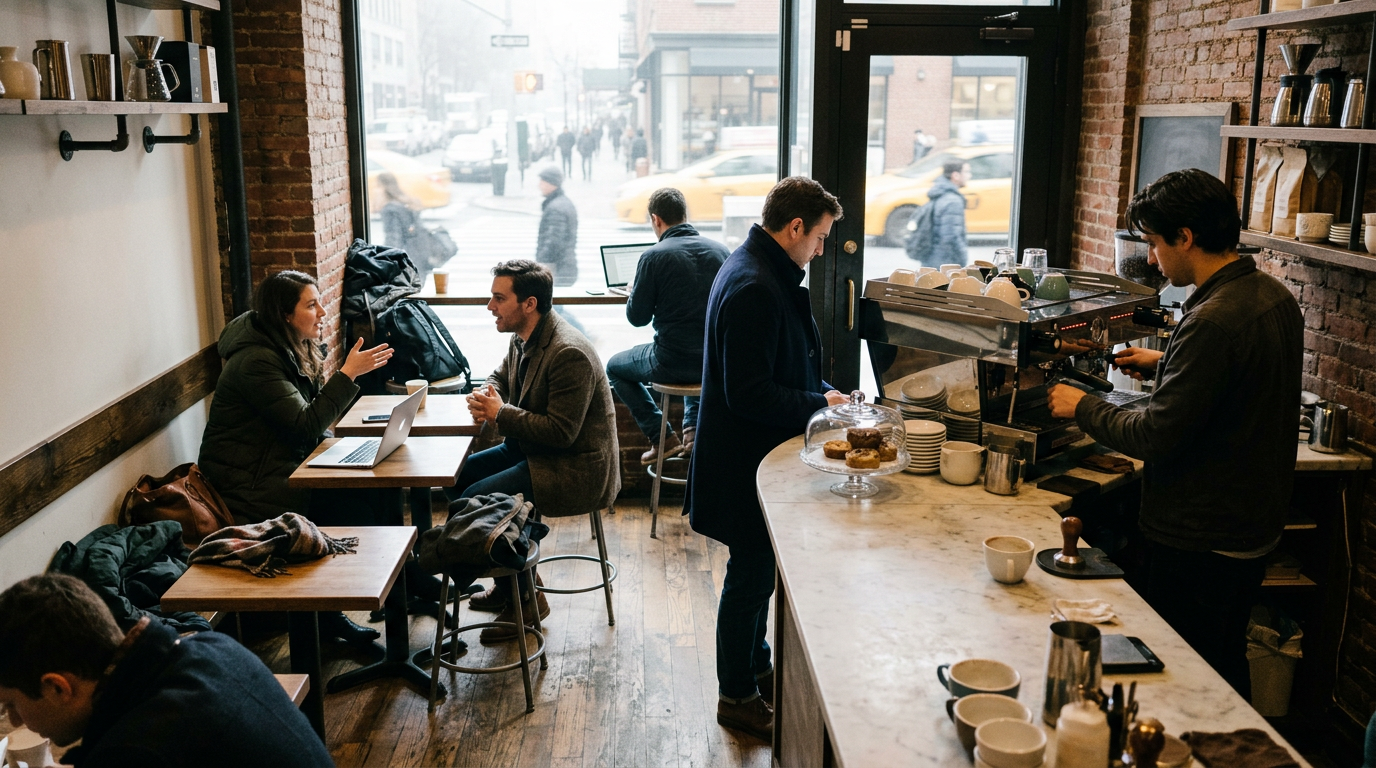
Order coffee in NYC without giving tourist energy
At 8:47 a.m. in Manhattan, nobody in line wants to hear a four-part monologue about whether the beans are “strong.” The barista is pulling shots, three people are late to standup, one founder is doing a quiet investor call outside, and the regular ahead of you just ordered a cortado without looking up from Slack.
That is the NYC coffee room. Fast, expensive, cramped, and socially useful if you know what you are doing.
Third-wave coffee here is no longer a novelty. Blue Bottle, Joe Coffee, Cafe Grumpy, La Colombe, Stumptown, Devoción, Birch, and a long tail of independent espresso bars trained the city to expect better sourcing, lighter roasts, precise milk texture, and clean retail design. The scene has matured. The flex is not knowing the most obscure origin. The flex is reading the room, ordering cleanly, and knowing when a café is for work, when it is for a quick standing espresso, and when it might actually produce a useful weak tie.
This is for founders, freelancers, operators, and creators who use coffee shops as part of the workday without acting like the shop owes them a conference room.
The local baseline: NYC coffee is about pace and purpose
New York has several coffee cultures running at once.
There is the classic cart-and-deli culture: large drip, light and sweet, no ceremony. There is the Italian-American espresso bar reflex: stand, drink, leave. There is the third-wave café: single-origin pour-over, dialed espresso, seasonal beans, branded totes, a few laptops, and a room full of people pretending not to notice one another.
If you want to sound local, do not overperform expertise. NYC has low patience for performative taste. You can care about coffee without turning the line into a seminar.
A good order here does three things:
- It matches the shop’s pace.
- It respects the barista’s workflow.
- It gives you the drink you actually want.
If the café is slammed, order something the bar can execute quickly: espresso, cortado, cappuccino, drip, cold brew. If it is slow and the menu clearly highlights a single-origin pour-over, that is when you ask one concise question.
The room matters too. A tiny espresso bar in the West Village is not a coworking space. A larger café in Brooklyn with communal tables and outlets might tolerate a two-hour laptop session if you keep buying and do not sprawl. A polished lobby café near Flatiron may be more about meetings than solo work. A coffee counter attached to a bookstore or hotel lobby can be excellent for first meetings because nobody feels trapped.
What to order / what to look for
!Barista preparing espresso drinks at a third-wave coffee counter
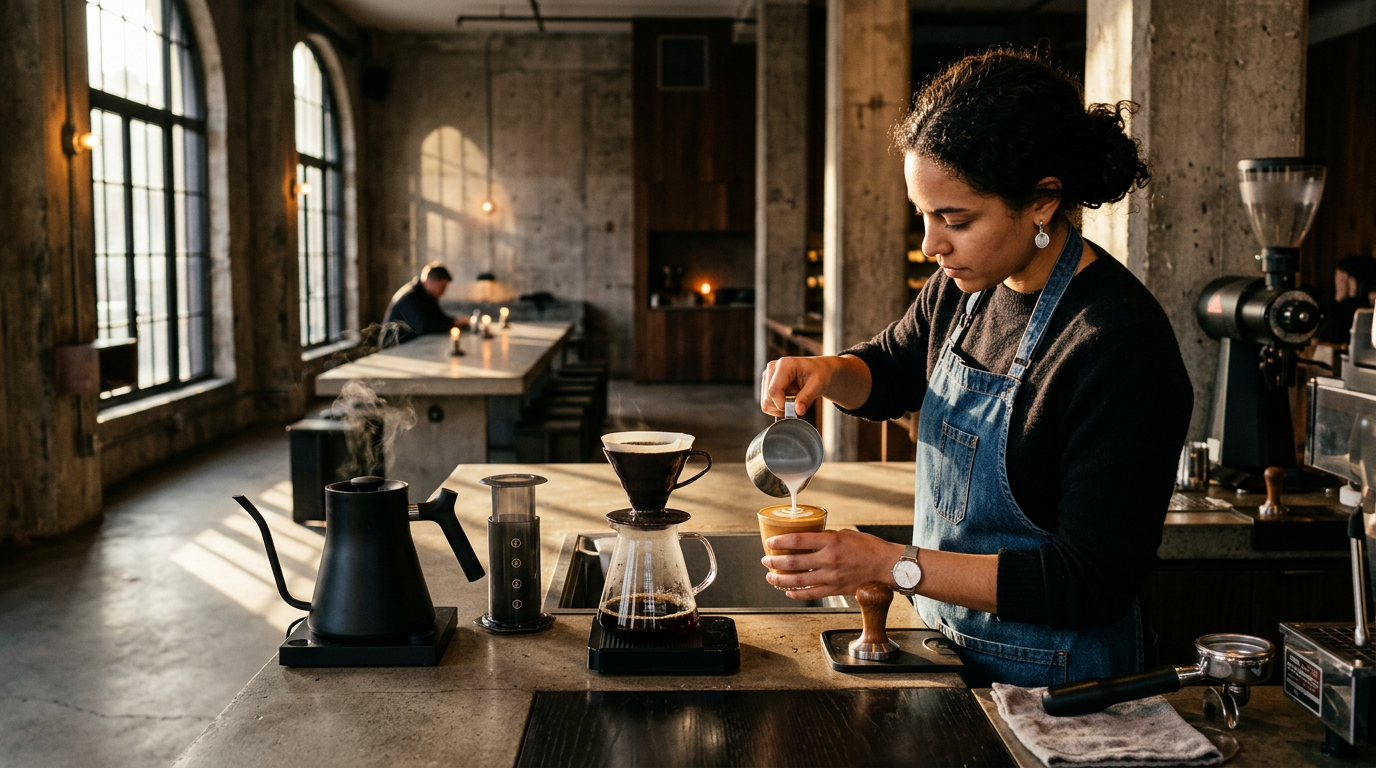
Start with the drink category, not a vague preference. “Something strong” makes you sound like you do not know what espresso is. “Not too sweet” is fine, but only after you name the drink.
Reliable NYC third-wave orders:
- Cortado: The most efficient local-looking order. Espresso with a small amount of steamed milk. Balanced, quick, not precious.
- Espresso: Good if you actually like espresso. Do not order it to look serious and then wince through it.
- Macchiato: A small espresso drink with a touch of milk, not a caramel dessert drink.
- Cappuccino: Safe, classic, and still one of the best tests of a bar.
- Batch brew: The underrated move. If a serious shop is brewing good beans in volume, batch can beat a rushed pour-over.
- Single-origin pour-over: Order when the shop is calm, the menu calls it out, and you have seven minutes.
- Iced americano: Better than asking for “iced espresso with water, but not too much water.”
- Cold brew: Fine in summer, but it can flatten origin character. Order it because you want it, not because it sounds more local.
What to look for before ordering:
- A short espresso menu with clear sizes.
- Batch brew listed by origin or roaster.
- A grinder dedicated to filter coffee.
- Beans on retail shelves with roast dates.
- Staff who can answer simply without reciting a script.
- Milk alternatives listed plainly, not treated like a lifestyle manifesto.
If you want a question that signals competence without slowing the line, use one of these:
- “What’s tasting best on batch today?”
- “Is the pour-over pretty bright, or more balanced?”
- “Which espresso are you running right now?”
- “Do you like this one better as drip or pour-over?”
Then accept the answer. Do not cross-examine the barista about altitude, fermentation, and tasting notes while six people wait behind you.
Best time of day to go
For drinking coffee, the best time is usually mid-morning after the commuter hit: around 10:00 to 11:15 a.m. The bar is warmed up, the staff is not yet exhausted, and the room has shifted from survival mode to work mode.
For meeting someone, aim for 9:30 a.m. or 2:30 p.m. A 9:30 coffee feels productive and contained. A 2:30 coffee avoids lunch chaos and gives both people an exit before the late-afternoon slump.
For working solo, the sweet spot is late morning to early afternoon, but only in places built for it. Look for:
- More than one communal table.
- Outlets that are visibly meant for customers.
- A steady laptop presence.
- Staff who are not glaring at campers.
- Enough seating turnover that you are not blocking revenue.
For actually meeting people, skip the peak rush. Nobody wants a networking opener while waiting for an oat cappuccino at 8:55. Better windows:
- 10:30 a.m. near communal tables.
- 1:30 p.m. when the lunch crowd thins.
- 3:00 p.m. when freelancers and founders start doing second-coffee math.
Evening coffee is less of a NYC thing than natural wine bars, izakayas, omakase counters, and member’s clubs. If you are trying to build a network, coffee is the first touch. The real relationship may move to a founder dinner, a small supper club, a Soho House lobby, NeueHouse, an Industrious lounge, or a quiet wine bar later.
Etiquette and unwritten rules
!Freelancers working at a communal table in a Brooklyn coffee shop
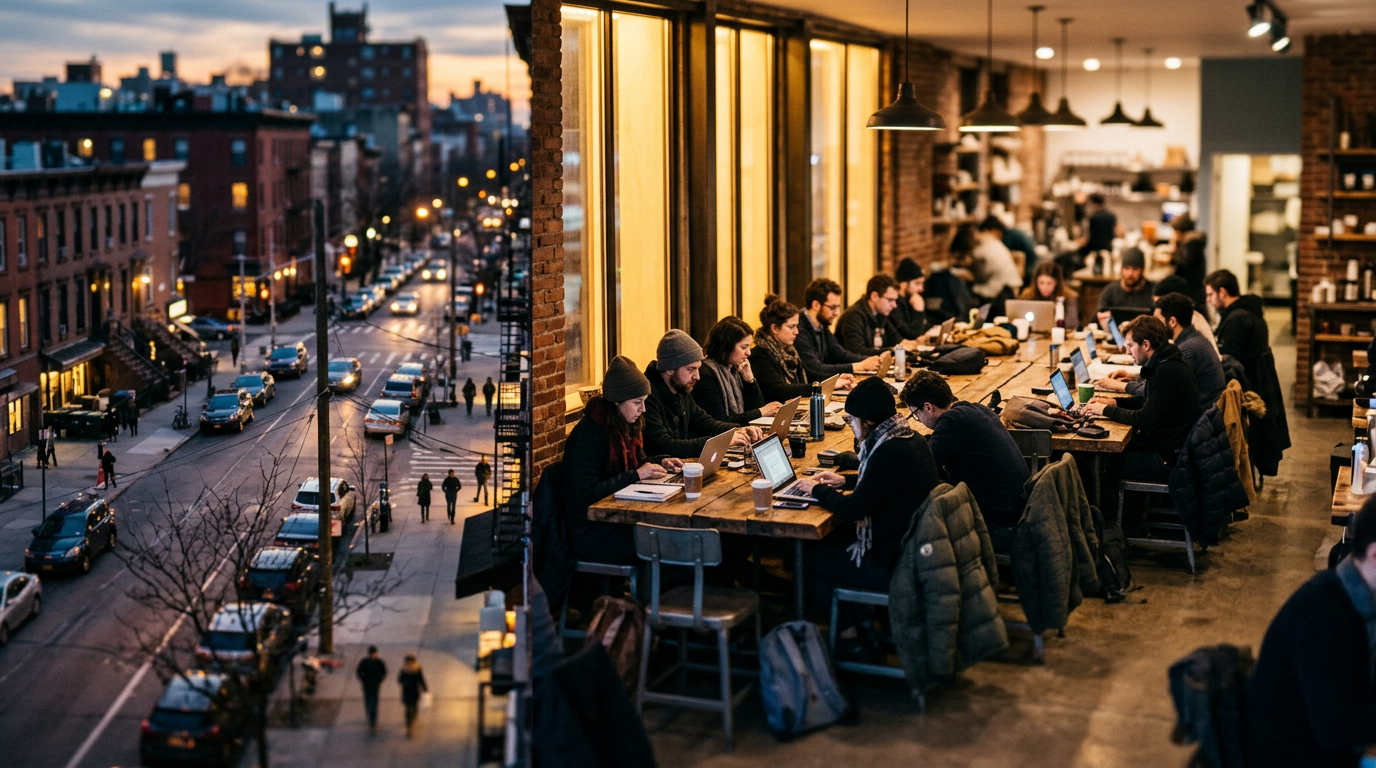
NYC café etiquette is not complicated. It is just enforced socially.
Order decisively. Step aside after paying. Do not hover over the pickup area like your flat white is being held hostage. If you need sugar, lids, napkins, or water, find the station and keep moving.
Tip. Especially if you are ordering espresso drinks, asking questions, or sitting for a while. You do not need to perform charity, but stiffing the bar while turning the table into your office is bad form.
Use laptop judgment. A laptop is acceptable in many third-wave shops, but not all. If every table is a two-top and people are circling with cups, close the laptop or move. If you need to run a call, go outside. Nobody came for your pipeline review.
Do not bring a full meal from somewhere else. A pastry from the counter is fine. Your takeout bowl is not.
Do not rearrange the room. Moving one chair is normal. Building a four-person workstation out of café furniture is not.
Do not ask for endless modifications during rush. One milk swap is normal. A half-caf, extra-hot, two-syrup, no-foam negotiation at a serious espresso bar will mark you immediately.
Respect the barista’s role. They are not your personal coffee tutor during peak service. When the shop is slow, good baristas often enjoy talking about beans. During a rush, the best customer is clear, polite, and fast.
The most local sentence in a third-wave shop is not “I know the owner.” It is “Thanks, I’ll step over here.”
How to actually meet people there
Coffee shops are good for weak ties, not instant best friends. Sociologist Mark Granovetter’s weak ties idea fits the room: loose connections often carry the most useful information because they sit outside your usual circle. In NYC, that might mean a designer who knows a fractional CFO, a seed founder hiring a growth lead, or a freelancer who just left a company you are trying to sell into.
But you have to approach lightly.
Best places to make contact:
- Communal tables where people are already sharing space.
- The pickup counter after a natural comment, not while someone is ordering.
- The retail bean shelf if someone is clearly browsing.
- Outside the café after a brief inside exchange.
- Recurring neighborhood cafés where staff and regulars recognize patterns.
Openers that do not sound like a pitch:
- “Do you know if this table usually turns into a laptop zone, or do people get moved along?”
- “Have you tried their batch brew today?”
- “Is this a decent place for a 30-minute meeting, or too loud?”
- “I see you’re using that portable stand. Worth it?”
- “Are you based around here, or just between meetings?”
If they engage, keep it human. Ask what they are working on only after a little context. If they give short answers, let it die. The city rewards clean exits.
A better founder coffee move is to schedule one intentional meeting at a café with enough ambient energy, then allow one extra weak-tie interaction before or after. Do not walk in trying to collect contacts. Walk in to be usefully present.
Follow-up matters more than the opener. If you exchange names, send a same-day note:
- “Good meeting you at coffee earlier. Here’s the hiring platform I mentioned.”
- “Nice crossing paths at Devoción. If you do end up testing that CRM workflow, happy to compare notes.”
- “Good luck with the launch. I know one operator who has dealt with that exact onboarding issue; want an intro?”
No essay. No pitch deck unless requested. One useful sentence, one clear next step.
The order that works in almost every serious NYC café
If you want the safest local order, make it this:
“Cortado for here, please.”
If you want black coffee:
“What’s on batch?”
If the answer sounds good, order it. If not:
“I’ll do an americano.”
If the shop is calm and clearly proud of its filter program:
“I have time for a pour-over. Which one is drinking cleaner today?”
That phrasing does a lot. It tells the barista you understand that pour-over takes time. It asks for their judgment. It avoids pretending you can decode every tasting note from a menu board.
For milk drinks, do not obsess over size. Serious shops often keep cappuccinos and cortados small because the ratios matter. If you want a large hot milk drink for a long walk, that is not a crime, but a third-wave counter may not be designed around that order. In that case, go to a larger café, a bakery-café, or a chain that handles volume.
For iced drinks, be direct:
- “Iced latte with whole milk.”
- “Iced americano.”
- “Cold brew, no milk.”
Skip the apology. New Yorkers are not offended by simple preferences. They are offended by indecision performed in public.
Mistakes to avoid
The first mistake is treating every third-wave shop like a remote office. Post-pandemic café culture got more complicated. Some shops welcomed laptop traffic to rebuild weekday revenue. Others got burned by campers buying one drip and occupying four seats for five hours. By 2026, the norm is situational. Read signage. Read furniture. Read faces.
Second mistake: asking for “regular coffee” at a specialty counter and then getting annoyed when the barista asks what you mean. In NYC, “regular coffee” can mean deli coffee with milk and sugar. At a third-wave bar, it may mean batch brew. Say what you want.
Third: ordering a single-origin pour-over during a line crush, then complaining about the wait. Pour-over is a small manual process. If you are in a hurry, batch brew exists for a reason.
Fourth: turning coffee knowledge into status theater. Nobody cares that you had a natural-process Ethiopian in Silver Lake in 2019. If you like fruitier coffees, say that. If you like chocolatey and balanced, say that.
Fifth: pitching strangers too hard. A café is not AngelList, Lunchclub, Meetup, On Deck, or South Park Commons. Those are built for declared networking. A coffee shop is ambient. You earn the right to talk by being normal first.
Sixth: camping at the wrong table. If you are one person at a four-top during peak traffic, you are the problem. Move before being asked.
Seventh: ignoring the staff. Regulars become regulars by being easy to serve. Learn names only if the relationship develops naturally. Say thank you. Bus your cup if that is the system. Do not make a production of it.
Picking the right type of room
For a quick solo reset, choose a small espresso bar with limited seating. Stand if needed. Drink the espresso or cortado there. Leave sharper than you arrived.
For a first business coffee, choose a larger third-wave café, a hotel-adjacent coffee bar, or a polished bakery-café with enough seating and noise cover. You want energy, not chaos. Avoid tiny rooms where your guest has to fight for a stool.
For laptop work, choose a café that behaves like a soft coworking space: communal tables, outlets, steady Wi-Fi, and a staff culture that tolerates work sessions. If you need four hours, consider a coworking day pass instead. WeWork, Industrious, Spaces, and neighborhood independent coworking spots exist because cafés are not built to absorb every remote worker all day.
For networking, pick repeatability over novelty. Go to the same good café near your office, studio, or coworking space two or three times a week at the same hour. Familiarity compounds. Staff recognize you. Other regulars become easier to greet. The room starts working for you without you forcing it.
That is the real local move: not the rarest bean, not the most elaborate order, not the café selfie. A clean order. A good table read. One useful conversation. Then back to work.
Discussion (0)
Loading comments…