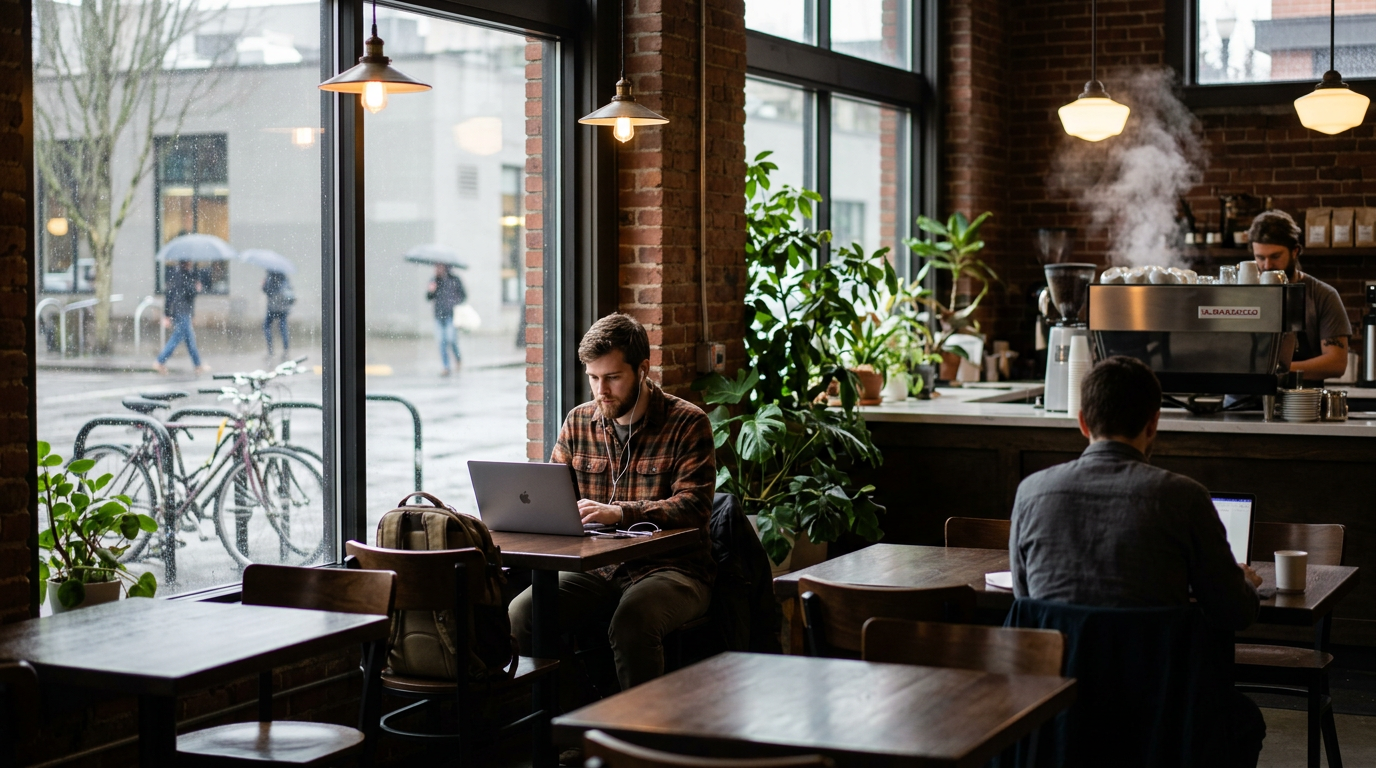
The Portland cafe circuit for solo builders
At 9:12 on a wet Tuesday, the useful Portland coffee shop is not the one with the longest line. It is the room where three people have laptops open, two people are actually talking, the outlets are not treated like public property, and the barista does not look defeated by remote workers nursing cold drip for four hours.
That is the Portland cafe problem for indie hackers and solo builders in 2026. The city has serious coffee literacy, a high tolerance for weird independent projects, and a lower tolerance for status theater than San Francisco or Miami. You can absolutely build a SaaS feature, write a landing page, ship a newsletter, or debug a Stripe issue from a cafe here. You can also quietly become a nuisance if you treat a small coffee bar like a free WeWork.
Portland is not short on third-wave coffee. Stumptown, Coava, Heart, Barista, Proud Mary, and Good Coffee all helped shape the city’s expectations around espresso, single-origin pour-over, and design-forward rooms. But the move for solo builders is not to camp at the most photogenic counter. It is to know which kind of room matches your work session, when to show up, how to spend, and how to turn a few weak ties into actual local momentum.
The Portland coffee-shop map for indie hackers
Think in categories first, venues second. Portland rewards people who read the room.
The serious coffee bar
This is the Stumptown, Coava, Heart, Barista, Proud Mary, or Good Coffee lane: trained baristas, dialed espresso, careful pour-over, clean interiors, plenty of people who know exactly what they like. These are strong for a 60- to 90-minute focused sprint, not an all-day build session.
Use them for:
- Writing the hard part of a product email
- Reviewing analytics before a founder call
- Sketching a pricing page
- Having one sharp coffee meeting
Do not use them for:
- A three-hour Zoom block
- Spreading out a laptop, iPad, notebook, charger, and external keyboard across a four-top
- Taking a product demo call with your volume up
The coffee is the product. Respect that.
The neighborhood laptop-friendly cafe
This is the workhorse category for indie hackers: a slightly larger room, mixed seating, dependable Wi-Fi, enough background sound to make typing normal, and staff who are used to remote workers as long as the room keeps turning. These are often better for solo builders than the famous rooms because nobody is treating the space like a coffee pilgrimage.
Look for:
- Two-tops along the wall
- A few outlets, not outlet dependence
- People working quietly but also eating real food
- A menu beyond espresso, because longer stays require more than caffeine
This is where you can take a two-hour build block without making it weird.
The cafe near a coworking cluster
Portland has the post-pandemic coworking pattern you see in a lot of US cities now: fewer people want a full-time dedicated desk, more people buy a day pass or hot desk when they need structure, and a lot of networking happens in the spillover zone around those buildings. Cafes near coworking offices, design studios, and agency blocks are better for chance collisions.
If you want founders, freelancers, operators, and fractional people, sit near where they already move between calls. Not necessarily in the busiest room. The adjacent one.
The late-afternoon cafe that turns social
Some Portland rooms are dead for networking at 8 a.m. and surprisingly useful at 3:30 p.m., when people are between meetings and open to a five-minute conversation. This is where the city’s indie energy shows up: writers, devs, product designers, solo consultants, e-commerce operators, and people building one-person businesses with a half-finished Notion doc open.
You are not looking for a party. You are looking for permission to talk.
What to order / what to look for
!Laptop and coffee on a small Portland cafe table during a work session

Order like you understand the trade. Portland coffee workers can spot the four-hour laptop camper from across the room.
For a short session:
- Espresso or a drip coffee if you need speed
- Single-origin pour-over if the bar is not slammed
- A pastry or breakfast item if you are taking a table during a busy hour
For a two-hour work block:
- Coffee first, food within the first hour
- A second drink if you stay past 90 minutes
- Tip normally, not performatively
For a meeting:
- Order before sitting down if there is counter service
- Do not make your guest wait while you debate tasting notes
- Choose the drink that keeps the interaction moving
What to look for before opening the laptop:
- Are half the tables already occupied by laptops? Fine. Join the pattern.
- Are most seats occupied by people eating and talking? Keep the laptop session short.
- Is there music loud enough to cover a low conversation? Good for a meeting, not a sales call.
- Are baristas glancing at a full room with no turnover? Buy more or leave.
A Portland-specific note: do not make a show of being busy. Nobody cares that you are shipping. The city is allergic to founder cosplay. Quiet competence plays better.
Best time of day to go
The right time depends on the job.
7:30 to 9:30 a.m.
Good for email triage, planning, and a clean first sprint. Bad for networking unless you already know the person. People are caffeinating, commuting, or trying to get one stable hour before the day starts.
If you take a table at peak breakfast, keep it tight. This is not the hour for a 14-tab research session.
10 a.m. to noon
The strongest work window. The rush has softened, the room is awake, and you can usually settle into a two-top without feeling like you are blocking revenue. If you want to finish a feature spec, edit a pitch memo, or ship a landing page, this is the slot.
1:30 to 4 p.m.
The best networking window. Lunch has passed, meetings loosen up, and people are more likely to notice the person next to them working on something adjacent. This is when a casual opener can work without feeling like an interruption.
After 4 p.m.
Cafe energy gets uneven. Some rooms start closing down; others become social. If you need connection, consider shifting to a natural wine bar, casual izakaya, brewery-adjacent food cart pod, or small founder dinner instead of forcing a coffee shop to be an evening networking venue.
Portland has a strong small-table culture after work. A low-key supper club, Meetup, or product-founder drinks gathering may do more for you than another oat latte.
Etiquette and unwritten rules
!People talking outside a rainy Portland neighborhood cafe in the evening

Portland cafes are generous, but not endlessly so. The basic rule: act like the business is a business.
Do this:
- Buy something within a few minutes of arrival
- Choose the smallest table that fits your work
- Use headphones for all audio
- Take calls outside or keep them under two minutes
- Pack up when the room fills and people are looking for seats
- Ask before using an outlet behind furniture
- Clear your dishes before you leave
Do not do this:
- Bring a full desktop setup
- Hold a team standup in a small room
- Use a cafe as your mailing address, emotional support office, or unpaid showroom
- Complain about limited outlets
- Sit for half a day on one drip coffee
The unwritten Portland rule is simple: independence is respected when it comes with self-awareness. If your solo-builder routine makes the staff’s day worse, you are doing it wrong.
Also, avoid pitching strangers cold while they are eating. A cafe is not a demo day. The better move is light recognition first, then a real follow-up later.
How to actually meet people there
The goal is not to work beside strangers forever. It is to turn repeated proximity into a few useful weak ties. Mark Granovetter’s weak ties idea fits here because the best opportunities often come from people just outside your tight circle: the designer one table over, the fractional CFO you keep seeing on Tuesdays, the Shopify operator waiting for coffee.
Portland makes that possible because people remember faces. You do not need to be loud. You need to be consistent.
Pick two regular rooms
Choose one serious coffee bar for short sessions and one laptop-friendly neighborhood cafe for longer work. Go at the same time twice a week for a month. Familiarity lowers the social cost.
Do not rotate through 18 cafes and expect connection. That is consumption, not community.
Use low-friction openers
Good openers in Portland are specific, calm, and easy to decline.
Try:
- I see you here a lot on Tuesdays. Are you working nearby or building something independent?
- Quick one: do you know any good small founder meetups around here?
- I am testing a landing page for a tiny software product. If you have thirty seconds later, I would take one blunt reaction.
- That looks like a product roadmap. Are you in software or consulting?
- I am trying to find more solo builders in Portland without turning it into a networking circus. Any rooms you like?
Bad openers:
- Can I pitch you something?
- What do you do?
- Are you an investor?
- Want to join my beta?
The first sounds needy. The second is lazy. The third is weird in a cafe. The fourth is too soon.
Make the follow-up easy
If the conversation goes well, do not trap the person for 25 minutes. Say: I do not want to interrupt your work block. Want to swap LinkedIn or email and do a 20-minute coffee next week?
Then send a same-day note:
- Good meeting you at coffee today. I liked your point about pricing before product polish. If useful, I am around next Tuesday afternoon for a quick coffee.
For indie hackers, follow-up is where most local networking dies. Use a simple system: notes app, contact, one sentence on context, one next action. If they mention AngelList, GitHub, a Meetup, Lunchclub, On Deck alumni, or a local Slack, write it down. Do not rely on memory.
The cafe-to-community ladder
Coffee shops are the front door, not the whole house. If you want real Portland operator relationships, use cafes to find the next room.
Move like this:
- Work consistently from one or two cafes
- Meet one or two adjacent people
- Ask what small events are actually worth attending
- Try one Meetup, founder dinner, or coworking day pass
- Invite one person back for a focused coffee
- Repeat without turning every interaction into a funnel
Portland has plenty of people building quietly: indie software, agencies, physical products, newsletters, creator businesses, food brands, outdoor-adjacent commerce, climate and hardware projects. Many are not hanging out under a big startup banner. You find them through small rooms, repeated sightings, and useful introductions.
Coworking still matters, but differently than it did in 2018. A hot desk day can be worth it when you need calls, printer access, and a reason to be around other operators. A dedicated desk only makes sense if you will actually use it. If your budget is tight, combine two cafe work blocks per week with one coworking day pass per month and one in-person event. That is enough structure for many solo builders.
Mistakes to avoid
Chasing famous coffee instead of fit
The best espresso in the room does not always equal the best work environment. Some Portland coffee shops are built for coffee, conversation, and turnover. Respect that. Use them for short, sharp sessions.
Taking calls in rooms that were not built for calls
A cafe is not your booth. If you have investor calls, customer interviews, or a product demo, use a coworking day pass, your apartment, or a quiet meeting room. Everyone can hear more than you think.
Over-networking the room
If you talk to five strangers in one cafe session, you are not networking. You are making the room tense. One gentle conversation is plenty.
Under-spending
Portland cafes operate on real margins. If you are there for two hours, buy like it. Coffee plus food is the floor for a longer stay.
Ignoring the staff
Baristas often know who works where, which regulars are friendly, and when the room gets slammed. Be respectful over time and you will understand the rhythm faster. Do not pump them for introductions. Just be a good regular.
Treating Portland like a smaller San Francisco
Wrong read. Portland has ambition, but it is less impressed by scale talk and more interested in craft, usefulness, independence, and whether you are tolerable to be around. Say what you are building plainly. Skip the inflated language.
A practical weekly routine
If you are a solo builder in Portland, try this for four weeks.
Monday morning: serious coffee bar, 75-minute planning sprint. No calls. One coffee, one focused task.
Tuesday afternoon: laptop-friendly neighborhood cafe, two-hour build block. Sit at a two-top. Order coffee and food. If a natural conversation appears, take it. If not, ship.
Wednesday: home or coworking day pass for calls, demos, and admin. Do not make a cafe absorb your meeting load.
Thursday afternoon: return to the same neighborhood cafe. Same general time. Become recognizable. Ask one low-pressure question if the moment is right.
Friday evening or Saturday: attend one small Meetup, founder dinner, maker hangout, or operator event you heard about from an actual person, not a broad event calendar.
This is not glamorous. It works because Portland rewards continuity. The city’s solo-builder scene is not one central club. It is a set of overlapping rooms: coffee bars, coworking lounges, natural wine tables, backyard supper clubs, bike-commute conversations, Slack groups, and small events where the same 40 people keep reappearing.
Your job is to become a good repeat presence. Buy properly. Work clean. Talk lightly. Follow up fast. Build something worth discussing.
That is the Portland cafe circuit at its most useful: less performance, more progress, and just enough conversation to stop building alone.
Discussion (0)
Loading comments…