The quiet trap inside the prisoner’s dilemma
The scene
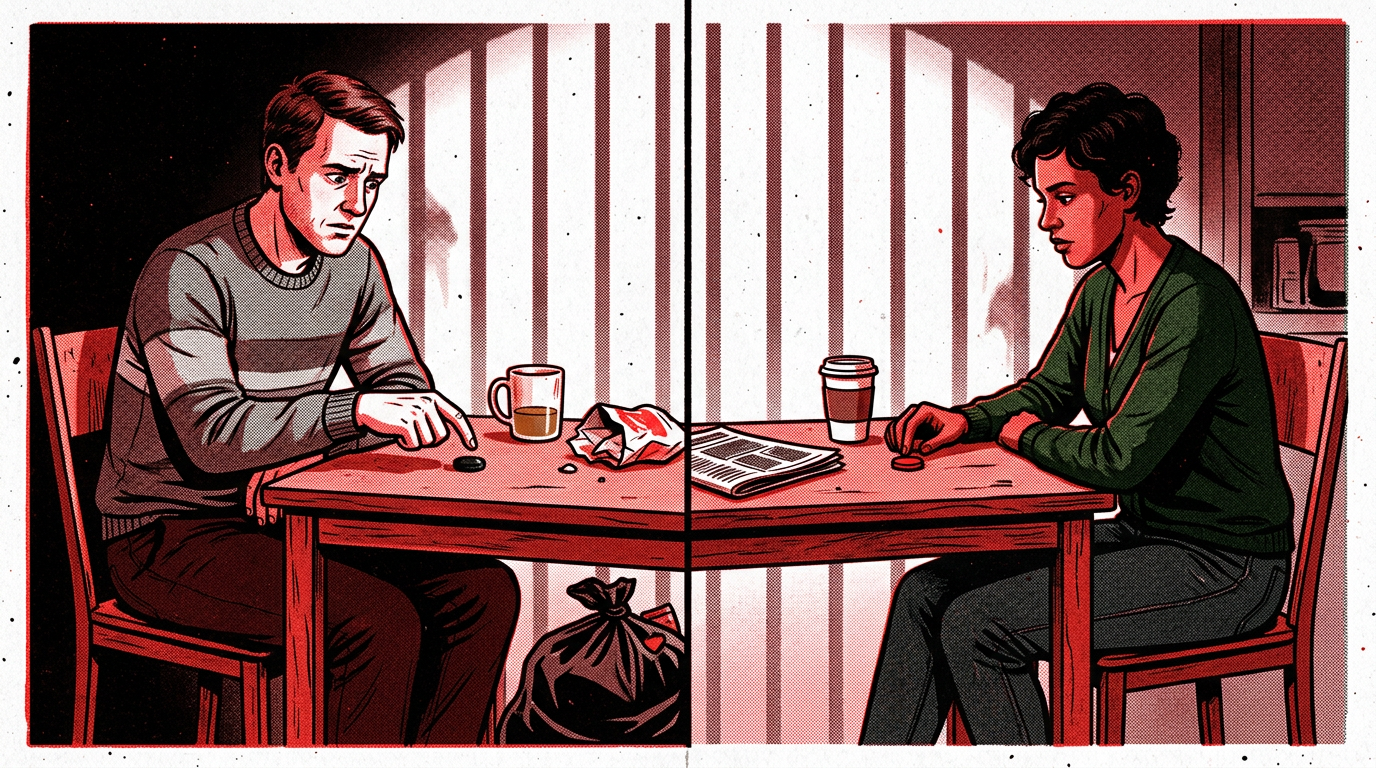
Two roommates hear the trash bag slide out of the kitchen can and hit the floor.
Neither one moves.
The bag is full. It smells faintly like onions and old takeout. Both people know the right answer: someone should take it outside. Both also know the private answer: if I wait long enough, maybe the other person will do it.
If one roommate takes the trash out, the apartment gets better and the other roommate gets a free ride. If neither does it, the kitchen gets worse. If both somehow jump up at the same time, one of them was unnecessary.
That little domestic standoff is game theory in sweatpants.
No guns. No casino table. No villain twirling a mustache. Just two people making decisions while trying to guess what the other person will do.
The prisoner’s dilemma is the most famous version because it strips the problem down to the bone: individual incentives can push people toward a result that is worse for everyone. That sounds obvious after you hear it. It is not obvious when you are the one staring at the trash bag.
What it actually is
Game theory is the study of strategic decision-making. “Strategic” does not mean fancy. It means your best choice depends on someone else’s choice.
A game, in this sense, has a few parts:
- Players: the people, companies, countries, apps, or animals making choices.
- Strategies: the actions each player can take.
- Payoffs: what each player gets from each combination of choices.
- Information: what each player knows when choosing.
- Rules: what is allowed, what is punished, and what happens next.
The field became formal in the 20th century. John von Neumann and Oskar Morgenstern published Theory of Games and Economic Behavior in 1944, giving economists and mathematicians a language for conflict, bargaining, and strategy. John Nash later introduced what is now called the Nash equilibrium in 1950: a situation where no player can improve their outcome by changing their choice alone, assuming everyone else keeps theirs.
That last part matters. A Nash equilibrium is not always good. It is not always fair. It is not even always smart from a group point of view. It is simply stable. Nobody wants to move first.
A traffic jam can feel like that. Everyone would benefit if cars flowed smoothly, but each driver inches forward to protect their own place. The result is a mess that no single driver can fix.
The prisoner’s dilemma without the courtroom fog
The classic prisoner’s dilemma was developed around 1950 by Merrill Flood and Melvin Dresher at RAND. Albert W. Tucker later framed it with the prisoner story that made it famous.
Here is the stripped-down version.
Two suspects are arrested. Police separate them. Each suspect has two choices:
- Stay silent.
- Betray the other suspect.
The possible outcomes look like this:
- If both stay silent, both get a light sentence.
- If one betrays and the other stays silent, the betrayer goes free and the silent one gets a heavy sentence.
- If both betray, both get a medium sentence.
The trap is that betrayal looks safer for each person individually.
If the other person stays silent, betraying gets you the best outcome. If the other person betrays, betraying protects you from the worst outcome. So betrayal is what game theorists call a dominant strategy: it looks better no matter what the other player does.
But when both follow that logic, both betray. They land in a worse result than if both had stayed silent.
That is the prisoner’s dilemma: rational individual choices can produce irrational collective outcomes.
Not because people are stupid. Because the incentives are badly shaped.
Why it matters
The prisoner’s dilemma shows up anywhere trust is useful but cheating is tempting.
Two companies can keep prices stable and earn decent margins. Or one can cut prices to grab customers. Once one cuts, the other often follows. Customers may benefit for a while, but both companies may end up in a lower-profit fight they did not really want.
Two coworkers can share credit on a project. Or one can quietly frame the work as mostly theirs. If both start protecting themselves, the team gets political. Meetings get longer. Documentation gets defensive. Work slows down.
Two countries can limit weapons. Or one can build more “just in case.” The other reacts. Arms races are not always caused by a desire for war; sometimes they grow from mutual fear.
The same logic appears in climate policy, neighborhood noise, shared office kitchens, online marketplaces, and public health. One person cutting a corner may be harmless. Thousands doing it can change the whole system.
Daniel Kahneman’s idea of loss aversion, described in Thinking, Fast and Slow (2011), helps explain why defection can feel so compelling. People often feel the pain of a possible loss more sharply than the pleasure of an equal gain. In prisoner’s dilemma terms, the fear of being the sucker can overpower the benefit of mutual cooperation.
That is why “just trust each other” is weak advice. Trust helps, but incentives decide whether trust survives contact with reality.
The simplest analogy that works
Picture two food trucks parked near the same office building.
Both sell lunch bowls for $12. At that price, each makes a healthy profit. Customers split between them based on taste, line length, and habit.
One owner thinks, “If I drop my price to $9 today, I can pull people from the other line.”
That move works if the other truck keeps charging $12. The discounter gets a rush. The other owner watches customers drift away and thinks, “Fine. I can do $9 too.”
Now both trucks are charging $9. The lines are not much better. The work is the same. The profit is worse.
Each owner made a reasonable decision from their own seat. Together, they made the block less profitable.
The analogy works because the pain is familiar. You do not need equations to understand the tension. Cooperation is profitable but fragile. Defection is tempting because it offers a short-term edge. Once both sides defect, the edge disappears and only the damage remains.
Barry Schwartz wrote about the burden of too many options in The Paradox of Choice (2004). The prisoner’s dilemma adds a sharper twist: sometimes the problem is not too many choices. Sometimes it is that the obvious self-protective choice leads straight into a worse shared outcome.
One round changes everything
The original prisoner’s dilemma is usually a one-shot game. You choose once. The other person chooses once. Then it is over.
Real life is rarely that clean.
You see the roommate again tomorrow. The food trucks park on the same block next week. Countries remember treaty violations. Sellers on marketplaces build reputations over months or years.
When a game repeats, cooperation becomes easier to sustain because today’s behavior affects tomorrow’s treatment. Game theorists call this a repeated game. The future casts a shadow over the present.
Robert Axelrod helped make this famous with computer tournaments around 1980, later discussed in his 1984 book The Evolution of Cooperation. Strategies competed in repeated prisoner’s dilemma games. One of the strongest was Tit for Tat, submitted by Anatol Rapoport. It started by cooperating, then copied the other player’s previous move.
Tit for Tat was not sweet. It was not cruel either. It was clear.
That clarity is the point. In repeated games, stable cooperation often needs a few things:
- A decent chance of future interaction.
- Some memory of past behavior.
- A way to reward cooperation.
- A way to punish defection without burning the whole relationship down.
Reputation is not fluff in game theory. It is a mechanism. It changes the payoff table.
What to track in any game
You can use game theory without doing advanced math. Start by watching the structure of the situation.
Track these pieces:
- Who are the players? Do not stop at the obvious names. A pricing fight may include customers, suppliers, platforms, regulators, and employees.
- What are the real payoffs? Money is only one payoff. Status, time, risk, embarrassment, and control count too.
- Is it one round or repeated? People behave differently when they expect to meet again.
- Can players observe each other’s actions? Cooperation is harder when cheating is invisible.
- Is there a credible punishment? Rules mean little if violations have no cost.
- Can communication change the outcome? Sometimes a simple agreement helps. Sometimes it does nothing because nobody believes it.
- Are there outside options? A player with nowhere else to go may accept a bad deal. A player with alternatives can walk.
The useful move is not “be more strategic” in a vague sense. The useful move is to draw the incentives honestly.
If the system rewards bad behavior, do not be shocked when bad behavior appears.
Common misconceptions
Game theory means everyone is selfish
Not quite. Game theory can model selfishness, but it can also model loyalty, fairness, revenge, generosity, and reputation. A payoff is whatever the player values. For one person, that may be money. For another, it may be not looking like a jerk in front of the team.
The Nash equilibrium is the best outcome
A Nash equilibrium is stable, not necessarily best. In the prisoner’s dilemma, mutual betrayal is stable because neither prisoner can improve by changing alone. But both would prefer mutual silence. Stability and goodness are different ideas.
Cooperation is always naive
Cooperation can be naive in a one-shot game with no trust, no enforcement, and no future. In repeated games, cooperation can be hardheaded. A reliable partner may earn more over time than a clever backstabber who burns every bridge.
People calculate payoffs like robots
Humans use shortcuts, emotions, habits, and stories. Kahneman would call much of this fast, intuitive thinking. That does not make game theory useless. It means the payoff table has to include psychology, not pretend it away.
The prisoner’s dilemma explains every conflict
It explains a lot, but not everything. Some conflicts are coordination problems, where people mainly need to choose the same standard. Some are zero-sum contests, where one side’s gain is the other side’s loss. The prisoner’s dilemma is specifically about the gap between individual temptation and mutual benefit.
A small decision framework
When a tense choice feels messy, try this five-step version on paper.
1. Name the players
Write down who can act and who gets affected. If you cannot name the players, you cannot understand the game.
2. List the choices
Keep it simple at first. Cooperate or defect. Share or hide. Wait or move. Match the discount or hold price.
3. Sketch the payoffs
You do not need perfect numbers. Use rough labels: best, good, bad, worst. The shape matters more than precision.
4. Find the trap
Ask: “What choice looks safest for each person individually?” Then ask: “What happens if everyone does that?” The gap between those answers is often the whole problem.
5. Change the game if you can
Better outcomes usually come from changing incentives, not begging people to become saints. Add transparency. Make the game repeat. Create consequences for cheating. Reward cooperation publicly. Reduce the fear of being exploited.
That is the practical heart of game theory. Do not only judge the players. Inspect the board.
Key takeaways
- Game theory studies choices where your outcome depends on what others do.
- The prisoner’s dilemma shows how self-protection can create a worse result for everyone.
- A Nash equilibrium is stable, but it may still be a bad outcome.
- Repeated games make cooperation more realistic because reputation and future consequences matter.
- The fastest way to understand a conflict is to map players, choices, payoffs, visibility, and enforcement.
- Better behavior often starts with better incentives, not better speeches.
Discussion (0)
Loading comments…