Seattle’s laptop coffee rules are stricter than they look
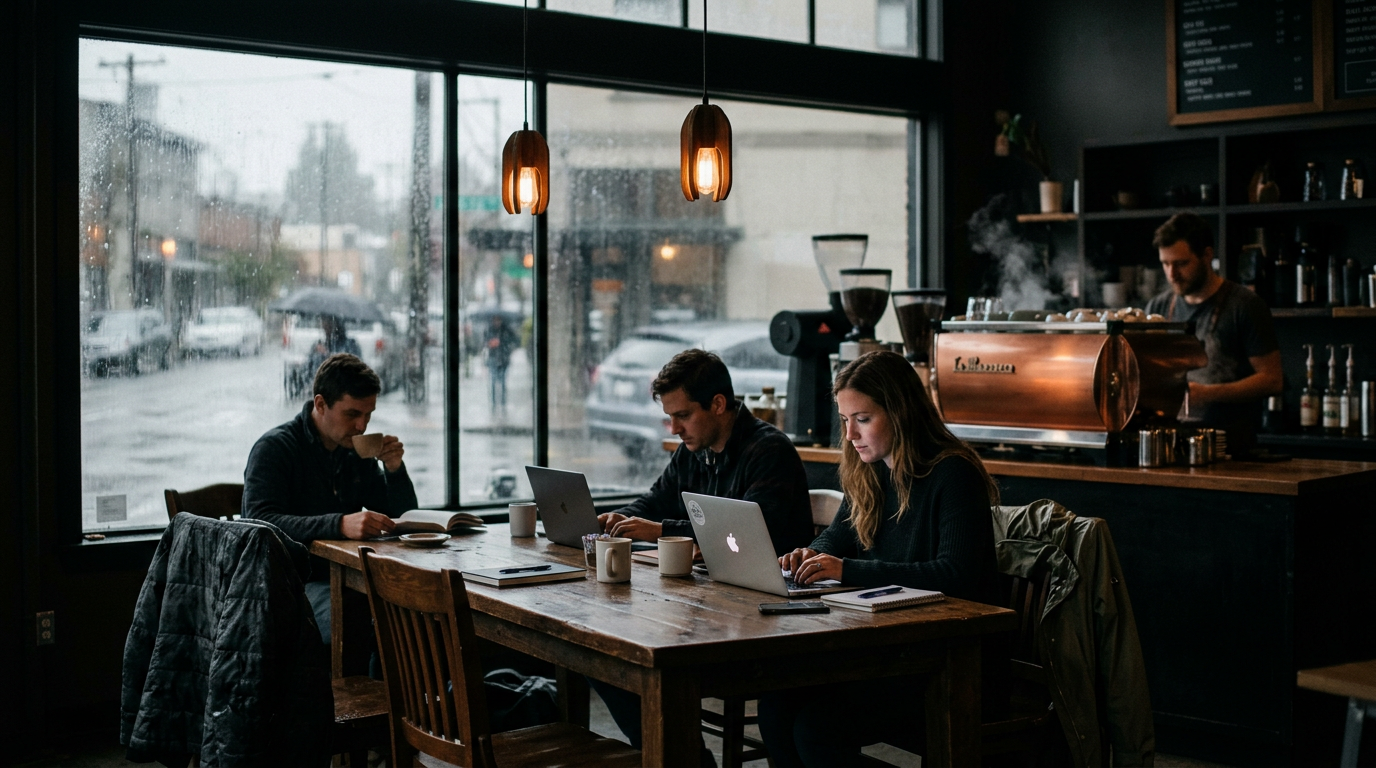
The dead giveaway in Seattle is the outlet hunt. Someone walks into a Capitol Hill coffee bar, scans the wall before looking at the menu, then spreads a charger, notebook, water bottle, headphones, and a half-open laptop across a two-top meant for lunch traffic. Nobody yells. This is Seattle. The barista just gets shorter with them.
Seattle is a serious coffee city, but it is not a free coworking city. The difference matters in 2026, when remote workers, founders, recruiters, designers, and graduate students are all trying to turn cafés into second offices again. The good rooms still exist. You just need to know which type of café fits the work you plan to do, what behavior reads as respectful here, and when it is smarter to pay for a day pass at a coworking space instead of nursing one espresso for four hours.
This is the local rule: Seattle coffee shops are generous if you act like a customer, not a squatter.
The Seattle coffee room has changed
Seattle’s third-wave coffee scene is mature now. The city is no longer trying to prove it can pull a proper espresso. Victrola, Caffe Vita, Espresso Vivace, Herkimer, Elm Coffee Roasters, Anchorhead Coffee, Milstead & Co., Cafe Allegro, and the Starbucks Reserve Roastery all occupy different parts of the local coffee map, from legacy espresso culture to polished downtown caffeine theater.
But laptop tolerance is not the same as coffee quality.
Some of the best coffee rooms are built for 22-minute visits: order, sit, talk, leave. Some larger cafés near South Lake Union, the University District, or downtown can absorb laptop workers because turnover is less fragile. Some neighborhood cafés are flexible on a wet Tuesday and unforgiving on a sunny Saturday. Seattle will not always post the rule in large type. You are expected to notice.
Post-pandemic, operators are more direct about table economics. Rent is high. Staffing is expensive. A four-seat table occupied by one person on a video call is not neutral; it costs the room money. The laptop workers who keep getting welcomed back are the ones who understand that.
What to order / what to look for
!Laptop and pour-over coffee on a communal table in a rainy Seattle café
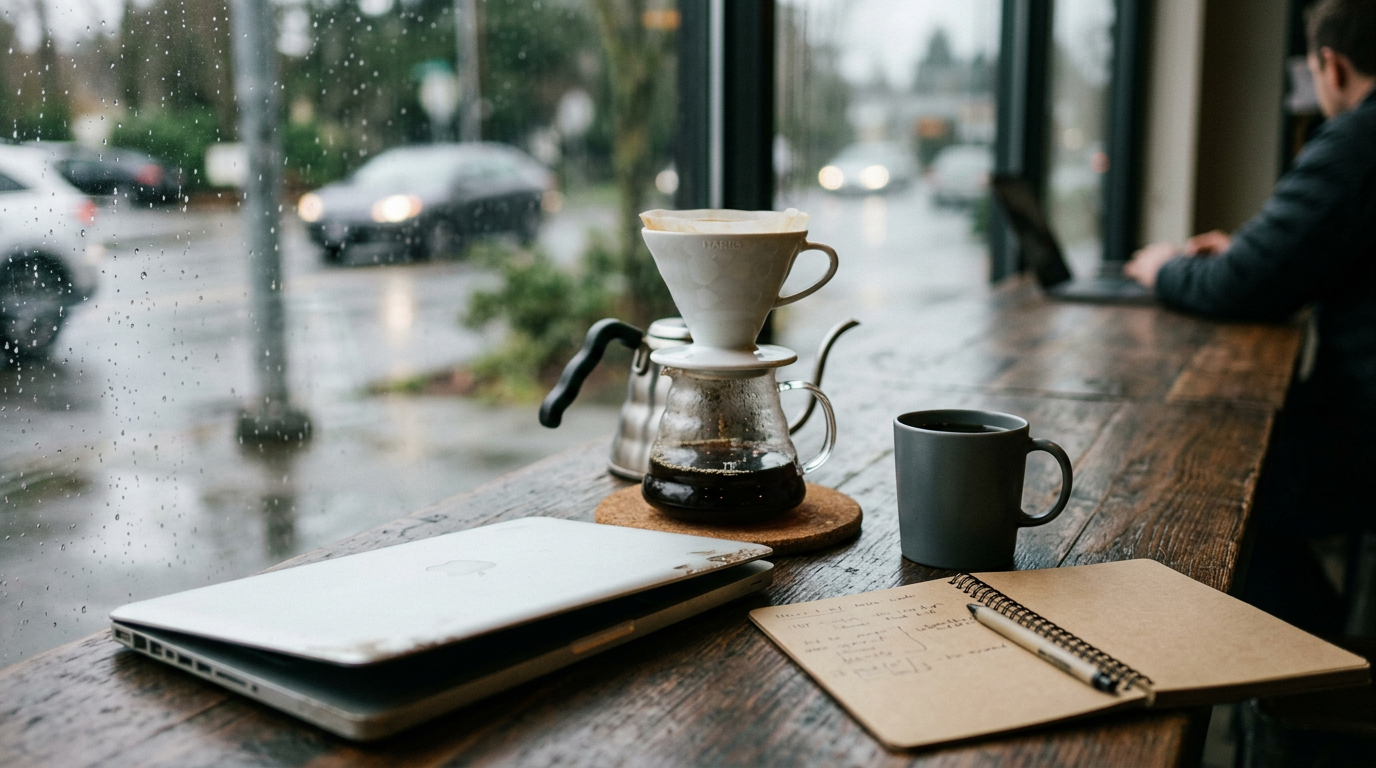
Order like you intend to stay. Not extravagantly. Just clearly.
If you are settling in for focused work, start with one real drink and one food item if the café offers food. A brewed coffee, single-origin pour-over, cappuccino, or espresso tonic is fine. If you plan to sit longer than 90 minutes, buy again. Seattle baristas notice. They may not say anything, but they notice.
What to look for before opening the laptop:
- Communal tables: Better than claiming a two-top alone. If the room has one long table, that is usually the laptop zone.
- Visible outlets: Outlets do not automatically mean camp all day, but their presence is a signal that laptops are expected.
- Other open laptops: One laptop in a room is not proof. Six laptops, headphones, and power cords means the room accepts work sessions.
- Counter seating: Good for solo work when the café is busy. Less social, but more respectful.
- Food program: Cafés with sandwiches, pastries, or breakfast plates can support longer visits better than tiny espresso bars.
- Table spacing: If every chair is needed for short-stay customers, do not be the person running a spreadsheet at the center of the room.
If the café is known primarily for espresso craft, treat it like a coffee bar first. Espresso Vivace, for example, is part of Seattle’s espresso DNA. Go for the coffee and the room. Do not assume it owes you a three-hour desk. Same with smaller, high-quality neighborhood shops where the seating is limited.
For laptop work, the safer category is the spacious neighborhood café near apartments, transit, or offices, especially places with a mix of solo tables and communal seating. South Lake Union, the University District, Capitol Hill edges, Fremont, Ballard, and parts of downtown all have versions of this. The exact name matters less than the setup.
Best time of day to go
Seattle café timing is its own operating system.
The strongest laptop windows:
- Weekdays from 9:30 to 11:30 a.m. after the commuter rush and before lunch pressure.
- Weekdays from 1:30 to 4 p.m. when tables open and staff are less slammed.
- Rainy afternoons if the room is large enough. Rain increases café demand, but it also keeps some casual traffic moving slower and quieter.
- University-adjacent evenings when the room naturally shifts toward study mode.
The weakest laptop windows:
- Saturday and Sunday brunch hours. Do not be the laptop person blocking a table while couples circle with food.
- 8 to 9:30 a.m. on weekdays in commuter-heavy areas.
- Lunch rush in downtown, Ballard, Fremont, and Capitol Hill if the café serves real food.
- Any time the line reaches the door. Close the laptop, finish up, or relocate.
If you need three or more hours, be honest with yourself. A coffee shop might work if it is quiet and spacious. A hot desk, day pass, or library may be cleaner. Seattle has coworking options from WeWork, Industrious, Spaces, and local independent spaces, plus member-style rooms and office-adjacent cafés where the expectation is more work-friendly. Paying for the right container can save you from awkward barista math.
Etiquette and unwritten rules
!People talking outside a Seattle coffee shop on a wet evening
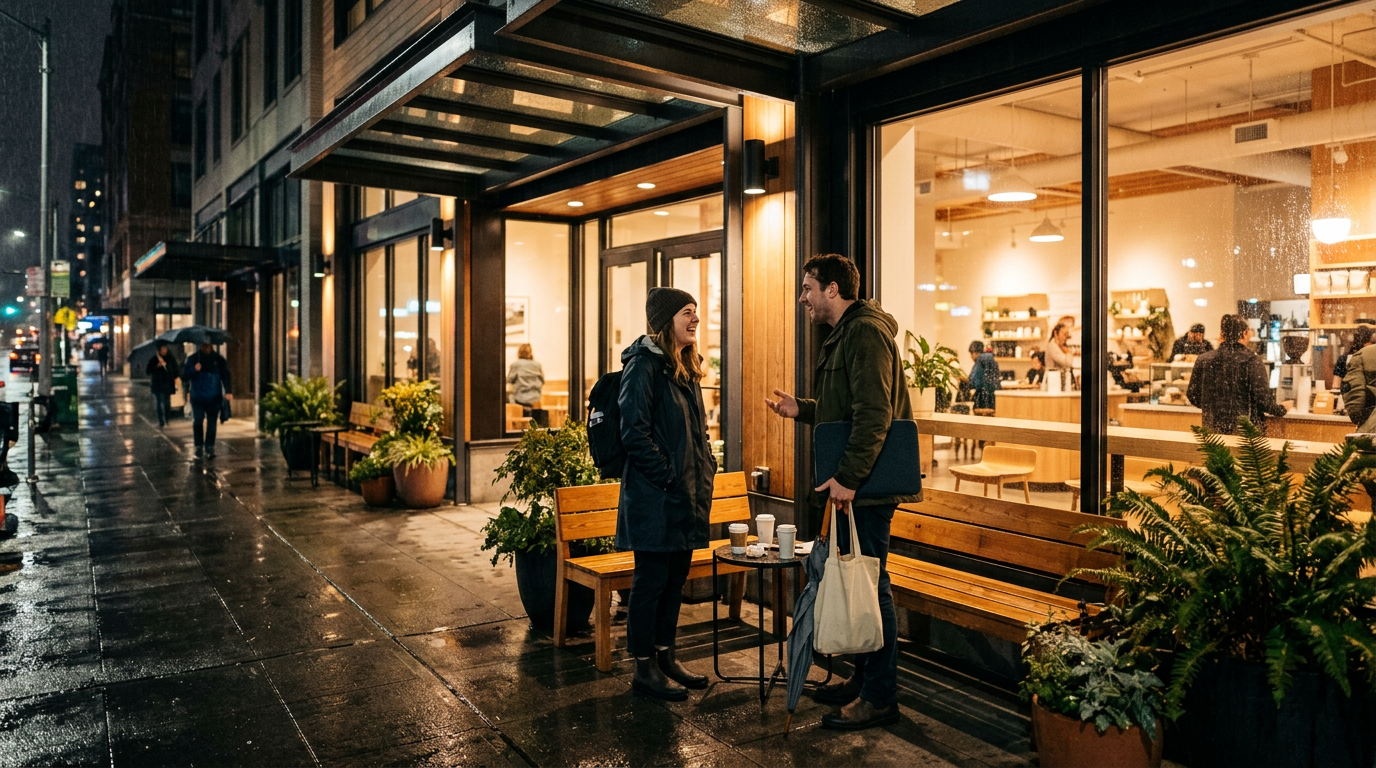
Seattle etiquette is polite on the surface and fairly strict underneath. People will not always confront you. They will just decide you are the problem.
The core rules:
- Buy before you sit. Do not claim a table with your bag while you “just check email.”
- One seat, one person. Your backpack does not get a chair when the room is half full.
- No video calls in small cafés. Step outside, take it from your car, or use a coworking phone booth.
- Headphones always. Audio from a laptop is an instant social penalty.
- Do not rearrange furniture unless staff clearly allow it.
- Tip like you are occupying space. Especially if staff are clearing your dishes or refilling water.
- Ask if you are unsure. “Is it okay if I work here for about an hour?” goes a long way.
- Watch the line, not the clock. A 45-minute stay can be too long if the café is packed. A two-hour stay can be fine in a quiet room.
- Do not bring a full desk setup. Laptop, notebook, small charger. That is it.
Seattle’s passive communication style makes signs important. If you see “no laptops,” “laptops only at communal table,” or “90-minute seating,” believe it. Do not negotiate with the sign. The sign exists because someone already pushed it.
Also, do not confuse quiet with permission. A calm café may still be a social room, a neighborhood room, or a coffee-first room. If everyone else is talking, reading, and drinking espresso, your Zoom standup is not part of the culture.
Neighborhood read: where laptop work makes more sense
Seattle is not one laptop market.
South Lake Union is practical and transactional. You will see engineers, product managers, healthcare workers, and startup people between meetings. Laptop use is normal, but table pressure can spike fast. Good for focused work and lightweight networking if you are not interrupting people mid-sprint.
Capitol Hill has range. Some rooms are laptop-heavy during the day and date-night social by late afternoon. Others are coffee bars with small seating and fast turnover. Read the room every time.
Fremont and Ballard are strong for freelancers, agency people, founders, and operators who do not want the corporate feel of SLU. The coffee may be excellent, the rooms can be neighborhood-sensitive, and weekends are usually poor laptop bets.
University District is study-friendly by default, though not always founder-friendly. If you need quiet writing, research, or heads-down admin, it can work well.
Pioneer Square and downtown are better than they were a few years ago, but still uneven block by block. Great for meeting someone before an office visit or founder coffee. Less ideal for camping unless the room is clearly built for it.
First Hill and Queen Anne can be useful for quieter solo work, depending on the exact café layout. These are places where being a regular matters.
How to actually meet people there
Coffee shops are weak-tie machines when you handle them correctly. Mark Granovetter’s idea of weak ties applies neatly here: casual acquaintances often move information farther than close friends do. In Seattle, that means the person you see twice a week at the communal table may be more useful than another closed-circle founder dinner.
But you cannot force it. Seattle punishes aggressive networking.
Use soft openers tied to the room:
- “Do you know if this table usually fills up after lunch?”
- “Is this a decent spot for an hour of laptop work, or does it turn over fast?”
- “I keep seeing people work here on Tuesdays. Are you local to this neighborhood?”
- “I’m trying to find a good writing room that is not a coworking space. Have you found one?”
- “That laptop stand is less ridiculous than most. Do you like it?”
Keep it under 60 seconds unless they extend the conversation. If they give short answers, return to your work. That restraint is what makes future conversation possible.
For founder or freelancer connections, do not pitch at the table. Ask context first:
- “Are you building something here in Seattle, or just working remote?”
- “Do you go to any local founder dinners or Meetup groups that are actually worth leaving the house for?”
- “Have you tried any of the coworking day passes around here, or do you mostly rotate cafés?”
Follow-up should be light and specific:
- “Good talking. If you want, I can send you the Seattle AI Meetup link I mentioned.”
- “I’m trying a few work-friendly cafés this month. Want me to share the short list?”
- “No pressure, but I’m grabbing coffee here next Thursday around 10 if you want to compare notes.”
For more structured connection, pair cafés with actual rooms built for meeting people: CreativeMornings Seattle, Startup Grind Seattle, relevant Meetup groups, UW CoMotion events, Pioneer Square Labs events when open to the community, AngelList-driven founder intros, Lunchclub-style one-on-ones, and coworking happy hours at places like Industrious, Spaces, or WeWork. Cafés are good first touchpoints. They are not always the whole funnel.
When a café is the wrong room
A coffee shop is wrong when the work has friction with the room.
Use a coworking day pass or dedicated desk if you need:
- Multiple calls
- A second monitor
- Confidential client work
- More than three hours in one seat
- Printing, whiteboards, or phone booths
- A place to leave gear while you step out
- A setting where introductions are expected, not accidental
Seattle’s coworking scene has been through the post-pandemic correction. The generic open-plan office is less compelling than it used to be, but day passes are still useful. WeWork, Industrious, and Spaces can be dull in the way airports are dull, which is exactly the point when you need reliable Wi-Fi, outlets, and a phone booth. If the goal is community, look at event calendars, not just desk inventory. A beautiful hot desk without recurring people is just rent by the day.
Mistakes to avoid
The fastest ways to become unwelcome are predictable.
- Taking meetings on speaker. This is never acceptable.
- Opening a laptop before ordering. It signals extraction.
- Camping through a rush with an empty cup. Staff will remember.
- Using a four-top alone. Even if it was open when you arrived.
- Asking staff to guard your stuff. They are not your office manager.
- Treating every café as the same category. A serious espresso bar and a spacious neighborhood café have different rules.
- Ignoring printed laptop policies. The policy is not a debate prompt.
- Over-networking. Seattle people need room to opt in.
- Staying because you feel awkward leaving. If the room turns, pack up and move.
A useful personal rule: if you would be annoyed by someone behaving exactly like you in a café you loved, stop doing it.
A workable Seattle café strategy
Build a rotation instead of searching for one perfect room.
Have one café for 45-minute email sessions, one for two-hour writing blocks, one for casual founder coffees, and one fallback near a coworking space when calls appear on your calendar. Keep your coffee-first places separate from your laptop places. It makes you a better customer and a calmer operator.
A practical weekly pattern:
- Monday morning: coworking day pass for calls and planning.
- Tuesday late morning: spacious café for writing or product work.
- Wednesday afternoon: coffee meeting in a central neighborhood like Capitol Hill, Fremont, or SLU.
- Thursday: return to the same café at the same time to build ambient familiarity.
- Friday: no laptop in the café; use it for one real conversation.
That last part matters. If you only use Seattle cafés as power outlets, you miss the actual advantage of the city. The rooms are full of engineers, designers, writers, investors, climate people, healthcare operators, indie hackers, and builders who are tired of Slack-only relationships. They are reachable. Not by barging in. By showing up consistently, buying properly, reading the room, and leaving before the staff wishes you had.
Seattle will let you work from its coffee shops. Just do not make the café do the job of an office.
Discussion (0)
Loading comments…