Seattle laptop coffee without the side-eye
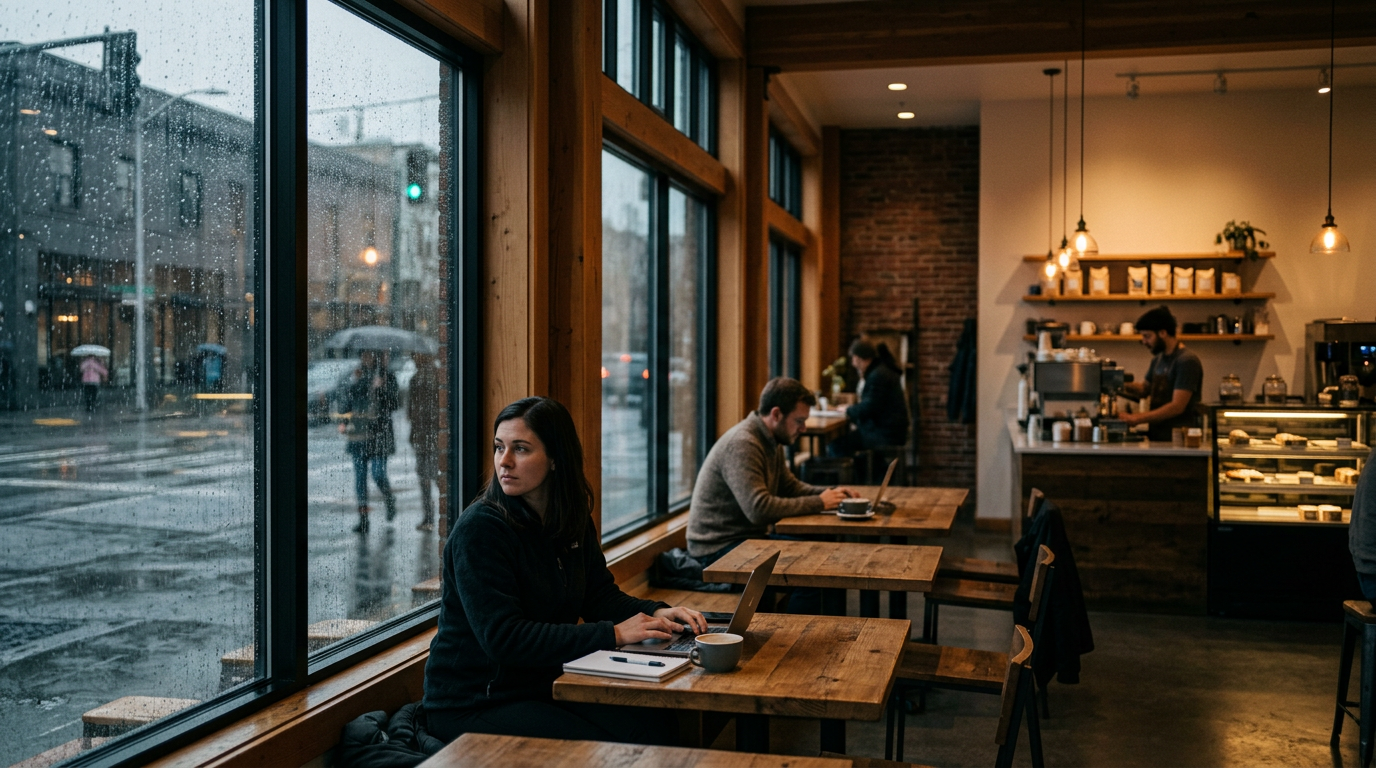
A 9:10 a.m. laptop row on Capitol Hill tells you a lot before the espresso hits the cup. One person is on a silent Figma review. Someone else has a notebook open next to a cortado. The guy taking a sales call on speaker is already losing the room.
Seattle is a coffee city, yes, but not every coffee shop wants to be your unpaid WeWork. That got sharper after the pandemic. Fewer cafés tolerate four-hour camping on one drip coffee. More rooms have limited outlets, quieter service models, or table signs that politely say what staff used to have to say out loud. At the same time, Seattle’s remote-work class is still everywhere: engineers, product leads, designers, founders, researchers, grant writers, climate people, and solo consultants who need a third place that is not their apartment.
The move is not to hunt for “laptop-friendly” as if it is a permanent trait. It changes by hour, day, seating layout, staffing, and neighborhood. The better move is to know which type of Seattle café fits the work you need to do, then behave like someone the room would invite back.
The Seattle coffee room is not a coworking plan
Seattle has a specific café culture: serious coffee, restrained social energy, and a high tolerance for quiet focus. That sounds ideal for laptops, but there is a catch. The better the coffee bar, the more likely it sees itself as a hospitality business first, workspace second.
Third-wave coffee is mature here. A single-origin pour-over is not a prop. Baristas at places like Victrola Coffee Roasters, Espresso Vivace, Caffe Vita, Elm Coffee Roasters, Milstead & Co., Herkimer Coffee, Analog Coffee, and Anchorhead Coffee are running a service floor, not managing your personal office. Some rooms are excellent for an hour of focused work. Some are better for a meeting. Some are better for a 25-minute reset with no laptop at all.
Think in venue types:
- The neighborhood third-wave café: good for writing, email, light product work, and one-on-ones when the room is half full.
- The big-format coffee hall or roastery-style room: better for casual meetings and short working sessions, less reliable for focus.
- The bookstore café or community café: usually calmer, often better for reading and low-volume calls, but still not a call center.
- The tiny espresso bar: great for coffee, bad for laptops. Do not force it.
- The café attached to a lobby, hotel, or mixed-use building: often better for laptop time because the seating model expects lingering.
If you need six hours, a monitor, and back-to-back Zoom calls, buy a day pass at a coworking space. Seattle still has WeWork, Industrious, Spaces, and plenty of local office suites competing for remote workers who want structure without a lease. A coffee shop is for a work block, not a lease substitute.
What to order / what to look for
!Laptop, coffee, and notebook on a tidy Seattle café table
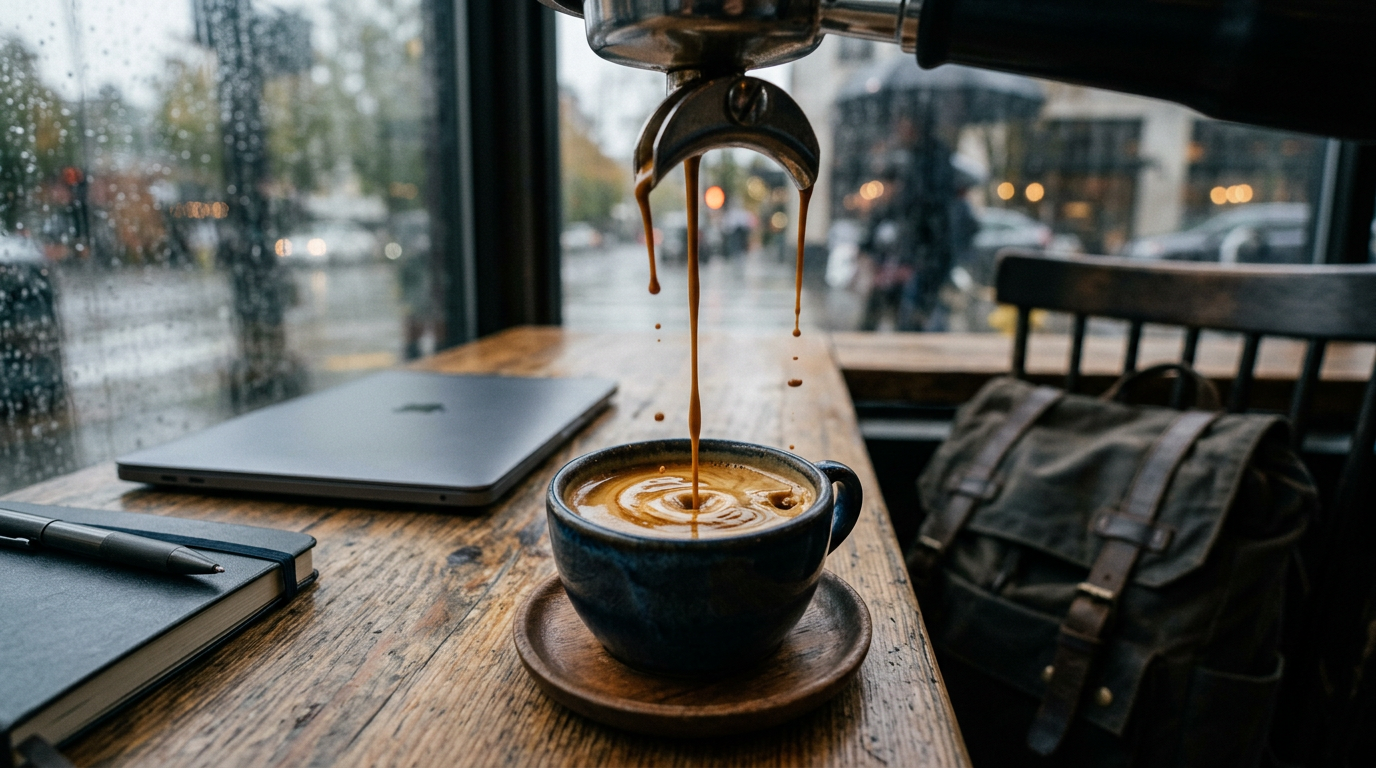
Order like you understand the exchange. If you are taking a table, buy something at the start. If you stay past 90 minutes, buy again. That can be a brewed coffee, espresso drink, tea, pastry, lunch item if they have it, or beans for home. The exact order matters less than the signal: you are not extracting value from the room for free.
What to look for before opening the laptop:
- Table mix: If every two-top is occupied and people are waiting, keep the session short or leave.
- Outlet placement: Outlets near communal tables are usually a soft yes. One lonely outlet behind a plant is not an invitation to rearrange furniture.
- Wi-Fi posture: Posted Wi-Fi details suggest laptop tolerance. No visible Wi-Fi, no outlets, and tiny tables suggest coffee-first.
- Sound level: If the room is mostly quiet, calls are a bad idea. If it is already loud, calls are still not automatically fine.
- Staff flow: If staff are constantly clearing around you, the shop is turning tables. Do not make them ask.
- Neighborhood rhythm: South Lake Union and downtown-adjacent rooms often understand laptop traffic. Capitol Hill and Fremont vary block by block. Ballard and Queen Anne can swing neighborhood-first.
For coffee, Seattle rewards the person who does not overcomplicate the counter. If a shop is known for espresso, order espresso or an espresso drink. If they are featuring a single-origin pour-over and the bar is not slammed, go for it. If there is a line to the door, do not make a ceremony out of asking for tasting notes while your laptop bag blocks the pickup area.
A useful rule: match the complexity of your order to the pace of the room.
Best time of day to go
The cleanest laptop window in Seattle is usually mid-morning after the rush: roughly 9:30 to 11:30 a.m. The commuters have cleared, staff have found their rhythm, and lunch pressure has not started. This is the time for a focused writing block, inbox triage, or a quiet founder check-in.
The second decent window is mid-afternoon, roughly 1:30 to 4 p.m., especially in neighborhoods with remote workers rather than office lunch traffic. This is good for admin, editing, research, and low-stakes meetings. It is also when you are most likely to have a casual conversation without interrupting someone’s morning sprint.
Avoid treating these windows as universal:
- Monday morning: too many people are trying to reset their week.
- Friday afternoon: social energy rises, but focus drops.
- Rainy weekdays: everyone has the same idea. Seattle rain does not empty cafés; it fills them.
- Weekend brunch hours: terrible for laptops unless the café is explicitly set up for it.
- First sunny stretch after gray weather: expect people to linger differently, staff to be busy, and patience to be thinner.
If you are scheduling a coffee meeting, 10:30 a.m. is the Seattle sweet spot. Early enough that people are alert. Late enough that the line is calmer. Not so close to lunch that you accidentally turn a 30-minute intro into a table-management problem.
Etiquette and unwritten rules
!People entering a Seattle coffee shop on a rainy workday
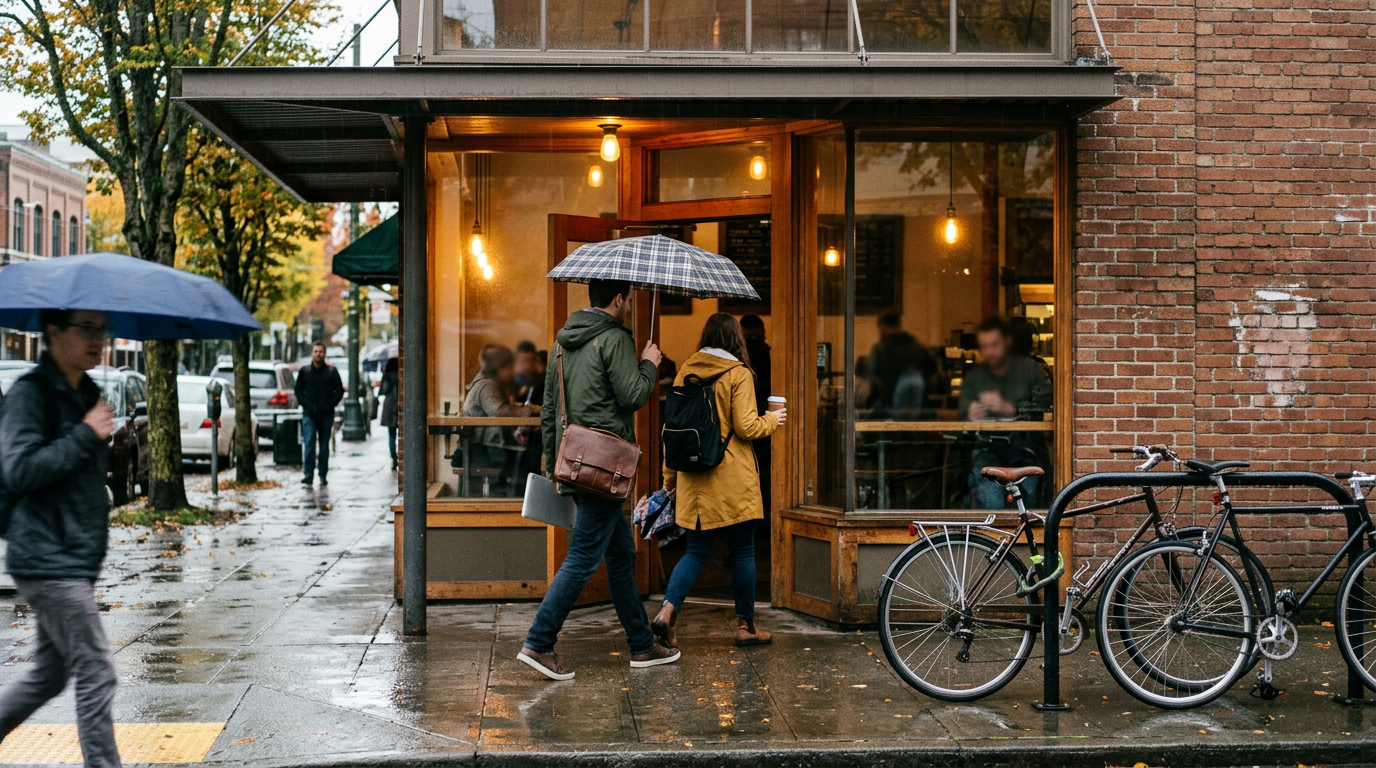
Seattle etiquette is not loud. It is enforced through glances, staff tone, and the sudden feeling that your table has become too visible. Pay attention early.
The rules that matter:
- One person, one small table. Do not take a four-top unless staff point you there or the room is empty.
- Backpack under the chair. Not on the chair next to you, not in the walking path.
- No speakerphone. Ever. Headphones are the minimum, and even then your voice should stay low.
- Video calls are a last resort. If you must take one, keep it short and choose a corner, not the middle of the room.
- Do not camp near closing. The final hour belongs to staff cleaning and locals grabbing a last coffee.
- Tip normally. Especially if you are using the room as work infrastructure.
- Reset your table. Cups, plates, napkins, crumbs. Leave no evidence except the sale.
- Ask once, not repeatedly. “Is it okay if I work here for a bit?” is fine. Negotiating policy is not.
Power is where people get weird. Do not stretch cords across walkways. Do not unplug lamps, POS equipment, fans, or anything you did not bring. Do not crawl around looking for outlets like you are auditing the building. Charge before you arrive. A laptop with a full battery is the cheapest etiquette tool in the city.
The deeper Seattle rule: be useful to the room or be light on it. Buy, tip, take up reasonable space, keep your sound contained, and leave before your welcome expires.
Where laptop-friendly usually works in Seattle
Rather than pretending one list can stay accurate, use this map of room types.
For focused solo work
Look for medium-size third-wave cafés with a few communal tables, visible laptop users, and enough spacing that you are not hovering over someone’s latte. Capitol Hill, Fremont, Ballard, and the University District all have versions of this. Victrola, Caffe Vita, Herkimer, and Elm are useful reference points for the kind of coffee-first room where laptop behavior needs to be respectful and time-bounded.
Best session length: 60 to 120 minutes.
For a casual founder or freelance meeting
Choose a room with more ambient noise and seating flexibility. Anchorhead-style downtown energy, larger neighborhood cafés, and hotel-lobby-adjacent coffee bars can work better than tiny espresso rooms. Starbucks Reserve Roastery on Capitol Hill can be useful for an out-of-towner meeting because it is easy to identify and has room, though it is not where I would go for deep focus.
Best session length: 30 to 75 minutes.
For reading, research, and calm admin
Bookstore cafés and quieter neighborhood rooms are your friend. Ada’s Technical Books and Cafe is a known Seattle reference for tech-adjacent people, though any specific day can vary. These spaces reward low-volume work and punish performative busyness.
Best session length: 60 to 150 minutes if the room stays open and relaxed.
For calls and real production work
Use coworking. This is where Seattle’s post-pandemic office shift matters. A day pass or hot desk at Industrious, Spaces, WeWork, or a local coworking operator is often cheaper than burning social capital in cafés all week. If you are taking investor calls, client calls, interviews, or anything with confidential details, do not do it between the pastry case and the condiment station.
Best session length: half day or full day, because that is what the product is for.
How to actually meet people there
Seattle is not a city where strangers always reward direct networking. The better play is low-pressure familiarity. Same room, same general time, same respectful pattern. People notice. That is ambient awareness: you become part of the room before you ask anything from it.
Start with light, situational openers:
- “Do you know if this table gets too loud once the lunch crowd hits?”
- “I’m trying to find a decent 90-minute work spot around here. Is this usually okay?”
- “That notebook setup looks efficient. Are you writing or planning?”
- “I’m between meetings and trying not to turn a café into an office. Is there a better spot nearby for calls?”
If someone gives a short answer, let it die. That is not failure. That is Seattle consent culture in miniature.
If they engage, keep it specific. “I work with early-stage teams on ops” is better than a wandering biography. “I’m building a small climate data tool” is better than “I’m in startups.” Mention neighborhoods, events, or shared work patterns. The city is full of people who are one warm intro away from being useful, but they do not want to be pitched over their cappuccino.
Follow-up moves that work:
- Ask for a low-friction exchange: “Want to swap LinkedIn? No pressure.”
- Send one sentence that reminds them where you met.
- Offer something concrete: an event link, a relevant Slack group, a founder dinner invite, a useful contact.
- Suggest a next coffee with a time limit: “Twenty minutes next week?”
For broader networking, use cafés as launch points, not the whole strategy. Meetup still matters in Seattle for technical groups. AngelList and founder Slack communities surface early-stage people. Lunchclub can still produce useful one-on-ones if you filter hard. South Park Commons and On Deck-style networks influence the founder layer even when the actual meeting happens elsewhere. The best café connection often becomes a walk, a small dinner, or a coworking day pass together.
Mistakes to avoid
The fastest way to get iced out is to act like the posted rules are the only rules. The real rules live in the room.
Avoid these:
- Buying one small coffee and staying all afternoon. Staff may not kick you out. They will remember.
- Taking calls from a prime table. Especially during rush windows.
- Leaving your laptop to “save” a seat. It is rude and also a bad idea.
- Assuming every café has Wi-Fi. Bring a hotspot. Seattle tech workers should know better.
- Spreading out like you pay rent. Laptop, tablet, notebook, headphones case, water bottle, jacket, and lunch container is too much.
- Pitching strangers cold. A café is not a demo day.
- Arguing with staff about time limits. If they tell you, the decision is already made.
- Ignoring food service. If a café has moved into lunch mode, laptop camping becomes less acceptable.
Also avoid the “I’m quiet, so it’s fine” trap. Quiet is not the only variable. Space, turnover, and staff workload matter just as much.
A practical Seattle laptop café plan
For one good work block, arrive charged at 9:45 a.m. Pick a two-top along a wall or a communal table seat that is clearly not blocking service. Order at the counter without slowing the line. Tip. Ask, if needed, “Is this area okay for a laptop for about an hour?” Then work with headphones in, camera off, and no calls.
At the 75-minute mark, reassess. Is the room filling? Buy again or wrap. If you need another two hours, move to a different venue type: coworking hot desk, library, office lobby, or home. Do not make one café absorb your whole day.
For meeting people, become a regular without becoming furniture. Same café, same mid-morning slot, two or three times a month. Learn names if staff offer them, not because you are trying to hack belonging, but because you are part of a small service economy. Say hello to the other repeat laptop people when the moment is natural. Share a table gracefully. Leave on time.
That is the Seattle version of laptop-friendly: not unlimited, not loud, not needy. A good room, used well, by people who understand that coffee shops survive on hospitality, turnover, and trust. Treat the café like a shared civic tool, and you can still get real work done here without catching the side-eye from the bar.
Discussion (0)
Loading comments…