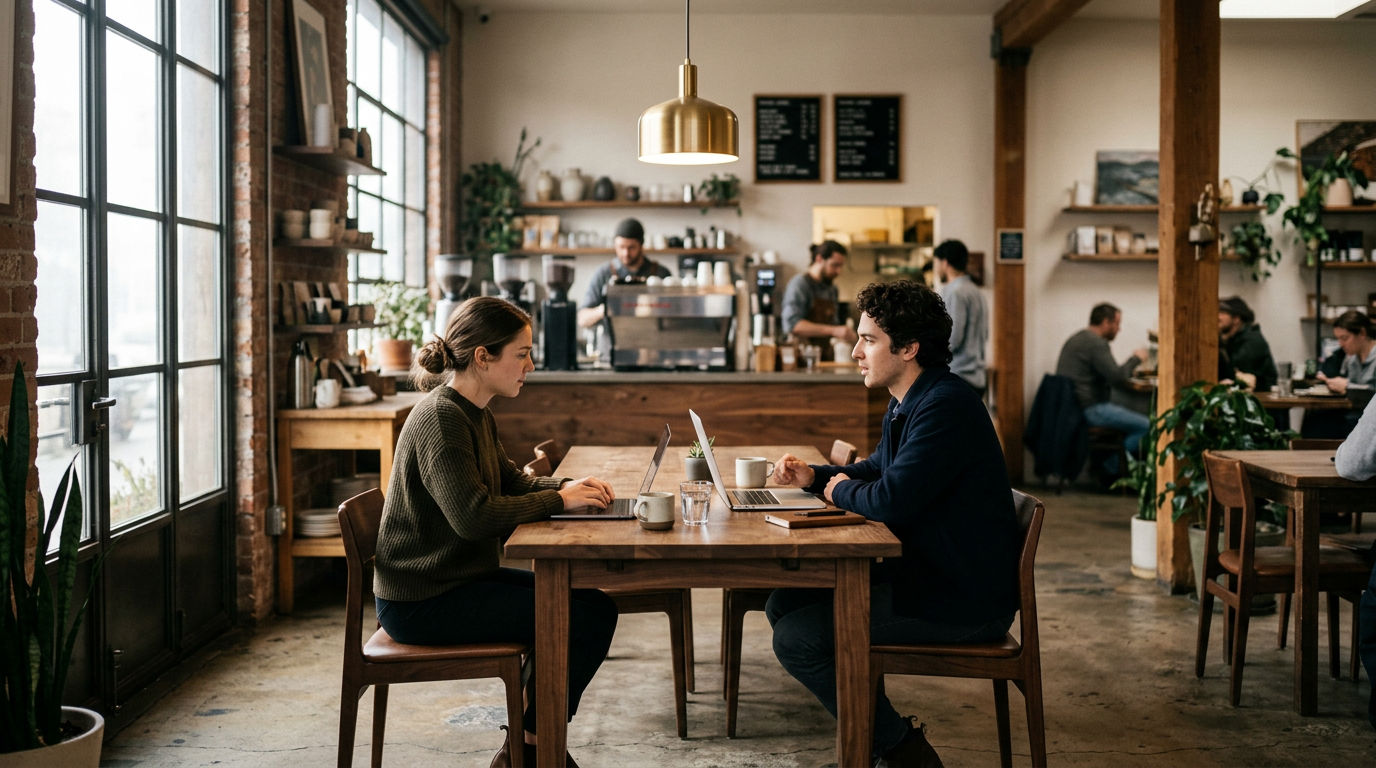
SF coffee bars where seed rounds get warmed up
At 8:17 on a Tuesday in Hayes Valley, the tables are already doing two jobs. One person is trying to ship before a standup. Two founders are rehearsing a partner meeting. A scout is pretending to answer email while listening for anything that sounds like a real wedge.
That is San Francisco coffee in 2026: less performative than the 2014 hoodie era, more useful than another dead Slack community. The serious rooms are not only about caffeine. They are informal routing nodes between South Park Commons, AI demo nights, AngelList circles, coworking day passes, former On Deck groups, and the founder dinners that still happen in private apartments from Duboce Triangle to North Beach.
The trick is knowing which room you are in. A third-wave coffee shop can be a heads-down office, a pre-meeting buffer, a light-intro zone, or a place where you should absolutely stop talking about your cap table.
The SF coffee-deal map is neighborhood-specific
San Francisco does not have one coffee scene. It has micro-scenes that change by block, weather, and calendar density.
Hayes Valley is still the highest signal for founders who want proximity without looking thirsty. It catches people before and after meetings near Civic Center, Mid-Market, and the Cerebral Valley orbit. Ritual Coffee Roasters is the kind of established third-wave name people understand without needing a pitch. Around Hayes, expect short meetings, fast exits, and lots of people between calls.
SoMa and the Design District are better for planned conversations than spontaneous magic. Sightglass Coffee on 7th is the reference point: big-room energy, serious coffee, enough volume to make a business conversation feel normal. It works well for a first founder-investor coffee when neither side wants a WeWork conference room yet.
The Mission and Valencia corridor are more builder-heavy and less investor-coded. Four Barrel on Valencia and Ritual's Mission presence belong to the old SF operating system: product people, designers, writers, early employees, and founders who prefer the city to Sand Hill Road. This is where you are more likely to meet someone who can actually tell you whether your onboarding is broken.
Jackson Square, FiDi, and the Embarcadero are for proximity to capital, law firms, and later-stage operators. Blue Bottle at the Ferry Building is a familiar meeting point for people crossing from the East Bay or coming from downtown. These rooms can be useful, but they are rarely where loose, warm networking happens. People are moving with intent.
Divisadero, Nopa, and Lower Haight are better for repeat exposure. The Mill on Divisadero is not a place to spray pitches. It is a place where you become a familiar face over time. That matters in SF, where reputation compounds quietly.
Outer Sunset and the west side are not classic deal-room territory, but they are useful for creator-founders, design-led operators, and people who want longer conversations away from the investor circuit. Andytown Coffee Roasters has that neighborhood gravity. Go there to think and build trust, not to prospect.
What to order / what to look for
!Two founders talk over coffee at a San Francisco third-wave cafe
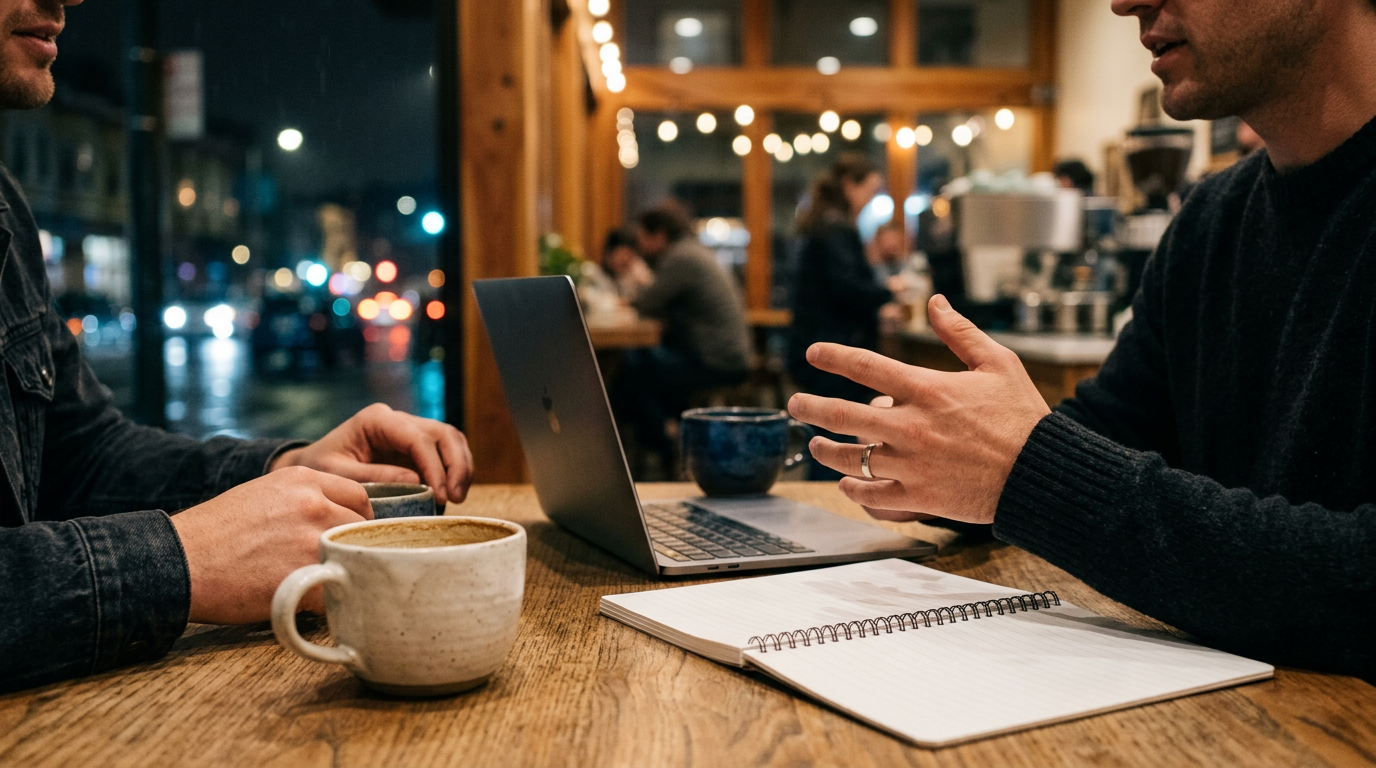
Order like someone who respects the room. SF coffee people notice when you treat a serious café like a free lobby.
For a first meeting, keep it simple:
- Espresso or macchiato if you need a short, focused conversation.
- Batch brew if you are settling in but do not want to create a production.
- Single-origin pour-over if you are early, unhurried, and not trying to rush the bar.
- Tea or sparkling water if you are on your third meeting and already wired.
- A pastry or toast if you are taking a table for more than 45 minutes.
Look for the room mechanics before you sit:
- Two-top tables with enough space for laptops but not enough for a board meeting.
- Natural light without glare if you need to show a product on a screen.
- Ambient noise that protects privacy without forcing you to shout.
- A line that moves. Long barista bottlenecks kill meeting rhythm.
- A visible outdoor option for calls or sensitive topics.
- Other people having business conversations at a normal volume.
The best coffee-deal rooms have one important trait: they let you leave easily. A good meeting in SF often ends with someone saying, I have ten before my next thing. Pick places where that sentence feels natural.
Best time of day to go
The room changes by hour.
7:30 to 9:00 a.m. is for serious locals, operators with calendars, and people getting in before Slack turns hostile. This is the cleanest window for founder-to-founder coffees. Keep it tight. Nobody wants a rambling origin story before 9.
9:30 to 11:00 a.m. is the deal-warmup slot. Investors, scouts, fractional operators, and senior ICs appear after their first call. If you are trying to meet people without being annoying, this is your best window. The room has energy, but people are not yet fried.
11:30 a.m. to 1:30 p.m. is awkward unless the café handles food well. Tables turn over. People are hungry. If you need a strategic conversation, move it to a lunch spot, natural wine bar later in the day, or a hotel lobby with proper seating.
2:00 to 4:00 p.m. is useful for second-order networking. The intense morning crowd has thinned out. You can have a calmer conversation with a potential hire, design partner, or advisor. This is also when remote workers from nearby apartments take over, so read the room.
After 4:00 p.m. is not prime deal time in most SF coffee shops. Move to a walk, a casual bar, a supper club, an izakaya dinner, or the pre-event window before a Meetup, South Park Commons session, AI salon, or founder dinner.
Etiquette and unwritten rules
!Morning coffee meeting scene outside a San Francisco neighborhood cafe
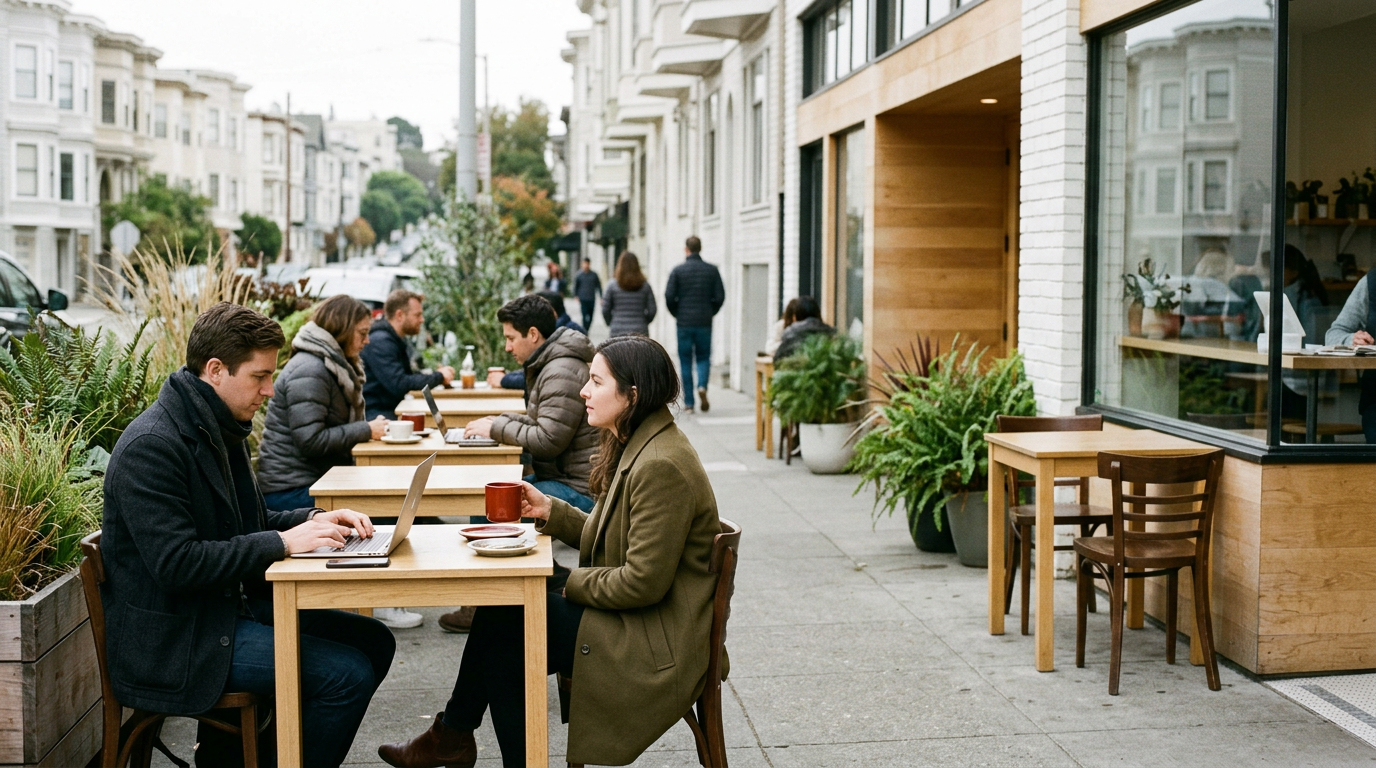
San Francisco is open to strangers, but allergic to bad networking.
Do not open with fundraising. Do not ask who someone works for before you have earned the right. Do not pitch across someone else's laptop. Do not scan the room like you are at a career fair.
The better rule: behave like you plan to be in this neighborhood for three years.
Practical etiquette:
- Buy something before sitting. If you stay, buy again.
- Keep calls short and quiet. Step outside for investor updates, layoffs, customer names, or anything legal.
- Do not take a four-top alone during peak hours.
- Put headphones on only if you want to be left alone.
- If someone has AirPods in, a laptop open, and no eye contact, leave them alone.
- If the table next to you is clearly mid-deal, give them acoustic space. SF is small.
- Never ask the staff who the regulars are. That is amateur behavior.
- Do not leave your laptop to hold territory for twenty minutes.
Privacy matters here. Plenty of people are between jobs, winding down companies, negotiating acqui-hires, or raising bridge rounds they do not want discussed on the sidewalk. A coffee shop is a public room, not a confessional booth.
How to actually meet people there
Most people fail because they treat the café as the networking event. It is not. It is the room before or after the event.
Use coffee to create low-friction contact around existing context:
- Schedule a 20-minute coffee before a nearby Meetup or demo night.
- Ask a founder dinner host if anyone else is grabbing coffee nearby beforehand.
- Use AngelList, Lunchclub alumni threads, On Deck groups, or South Park Commons connections to set a soft landing.
- Turn a weak LinkedIn connection into a real conversation by offering two specific time windows near a known coffee spot.
- After a coworking day pass at WeWork, Industrious, Spaces, or a local hot desk, move the better conversation to coffee instead of forcing it in the kitchen.
Useful openers when you have light context:
- I think we have three SF people in common. Are you open to a quick coffee sometime this week?
- I am talking to operators who have sold into developer teams. Your last company looked relevant. Could I buy you coffee and ask three questions?
- I saw you are going to the same AI Meetup tonight. Want to meet 20 minutes early nearby?
- I am not pitching investors this week. I am trying to sanity-check the category. Would you be open to a short conversation?
Useful openers in the room, when there is real permission:
- Is this a heads-down morning, or are you open to a quick local question?
- I heard you mention customer discovery. I am working through the same thing in a different market. Happy to trade notes if useful.
- I recognize you from the event last night. I am Alex. Your question about distribution was the useful one.
Then stop. Let them choose the next step.
This is where Granovetter's weak ties idea still earns its keep. Your closest friends often know the same people you do. The light-touch coffee acquaintance, the scout you met twice, the operator at the next table who remembers your category — those are the bridges to new information.
Picking the right venue type for the meeting
Do not choose based on Instagram. Choose based on job-to-be-done.
For investor first coffees: Pick a known, central third-wave shop with easy exits and dependable coffee. Sightglass, Blue Bottle, Ritual, Saint Frank, and Verve-level rooms work because nobody needs directions explained. Keep the meeting to 25 minutes unless the other person extends it.
For cofounder dating: Use a quieter neighborhood coffee shop with tables and enough time to talk through working style. You need signal, not scene. Bring one hard question: how do you behave when the product is wrong and payroll is close?
For hiring conversations: Avoid the loudest rooms. Candidates need dignity and a little privacy. If you are talking comp, equity, visa status, or a current employer, book a proper room or take a walk.
For customer discovery: Go where the customer type already is. Developer tooling founder? SoMa, Hayes, Mission, or a café near a technical event. Design product? Mission, Divisadero, or a studio-adjacent room. Finance or B2B sales? Downtown or Embarcadero.
For post-event follow-up: Do not default to another calendar-heavy Zoom. Send a same-night note and offer coffee within 72 hours. In SF, momentum decays fast because everyone has eight plausible conversations competing for attention.
Mistakes to avoid
The fastest way to look new is to over-network the room.
Avoid these:
- Opening with stealth mode. It sounds like you have not found the sentence yet.
- Asking for investor intros before explaining why the company deserves one.
- Turning a casual coffee into a deck review without warning.
- Talking loudly about round size, runway, term sheets, or named customers.
- Choosing a tiny café for a four-person meeting.
- Camping through peak hours with one drink and a charger hunt.
- Treating every person with a MacBook as a founder.
- Assuming AI interest equals check-writing interest.
- Following up with a long memo when the meeting earned only a short note.
The follow-up is where most coffee meetings either become real or disappear.
Send it the same day:
- One sentence reminding them where you met.
- One sentence naming the useful point from the conversation.
- One clear ask or offer.
- If relevant, one link, not five.
Example structure:
- Good meeting you at Ritual before the Hayes event.
- Your point about selling the workflow before the model was useful.
- I am going to test that with three design partners this week.
- If you are open, I will send the notes Friday and you can tell me where I am wrong.
That is enough. Confident, low-pressure, easy to answer.
The local editor's call
For classic SF deal-room energy, start with Hayes Valley in the morning and SoMa for planned coffees. Use the Mission when you want builder candor. Use downtown when the calendar demands it. Use neighborhood rooms for repeat trust.
The coffee matters, but the behavior matters more. San Francisco still rewards people who show up in person, ask sharper questions than they answer, and make the next step small enough to say yes to.
A good café meeting here does not end with a handshake worthy of a press release. It ends with a useful intro, a corrected assumption, a second meeting, or a note someone actually replies to. That is the room doing its job.
Discussion (0)
Loading comments…