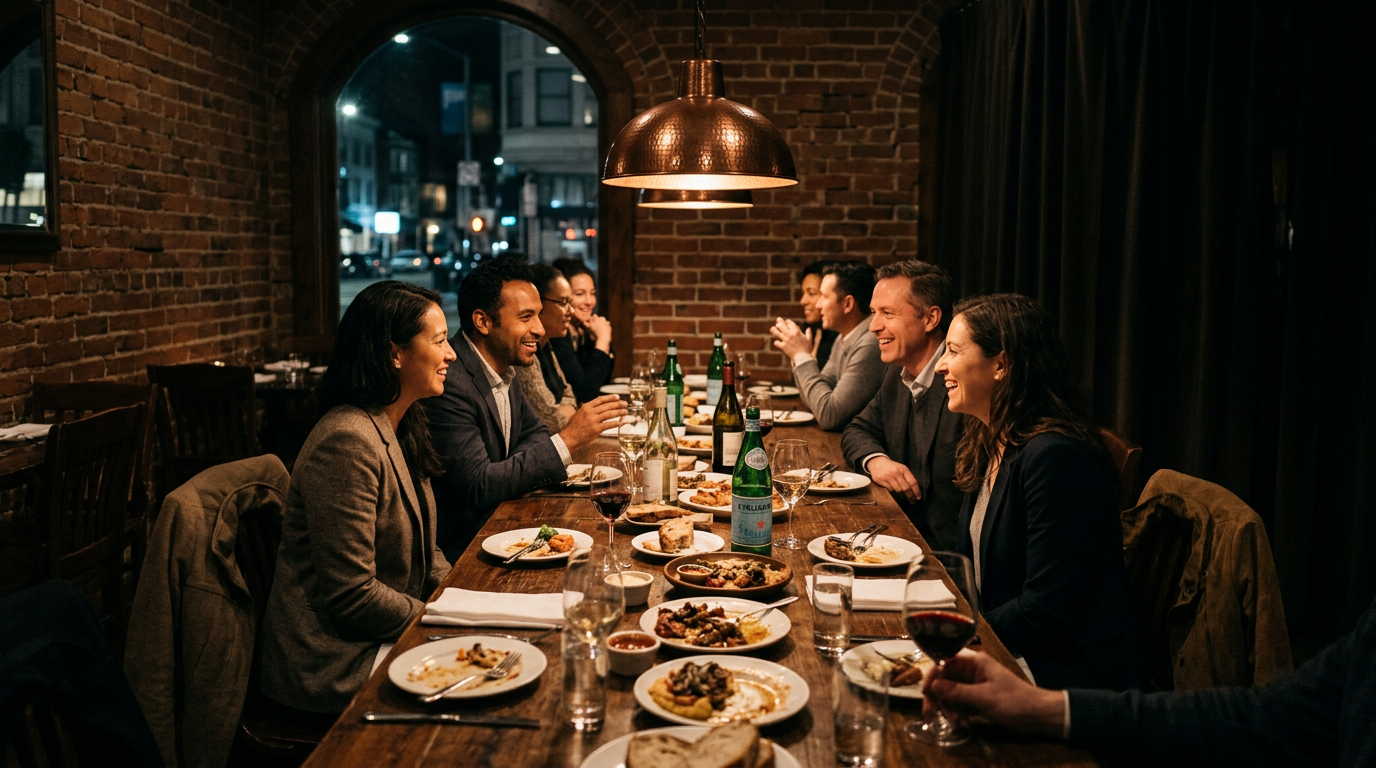
The SF founder dinner rules that decide who gets invited back
At 7:18 on a Wednesday in Hayes Valley, half the table is already comparing notes on model latency, one person is trying not to say stealth, and the host is quietly watching who treats the server like a human. That is a San Francisco founder dinner in 2026: part salon, part hiring channel, part investor filter, part social test.
The city has moved past the old open-networking mixer as the default room. Big demo nights still exist. Meetup still works in pockets. AngelList, South Park Commons, On Deck alumni circles, Slack groups, and operator group chats still create introductions. But the dinner table has become the higher-signal format because SF is tired of standing around with warm white wine and vague ambition.
A good founder dinner is not about collecting business cards. Nobody uses them here anyway. It is about proving, in two hours, that you are sharp, generous, socially calibrated, and worth a second conversation. The winners are not always the loudest people or the ones with the cleanest seed deck. Usually, they are the people who make the room easier for everyone else.
What SF founder dinners are actually for
SF dinners are rarely just dinner. They are informal diligence.
A founder dinner might be built around AI infra, climate, dev tools, consumer social, defense, healthcare, fintech, solo GPs, women operators, second-time founders, or people who left big AI labs and have not updated LinkedIn. The format signals the room:
- Eight to ten people at a restaurant: usually a curated peer room, not a pitch event.
- Private dining room: often investor-hosted or community-hosted, with more structure.
- Apartment dinner in the Mission, Noe Valley, or Hayes Valley: higher trust, more personal, less polished.
- Member's club dinner: relationship maintenance, not first contact. The Battery is the kind of SF institution where this format makes sense, though access is its own filter.
- Coworking-adjacent dinner: often connected to South Park Commons, an accelerator network, an alumni group, or founders who spend days around hot desks and dedicated desks at places like WeWork, Industrious, or Spaces.
The real point is compression. SF people are busy, but they will give a serious two-hour dinner to a room where every person has been pre-screened. That is why an invite matters more than a public RSVP.
One useful lens is weak ties, from sociologist Mark Granovetter. Your close friends already know what you are building. The dinner table is where a second-degree operator says, I know the exact design partner you need, or the person who just left that platform team, or the angel who writes fast checks in this category. SF runs on those weak ties.
Who pays, without making it weird
!Founders talking over coffee in a quiet San Francisco cafe

This is where newcomers get tense. SF is casual in clothing and direct in conversation, but money etiquette at founder dinners is specific.
If a VC, angel group, platform team, law firm, bank, or founder community hosts the dinner, the host usually pays. You do not reach for the check performatively. You say thank you, once, clearly. If the host mentions a sponsor, do not turn the table into a vendor booth. Sponsors pay for access to the room, not your attention on command.
If a founder organizes a peer dinner, expect a split unless the invite says otherwise. In 2026, that usually means one person puts down a card and sends a payment request after. Pay it immediately. Same night. No one wants to chase a $94 transfer from a founder who claims to be building the future of payments.
If the dinner is at someone's home, ask what to bring. Do not arrive with nothing unless explicitly told. Wine is fine, but SF has enough non-drinkers, biohackers, pregnant founders, sober operators, and people trying to wake up for a 6 a.m. run that a good sparkling water, high-quality fruit, or dessert can be more useful.
If you are invited by an investor, do not assume it is a funding meeting with a meal attached. If they want the deck, they will ask. Your job is to be a strong dinner guest first.
A clean payment script:
- If you are unsure: “Thanks for pulling this together. Are we splitting tonight or is there a host card down?”
- If someone paid: “Really appreciate you hosting. I’ll send you a proper thank-you tomorrow.”
- If you owe money: pay before you get into the Uber, Waymo, or BART ride home.
What to order / what to look for
The food matters less than the table design, but bad ordering can still mark you as high-friction.
For restaurant dinners, look for places that can handle conversation: private or semi-private tables, warm service, moderate noise, and a menu that can support dietary constraints without drama. In SF, that often means a California-Italian spot, an izakaya-style restaurant, a natural wine bar with real food, a neighborhood restaurant in Hayes Valley or the Mission, or a private room near SoMa for people coming from offices and coworking spaces.
Well-known SF restaurants such as Nopa, Zuni Cafe, Foreign Cinema, and Rich Table have the kind of city credibility that makes sense for serious meals, but the exact venue is less important than acoustics and pacing. If the table cannot hear each other, the dinner fails.
Order like an adult:
- Choose dishes that are easy to share if the host suggests family style.
- Avoid the most expensive item unless the host directly recommends it.
- Mention dietary restrictions early, not when dishes land.
- If you do not drink, say so plainly. No speech needed.
- If the table is ordering wine, do not turn it into a natural wine seminar unless asked.
What to look for in the room:
- Who asks specific questions rather than performing expertise.
- Who references customers, users, revenue, retention, or hiring reality.
- Who listens when someone junior speaks.
- Who makes useful introductions without making themselves the hero.
- Who can explain what they are building in one clean sentence.
That last one is SF currency. If you need four minutes and three acronyms to explain the company, the table will move on.
Best time of day to go
!Small founder groups gathering outside a Hayes Valley restaurant
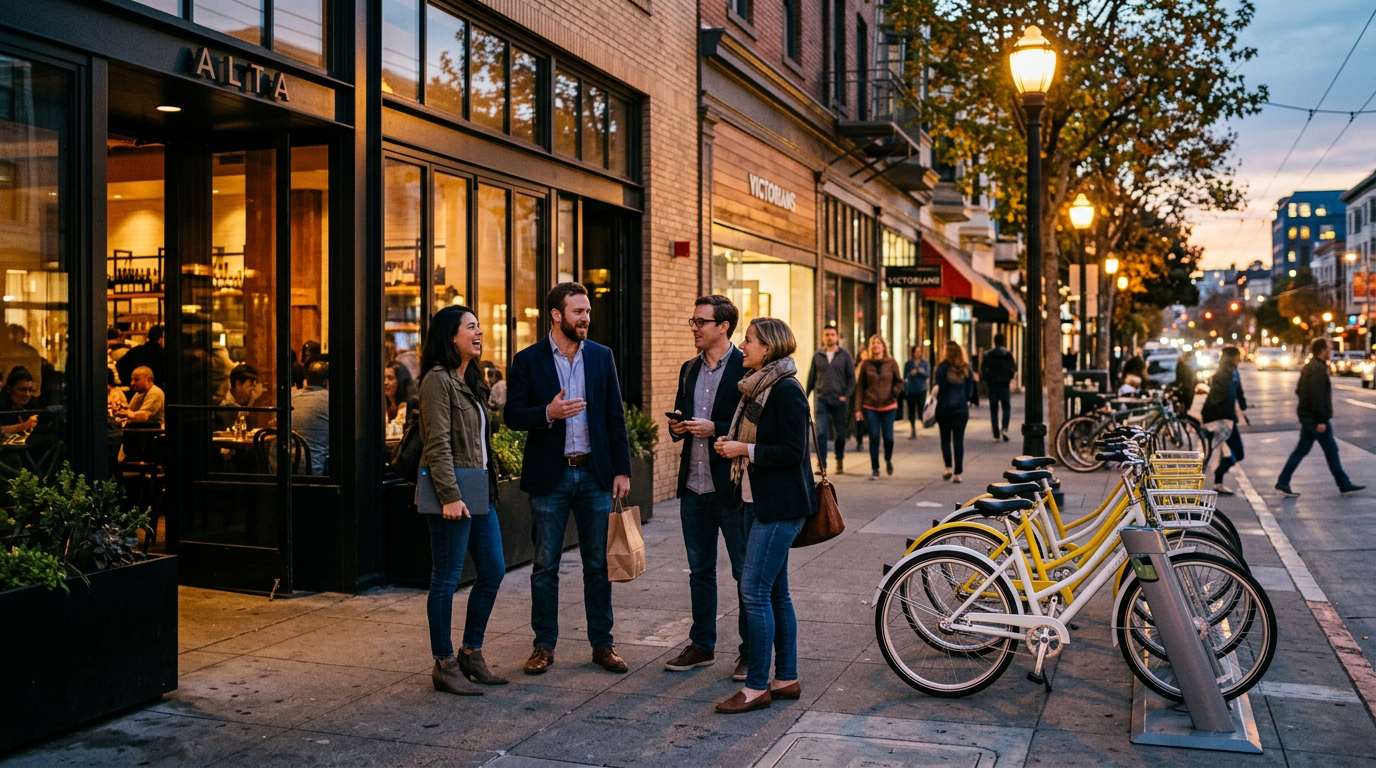
Dinner is not always the right format. In SF, the time slot tells you the room's intent.
Breakfast near South Park or the Ferry Building is usually operator-to-operator or investor-to-founder, with a hard stop. It is good for focused asks, not sprawling conversation.
Coffee at Blue Bottle, Sightglass, Ritual, Four Barrel, or a serious neighborhood third-wave coffee shop works for first meetings. Single-origin pour-over is not the point. The point is a 35-minute slot where nobody feels trapped.
Lunch in SoMa, FiDi, or near Mission Bay is practical for people with office days, AI lab schedules, or investor meetings stacked back-to-back.
Dinner from 6:30 to 9:00 is the relationship format. This is where people share what is not on the website: cofounder tension, investor behavior, hiring mistakes, customer objections, category gossip.
Late drinks after dinner are for trust, not volume. Trick Dog is a known SF cocktail institution, and there are plenty of natural wine bars and hotel bars that work for a smaller second act. But do not drag a whole table to a second location unless the energy is obvious.
The strongest move is often leaving on time, then following up well. SF respects momentum. It also respects sleep more than it did in 2016.
Etiquette and unwritten rules
SF is informal, but it is not loose. The room has a code.
Arrive on time. Not New York ten-minutes-late on time. Actual on time. Dinner reservations are operational systems, and founders notice who breaks systems.
Do not pitch the whole table unless invited. A 20-second intro is enough: who you are, what you are building, who you serve, what you are trying to learn. Then stop.
Do not corner the most famous person. If a well-known founder, GP, or operator is at the table, they have already developed defenses against attention extraction. Ask one good question. Let them eat.
Do not dunk on other founders for sport. SF has a long memory and a small room. The person you mock tonight may be your acquirer, reference, or candidate source later.
Treat confidentiality seriously. A dinner is not content. Do not post a table photo, tag everyone, or turn an offhand comment into a LinkedIn lesson. Ask before sharing names publicly.
Make space. If you are naturally talkative, your job is to bring quieter people in. Try: “Maya, you were saying something related to this before dinner. What are you seeing with customers?” That single move can get you invited back.
Also, do not confuse cynicism with intelligence. SF has plenty of skeptics. The useful ones can still build.
How to actually meet people there
The amateur strategy is to scan the room for investors. The better strategy is to become easy to introduce.
Before the dinner, do light homework. Read the attendee list if you have one. Check company sites, recent launches, hiring pages, podcasts, or GitHub if relevant. Do not recite the research like a creep. Use it to ask better questions.
Good openers:
- “What customer conversation changed your roadmap recently?”
- “Where are you getting the most honest feedback right now?”
- “What part of the company is taking more founder time than expected?”
- “Are you hiring for anyone unusually hard to find?”
- “What is one intro that would actually help this month?”
If you are pre-product, do not fake traction. Say: “I’m still in customer discovery. I’m trying to understand whether this pain is budgeted or just complained about.” That lands better than inflated metrics.
If you are fundraising, resist making every sentence orbit the round. A better line: “We’ll likely raise later this year, but tonight I’m more interested in pressure-testing the wedge.” Now you sound like a founder, not a walking allocation memo.
During the meal, listen for useful connection points. A hiring need. A design partner. A compliance question. A launch channel. Then offer one specific thing.
Try:
- “I know one person who ran growth in that market. I can ask if she’s open to a quick call.”
- “We tested that channel and it failed for a non-obvious reason. Happy to send you the notes.”
- “You should meet a founder in my On Deck circle who is two quarters ahead on that problem.”
The follow-up should land within 24 hours. Keep it short:
“Great meeting you at dinner last night. Your point about enterprise pilots getting stuck at security review was useful. I mentioned I might know someone who has handled that at scale. Want me to make the intro?”
Then do what you promised. Fast. The person who follows through wins more rooms than the person with the sharpest monologue.
Who wins the room
The winner is not the person who extracts the most. It is the person other serious people want at the next dinner.
That usually means three traits.
First, clarity. You can say what you are building without fog. “We help independent clinics reduce no-shows using automated deposit workflows” beats “We are reimagining healthcare access with AI-native patient engagement.” Every time.
Second, generosity with boundaries. You help, but you do not spray intros without consent. In SF, a bad intro costs social capital. Ask both sides first. Add context. Make it easy to say no.
Third, taste. Not taste in restaurants, though that helps. Taste in problems, people, timing, and conversation. You know when to push and when to leave space. You can talk about distribution, not just product. You can admit what you do not know.
The quiet killer move: send a short thank-you to the host that proves you understood the room.
“Thanks again for hosting last night. Strong table, especially the mix of infra and applied AI founders. I followed up with Daniel on the design partner intro and sent Priya the procurement notes I mentioned. Happy to be useful for a future dev tools dinner if helpful.”
That note says you are not a passenger. You are a contributor.
Mistakes to avoid
The bad moves are predictable.
Do not arrive hungry for attention. Founder dinners are not audition rooms. If you dominate the first 25 minutes, people will spend the next 95 avoiding eye contact.
Do not ask investors to sign an NDA. SF will not be gentle about this.
Do not turn every topic into AI if the table is trying to discuss customers, hiring, pricing, or go-to-market. AI is everywhere in SF in 2026. That does not mean every dinner should become the same model-stack conversation.
Do not bring an unapproved plus-one. A curated dinner is curated for a reason.
Do not make the server manage your ego. Complicated substitutions, rude interruptions, and check drama all register.
Do not follow up with a generic deck, calendar link, and seven-paragraph life story. Send a tight note tied to the actual conversation.
Do not confuse access with relationship. Getting into one room is easy compared with being welcomed into the next one.
The SF dinner playbook that still works
If you want to get invited to SF founder dinners, start by hosting something small. Six people. Clear theme. Good acoustics. Simple payment expectation. No speeches unless the room asks for structure.
Use venue types that fit the conversation: a quiet third-wave coffee shop for first contact, a natural wine bar for looser operator talk, a private dining room for investor-hosted discussion, an apartment table for trusted peers, a member's club for relationship maintenance. The room should serve the goal, not your Instagram.
The city rewards people who are useful before they are needy. That is the whole game. Pay quickly. Ask clean questions. Make one strong intro. Follow up within 24 hours. Protect the room.
Do that consistently and SF starts to open. Not all at once. One dinner, one weak tie, one earned invitation at a time.
Discussion (0)
Loading comments…