The SF founder dinner rules that decide who gets invited back
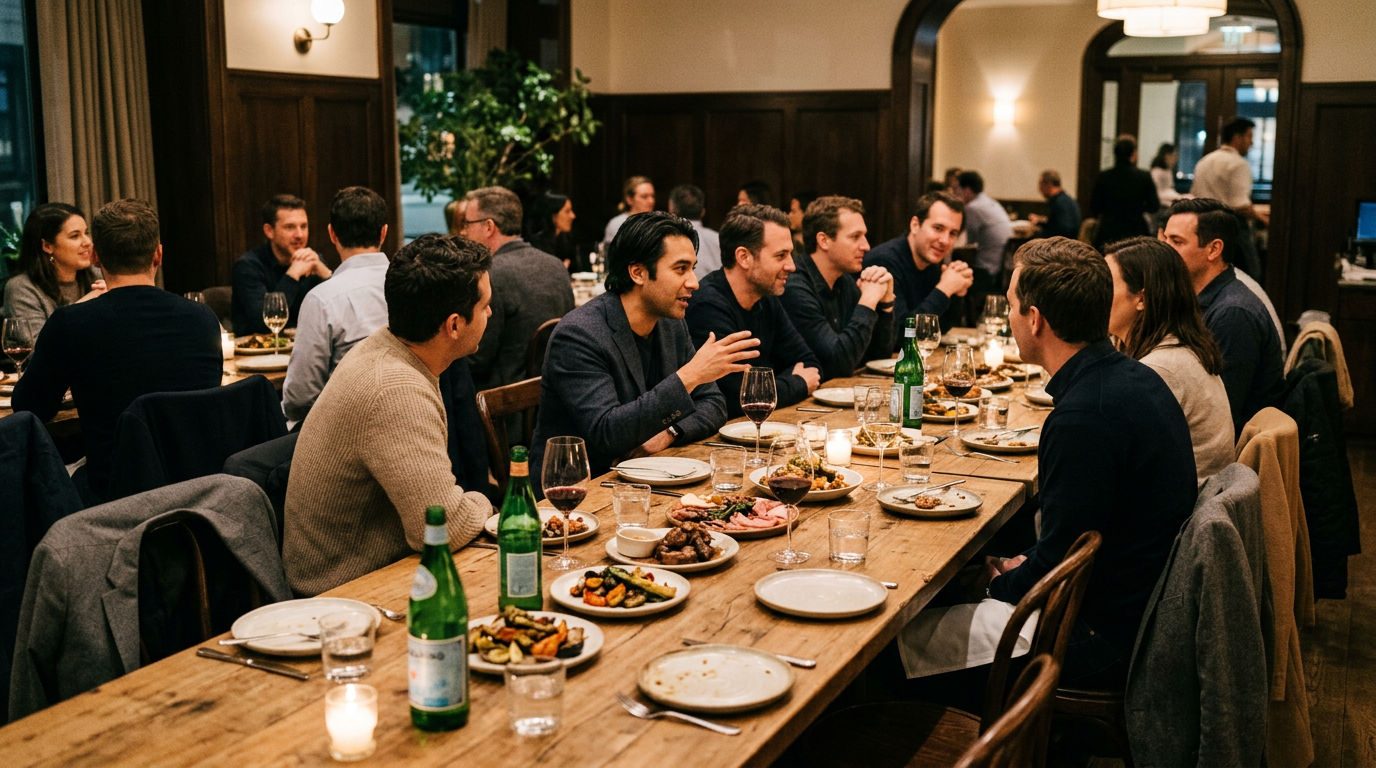
At 7:18 p.m. in Hayes Valley, the table is already being sorted before the host has ordered wine. The AI infrastructure founder is trying not to sit next to the other AI infrastructure founder. The seed investor is scanning for the person who has customers, not just a deck. Someone flew in from New York and is about to make the classic mistake: treating dinner like a panel with appetizers.
San Francisco founder dinners are not casual meals with a little networking attached. In 2026, they are one of the city’s highest-signal rooms: smaller than a demo day, warmer than a cold intro, and more honest than a conference hallway. They happen in private rooms, back patios, member’s clubs, coworking event spaces, natural wine bars, izakayas, and the kind of neighborhood restaurants where the staff can handle twelve opinionated people ordering at once.
The job is not to collect ten LinkedIn connections. The job is to enter the right room, behave like someone people want near their cap table or customer list, and leave with two or three useful next steps.
The room matters more than the restaurant
SF has a specific dinner culture. It is not Miami bottle-service networking. It is not New York power dining. It is not Austin founder-house casual. San Francisco still rewards technical depth, fast pattern recognition, and useful generosity. If you can explain what you are building without turning the table into a pitch meeting, you are already ahead.
The best founder dinners usually fall into a few formats:
- Operator-led private dinners for eight to fourteen people, often around a narrow theme: AI agents for healthcare ops, developer tools, climate finance, defense tech, vertical SaaS, robotics, fintech infrastructure.
- Investor-hosted dinners where the check is covered or heavily subsidized, but the real exchange is access, feedback, and deal flow.
- Community dinners tied to South Park Commons, On Deck alumni circles, AngelList-adjacent networks, Meetup groups, or Slack communities that have moved back offline.
- Coworking and member’s club dinners at places like Shack15, The Battery, Industrious, WeWork, or Spaces-style event rooms, where the room may be more valuable than the food.
- Friend-of-a-friend dinners in the Mission, Hayes Valley, Noe Valley, Dogpatch, North Beach, or SoMa, often organized by someone who is quietly excellent at curating people.
Restaurants matter, but only after the guest list. A dinner at a known SF institution such as Nopa, Foreign Cinema, Zuni Café, The Progress, State Bird Provisions, or Cotogna can set a strong tone, but the venue does not do the work for you. A plain private room with the right twelve people beats a glamorous table with no shared reason to talk.
The best hosts define the room in one sentence. “Seed-stage founders selling into hospitals.” “People building tools for AI evals.” “Operators who have actually hired in Japan.” If the invite is vague, ask who the dinner is for. That is not rude. It is due diligence.
Who pays in SF founder dinners
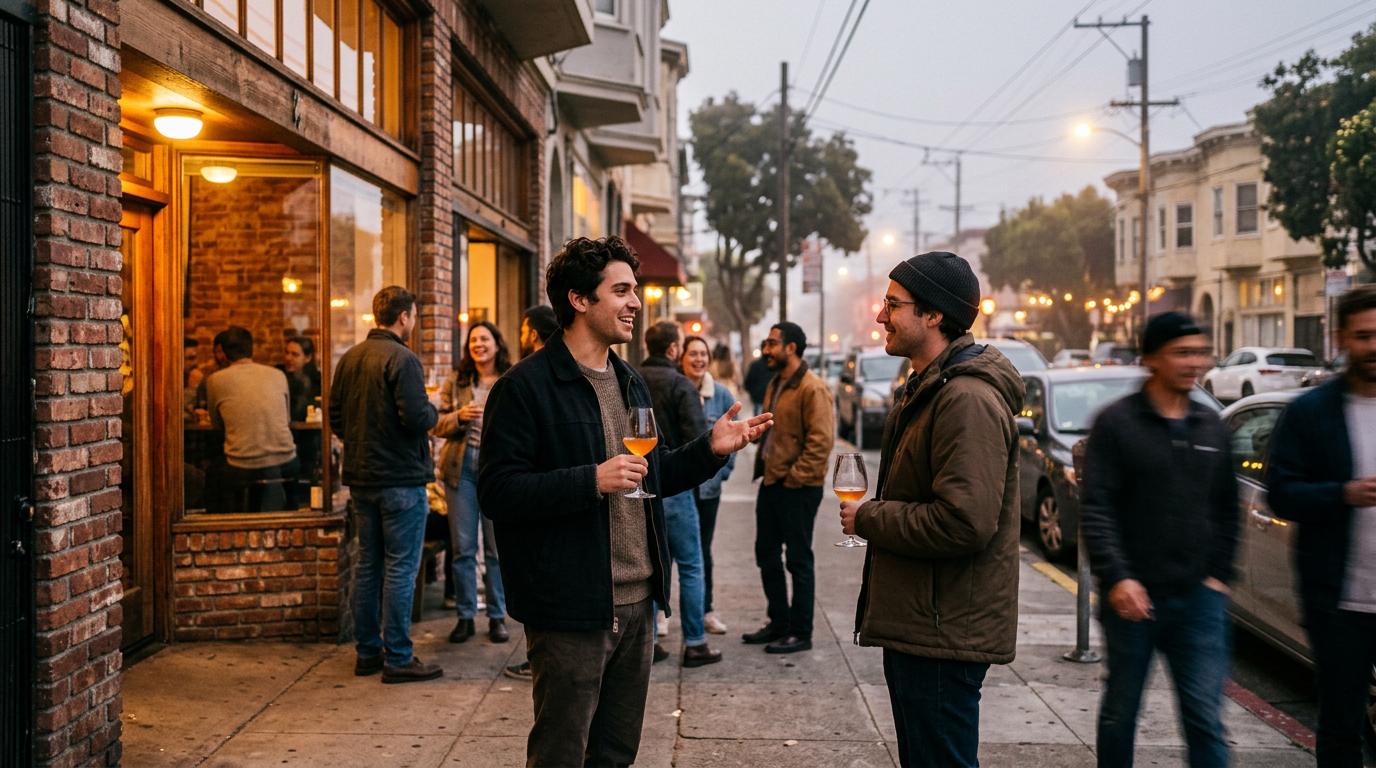
!Founders talking outside a Mission District wine bar at dusk
Payment signals intent. It also creates awkwardness when nobody says the rules out loud.
In SF, there are four common payment models:
- Host pays: Usually an investor, company, community builder, or senior operator. The expectation is not immediate payback. The expectation is that you bring signal, referrals, market knowledge, or future deal flow.
- Sponsor pays: A fund, startup, law firm, bank, recruiting firm, or cloud provider covers the table. This is common around conference weeks and AI events. Be polite, but understand the commercial context.
- Split evenly: Common among founder peer dinners. Venmo, card split, or a fixed amount. The least awkward version is set before the first drink arrives.
- Ticketed or prepaid: Increasingly common post-pandemic because no-shows got expensive and restaurants require deposits for groups.
If you are the host, state the payment model in the invite. One clean line is enough: “Dinner is covered,” “We’ll split the bill evenly,” or “Prepaid seat, food included, drinks separate.” Ambiguity makes people perform class anxiety instead of having a real conversation.
If you are invited and the host pays, do not fight the check at the table. Say thank you once, sincerely. If you want to reciprocate, send a useful intro the next morning or invite the host to a smaller coffee later. The return gift in SF is not a dramatic toast. It is relevance.
If the dinner is split, do not be the person auditing who ate the crudo. Unless the host has set a different rule, assume even split. If you have budget constraints, say so privately before the dinner. Many founders are cash-conscious. The issue is not the constraint. The issue is making the table manage it after dessert.
What to order / what to look for
Order like an adult who understands group dynamics. Founder dinners die when the table gets trapped in menu logistics.
Look for venues and formats with:
- Shared plates that arrive steadily
- Moderate noise, not club-volume acoustics
- A round table or compact rectangular table, not a long banquet where half the room disappears
- Vegetarian and gluten-free options without making it a production
- Wine, beer, and nonalcoholic options
- A staff that can handle one check or a clean split
- A nearby coffee bar or hotel lobby for a follow-up chat afterward
For food, the strongest choices are Mediterranean, Cal-Italian, izakaya, upscale Mexican, modern American, Korean barbecue with a private room, or a natural wine bar that actually serves enough food. Omakase can be excellent for two or four, but it is usually wrong for founder networking. Everyone faces forward. The chef becomes the event. Conversation fragments.
What to order if you are not hosting:
- One drink maximum before real conversation starts
- Food that is easy to share and does not require a tutorial
- Sparkling water if you are not drinking; nobody worth knowing cares
- Coffee or tea at the end if the room is still working
What to look for beyond the menu:
- Who asks precise questions
- Who listens when the conversation is not about their company
- Who offers a customer intro without turning it into theater
- Who can disagree without posturing
- Who knows the difference between traction and noise
SF respects competence more than polish. A founder with messy hair and sharp customer insight will beat a rehearsed operator with no substance.
Best time of day to go
!Two founders meeting over coffee in a San Francisco cafe

The strongest SF founder dinners start between 6:30 and 7:15 p.m. Earlier than that, people are still fighting calendar debris. Later than that, you lose the operators with kids, morning standups, or actual sleep habits.
Tuesday and Wednesday are the best nights. Monday can work for intimate rooms because people are less socially overloaded. Thursday often becomes scattered: people are stacking events, flying out, or half-present. Friday is for close friends, not serious new connections.
During major tech weeks, the rules change. If there is a big AI, SaaS, fintech, climate, or security event in town, dinner becomes the real conference. The official programming may end at 5 p.m., but the useful room starts at 7 p.m. Be careful, though. Conference-week dinners can be full of tourists with pitch decks and no local trust. Ask who else is coming before you burn an evening.
Breakfasts and lunches are underrated in SF. A 9 a.m. third-wave coffee near South Park, Mission Bay, or Hayes Valley can be more productive than a crowded dinner. Sightglass, Ritual Coffee, Blue Bottle, and Verve-style rooms work for short follow-ups, not twelve-person networking. Use coffee for the second meeting, not the main event.
Etiquette and unwritten rules
The city has changed, but the dinner code is still real.
First rule: do not pitch the whole table unless asked. Give a clean twelve-second version of what you do. Then stop. “We help hospital finance teams catch underpayments from insurers. Seed stage, live with four systems.” That is enough. People will ask if they care.
Second rule: do not confuse proximity to capital with status. SF has too many people who know investors. That is not interesting. What is interesting is customer pull, technical edge, hiring judgment, or a non-obvious market read.
Third rule: protect confidentiality. If someone shares revenue, churn, a hiring issue, acquisition interest, or a messy founder problem, it stays off X, LinkedIn, and your next dinner. Screenshots kill invitations.
Fourth rule: do not dominate with macro takes. Nobody needs a fifteen-minute monologue about AGI, interest rates, or the future of work. Make one sharp point and pass the ball.
Fifth rule: help the host. Arrive on time. Fill awkward gaps. Pull quieter people in. Introduce two guests who should know each other. A good guest is a co-host without the ego.
Useful table moves:
- “What are you seeing that most people outside your niche are missing?”
- “Which customer surprised you this quarter?”
- “What are you trying to learn while you’re in SF?”
- “Who would be a useful buyer, partner, or operator for you right now?”
- “What is one intro you do not need more of?”
That last question is very San Francisco. It cuts through generic networking and respects everyone’s time.
How to actually meet people there
The winning move starts before dinner. When you RSVP, send the host a short note:
“Excited to join. For context, I’m building payroll compliance tooling for distributed healthcare teams. Happy to be useful on hospital ops, SOC 2 vendors, or early sales hiring.”
That gives the host something to work with. It also tells them where to seat you.
At the table, aim for three real conversations, not twelve shallow ones. The old weak ties idea from Mark Granovetter applies here: many career-changing opportunities come from people just outside your close circle. Founder dinners are built for those ties, but only if you create enough context for someone to remember you.
Do this:
- Sit next to one person you do not know.
- Ask the person across from you one specific question before appetizers land.
- Mention one concrete thing you can help with.
- Make one intro in real time if it is obvious and welcome.
- Keep notes after dinner, not during the meal.
Do not scan the room for the highest-status person and ignore everyone else. In SF, the quiet person in the hoodie may be the staff engineer evaluating tools for a 400-person company. The founder who has not announced a round may have the strongest customer pipeline at the table.
If you are new to the city, say it plainly without sounding needy: “I’m new to SF and trying to find the serious operator rooms, not just event noise. If there’s a community you think is worth earning my way into, I’d appreciate the pointer.” That lands better than asking to be invited everywhere.
Who follows up, and how fast
The person who follows up well often beats the person who sounded smartest over dinner.
Send follow-ups by 10:30 a.m. the next day. Same night can feel too eager unless you promised something urgent. Two days later means you were not serious.
Use short, specific messages:
“Good meeting you at Maya’s dinner. Your point about CFOs caring less about automation and more about audit trails stuck with me. I mentioned the healthcare rev-cycle operator who might be useful; happy to intro if helpful.”
Strong follow-up includes:
- Where you met
- One specific thing they said
- The promised resource, intro, or next step
- A low-friction ask, if you have one
Weak follow-up sounds like this: “Great connecting. Let’s stay in touch.” That is a dead end wearing business casual.
If you promised an intro, ask both sides for permission unless the relationship is already warm enough. A clean double opt-in still matters. If you want a meeting, suggest two windows and a reason. If there is no reason, do not ask.
The host deserves a separate note. Thank them, name one person you were glad to meet, and offer one useful suggestion for a future room. Not a critique. A contribution.
Mistakes to avoid
Most SF dinner mistakes are not dramatic. They are small signals that you do not understand the room.
Avoid these:
- Arriving fifteen minutes late and blaming traffic like nobody else lives here
- Asking an investor for money before asking what they invest in
- Treating every founder like a potential customer
- Name-dropping YC, Stanford, OpenAI, or a16z with no reason
- Cornering one person for the entire night
- Turning dietary restrictions into a group negotiation
- Drinking past the room’s pace
- Taking photos of the table without asking
- Posting who attended before the host does
- Bringing an unapproved plus-one
- Asking for a warm intro you have not earned
- Pitching a service provider offer under the disguise of friendship
Also avoid the “I just moved here from New York and SF is back” speech. Locals have heard it. Many never left. The better move is to ask what has changed on the ground and listen.
If you are hosting, the biggest mistake is lazy curation. “Founders and investors” is not a dinner thesis. It is a mailing list. Build around stage, sector, operating problem, or shared context. Seat intentionally. Cap the room before it becomes a mixer.
Who wins the dinner
The winner is not the loudest person, the richest person, or the founder with the cleanest one-liner. The winner is the person who becomes easier to trust over two hours.
They ask better questions. They give without spraying advice. They know when to stop talking. They make one useful connection and do not demand applause for it. They follow up with precision. They make the host look smart for inviting them.
For founders, the immediate win might be a customer intro, an investor conversation, a candidate lead, or a sharper understanding of the market. The bigger win is becoming part of the local memory. SF runs on repeated rooms. You see someone at a founder dinner in Hayes Valley, then at a South Park coffee, then at a Shack15 event, then in a small group chat where the real asks happen.
That is how the city works when it is working well. Not through random networking volume. Through earned recurrence.
If you want to get invited back, be useful before you are important. Pay cleanly. Follow up fast. Protect the room. And never make the host wonder whether seating you next to their best contact was a mistake.
Discussion (0)
Loading comments…