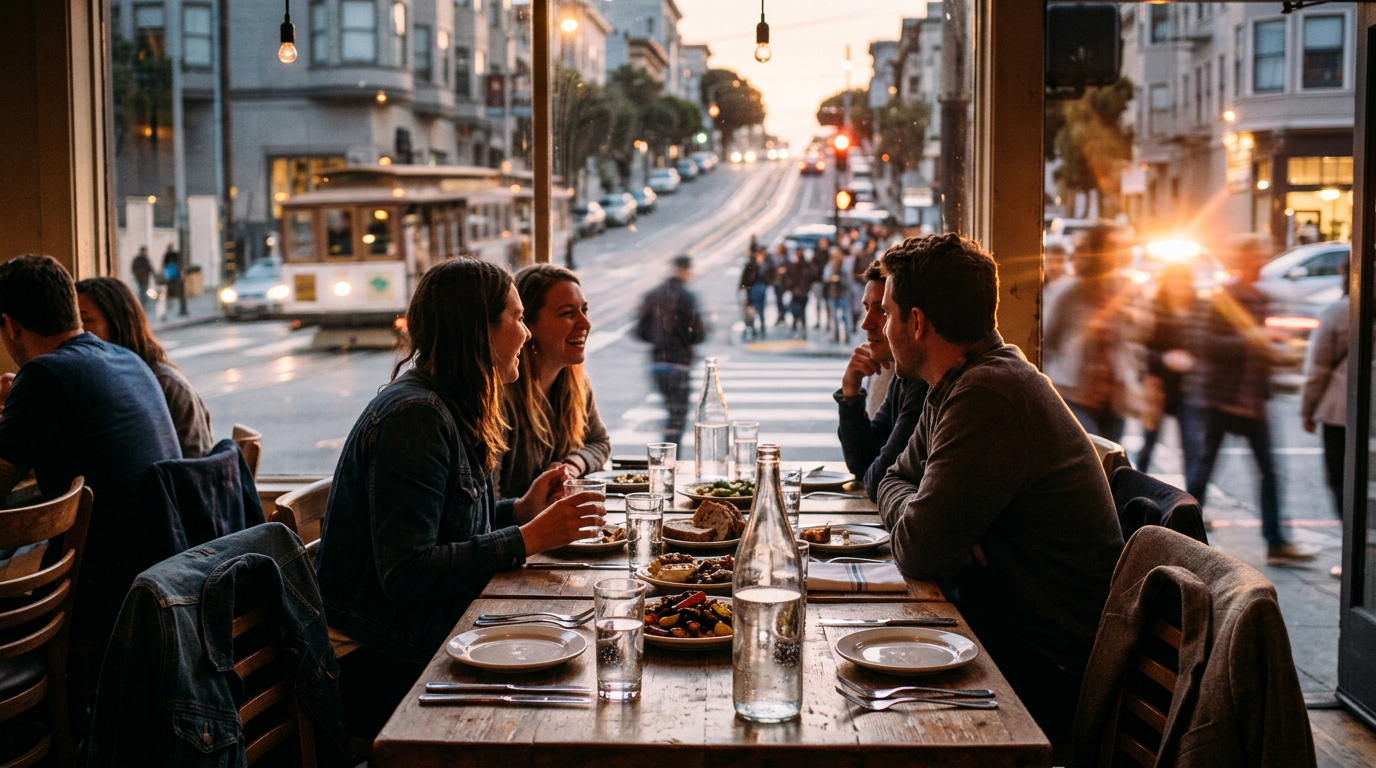
The SF founder dinner that skips the private room
A Tuesday night in Hayes Valley can cost less than a bad banner ad and produce a better investor intro. That is the SF math people forget. The city still rewards small rooms, fast context, and founders who can make six strangers feel like they should have met already.
The expensive version is easy: reserve a private dining room, agree to a food-and-beverage minimum, add wine, tax, service, and the person who ordered the second bottle of Burgundy, then pretend the receipt was strategic. The better version is tighter. Eight to ten people. A regular restaurant table or a back patio corner. A host who knows the point of the night. One clean follow-up thread before noon the next day.
San Francisco’s founder dinner culture in 2026 is not about spectacle. It is post-ZIRP, post-remote-everything, post-pitch-the-room energy. People are back in person, but they are allergic to performative networking. The strongest dinners feel curated without feeling gatekept. They create weak ties, the Granovetter kind: not your closest friends, but the people who change what you know and who can get a useful note in front of the right person.
Pick the right room without renting one
Private rooms are where small founder dinners go to get overbuilt. Unless you are announcing a round, hosting LPs, or running a board-adjacent conversation, you usually do not need one.
In SF, look for venue types that can handle adults talking without making you shout:
- A neighborhood restaurant with six-to-ten-top tables and staff used to groups
- A natural wine bar that serves real food, not just olives and tinned fish
- An izakaya-style spot where sharing plates are normal and ordering is flexible
- A hotel lobby restaurant that is calmer on Tuesday or Wednesday
- A coworking-adjacent café or event lounge for a pre-dinner meet, then a walk to food
- A casual but polished place in Hayes Valley, Mission, Dogpatch, Noe Valley, or near South Park
Do not chase the most talked-about table in the city. You are not trying to impress people with reservation scarcity. You are trying to create a room where a seed founder, a senior operator, an angel, and a technical lead can actually hear each other.
Known SF reference points matter because they tell you the standard, not because you need to book them. Zuni Café, Nopa, Foreign Cinema, Kokkari, Cotogna, and The Progress all signal what the city considers serious hospitality. For a budget-conscious founder dinner, you are often looking for the less ceremonial cousin of those experiences: good lighting, confident service, food that shares well, and no clubby nonsense.
Call instead of relying only on Resy or OpenTable. Say the quiet part clearly: “We are hosting eight founders for dinner. We do not need a private room. We need a table where conversation works, and we will keep ordering simple.” That line saves everyone time.
The guest list is the budget strategy
!Small founder dinner table in a warm San Francisco restaurant

A founder dinner gets expensive when the guest list gets lazy. Twelve people becomes fifteen. One investor brings an associate. Someone asks if their cofounder can come. Now the table is too long, nobody hears the person at the other end, and the bill has its own personality.
Keep it to eight if you want one conversation. Ten if you are comfortable managing the room. More than that and you are hosting an event, not a dinner.
A strong SF dinner usually has this mix:
- Two or three founders at similar company stages
- One person one stage ahead, with scars
- One operator who has done the work, not just advised on it
- One investor or angel, max two, and only if they are useful in a room
- One wildcard from an adjacent scene: AI tooling, climate, design, biotech, fintech, or creator infrastructure
Avoid stacking the room with only CEOs. SF already has enough people speaking in fundraising abstractions. Add a head of product, a technical founder who still ships, a former growth lead, or someone from South Park Commons or On Deck circles who knows how to contribute without hijacking the night.
Send individual invites. No mass BCC. No fake exclusivity. Try:
“Hosting a small dinner next Tuesday in Hayes Valley for founders building around applied AI and workflow software. Eight people, no pitches, mostly operator notes. You would add a useful perspective because you’ve seen the enterprise side up close. Want a seat?”
That is specific. It respects their time. It also tells them how to behave.
What to order / what to look for
The menu can protect your budget or wreck it. You want shared food, limited decision-making, and no social pressure around alcohol.
Look for:
- Shareable plates that do not require constant knife-and-fork concentration
- A kitchen that can stagger dishes without turning dinner into a two-hour tasting menu
- Clear nonalcoholic options that do not make anyone feel like a child
- Wine by the bottle if the group drinks, but only after you set a cap with yourself
- Tables that are round or compact, not a long banquet setup
- Lighting that lets people read faces without feeling like they are in a pitch deck review
Order like a host, not like a gourmand performing for the table. Ask about allergies in advance. When everyone sits, say: “I’m going to handle the first round of food so we don’t spend twenty minutes negotiating the menu. Add anything you need.”
That one sentence is worth money. It stops the drift.
For alcohol, do not let the loudest drinker set the pace. SF founder rooms now have plenty of sober, sober-curious, training-for-something, or just-done-with-weeknight-booze people. Make it normal early: “I’ll get sparkling water for the table too.” If wine makes sense, order modestly and slowly. Nobody has ever left a founder dinner thinking, “The best part was how aggressively we attacked the wine list.”
If the restaurant offers a family-style option without forcing a private room, ask about it. If not, build your own version: a few vegetable dishes, a few proteins, something substantial, and a clean ending. Dessert is optional. A crisp goodbye is not.
Best time of day to go
!Early evening sidewalk scene outside a Hayes Valley restaurant
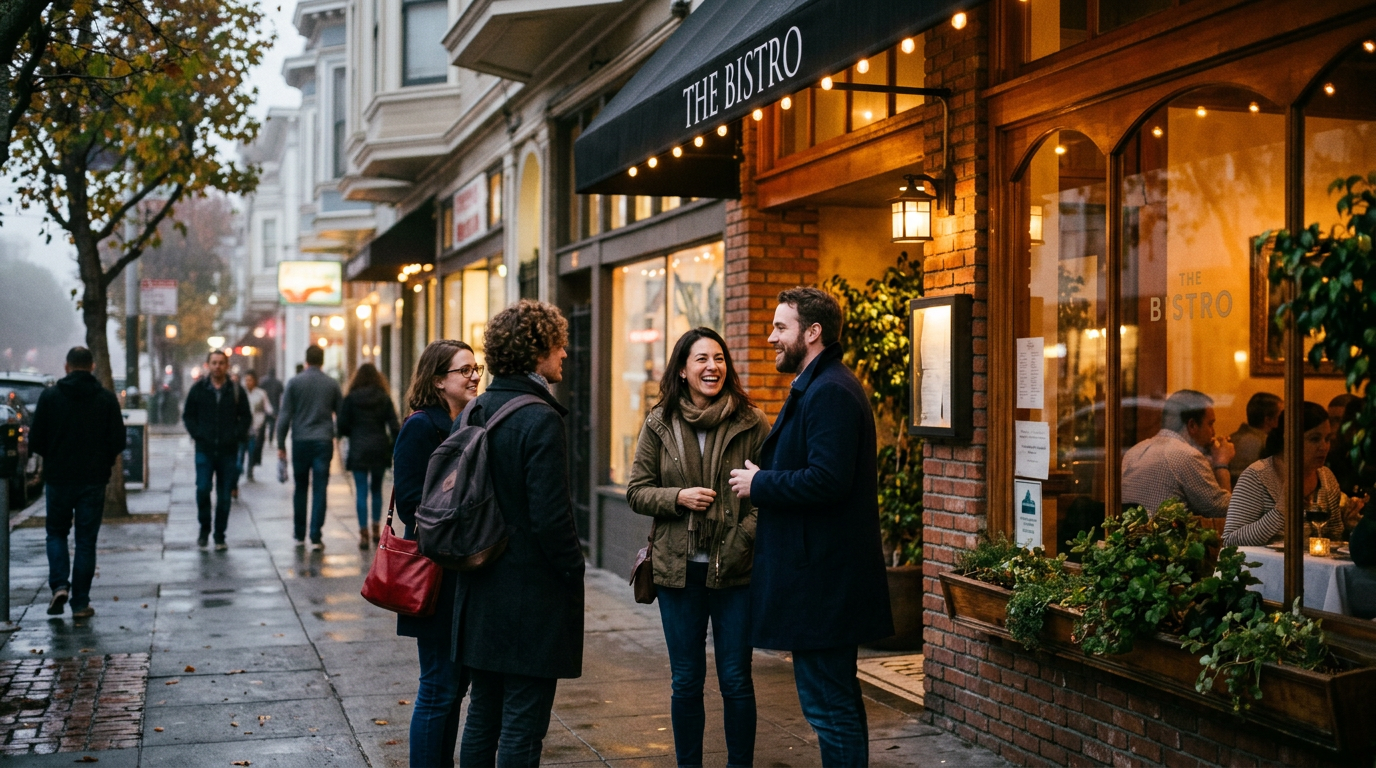
In SF, the sweet spot is Tuesday or Wednesday, seated between 6:30 and 7:15 p.m. Monday has too many “catching up after the weekend” cancellations. Thursday competes with bigger events, happy hours, and people trying to escape to Tahoe, LA, or whatever wedding airport they are pretending not to dread.
Earlier is better than later. Founders with kids, operators with early calls, and investors who have already done three coffees will all appreciate a dinner that does not swallow the night.
The best schedule:
- 6:15 p.m. optional pre-walk or coffee nearby for the host and one anchor guest
- 6:45 p.m. seated
- 7:05 p.m. host sets the frame
- 8:10 p.m. second conversation arc, not another round of intros
- 8:45 p.m. soft close
- 9:00 p.m. out the door or moved to a bar with only the people who truly want to continue
Do not plan a three-hour dinner unless the room is already close. New relationships need energy, not endurance.
Neighborhood matters. Hayes Valley works because it is central enough for people from the Mission, SoMa, the Marina, and the west side. South Park and Mission Bay work for startup density, but they can feel dead after work if you choose poorly. The Mission has stronger food and more social texture, but parking and timing can annoy people. Dogpatch is underrated for operators and hardware-adjacent founders. The Marina can work for consumer, fintech, and social founders, but be honest about the crowd you are assembling.
Etiquette and unwritten rules
SF founder dinner etiquette is simple and often ignored.
Do not pitch the table. If someone wants the full deck, they will ask. Your job is to give enough context that the right people can help.
Do not turn the investor into the guest of honor. It makes everyone stiff and gives the investor a worse night. Seat them like a normal human between two people who will challenge them politely.
Do not let one person monologue about AI agents, distribution, or their previous exit. Interrupt kindly: “I want to bring Maya in because she has seen this from the customer side.” That is not rude. That is hosting.
Do not make the bill weird. Decide before dinner whether you are hosting, splitting, or sponsor-backed. If you are hosting, host. If you are splitting, say it in the invite. If a company sponsor is paying, disclose that lightly and do not let the night become branded content.
Do not surprise people with a photographer, recording, or social posts. SF has too many founders discussing sensitive hiring, fundraising, cap table, and product questions. The default should be off-record unless everyone agrees otherwise.
Seat intentionally. Put close friends apart. Put the most generous operator near the person who needs context. Put two direct competitors near each other only if both are mature enough for it. Keep the loudest person near you so you can manage the volume.
The host speaks first, but briefly:
“Thanks for coming. The point tonight is useful conversation, not pitches. Quick intros: name, what you’re building or working on, and one question you are actively trying to answer this quarter. Keep it under a minute.”
Then enforce it with warmth.
How to actually meet people there
The dinner starts before the dinner. Send a short guest note the morning of, not a giant dossier. Include names, one-line context, and maybe LinkedIn profiles if helpful. Keep it clean.
At the table, use prompts that produce real information:
- “What changed your mind this quarter?”
- “What distribution channel is working better than you expected?”
- “Where are you seeing buyers move faster than the market narrative?”
- “What are you trying not to hire for yet?”
- “Who in this room should talk again next week?”
The last question is the money. It turns dinner from ambient chatter into actual connection.
As the host, listen for pairings. When two people overlap, name it in the moment: “You both mentioned onboarding technical buyers. You should compare notes.” Then make it easy after dinner.
Do not hand out business cards like it is 2008. Do not scan QR codes around the table while food is landing. The better move is a simple follow-up message:
“Good meeting you tonight. Your point about design partners landing better when scoped like paid pilots stuck with me. I’m going to send you the marketplace founder I mentioned.”
Specificity proves attention. Attention is rare enough in SF to be a competitive advantage.
Mistakes to avoid
The biggest mistake is overproducing. A founder dinner is not a conference track with better lighting. Skip name tags, printed menus, sponsor slides, and anything that makes people feel trapped in someone’s funnel.
Other mistakes:
- Booking a table too loud for conversation because the food looked good on Instagram
- Inviting people across wildly different stages without explaining why
- Letting “plus one” energy dilute the room
- Choosing a venue where everyone has to order individually and wait separately
- Starting with fundraising talk before trust exists
- Sitting yourself at the end of a long table where you cannot host
- Ignoring dietary restrictions until the server arrives
- Letting the night end with vague “let’s stay in touch” theater
Also, stop assuming expensive equals high-status in SF. The highest-status move is precision. The right eight people, in the right room, with a host who knows when to speak and when to get out of the way.
A simple budget structure that works
You do not need to publish the budget to guests, but you do need one. Decide your ceiling before you contact venues. Then design backward.
Control the big variables:
- Keep the guest count fixed
- Avoid private-room minimums unless someone else is paying for a strategic reason
- Choose shared ordering over full à la carte chaos
- Limit alcohol without making a speech about it
- Pick a neighborhood that does not force rideshare across the whole city
- End on time so nobody starts ordering out of restlessness
If you want help covering the dinner, ask one aligned company or fund quietly. Keep the sponsor presence tiny: “Dinner is covered by X, who is interested in this operator community.” No pitch. No swag bag. No forced demo.
If you are paying personally, say so only if it matters. People respect a founder who hosts within their means. They do not respect someone who acts generous, then sends a confusing Venmo request at midnight.
The follow-up is the actual asset
By 10 a.m. the next day, send one clean group note:
“Thanks again for last night. Three threads I heard: enterprise pilots need tighter success criteria, founder-led sales is still the bottleneck, and hiring senior ICs before repeatability is risky. I’m making a few direct intros separately.”
Then send those direct intros. Same day. Short and permission-based when needed.
A good intro sounds like:
“Sam, you mentioned looking for someone who has sold workflow software into legal teams. Priya did that at scale and had a sharp take last night on pilot design. Worth a 20-minute call if you’re both open.”
That is the real ROI. Not the dinner. Not the table. Not the wine. The aftercare.
SF rewards hosts who create useful rooms and then do the boring follow-through. You can spend $5k and still leave people cold. Or you can book a normal table, invite carefully, order sanely, and send three intros that change someone’s quarter.
That second version is the one locals remember.
Discussion (0)
Loading comments…