The SF founder dinner that doesn’t torch your runway
At 6:12 p.m. on a Tuesday in Hayes Valley, half the room is pretending not to check Slack while the other half is comparing notes on hiring their first infra engineer. That is San Francisco founder dining in 2026: early, tactical, mildly over-caffeinated, and allergic to anything that feels like a banquet.
You do not need a $5,000 private room to host a useful founder dinner here. In fact, spending that much can make the room worse. Too much production turns operators into panel attendees. The better SF dinner is tighter: 8 to 12 people, one long table or adjacent four-tops, a clear theme, no speeches longer than 90 seconds, and a bill structure that does not make the host quietly resent everyone by dessert.
The job is not to impress people with the room. The job is to create a dinner where the right founders talk to each other early enough in the night that they still have energy to follow up tomorrow.
Start with the room, not the restaurant fantasy
SF has plenty of restaurants that look perfect for a founder dinner until you ask about private dining minimums, cancellation terms, tax, service, AV fees, and beverage requirements. That is how a casual idea turns into a five-grand invoice.
The cheaper, better move is to avoid full private rooms unless someone else is underwriting the dinner. Look for:
- A semi-private back area at a neighborhood restaurant
- A communal table that can hold 8 to 12 without isolating the group
- A wine bar with real food, not just olives and two cheeses
- An izakaya-style spot where shared plates are normal
- A restaurant used to family-style ordering
- A coworking lounge or office common area where you bring in catering
- A member’s club only if a member can book without turning it into a scene
The best neighborhoods depend on the guest list. Hayes Valley works because it is central for people coming from the Mission, SoMa, Lower Haight, and the north side. The Mission is better for casual operator energy and less formal food. FiDi and South Park still make sense for investor-adjacent dinners, but they can feel empty later in the week. Dogpatch is underrated if your people are already in hardware, climate, robotics, or studio space. The Marina is usually the wrong call unless your group already lives there.
Well-known SF restaurants such as Nopa, Zuni Café, Foreign Cinema, State Bird Provisions, The Progress, Delfina, and Flour + Water prove the point: San Francisco has serious rooms, but the right dinner is less about chasing the reservation everyone recognizes and more about choosing a place that lets your table talk without yelling. If you cannot hear the founder across from you, you did not host a dinner. You bought noise.
The guest list is the budget control
!Small founder dinner table in a quiet San Francisco wine bar
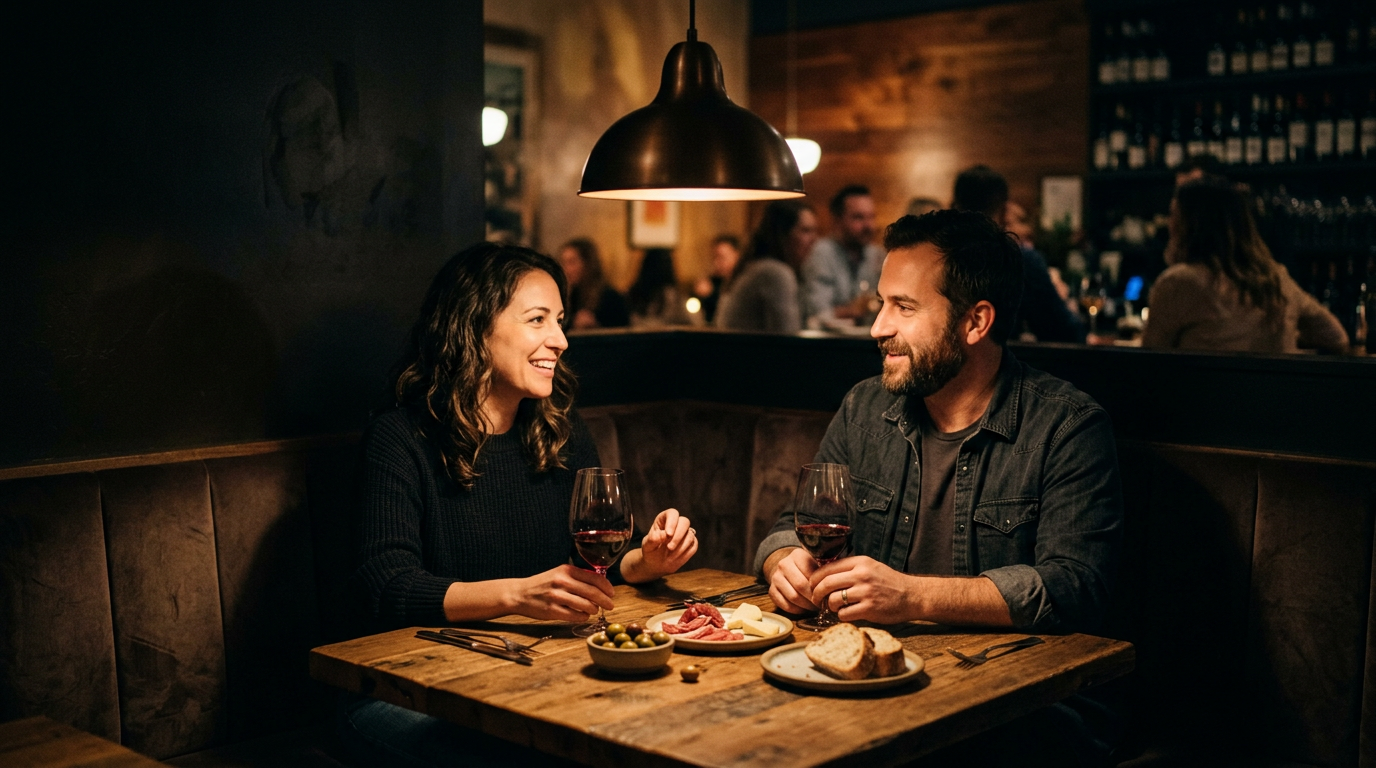
The biggest lie about founder dinners is that 20 people is just a slightly larger version of 10. It is not. Ten is a dinner. Twenty is an event with food.
For an under-$5k SF dinner, keep it to 8 to 12 guests. That size lets you use normal reservations, order intelligently, and avoid venue minimums. It also keeps the social graph manageable. One host can actually know who should meet whom.
A strong guest mix looks like this:
- 4 founders building in a similar market or stage
- 2 operators who have already solved a problem the founders are facing
- 1 investor or angel who can be useful without dominating the table
- 1 technical or GTM specialist who raises the quality of the conversation
- 1 wild-card guest with relevant scars from a different category
Do not fill the room with only CEOs. It gets performative fast. SF already has enough founder theater. Add a head of product who shipped through a messy pivot. Add a design partner from a serious AI workflow company. Add the person who knows enterprise procurement, not just the person who posts about it.
One useful filter: every guest should either learn something specific or be able to help someone specific. If you cannot name that connection before the dinner, they probably do not belong at this one.
What to order / what to look for
Order for conversation, not Instagram. The best founder dinner food is good enough to remember but not so complicated that every plate requires an explanation.
Look for:
- Family-style service or shareable plates
- A short prix fixe option with dietary flexibility
- One good salad or vegetable course that is not an afterthought
- One fish or vegetarian anchor, not only steak and pasta
- A wine list with sane by-the-bottle choices
- Nonalcoholic options that are not treated like punishment
- Tables where laptops are unnecessary and phones look rude
Avoid tasting menus unless the whole point is the restaurant. Omakase can be excellent, but it is usually bad for group conversation because everyone faces the counter and the cadence belongs to the chef. A natural wine bar can work if it has enough food and the music is not competing with the table. Izakaya-style ordering often works well because plates arrive in waves and people naturally share.
The simplest cost structure is one of these:
- Host covers food, guests cover their own drinks after the first round
- Sponsor covers a capped menu, no open bar
- Guests pay a fixed contribution in advance, host covers the overage
- Company card covers dinner only if there is a clear business purpose and clean attendee list
Do not do an open bar. Not in SF, not for a founder dinner, not if you care about the invoice. Start with sparkling water and one round of wine or beer. Anyone who needs cocktails to network is telling you something.
When you book, ask directly:
- Can you seat 10 at one table or adjacent tables?
- Is there a minimum spend for that area?
- Can we do family-style with a capped food budget?
- Can the check be settled by the host with drinks separated after a set point?
- What is the latest time we can make final headcount changes?
- Is there a quieter seating window earlier in the evening?
That last question matters. SF restaurants often get loud after 7:30. A founder dinner needs signal.
Best time of day to go
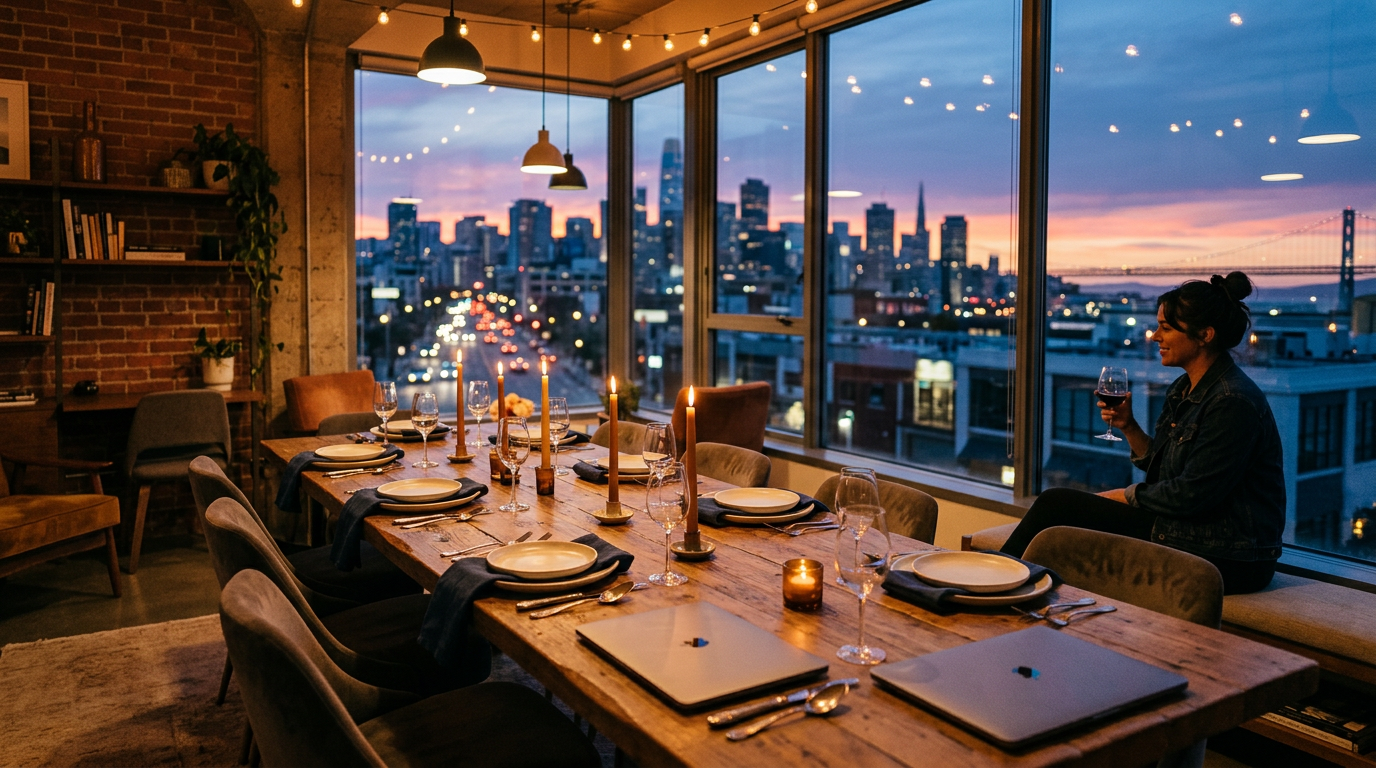
!Coworking lounge set for a catered San Francisco founder dinner
The strongest window is Tuesday or Wednesday, 6:00 to 8:30 p.m. Thursday is more crowded and more likely to collide with fund events, AI meetups, Launch House alumni hangs, South Park Commons sessions, or someone’s company happy hour. Monday can work for disciplined operators, but it has a lower show rate. Friday is for friends, flights, and people pretending they are not working.
Start early. This is not New York. In SF, a 6 p.m. dinner does not feel embarrassing. It feels efficient. People can bike from the Mission, walk from Hayes, or come from a late afternoon meeting in SoMa and still be home before their next deploy window.
A good format:
- 5:45 p.m. host arrives, checks table, confirms ordering plan
- 6:00 p.m. guests arrive, no formal networking circle
- 6:20 p.m. quick host framing
- 6:30 p.m. first round of food arrives
- 7:15 p.m. one structured prompt
- 8:15 p.m. host starts soft landing
- 8:30 p.m. official end
- 8:45 p.m. optional second location for people who want more
The optional second location should not be another expensive venue. It can be a nearby bar, a walk, or a coffee shop if it is still open. The point is to let the high-intent conversations continue without forcing the whole table to sit through them.
Etiquette and unwritten rules
SF founder culture rewards clarity and punishes polish when polish feels like concealment. People are happy to talk about revenue, technical bottlenecks, fundraising timing, distribution, and hiring. They are less patient with vague ambition.
Set rules lightly. Nobody wants a corporate offsite. But the host should create a container.
Say something like:
“This is a working dinner, not a pitch night. Quick intros, specific asks, useful candor. If someone says something sensitive, keep it at the table.”
Unwritten rules that matter:
- Do not invite someone and then surprise them with a pitch deck.
- Do not seat direct competitors next to each other without warning.
- Do not let the investor become the campfire everyone faces.
- Do not turn every AI conversation into a model leaderboard argument.
- Do not shame anyone for not drinking.
- Do not ask a founder about runway in front of the whole table unless they volunteered it.
- Do not dominate with your latest raise, launch, or Substack thread.
- Do not split the check twelve ways at the table like a college reunion.
Seat intentionally. Put the two loudest people apart. Put the shy but high-quality operator near you early. Put the investor in the middle only if they know how to listen. If not, put them at the end.
The best hosts interrupt gently. If someone starts monologuing, use a bridge: “I want to bring Maya in here because she just dealt with this on the enterprise side.” That is not rude. That is hosting.
How to actually meet people there
A founder dinner is not useful because everyone exchanged LinkedIns. It is useful because the room produces weak ties, the kind Mark Granovetter wrote about: relationships outside your immediate circle that carry new information. SF runs on those. The person who knows the design partner, the fractional CFO, the early customer, the angel who actually writes checks.
Do the matchmaking before the dinner, not during dessert.
Send a short pre-note the morning of:
“Tonight is 10 people working on AI workflow, infra, and applied enterprise tools. No presentations. Come with one concrete ask and one thing you can help with. I’ll make a few targeted intros at the table.”
At the table, skip the résumé intros. Use a sharper prompt:
- “Name, company, what you are building, and the constraint you are wrestling with this month.”
- “One customer conversation that changed your roadmap recently.”
- “One hire, intro, or piece of advice that would actually move the needle in the next 30 days.”
- “One belief you have about your market that smart people disagree with.”
Then pair people in real time:
“Daniel, you should talk to Priya after dinner. She just sold into the same buyer you’re trying to reach.”
“Sam, hold that thought for Alex. He has the scar tissue from doing this pre-Series A.”
“Two of you are describing the same onboarding failure from opposite sides. Sit together for the next course.”
That is the host’s job. Not to be the star. To move current through the room.
The under-$5k math without awkwardness
You can keep this under $5k if you avoid three traps: private room minimums, open bar drift, and bloated headcount.
For 10 to 12 people, your planning categories are simple:
- Food
- First round of drinks or wine for the table
- Tax and service
- Dietary substitutions
- A small buffer
- Optional post-dinner coffee or one additional round elsewhere
The dangerous costs are the ones that sound harmless: welcome cocktails, extra bottles, late additions, dessert wine, room fees, AV, printed menus, and people who bring an unapproved plus-one. You do not need any of that.
If you have a sponsor, keep their role clean. A sponsor can cover the bill and get a short thank-you. They should not get a captive sales pitch. The fastest way to ruin the room is to make founders feel they are paying for dinner with attention.
If guests are contributing, collect in advance. Not because people are dishonest, but because nobody wants the last 12 minutes of the night to become Venmo math. Use a simple note: “Dinner is capped at a fixed contribution; I’m handling the booking and any small overage.”
If you are hosting from a coworking space, this is where SF’s post-pandemic office reality helps. Many teams now have access to underused lounges, conference areas, or flexible event rooms through Industrious, Spaces, WeWork, or company subleases. A catered dinner in a clean common area can beat a restaurant private room if the guest list is right. Just do not make it feel like a demo day. Real plates if possible. Good lighting. No fluorescent conference-room sadness.
Mistakes to avoid
The expensive mistakes are obvious. The social mistakes are quieter.
Avoid these:
- Booking a table too large for one conversation
- Choosing a restaurant because it is famous instead of functional
- Inviting people across wildly different stages with no bridge
- Letting one founder pitch for 20 minutes
- Seating all friends together and newcomers at the edge
- Asking for “quick intros” and then letting them run 35 minutes
- Forgetting dietary restrictions until the server is standing there
- Posting the whole dinner on social without asking
- Sending no follow-up because you are tired the next morning
The biggest mistake: treating the dinner as the deliverable. The dinner is the setup. The value happens in the 48 hours after.
Send follow-up by noon the next day:
“Great having you last night. Three useful threads I heard: enterprise onboarding, design partners in healthcare, and hiring senior applied AI engineers. I’m making the Priya-Daniel and Maya-Alex intros now. If you promised someone something, send it today while the room is still warm.”
Then make the intros in separate emails or messages. Not one giant thread. Each intro should say why both people should care.
Example:
“Priya, meet Daniel. Daniel is selling into operations teams at mid-market manufacturers and is stuck on buyer mapping. Priya just closed a similar motion and offered to compare notes. Worth a 20-minute call.”
That is the difference between a nice dinner and a useful one.
A simple SF playbook you can reuse
Here is the clean version.
Pick one theme: applied AI sales, climate GTM, first design partners, hiring founding engineers, enterprise procurement, consumer subscription retention. Keep it narrow enough that strangers have something to say.
Invite 10. Expect 8 to 10. Cap at 12. Book Tuesday or Wednesday at 6 p.m. Choose a restaurant or wine bar with family-style ordering and manageable sound, or use a coworking lounge with good catering. Avoid private room minimums unless a sponsor is paying and the room still feels human.
Frame the dinner in the invite. Ask for one concrete ask and one concrete offer. Seat people with intent. Keep intros short. Make targeted connections during the meal. End on time. Follow up the next morning.
That is the SF way when it works: specific, useful, a little intense, and done before the night gets sloppy. You do not need to spend $5k. You need a table where the right people can hear each other.
Discussion (0)
Loading comments…