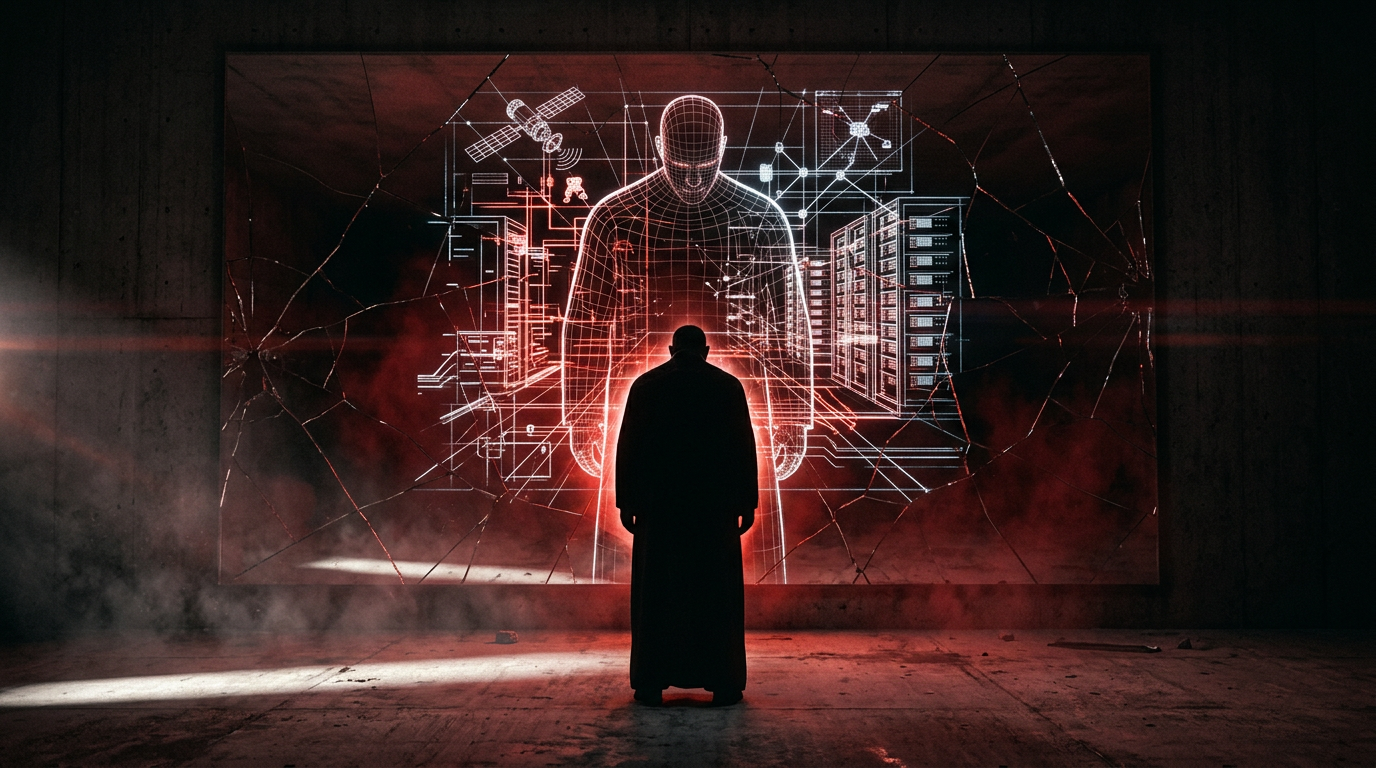
The shadow of the leader, the signature of the system
Trump did not build the new world order. He is the mirror it stares into.
In my view, Trump is not merely a politician. He is a symptom — the most visible sign that an era has ended. But I want to be precise, because precision is what separates an argument from a slogan: Trump did not create the world that is replacing the old one. He only made it impossible to look away from. That distinction carries this entire essay.
For generations, presidents and prime ministers were treated as serious, almost sacred figures. They were expected to weigh their words, carry themselves with dignity, and embody the authority of the state. With Trump, that aura cracked. But "the aura cracked" is actually three different claims wearing one coat, and unless we pull them apart we will keep mistaking a comedian for a cause.
First: political leadership has lost its sacredness. Trump speaks crudely, exaggerates, turns diplomacy into a stage act. The freshest proof came at the G7 summit in June 2026, in Evian-les-Bains. Trump claimed that Giorgia Meloni — until recently regarded as one of his closest allies in Europe — had "begged" him for a photograph. Meloni said she was stunned and called the story invented; Italy cancelled a planned diplomatic visit in protest. This is not just one man being rude. It is a symbol of how easily international diplomacy now collapses into a comedy sketch.
Second: the center of gravity of power is moving. A country no longer grows on land, soldiers, and old-style factories alone. It grows on software, artificial intelligence, defense technology, data infrastructure, unmanned systems, cyber capacity, and control over information. The state still matters — but the brain of the state is quietly becoming code. Companies like Palantir are the emblem of this age: they don't sell ordinary products, they build the operating systems of governments, armies, intelligence services, borders, and targeting decisions.
Third — and most dangerous: the accountability gap. States, for all their faults, have elections, laws, and public responsibility. The great technology and defense corporations are not elected by anyone. They do not stand in front of citizens. They are not answerable to the people whose lives they increasingly shape.
These three are connected, but they are not the same thing. Trump's vulgarity and Palantir's contracts do not grow from the same root. A serious analysis does not lay them side by side and let the reader assume they are one phenomenon. It explains the bridge between them — and the bridge is this: when leadership becomes a performance, the public stops looking at where decisions are actually made. The louder the show on stage, the easier it is to move the real machinery in the dark.
The state did not die. It fused.
There is a tempting, tidy story: once, companies needed states to survive; now, states need companies to function. It is clean, it is quotable, and it is mostly wrong. Because the strongest example proves the opposite. Palantir is almost entirely dependent on government contracts. If states stopped buying, Palantir would not exist. So the dependency is not one-directional. It runs both ways.
The real picture is not a replacement but a fusion. The state did not vanish; it became a knot tangled so tightly with private technical systems that you can no longer say cleanly where one ends and the other begins. This is not a weaker version of the argument — it is a far stronger one. Because the danger was never that a company would simply replace a government. The danger is that the two bind together so completely that the question "who actually decided this?" stops having an answer.
This is where the phrase "the system approved it" reveals its true meaning. Most of the time it does not mean software decided in place of a human. It means officials made the decision they already wanted, then hid it behind the algorithm and pointed: the system said so. It is a cleaner, more modern mask for an old instinct — the flight from responsibility. And note this carefully: the accountability problem is older than the technology. The machine did not invent it. The machine only gave it a better disguise.
The great hypocrisy, abroad: two wars, two voices
The new world order is not only about Trump or America. It is also about the slow collapse of the old alliances and the moral credibility that held them together. And here we reach the most dangerous territory in this essay — the place where careless words destroy a serious argument — so I will walk it carefully and on the record.
Start with what is documented and beyond dispute. Western public opinion has genuinely turned. In YouGov's polling across major Western European countries, favorable views of Israel collapsed to roughly 13–21 percent, against 63–70 percent unfavorable — the lowest standing since the state was founded in the late 1940s. There is a sharp generational split. Large majorities across Europe view the campaign in Gaza as disproportionate, and significant majorities in Spain and Italy opposed the US–Israeli strikes on Iran. This is measurable, repeated, and real.
Now the part that demands honesty rather than slogans. On the gravest accusation — genocide — the world's institutions are split, and an argument earns nothing by pretending otherwise. A United Nations Independent Commission of Inquiry concluded in September 2025 that Israel was committing genocide in Gaza, finding four of the five prohibited acts under the 1948 Genocide Convention and sufficient evidence of genocidal intent, and called for genocide charges to be added to the existing ICC arrest warrants. Amnesty International and Human Rights Watch reached parallel conclusions. The International Court of Justice, in South Africa's case, found it plausible that Palestinians' rights under the Convention were at risk and ordered Israel to take measures to prevent genocidal acts — but its final verdict on the merits is years away, buried under procedural delays, and Israel rejects the charge entirely, as do the United States and several allies that have intervened in the case. So the honest sentence is this: the most authoritative human-rights bodies that have ruled say genocide; the highest court has not yet ruled and may not for years; the accused and its protectors deny it. Stated that way, the indictment is heavier, not lighter — because no one can wave it away as invention.
And here is the hypocrisy that should make any honest European or Briton uncomfortable. Compare the speed and the volume of the two reactions. When Russia invaded Ukraine, the Western response was instant and total: condemnation within hours, sweeping sanctions within days, a wall-to-wall moral and informational campaign so intense that even its supporters called it propaganda. Flags changed on social media overnight. The aggressor was named without hesitation. Whatever one thinks of that war, the moral clarity was immediate.
Now look at Gaza. For month after month, the same governments who found their voice in a single afternoon for Ukraine could only manage "Israel has the right to defend itself," while the death toll climbed into territory that their own institutions would eventually call genocide. The condemnation did not come in hours. It came in years — if it came at all — and only after the catastrophe had grown too large to hide. People who screamed about one war whispered about the other. That is the hypocrisy. Not that the West cared about Ukraine. That it discovered, in real time and in front of everyone, that its outrage has a price list, and that the price depends on who is holding the gun.
For years, Israel's hardline policies were shielded in the West by powerful, well-funded advocacy, by media deference, and by strategic alliances. I want to be exact here, because this is precisely where a real argument gets murdered by a lazy one. The influence of organized lobbying on foreign policy is a legitimate, documented subject — Mearsheimer and Walt wrote a serious, contested book on exactly this. "AIPAC is an effective single-issue lobby" is a true and ordinary sentence about how Washington works. But "lobbies secretly control the media and push the world into war" is a different register entirely — unfalsifiable, conspiratorial, and self-defeating. The first is political analysis. The second is the oldest poison in Europe, and the moment you reach for it you hand your opponent the only weapon he needs to dismiss everything you said. The fix is one word: specificity. Name the spending. Name the bill. Name the vote that was changed. Talk about measurable influence, not invisible hands. This is not about a people or a faith — it is about a state's policy and the cost of endless conflict — and that distinction must be felt in every line, because it is the truth.
The great hypocrisy, at home: justice, borders, and the double standard
The rot is not only in foreign policy. It is in the everyday machinery the European Union sells to the world as its moral superiority: the rule of law. And the cracks are showing in cases that are not abstract at all.
In June 2026, an Oslo court sentenced Marius Borg Høiby — the stepson of Crown Prince Haakon, a man who entered the royal household as a child but holds no title — to four years in prison. He was convicted of two counts of rape, one committed in the basement of the Crown Prince's own official residence, along with domestic violence and other crimes. Prosecutors had asked for seven years and seven months. He got four. If you have heard this described as "a prince got three years," the details have drifted in the retelling — but the core scandal is real, and it is bad enough on the true facts.
In Sweden, the failure is sharper still. An Eritrean man, Yazied Mohamed, was convicted of raping a 16-year-old girl in Skellefteå as she walked home from a shift. He received three years — the statutory minimum for rape in Sweden. Then an appeals court ruled he would not be deported after serving that sentence, reasoning that the crime, while serious, did not clear the "exceptionally grave" threshold required under the 1951 Refugee Convention — and the judge confirmed that the short duration of the assault was one factor in that assessment. The Swedish Prime Minister himself called the outcome unacceptable and promised tougher laws. Sit with the logic for a moment: a court weighed a child's lifelong trauma against a stopwatch and found the trauma wanting.
This is the heart of it, and it has nothing to do with where the criminal was born. Protecting perpetrators protects no one. A lenient sentence does not heal; it teaches. It tells every future predator that the price is survivable. It tells the victim — who will carry that night for the rest of her life, who will flinch on quiet streets, who may never again feel safe walking home — that her suffering was measured and discounted. And it radiates outward: into her family, into her town, into every parent who now calculates which routes their daughter may walk. A justice system that cannot protect the most vulnerable from the most serious harm is not "merciful." It is broken, and its brokenness is a quiet kind of cruelty.
And here I want to be harder on both sides than either is willing to be on itself, because this is where the hypocrisy turns into a trap. The political right seizes on cases like these to indict every migrant as a criminal — which is a lie, a smear against millions of decent people, and a betrayal of the actual victim, who becomes a prop in someone else's campaign. The political left and the establishment press, terrified of feeding that narrative, look away, soften the headline, bury the story — which is its own betrayal, because it abandons the same victim to silence. Between the two, the girl on the street disappears entirely. One side exploits her, the other erases her. Neither protects her. That is the European hypocrisy: a continent that lectures the planet on human rights while its own courts and its own media cannot hold a simple, human line — that a child raped on her way home deserves justice, and that this truth has no nationality.
The double standard does not stop at the courtroom. Consider the border. Between January 2024 and February 2025, Germany returned roughly eleven thousand migrants to Poland — in at least one documented case, German police left an Afghan man at the frontier in the middle of the night without waiting for Polish officers, an act Poland's own government condemned as unacceptable. Poland did push back, loudly, and eventually reimposed its own border controls; so it is not quite true that "no one can say anything to Germany." But the asymmetry is real and instructive. When a powerful state hardens its borders and offloads the human consequences onto a smaller neighbor, the reckoning is muted, managed, diplomatic. The lecture that any weaker country would receive never quite arrives.
You can see the same asymmetry in how identical policies are framed depending on the flag above them. Across 2025 and 2026, a wave of governments moved to keep young teenagers off social media — Australia first, then the United Kingdom, Germany, France, Spain, Denmark, Greece, and many more; the European Parliament itself called for an under-16 ban. When Turkey passed its own version in April 2026, restricting under-15s, much of the Western framing turned noticeably more skeptical — "controversial," "a tool of control" — than the approving coverage the same idea received in Western capitals. Now, in fairness, there is a legitimate reason Turkey's version draws extra scrutiny: its government has a real record of throttling social media to suppress dissent, as it did during the protests over the jailed Istanbul mayor. That context is not bias; it is relevant. But strip that away and the pattern still stands across countless stories: the very same measure is read as "responsible child protection" in one capital and "creeping authoritarianism" in another, and the deciding variable is too often not the policy but the passport. A media that cannot apply one standard to one fact forfeits the authority it claims.
A childish world with grown-up weapons — and the hero who always comes
So here is the world the mirror shows us. The same scene, looping: a war ignites, leaders shout, markets panic, oil lurches, ships stop, borders shake, and then — a ceasefire. And then it begins again. Lebanon becomes a playing card. Hormuz becomes a switch: open, close, open, close. Iran becomes a threat to be flicked on when convenient. Europe pays the economic bill, Britain the diplomatic one, and ordinary people pay the only bill that can never be refunded.
This may be the most frightening truth of the new order. The world is not becoming more serious. It is becoming more childish — but with far more dangerous toys. War, ceasefire, threat, negotiation: all of it handled with the emotional maturity of a tantrum, and the destructive power of an empire.
And yet. I do not believe this is where the story ends, because the story has never once ended here. In every dark age — every era when the powerful grew arrogant and the systems grew cold and the crowd was told to look away — a hero has risen against the evil of the day and refused. Always. It is the most reliable pattern in human history. The hero is rarely the loudest man on the stage. More often the hero is the journalist who would not stop filming, the court that finally said the forbidden word, the sixteen-year-old who looked the world in the eye and said he destroyed me and refused to be measured in minutes, the ordinary people who changed their minds because they could not unsee what they had seen. Power builds the machine. Conscience refuses to obey it. That refusal is the hero, and it never fails to appear.
That is why the future does not have to read: "The president decided." And it does not have to read: "The system approved it." Those are only the sentences we get if no one stands up. The truer task of our time is to drag every decision back into the light — to insist that behind every "the system approved it" stands a human being with a name, who can be asked, and judged, and held to account. The world does not need another tantrum with better weapons. It needs a new road. And the first stone of that road is simple, and as old as every hero who ever walked it: refuse to look away.
Anticipated objections — and the answers they deserve
1. "You're exaggerating — the state isn't dead."
Read more carefully. The essay never says the state is dead. It says the state has fused with private technical systems until accountability blurs. Yes, the state still holds the monopoly on legitimate violence; it can tax, regulate, break up, and jail. That is exactly the point: a state with all that power that still hides behind "the system decided" is not weak — it is evasive. The problem was never lost power. It was vanished responsibility. If you think those are the same thing, you have missed the argument, not refuted it.
2. "Trump isn't historically unique. Crude populism is old."
Correct, and irrelevant. The claim was never that Trump invented vulgarity — it's that he made the rot visible at planetary scale, in real time, with no filter, and paid no price for it. Berlusconi had a country; Trump has an algorithm-amplified globe. The novelty isn't the crudeness. It's the impunity and the reach. Pointing out that bad leaders existed before is not a counterargument; it's a footnote.
3. "'Software runs everything' is just a comforting myth — techno-determinism."
This is the strongest objection, which is why the essay already swallows it whole. "The system runs us" is a comforting lie, because it lets voters and elected officials off the hook. That is precisely why the essay refuses to say software decides. It says humans hide behind software. The agent is still a human being. The machine is the alibi, not the culprit. If you're arguing against techno-determinism, congratulations — so is the essay. You're fighting a position it doesn't hold.
4. "Palantir depends on government contracts, which sinks your whole thesis."
It does the opposite — it floats it. The thesis is not "the company conquered the state." It's "the two are so entangled they can't be pulled apart." Palantir's total dependence on government money is not a hole in that argument; it is the single best piece of evidence for it. You handed me my own proof and thought it was a rebuttal.
5. "Calling Gaza a genocide is contested — and the lobby talk is antisemitic."
On the first: the essay says plainly that the question is contested and that the ICJ hasn't ruled. It also reports, accurately, that a UN Commission of Inquiry and the two largest human-rights organizations on earth concluded it is genocide. Reporting what major institutions found is not a slur; refusing to report it would be cowardice. On the second: the line between analysis and bigotry is drawn in the text itself — measurable lobbying influence is legitimate political science; invisible-hand conspiracy is poison, and the essay names it as poison. If your only move against a policy critique is to reach for "antisemitism" regardless of what was actually said, you are not defending Jewish people — you are using them as a shield for a government's conduct, and that does them no favors.
6. "The Ukraine–Gaza comparison is whataboutism."
No. Whataboutism deflects from a crime by pointing at a different one. This does the reverse: it points at the same actors applying different standards to comparable atrocities — which is the definition of hypocrisy, and hypocrisy is a legitimate charge against people who built their authority on moral consistency. If you condemned aggression in hours for one war and needed years for another, the gap between those clocks is the argument. Naming it isn't a dodge. It's the indictment.
7. "Using migrant crime cases is cherry-picking and xenophobic."
Then you didn't read the section, because it attacks your side and the other side with equal force. It explicitly says blaming all migrants is a lie and a smear, and that exploiting these victims for an anti-immigrant campaign is a betrayal of them. It also says burying the cases to avoid that narrative is a second betrayal. The argument isn't about migrants. It's about a justice system that discounted a child's trauma against a stopwatch, and a political culture in which both tribes are too busy using her to protect her. If naming a real court ruling is "xenophobic," then the xenophobia is in the verdict, not in the sentence describing it.
8. "You diagnose everything and solve nothing — and the 'hero' bit is naive."
Fair on the first half, answered in the text: the first concrete step is to make decisions visible — transparency, traceability, a name behind every "the system decided." You can't reform a power you can't locate. As for the hero being naive: naming the pattern that journalists, courts, and ordinary witnesses have repeatedly forced change is not sentimentality, it's history. Cynicism feels sophisticated and accomplishes nothing. If hope is naive, then every reform you currently enjoy was built by naive people. I'll keep their company.
9. "This is all Western-centric."
Partly true, and worth conceding. China, Russia, and the Gulf states are running the same technological fusion through different models — some of them further down the road of state–corporate merger than the West. The essay's focus on the West is a chosen frame, not a claim that this happens only there. But the frame is honest: in the West, the transformation arrived wearing Trump's face, in full view, which is exactly why it makes such a useful mirror.
Discussion (0)
Loading comments…