Small SF founder dinners without the $5k hangover
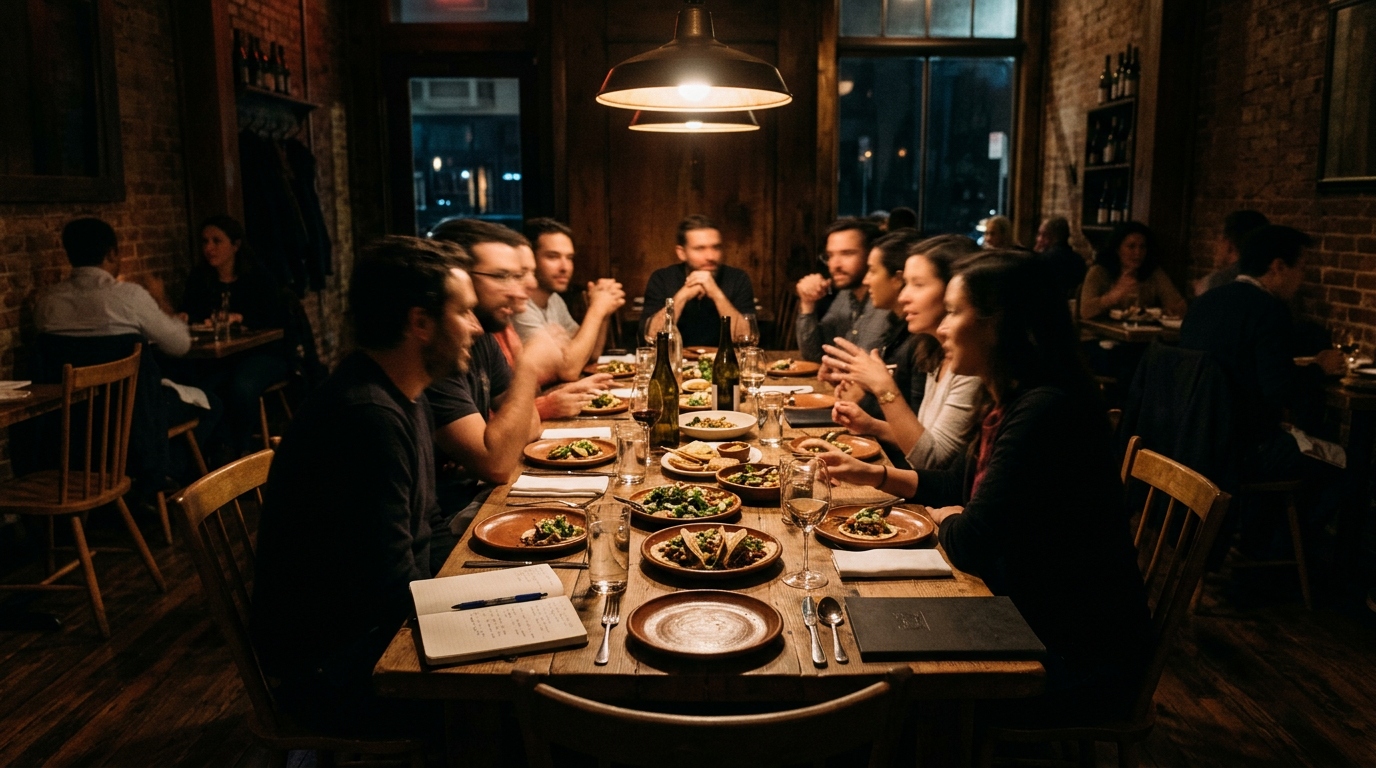
The expensive version is easy in San Francisco: book a private dining room, add wine, watch the service fee land, and pretend the room full of half-strangers was worth it. The better version is smaller, sharper, and more SF: eight people at a neighborhood table, one tight theme, no speeches, no sponsor banner, no weird pitch energy.
Founder dinners work here because San Francisco still runs on proximity. Hayes Valley, the Mission, South Park, Dogpatch, the Marina, FiDi, and the AI-heavy blocks around Cerebral Valley all have their own social gravity. People bounce between coworking spaces, South Park Commons events, AngelList intros, alumni Slack groups, seed-stage happy hours, and friends-of-friends dinners. The city is not short on rooms. It is short on hosts who can create a room that does not waste anyone’s Tuesday night.
A founder dinner under $5k is not a downgrade. It is usually the right format. Your job is not to impress people with a buyout. Your job is to pick the right guests, control the pace, make paying painless, and leave everyone with two or three real follow-up threads.
Start with the room size, not the restaurant
The sweet spot in SF is six to ten people. Twelve can work if you already know half the table. More than that and you are hosting an event, not a dinner.
For early-stage founders, operators, angels, and solo builders, a small table beats a private room because it creates social pressure in a useful way. People cannot disappear into their phones. They cannot hide behind the loudest investor. They have to participate.
Set the theme before you pick the venue:
- “Seed-stage AI founders hiring first GTM.”
- “Climate founders who sell into boring enterprise buyers.”
- “Founders building around agent workflows, no tourists.”
- “Solo technical founders deciding whether to raise.”
- “NYC and SF operators comparing post-Series A sales motion.”
That theme matters more than cuisine. San Francisco people will tolerate a simple table if the room is well-composed. They will not tolerate vague networking over an overpriced prix fixe.
A good founder dinner guest list usually has:
- 4 to 6 founders with adjacent problems, not direct competitors.
- 1 operator who has already solved the problem everyone is circling.
- 1 investor or scout only if they can behave like a human, not a panelist.
- 1 connector who knows the city and can make useful second-degree intros.
This is where Granovetter’s weak ties idea actually matters. The best dinner is not your five closest friends. It is people close enough to trust the room and far enough apart to create new information.
The SF venue types that keep the bill sane
!Founders arriving for a small dinner outside a San Francisco restaurant

Do not start by searching “private dining San Francisco.” That is how you end up with a minimum spend you did not need. Start with restaurants and bars that can handle a larger table, move food quickly, and do not require a production crew to make the night feel intentional.
Good venue types:
- Neighborhood izakaya or Japanese small-plates spot: Shared plates create motion without turning the night into a banquet. Keep the sake order modest unless you know the group.
- Natural wine bar with real food: Works well for six to eight, especially in the Mission, Hayes Valley, or North Beach. Watch noise levels.
- Cal-Italian neighborhood restaurant: Pasta, vegetables, a couple of proteins, one or two bottles. Reliable for mixed dietary needs.
- Modern Chinese, Burmese, Thai, or Vietnamese restaurant with big tables: Often better for group energy than a precious tasting menu.
- Hotel lobby restaurant or bar with bookable tables: Useful for FiDi, SoMa, and out-of-town guests. Less personality, more logistics.
- Coworking-adjacent casual dinner: After a South Park Commons, Shack15-style, WeWork, Industrious, or Spaces day, a nearby casual sit-down spot can be enough.
Specific SF names worth knowing as reference points, not automatic picks: Zuni Cafe, Nopa, Foreign Cinema, State Bird Provisions, The Progress, Burma Love, Souvla, and Mister Jiu’s are all established parts of the city’s dining map. Some will be too expensive or too hard to book for your exact night. Use them to calibrate style and neighborhood, then choose based on availability, sound, and table format.
For a budget-conscious dinner, avoid:
- Omakase for a mixed group unless one person is clearly paying.
- Tasting menus, which kill conversation rhythm.
- Rooftop cocktails before dinner. Expensive, loud, and rarely useful.
- Formal private rooms with food-and-beverage minimums unless a sponsor is covering it.
- Anything that requires a deposit you cannot afford to lose when two founders cancel.
The practical move: call or email and ask for a table for eight at 6:00 or 8:30, with shared plates and one check. Say it is a business dinner, not a party. Restaurants understand that.
What to order / what to look for
You are not curating a culinary flex. You are designing a conversation engine.
Look for:
- Tables where everyone can hear everyone.
- Banquettes or round tables over long, narrow tables.
- Food that arrives in waves, not one dramatic course.
- Clear vegetarian options without making one person feel like a problem.
- Wine, beer, and nonalcoholic choices that do not require a negotiation.
- A room that lets people arrive with a laptop bag and not feel ridiculous.
Order like an adult host:
- Start with still and sparkling water immediately.
- Pre-order a few shareable starters if the restaurant allows it.
- Keep alcohol light for the first hour.
- Ask about dietary restrictions in the confirmation message, not at the table.
- If you are hosting, decide whether you are paying before anyone sits down.
The cleanest budget structure is simple: host pays for food, guests cover their own drinks, or everyone splits evenly with a clear cap. Say it in advance. SF founders are used to directness. The awkward version is pretending it will sort itself out after someone orders rare Burgundy.
A strong under-$5k target:
- 8 guests.
- Shared plates.
- 1 to 2 drinks per person max.
- No rented private room.
- No swag.
- No photographer.
- No sponsor performance.
If you need a sponsor, keep it quiet and useful. “Dinner is covered by a founder-friendly accounting firm” is fine. A five-minute pitch is not.
Best time of day to go
!Shared plates and notebooks on a compact founder dinner table
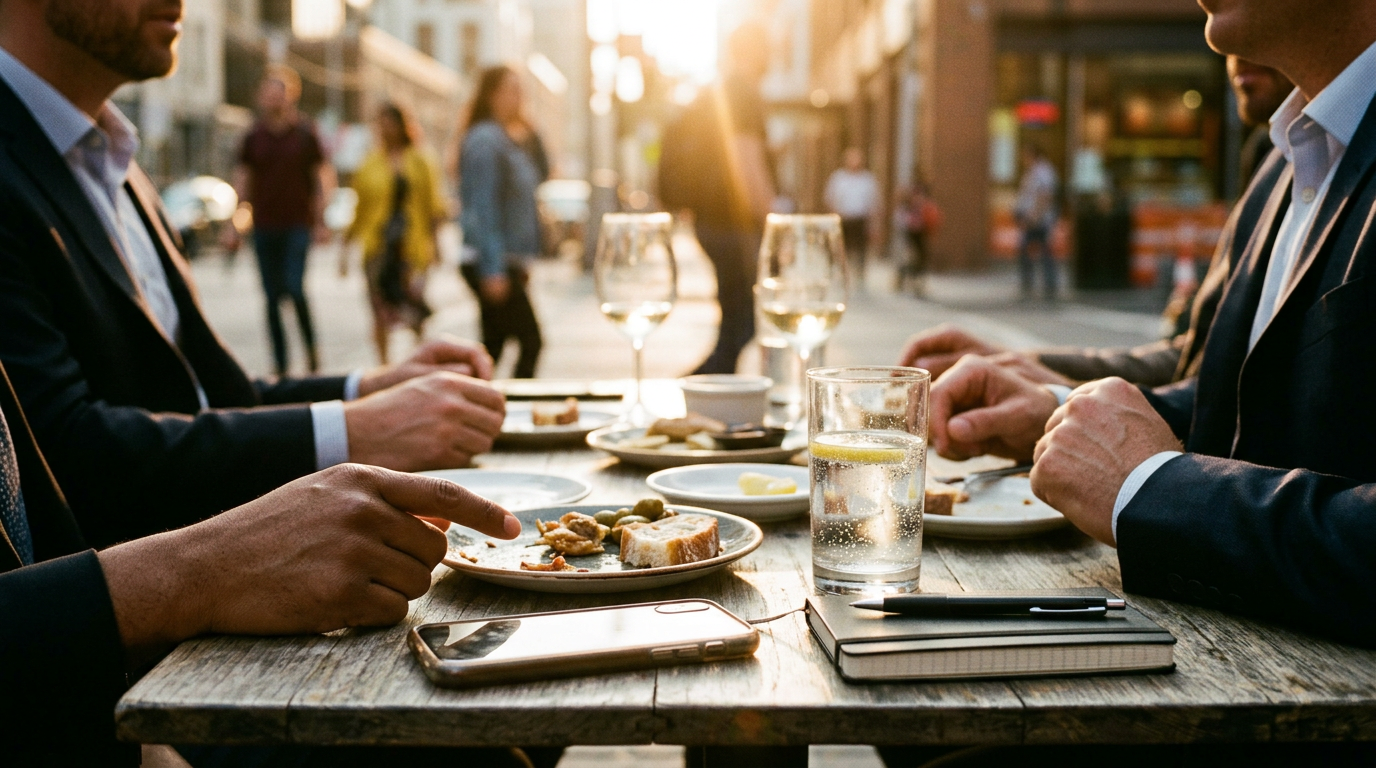
Tuesday and Wednesday are the strongest founder dinner nights in SF. Monday feels too internal. Thursday competes with happy hours, partner dinners, and flights. Friday is unreliable unless the group already knows each other.
The best start times:
- 5:45 p.m. for founders with kids, Peninsula commutes, or early investor calls.
- 6:30 p.m. for the standard SF operator crowd.
- 8:15 p.m. if guests are coming from events, coworking days, or demo nights.
Earlier is better than people think. A 6:00 dinner that ends at 8:15 lets guests take one more meeting, make a late drink, or get home without feeling trapped. That matters in SF, where a founder may be coming from Dogpatch, another from the Mission, another from Hayes Valley, and one poor soul from Palo Alto Caltrain.
Neighborhood matters by guest list:
- Hayes Valley works when people are split between west side, downtown, and the Mission.
- Mission works for AI, design, creative tech, and younger founder circles.
- FiDi / SoMa works for visiting investors and workday-heavy groups.
- Dogpatch works when the table includes hardware, robotics, biotech-adjacent, or people coming from Mission Bay.
- North Beach / Chinatown edge works when you want less tech-scene theater and more actual dinner.
Pick a Schelling point: a place people can agree on without a six-message debate. In SF, that usually means transit-adjacent, easy rideshare pickup, and not so precious that guests have to dress like they are auditioning for a member’s club.
Etiquette and unwritten rules
San Francisco founder culture rewards specificity and punishes social fog. People do not need you to be polished. They need you to be clear.
Send a tight invite:
- Who is coming, or at least the type of people coming.
- Why this group exists.
- Start and end time.
- Payment expectation.
- One sentence on format.
Example:
“Pulling together eight founders and operators working on agent workflows and enterprise adoption. No panel, no pitches. Shared dinner in the Mission, 6:30 to 8:30. I’ll cover food; drinks are individual. Goal is useful customer, hiring, and investor notes.”
At the table:
- Do not make everyone do a full résumé lap.
- Do not let one VC interrogate every founder.
- Do not open with fundraising status.
- Do not record anything unless everyone explicitly agrees.
- Do not bring an unannounced plus-one.
- Do not ask for intros before you have earned context.
A better opener is a 45-second round:
- Name.
- What you are building or operating.
- One problem you are actively trying to solve.
- One thing you can be useful on.
Then you, as host, steer pairs:
- “You two should compare enterprise onboarding.”
- “Both of you hired founding AEs too early; talk.”
- “You are selling into healthcare and you are selling into insurance. Similar procurement pain.”
That is the job. Not announcing topics. Making the right collisions happen.
How to actually meet people there
If you are hosting, you should know at least three guests directly and have a real reason for every other person. Pull from places where SF people already signal seriousness:
- Founder Slack groups and private Discords.
- AngelList and scout networks.
- South Park Commons circles.
- On Deck alumni groups.
- Lunchclub-style intros that turned into real calls.
- Meetup groups that still have quality in-person attendance.
- Coworking floors at WeWork, Industrious, Spaces, and independent studios.
- Coffee regulars at places like Sightglass, Blue Bottle, Ritual, Four Barrel, Verve, or Stumptown-connected circles.
Do not blast a public invite unless you want a different event. For founder dinners, curation is the product.
Useful invite language:
- “I’m keeping this to eight people so the table can actually talk.”
- “You came up because two people mentioned you are thinking hard about this problem.”
- “No need to prep. Come with one question you want the table to pressure-test.”
- “If you cannot make it, tell me early. I’m balancing the room.”
At dinner, help quieter people enter without turning into a moderator:
- “You were nodding at that. Same problem?”
- “What did you try that did not work?”
- “Who here has sold into that buyer before?”
- “What would you do differently if you had to restart this quarter?”
The follow-up starts before dessert. Keep a note on your phone with promised intros. After the check, send a same-night message:
“Great seeing everyone tonight. Three threads I heard: enterprise pilots stalling, first sales hire timing, and SOC 2 buyer anxiety. I’ll send specific intros tomorrow. If you promised someone a link, reply-all or send it directly.”
Then actually send the intros within 24 hours. That is what separates a host from someone who likes the idea of hosting.
Mistakes to avoid
The most common SF founder dinner mistake is trying to make it feel bigger than it is. Bigger venue. Bigger names. Bigger spend. Worse room.
Avoid these:
- Inviting too many investors: One investor can add signal. Three investors turn the room into theater.
- Mixing stages carelessly: A pre-seed founder and a Series C COO can learn from each other, but only if the theme is tight.
- Letting sponsors hijack the table: If the dinner has a commercial backer, disclose it and keep the sponsor useful.
- Choosing a loud room: If people have to yell, the night becomes social instead of useful.
- Overprogramming: No printed agenda. No name tents unless guests truly do not know each other. No forced “fun facts.”
- Waiting too long to confirm: SF people calendar aggressively. Send the hold early, confirm 48 hours out, reconfirm any waitlist replacements quickly.
- Splitting the bill poorly: Nothing ruins goodwill like a 15-minute check negotiation.
- Ignoring geography: A dinner that is easy for one host in the Marina may be a pain for a founder in Dogpatch or Oakland.
Also: do not pretend every connection needs to become a friend. The win is a useful second conversation, not a group chat that lives forever.
A simple format that works
Use this if you want the dinner to feel intentional without being stiff.
- 6:15 Host arrives, confirms table, water, first small plates.
- 6:30 Guests arrive. No formal start until most of the table is seated.
- 6:45 45-second round: what you are working on, what you need, what you can help with.
- 7:05 Food wave one. Host makes targeted bridges.
- 7:35 One table question: “What is one thing you changed your mind about this quarter?”
- 8:00 Food wave two or dessert. Host checks promised intros.
- 8:20 Check handled cleanly.
- 8:30 Official end. People can peel off or move to a nearby bar.
If the night is going well, resist the urge to extend it too aggressively. Leave people with energy. In San Francisco, the best founder dinners end with someone saying, “I wish we had another hour,” not “I need to get out of here.”
The local read
SF in 2026 is not cheap, but it is still small. Reputation travels quickly. A good host becomes a useful node fast: not because they know everyone, but because they make rooms where serious people can talk plainly.
You do not need a $5k budget. You need a table people can hear across, a guest list with tension and trust, a clear payment plan, and follow-up that happens before the week gets away from you.
That is the San Francisco version that actually works. Less spectacle. More signal.
Discussion (0)
Loading comments…