The two slits that broke common sense
A scene with a dim laser and two cuts
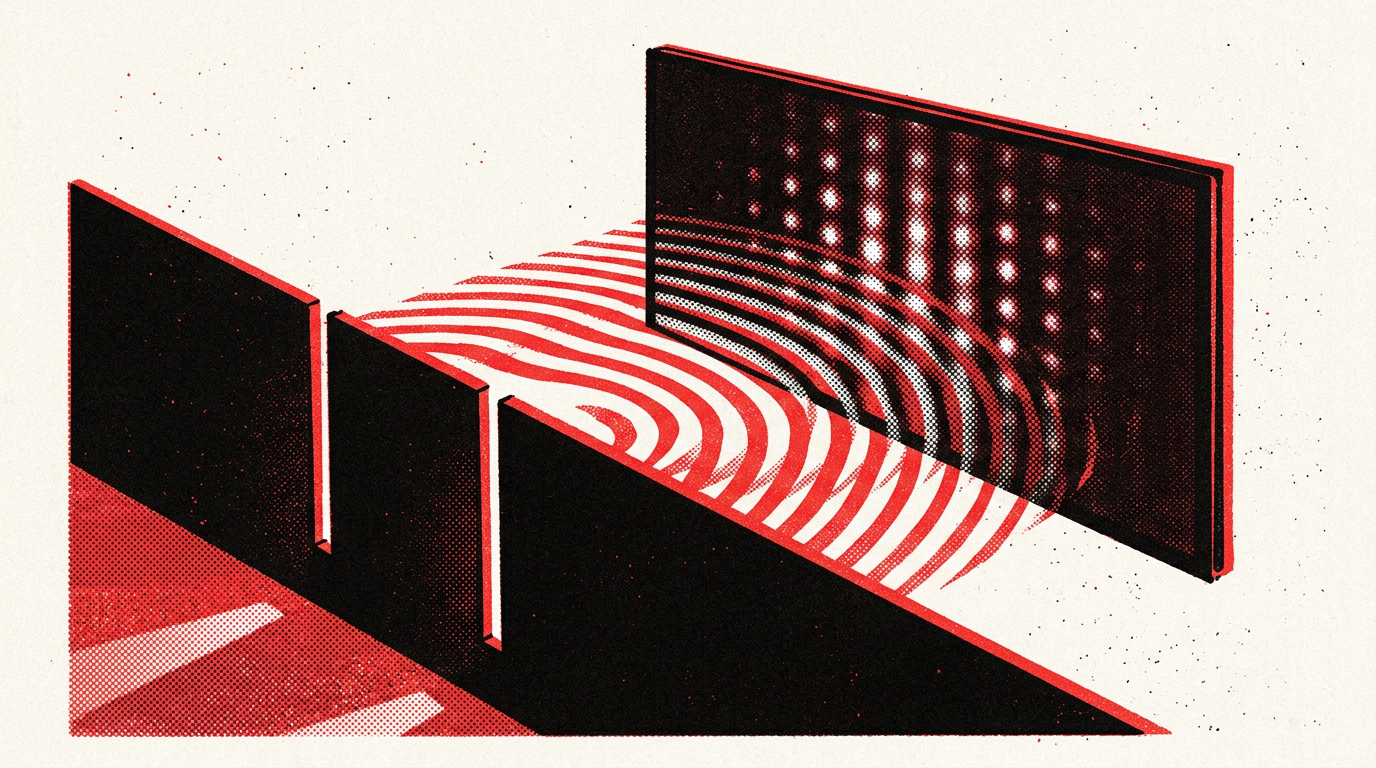
A physics lab can look disappointing. No thunder. No glowing reactor. Just a light source, a barrier with two narrow openings, and a screen on the far side.
Turn on the light, and stripes appear.
That is the part that sounds too small to matter. Stripes? Fine. Waves make stripes. Water does it. Sound does it. Light, if it behaves like a wave, should do it too.
Then the lab tech turns the beam down so low that only one tiny packet of light goes through at a time. One photon. A photon is the smallest indivisible unit of light energy we can detect. You wait. A dot appears on the screen. Then another. Then another.
Each photon lands like a tiny particle. But after thousands of single dots pile up, the same striped pattern appears.
That is the trouble.
One particle at a time somehow builds the pattern you would expect from a wave passing through both openings and interfering with itself. The double-slit experiment is famous because it takes our ordinary categories — wave, particle, path, observation — and makes them sweat.
Richard Feynman, in his 1965 physics lectures, treated this experiment as the central weirdness of quantum mechanics. Not a side trick. The main event.
What it actually is
The double-slit experiment starts with three simple pieces:
- A source that sends out light or matter in a controlled way
- A barrier with two thin slits cut into it
- A screen or detector that records where each particle lands
Thomas Young used a version of this idea in the early 1800s to argue that light acts like a wave. In 1801, he presented work showing interference, the pattern created when waves overlap. Where two wave peaks meet, they reinforce each other and make a bright band. Where a peak meets a trough, they cancel and make a dark band.
That part fits classical wave thinking.
The stranger version came later, once physics had learned that light also arrives in discrete packets. Max Planck introduced energy quanta in 1900. Albert Einstein used the photon idea in 1905 to explain the photoelectric effect, where light knocks electrons out of metal. Light was not just a smooth wave. It also behaved like particles.
Then matter joined the mess. Louis de Broglie proposed in 1924 that particles such as electrons have wavelengths too. In 1927, the Davisson-Germer experiment showed electron diffraction, meaning electrons scattered in a way that matched wave behavior. Claus Jönsson performed a double-slit experiment with electrons in 1961. Later experiments, including work by Akira Tonomura and colleagues published in 1989, showed single electrons building up an interference pattern one detection at a time.
Here is the basic sequence:
- Fire many photons or electrons through two open slits.
- They form an interference pattern: bright and dark bands.
- Fire them one at a time.
- Each one lands as a single dot.
- Over time, the dots still build the same banded pattern.
- Add a detector that records which slit each particle went through.
- The interference pattern disappears.
That last step is the knife twist. When the experiment gives you which-path information — knowledge of which slit the particle used — the striped interference pattern goes away. The result becomes more like two ordinary piles behind the two slits.
Quantum mechanics says the particle is described by a wavefunction. A wavefunction is not a water wave or a sound wave. It is a mathematical object that lets physicists calculate probabilities. Before detection, the wavefunction includes multiple possible paths. After detection, you get one actual result: a dot on the screen.
The short version: quantum objects move like waves of possibility and arrive like particles.
Why it matters
The double-slit experiment matters because it shows that nature is not just classical physics with smaller parts.
A baseball has a path. You can film it leaving the bat, moving through the air, and landing in the glove. If you do not know the path, that is your problem. The baseball had one anyway.
Quantum objects do not behave that cleanly. An electron is not a tiny baseball with a hidden travel itinerary that you simply failed to read. The experiment suggests that before measurement, the electron is described by a spread-out set of possibilities. Those possibilities can interfere with each other.
That idea is not philosophical decoration. It is the operating logic behind much of modern technology.
Semiconductors depend on quantum behavior in solids. Lasers depend on quantum transitions in atoms. MRI machines rely on quantum properties of atomic nuclei. LEDs, solar cells, electron microscopes, and quantum sensors all sit downstream from the same uncomfortable lesson: very small things do not obey the rules your kitchen table seems to obey.
Niels Bohr and Einstein argued about this kind of thing for years, especially around the famous Solvay Conferences in the 1920s. Einstein objected to the idea that probability was built into the foundations of physics. Bohr defended the quantum view that experiments do not merely reveal prewritten classical facts; they help define what can be said about a system.
You do not need to pick a philosophical team to get the practical point. The double-slit experiment forces a new rulebook.
The world is not made of little billiard balls following crisp paths at all times. At small scales, probability is not just ignorance. It is part of the machinery.
The simplest analogy that works
Use a pond.
Drop one pebble into still water. Ripples spread outward in circles. Drop two pebbles at the same time, side by side. Their ripples overlap. In some places, wave crests meet and make a taller crest. In other places, a crest meets a trough and the water flattens out.
That is interference.
Now place a wall in the pond with two narrow gaps. Send a straight wave toward the wall. After the wave passes through the two gaps, each gap acts like a new ripple source. The ripples overlap on the far side, creating a striped pattern of stronger and weaker motion.
That is the wave picture of the double-slit experiment.
For light, the bright bands are like the strong-ripple zones. The dark bands are like the canceled zones. For electrons, the screen does not glow in smooth waves. It records individual hits. Still, after many hits, the pattern matches the wave prediction.
Here is the everyday version that makes the weirdness sharper.
Picture a rainstorm hitting a fence with two vertical gaps. If raindrops were ordinary little pellets, you would expect two wet regions on the wall behind the fence, one behind each gap. Turn the rain down to one drop every few seconds, and you would still expect the same thing: each drop goes through the left gap or the right gap, then lands somewhere behind it.
But quantum particles act as if each drop’s probability wave passes through both gaps. Then the drop lands in one spot. After enough drops, the wall shows alternating wet and dry stripes.
The analogy is not perfect. A photon or electron is not secretly a tiny raindrop guided by a normal water wave. The “wave” is a probability amplitude. An amplitude is a number used to calculate the chance of a result, and in quantum mechanics amplitudes can add or cancel before probabilities are produced.
Still, the pond analogy earns its keep. It explains why two openings can create bands instead of two simple blobs.
The part people usually get wrong
The most tempting story is also the sloppiest one: “The particle knows it is being watched.”
That makes the experiment sound like consciousness has magical force. It does not need that. In physics, measurement means an interaction that leaves information in the world. A detector near a slit, a scattered photon, a disturbed atom, a record in an instrument — any of these can make which-path information available.
No graduate student needs to stare at it.
The better word is decoherence. Decoherence is what happens when a quantum system becomes entangled with its environment in a way that destroys visible interference between alternatives. Entangled means the state of one thing can no longer be fully described without the state of another. If the environment carries away information about the path, the clean two-path interference is lost.
This is why the detector matters. It is not the human eye. It is the physical record.
Another useful idea is the uncertainty principle, introduced by Werner Heisenberg in 1927. It says certain pairs of properties, such as position and momentum, cannot both be known with unlimited precision at the same time. This is not just bad equipment. It is a limit built into quantum systems.
But be careful: the double-slit experiment is not only about clumsy measurement kicking the particle. Some setups erase interference because path information exists, even if nobody reads it. Other “quantum eraser” experiments show that the availability of path information is the key issue. The details get technical fast, but the core lesson stays simple: alternatives interfere only when the experiment does not preserve a usable record of which alternative happened.
The math in one friendly paragraph
Quantum mechanics does not usually add probabilities first. It adds amplitudes.
That sounds like a small bookkeeping choice. It is not. If a particle can reach the screen by the left slit or the right slit, each route has an amplitude. Those amplitudes can reinforce or cancel, like positive and negative ripples. Only after combining the amplitudes do physicists calculate the probability of a hit at each point.
That is why some spots on the screen get many hits and others get almost none. It is not because particles take turns politely filling stripes. It is because the probability pattern itself has bright and dark regions.
Paul Dirac’s 1930 textbook, The Principles of Quantum Mechanics, helped formalize this style of thinking. The modern versions use more advanced math, but the heart is still the same: possible paths contribute amplitudes, and amplitudes can interfere.
Common misconceptions
“The experiment proves reality is fake”
No. It proves that everyday intuition is a poor tool for quantum-scale events. Reality is doing something precise enough that physicists can predict patterns with stunning accuracy. Weird is not the same as fake.
“A conscious observer changes the result”
Not required. A measurement is a physical interaction that creates which-path information. A detector can ruin the interference pattern while nobody is looking at the data.
“The particle literally splits in half”
That is too crude. Quantum theory describes the particle with a wavefunction spread across possible paths. When detected, the particle is found at one spot. Saying it “splits” can help beginners for five seconds, then it starts causing trouble.
“The detector destroys the pattern only because it bumps the particle”
Sometimes measurement disturbs a system, yes. But the deeper issue is information. If the setup records which slit the particle went through, interference is lost. The bump story is not enough.
“Only light does this”
Electrons do it. Neutrons and atoms have shown interference too. In 1999, Markus Arndt, Olaf Nairz, Anton Zeilinger, and colleagues reported interference with C60 molecules, also called buckyballs. Bigger objects are harder because they interact with the environment more easily, causing decoherence.
“Quantum weirdness lets you send messages faster than light”
No. Quantum mechanics has strange correlations, but it does not let you transmit usable information faster than light. Experiments related to John Bell’s theorem, first published in 1964, test deep questions about locality and hidden variables, but they do not give anyone a cosmic text-message hack.
Key takeaways
- The double-slit experiment shows that quantum objects can behave like waves of probability and still arrive as individual particles.
- With both slits open and no which-path record, many single particles build an interference pattern.
- If the experiment records which slit each particle used, the interference pattern disappears.
- “Observation” means physical measurement, not human consciousness staring at the apparatus.
- The experiment matters because the same quantum rules support lasers, semiconductors, electron microscopes, and emerging quantum technologies.
- The cleanest mental picture is a pond wave through two gaps, with one warning: the quantum wave is a probability amplitude, not a little splash of water.
The double-slit experiment is not famous because it is complicated to build. It is famous because it is hard to fit into the categories we bring from ordinary life. Two slits, one screen, a handful of particles, and common sense starts negotiating for better terms.
Discussion (0)
Loading comments…