
Where West Loop founders work without wasting the day
At 8:12 a.m. on Randolph, the room already tells on you. The serious people have coffee, a charger, and one clear task. The tourists are still photographing pastry cases. The founder trying to raise a pre-seed round is scanning for two things: a seat with power and someone worth talking to after the call.
That is the West Loop workflow in 2026. It is not the old coffee-shop fantasy where you park for six hours on one drip coffee and call it community. It is not pure coworking either. The useful pattern is a rotation: café for focused work, hotel lobby or member's club for a polished meeting, hot desk for call-heavy days, natural wine bar or dinner table for relationship-building.
Chicago rewards repeat presence. Especially here. Fulton Market and the West Loop have money, operators, hospitality people, agency owners, VC associates, healthcare founders, logistics brains, and restaurant groups all walking the same blocks. But nobody wants to hear your pitch at full volume next to their cortado. You earn the room by knowing when to work, when to talk, and when to leave.
The West Loop founder workflow is a circuit, not one perfect café
The mistake newcomers make is looking for a single all-day headquarters. West Loop real estate does not work that way. The better approach is to build a three-stop circuit within a 10-minute walk.
Use this structure:
- Morning focus café: third-wave coffee, decent light, laptop tolerance, early arrival.
- Midday call base: coworking day pass, dedicated desk, hotel lobby with enough spacing, or an office you can book.
- Late afternoon meeting room: lobby bar, restaurant bar before dinner rush, member's club, or quiet café after the lunch wave.
Sawada Coffee is the obvious cultural reference point in the neighborhood: serious coffee, creative-industry energy, and a room that has never felt like a suburban laptop farm. La Colombe has the dependable third-wave utility founders like because the coffee is consistent and the setup is easy to understand. Intelligentsia remains a Chicago coffee standard, even when you are using it more as a signal than a workstation.
For longer days, do not force the café to do coworking's job. Check current day pass options at operators such as Industrious, Spaces, and WeWork around Fulton Market, the Loop, and River North. If your day includes investor calls, sales demos, or hiring screens, pay for the room. The cost is usually less than the damage caused by bad audio and a bus tub clattering behind your Series A update.
The smarter founder keeps the café for what it does well: ambient accountability, weak-tie exposure, and short meetings that do not require a conference room. Mark Granovetter's weak ties idea still fits here. The person loosely adjacent to your world often brings the lead, customer intro, or hire you would not get from your tight circle.
What to order / what to look for
!Professionals meeting in a West Loop lobby seating area
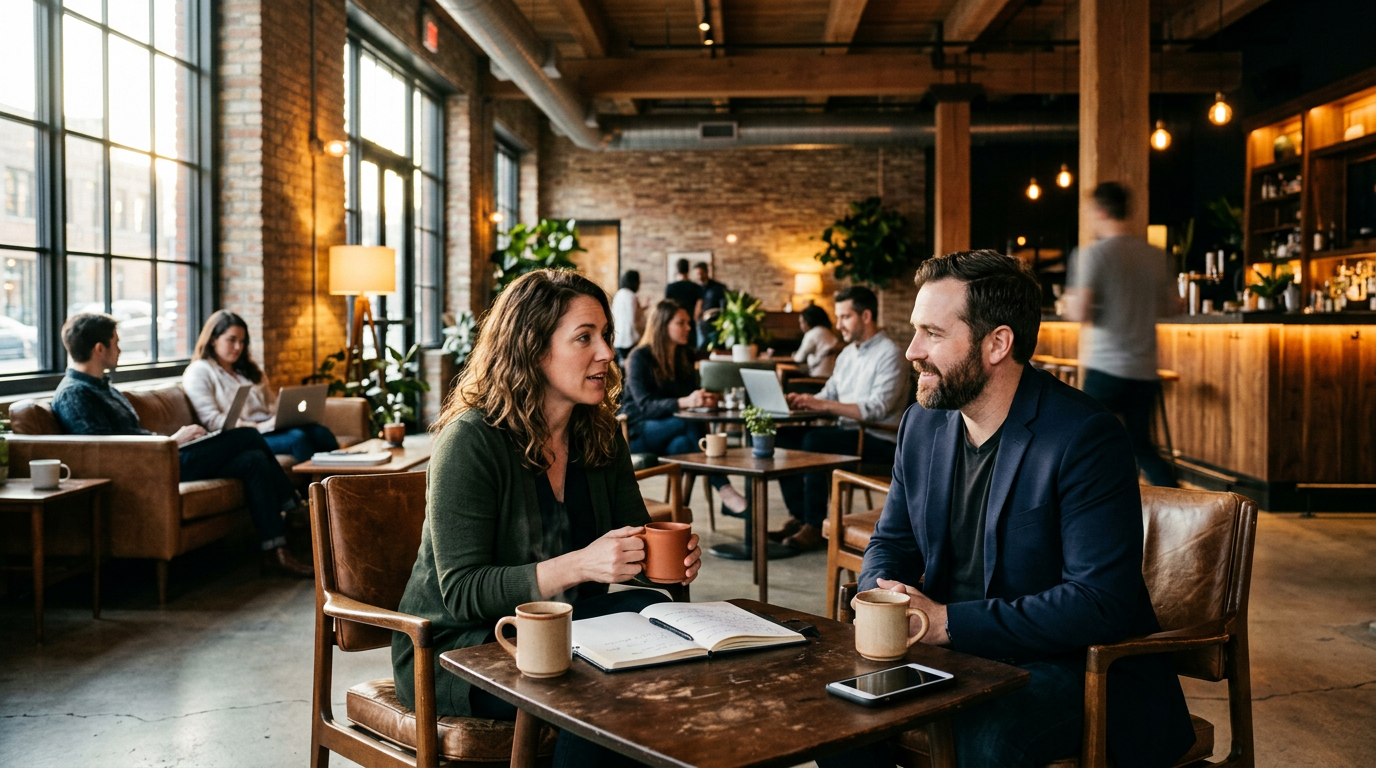
Order like someone who understands the business you are occupying. If you are staying, buy more than one thing. A coffee at 8:30 and nothing else until 1:00 is not a personality; it is bad math for the café.
Look for:
- Single-origin pour-over or batch brew when you need focus without milk-sugar drag.
- Espresso or cortado for a quick stand-up meeting where you are not camping.
- Sparkling water or iced tea as your second purchase after the first hour.
- Real food if the place offers it and you are taking up table space through lunch.
- Seats along walls or counters if you need power and less visual distraction.
- Two-tops near the edge of the room for a 25-minute intro meeting.
Do not judge a founder café only by the coffee. Judge the room. Can you take notes without feeling watched? Are outlets available without crawling under strangers? Is the music workable, not performative? Does the staff seem irritated by laptops, or have they clearly accepted weekday laptop traffic as part of the model?
In the West Loop, the best coworking café type is usually one of these:
- The third-wave counter with early energy: better for writing, product review, light email, and solo planning.
- The hotel lobby café near Fulton Market: better for polished one-on-ones, out-of-town investors, and customer coffees.
- The bakery-café with real seating: better for breakfast meetings and short working blocks.
- The restaurant bar before service: better for late afternoon relationship meetings, especially if you are not opening a laptop.
- The paid hot desk nearby: better for call-heavy days, team sprints, and work that needs privacy.
Your order should match your time horizon. Espresso means 20 minutes. Coffee and food means an hour. Multiple purchases and low-impact behavior might earn you a longer stay. Nothing earns you the right to run your all-hands from a communal table.
Best time of day to go
West Loop timing is not casual. The neighborhood changes every two hours.
7:30 to 9:00 a.m. is the best window for focused solo work. You get cleaner tables, better seat selection, and the serious pre-office crowd. If you want a wall seat with power, arrive before 8:15. This is when founders can write investor updates, clean up a deck, or handle the task they keep avoiding.
9:30 to 11:15 a.m. is strongest for intro coffees. People are caffeinated, not yet wrecked by Slack, and less likely to be late because dinner traffic has not entered the day. Keep these meetings to 25 or 30 minutes. Chicago operators respect people who end on time.
11:30 a.m. to 1:30 p.m. is usually poor for laptop camping. Lunch pressure rises, staff turnover increases, and the room belongs to diners. If you need to work through this window, move to a coworking day pass or a lobby where lingering is built into the economics.
2:00 to 4:30 p.m. is underrated. The caffeine crowd thins, meetings feel less transactional, and you can often get a better table. This is a good window for founder-to-founder problem solving, recruiting chats, and customer discovery calls that do not need a full conference setup.
After 4:30 p.m. the West Loop becomes a different machine. Restaurants and bars start preparing for dinner. Laptops look wrong in many rooms. Shift into relationship mode: notebook, drink, short agenda, no screen unless you are showing one specific thing.
Etiquette and unwritten rules
!Laptop and espresso on a Chicago café counter
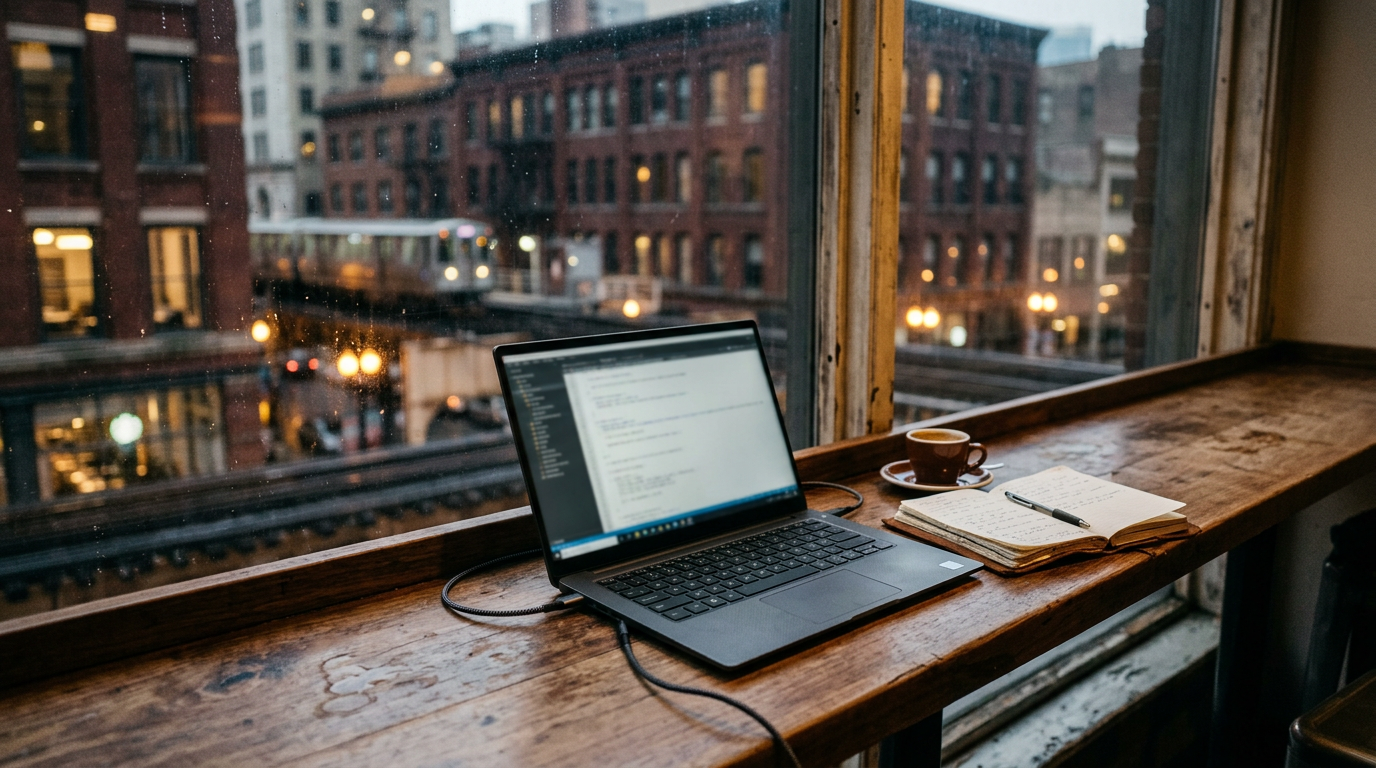
Chicago is friendly, but the West Loop is not passive. People clock whether you are considerate. The neighborhood has too much hospitality DNA for bad guest behavior to go unnoticed.
Rules worth following:
- Buy early, then buy again. If you stay past 90 minutes, make a second purchase.
- Tip well. Especially if you are using the room as an office.
- Keep calls short and quiet. If you need to talk for more than 10 minutes, step outside or book a room.
- Do not spread across a four-top alone. Unless the room is empty and you move when asked.
- Avoid speakerphone completely. There is no acceptable founder exception.
- Do not pitch the barista. Be pleasant, be regular, leave them out of your funnel.
- Read the lunch shift. If tables are turning, pack up.
- Protect confidential work. Chicago has competitors, investors, and recruiters sitting closer than you think.
The most respected West Loop regulars are low-friction. They know the staff, do not demand special treatment, and make the room easier to run. That matters because a founder's reputation is often built in tiny public moments: how you handle a wrong order, whether you hog space, whether you talk over everyone else.
If you are meeting someone senior, pick a place where they do not have to fight the room. A hotel lobby, Soho House Chicago if membership access makes sense, or a quieter restaurant bar before service can be better than a packed coffee counter. For pure startup density, remember that 1871 at the Merchandise Mart and mHUB on the Near West Side are part of the broader Chicago operator map, even if they are not West Loop cafés. Use them for programming and structured networking, then use the West Loop for follow-up coffees.
How to actually meet people there
Do not walk into a café and start networking. That is amateur hour. The play is to create repeat visibility, then convert it into a normal conversation.
Start with a simple operating rhythm:
- Pick two weekday mornings and show up consistently for a month.
- Sit in roughly the same zone without being territorial.
- Learn staff names if they offer them naturally.
- Notice regulars, but do not stare at screens or interrupt calls.
- Bring one short, specific reason to speak to someone.
Good openers in this neighborhood are practical, not breathless:
- "I see you here most Tuesdays. Are you working nearby or building something in the area?"
- "Quick local question: where do you take a 30-minute investor coffee when this place is full?"
- "I heard you mention hiring a product designer. I know two Chicago people who might be relevant if you want names."
- "Are you going to the 1871 event this week, or is it not worth the calendar slot?"
- "I am trying to get smarter about logistics software in Chicago. Is that your world at all?"
Offer context in one sentence. Not the full founder monologue.
Try: "I run a small B2B workflow startup for restaurant operators, based here in Chicago." Stop there. Let them ask.
The follow-up move is where most people fail. Send it the same day, with one useful hook:
- "Good meeting you at coffee this morning. Here is the mHUB event I mentioned."
- "You asked about fractional finance help. This is the person I trust."
- "Appreciated the note on enterprise pilots. If useful, I can send our one-page customer profile."
Do not add them to a newsletter. Do not send a deck without permission. Do not ask for three introductions after a seven-minute conversation. Build the second touch first.
For more structured connection, layer in Meetup groups, AngelList-adjacent founder networks, Lunchclub-style matching when it is active for your circle, On Deck alumni groups, and South Park Commons if you are already in that orbit. In Chicago, though, the offline conversion matters. A founder dinner, a small operator breakfast, or a recurring coffee table will outperform another cold LinkedIn thread.
Matching the room to the work
A West Loop founder day usually contains different kinds of work. Match each one to the right room and you will stop burning energy.
Investor update writing: early third-wave café, headphones, no meetings. Order coffee and food. Leave before lunch.
Sales calls: paid hot desk or day pass. Do not trust café Wi-Fi or background noise when revenue is on the line.
Candidate screening: private room or quiet coworking booth. Candidates judge your seriousness by the environment.
Customer discovery: café or hotel lobby if the conversation is casual; conference room if you are showing product.
Founder therapy: restaurant bar at 4:00 p.m., no laptop, one notebook. This is where you compare burn, hiring pain, and what is actually working.
Out-of-town investor meeting: hotel lobby or member's club. Keep transit easy from Ogilvie, Union Station, or the Loop. Do not make someone decode parking and construction on a tight schedule.
Creative sprint: coffee shop in the morning, then move. West Loop rooms are stimulating, but they can become expensive distraction if you confuse motion with progress.
The room should reduce friction. If you are constantly guarding your bag, hunting outlets, apologizing for noise, or ordering just to justify your seat, you picked wrong.
Mistakes to avoid
The first mistake is treating West Loop like a content backdrop. People who work here can tell when someone is performing founder life rather than operating. If your entire day is laptop open, calendar visible, AirPods in, no real output, the room is not the problem.
Other common mistakes:
- Taking loud fundraising calls in cafés. You sound less important than you think.
- Using one café for every task. Rotate based on the work.
- Scheduling first meetings during lunch crush. The room will fight you.
- Over-indexing on famous names. A well-known coffee brand is not always the right room for a sensitive conversation.
- Ignoring paid coworking. A day pass can save a day that a café would ruin.
- Confusing proximity with connection. Sitting near founders is not the same as knowing them.
- Making every conversation a pitch. Ask better questions first.
- Failing to follow up cleanly. The West Loop rewards people who do what they said they would do.
Also avoid the fantasy that one neighborhood contains the whole Chicago startup scene. West Loop is powerful because it is a Schelling point, a place people can easily choose when nobody wants to overthink the meeting location. But serious Chicago networks also run through the Loop, River North, Hyde Park, Lincoln Park, the Merchandise Mart, university circles, industry groups, and private dinners in neighborhoods where nobody is posting the table.
A practical West Loop day that actually works
Here is the pattern I would use for a founder with one day in the neighborhood.
Start before 8:30 at a serious coffee room. Buy properly. Write the hard thing first: investor note, hiring plan, customer memo, product teardown. No meetings yet.
Take one intro coffee around 10:00. Keep it tight. Your goal is not to impress; it is to find one useful next step. Ask what they are seeing in the Chicago market that outsiders miss.
Move to a paid workspace or private room before lunch if calls matter. Do not gamble the middle of the day on café seating. Eat somewhere that lets you reset instead of typing through a sandwich with one hand.
Use the 2:30 window for a second meeting. This is where you can talk partnerships, hiring, or customer discovery without the morning rush. Bring a notebook. People notice.
End with one relationship touch after 4:30: a drink, a quick bar meeting, a founder dinner, or an event tied to 1871, mHUB, a university network, or a sector-specific Meetup. Leave before you become the person trying to turn a social setting into a demo day.
The West Loop works for founders who treat rooms as tools. Coffee is for focus and light connection. Coworking is for execution. Bars and dinners are for trust. Get that right, and you leave with more than a caffeine bill. You leave with a cleaner day, a better reputation, and one or two Chicago contacts who might actually answer your next message.
Discussion (0)
Loading comments…