
Where Brooklyn coffee turns into work contacts
At 9:12 on a Wednesday in Williamsburg, the real meeting is not the one on the calendar. It is the three-minute exchange at the end of a communal table, the founder recognizing the freelance designer from a DUMBO panel, the product lead asking who knows a good fractional CFO while waiting on a single-origin pour-over.
Brooklyn coffee networking is not handshakes and name tags. It is proximity, repeat attendance, and knowing when not to pitch. The borough rewards people who become familiar before they become useful. That is especially true in 2026, when formal coworking has settled into a cleaner role: good for focus, calls, and paid community. Coffee shops are where the softer layer happens. The weak ties. The offhand introductions. The “you should meet my friend” that turns into a contract six weeks later.
This is not about camping at any café with Wi-Fi and hoping your next investor appears. It is about choosing the right room for the type of work you do, reading the pace, and leaving with one real connection instead of five awkward LinkedIn requests.
The Brooklyn rooms that actually work
Brooklyn is not one coffee scene. Williamsburg, Greenpoint, Bushwick, Fort Greene, DUMBO, Cobble Hill, Park Slope, and Gowanus each have different social physics.
Williamsburg is still the highest-density room for founders, creators, agency people, CPG operators, fashion-adjacent freelancers, and visiting investors who pretend they are only in town for dinner. Devoción in Williamsburg is the obvious example: beautiful room, serious coffee, lots of people doing real work in public. Partners Coffee in Williamsburg has long been a reliable roaster-café stop for coffee meetings and pre-office catchups. These are not places to perform being busy. They are places to be readable: what you do, what you are building, who you know.
Greenpoint is slower and more local. Cafe Grumpy has the long-standing neighborhood credibility, and the area pulls designers, writers, production people, architects, and founders who have aged out of pretending every conversation needs to happen in Soho. Greenpoint is better for second meetings than cold approaches.
Bushwick has the coffee nerd gravity. Sey Coffee is nationally respected, and the crowd skews serious: roasters, designers, artists, photographers, software people who care about taste, and people building things without announcing them every 20 minutes. If Williamsburg is where people are visible, Bushwick is where people are specific.
Fort Greene and Clinton Hill are better for media, nonprofits, education, culture, and operators who need calmer rooms. A bookstore café, museum-adjacent café, or neighborhood espresso bar near a good lunch corridor can outperform a famous roaster if your goal is trust rather than volume.
DUMBO is the practical business layer: agencies, startups, design firms, real estate people, and bridge-and-tunnel meeting energy from Manhattan. It is less cool than parts of North Brooklyn, which is exactly why it can be useful.
What to order / what to look for
!Brooklyn coffee shop counter with people working at a shared table
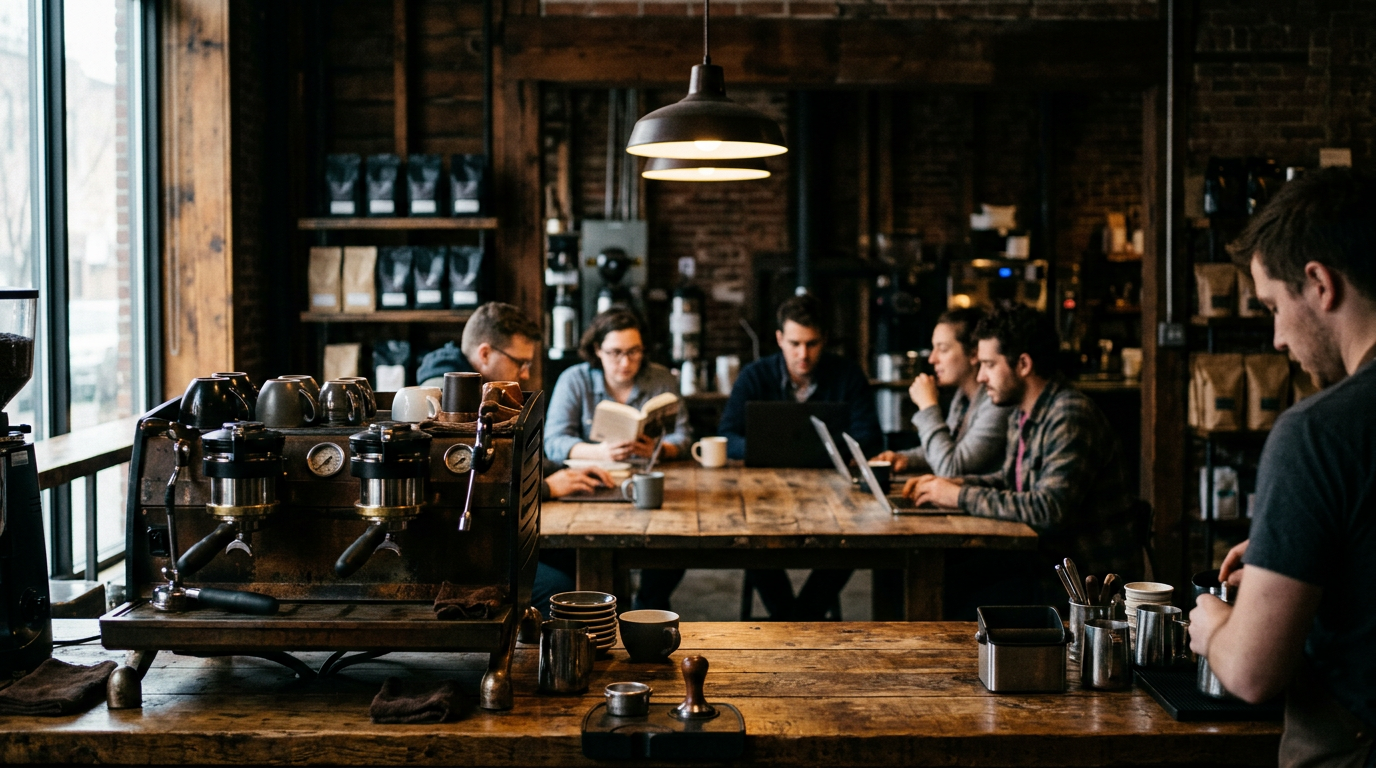
Order like someone who respects the room. You do not need to become a coffee obsessive, but your order signals pace.
Good networking orders:
- Espresso or macchiato if you are doing a short standing conversation
- Drip coffee if you are settling in for email and light visibility
- Single-origin pour-over when the café is built for it and you are not blocking a rush
- Tea or sparkling water for a second meeting when you have already had too much caffeine
- A pastry or sandwich if you are taking a table for more than 45 minutes
What to look for matters more than the drink:
- A communal table where people can naturally overhear context without feeling trapped
- Counter seating near the bar but not in the pickup lane
- Outlets that are available but not the entire point of the room
- A mix of solo laptop workers and two-person meetings
- Staff who seem relaxed, not visibly managing table turnover every five minutes
- Enough ambient noise for a conversation, not so much that you are shouting
The strongest networking cafés are not always the quietest. A dead-silent room makes every opener feel intrusive. A chaotic room makes follow-through impossible. You want the middle: busy enough that talking is normal, calm enough that listening still works.
Avoid treating the café like a free WeWork. If you need three calls, a monitor, and a charger nest, buy a day pass at a coworking space. Industrious, Spaces, and WeWork still make sense when you need infrastructure. Coffee shops are for ambient awareness and low-friction contact.
Best time of day to go
Brooklyn coffee networking has a clock. Ignore it and you will read the room wrong.
7:30 to 9:00 a.m. is neighborhood mode. Parents, regulars, people grabbing coffee before the G train, operators who want one clean hour before Slack gets loud. Good for becoming a familiar face. Bad for interrupting.
9:30 to 11:30 a.m. is the strongest window for informal work contact. The first rush has cleared, laptops are open, and people are still mentally fresh. If you are trying to meet founders, freelance clients, collaborators, or other builders, this is the window.
12:00 to 2:00 p.m. is risky. Tables turn, food orders matter, and staff patience drops if you are nursing one cold brew through lunch. Use this window for a scheduled coffee, not speculative networking.
2:30 to 4:30 p.m. is underrated. The café softens. People are between calls. Creative workers come up for air. This is a good time for casual intros, especially in Greenpoint, Fort Greene, and Bushwick.
After 5:00 p.m., many coffee shops stop being networking rooms unless they shift into wine, events, or community programming. Brooklyn’s natural handoff is from third-wave coffee to natural wine bar, brewery, izakaya, supper club, or small founder dinner. The smartest move is often to meet at coffee, then send the better invite for later.
Etiquette and unwritten rules
!Two people talking over coffee beside a Brooklyn café window

Brooklyn is allergic to obvious networking. Not ambition. Obviousness.
The first rule: do not pitch across a laptop. If someone has headphones on, a video call face, or a spreadsheet panic stare, leave them alone. If they are reading the room, chatting with staff, or making eye contact after a shared moment at the counter, you have a small opening.
The second rule: buy enough. One drink per hour is the floor if you are staying. Add food if you are taking a real table. Tip. Clear your cup. Do not make the staff become your office manager.
The third rule: keep calls short or take them outside. Nobody wants your seed round update, client drama, or therapy-adjacent founder monologue as background audio.
The fourth rule: respect neighborhood regulars. In Brooklyn, regulars are infrastructure. Baristas, writers, designers, parents, agency owners, DJs, editors, and founders all overlap. The person you ignore because they are not wearing a VC costume may be the one who knows every room worth entering.
The fifth rule: do not pretend you discovered the place. If you are new to the area, say that. Brooklyn people are much warmer to honest newcomers than to people who arrive with main-character energy.
A useful mental model is Mark Granovetter’s idea of weak ties: many career-shaping opportunities come from acquaintances, not close friends. Coffee shops are weak-tie engines. But only if you let familiarity build over multiple visits.
How to actually meet people there
The goal is not to “network the room.” The goal is one clean connection with a reason to continue.
Start with context, not identity. Better openers:
- “Are you here most mornings, or is this just your between-meetings spot?”
- “I’m trying to find a reliable place for two-person work coffees around here. Is this your pick?”
- “That notebook setup is serious. Are you writing, designing, or running ops?”
- “I heard you mention Shopify. Are you on the brand side or agency side?”
- “I’m new to using Brooklyn cafés for work meetings. Any rooms you think are actually good for conversation?”
Notice what these do. They are situational. They give the other person an easy exit. They do not require them to care about your company immediately.
If the person responds with short answers, stop. Smile, return to your work, and preserve the room. If they open up, keep it under three minutes unless they clearly extend it.
A good micro-intro structure:
- One sentence on what you do
- One sentence on why you are in that neighborhood
- One question about their world
Example: “I work with early-stage consumer brands on retention and lifecycle email. I’m in Williamsburg twice a week because half my clients keep moving their meetings here. Are you building something in CPG or just surviving the inbox?”
That is specific, human, and not a pitch deck in disguise.
If there is a nearby event layer, use it. Mention founder dinners, Meetup groups, AngelList-adjacent gatherings, Lunchclub intros, On Deck alumni circles, South Park Commons events when relevant, or a panel happening later in Manhattan. Brooklyn coffee often functions as the pre-room before the room.
The follow-up move that does not feel thirsty
The best follow-up happens fast and lightly. Do not send a 400-word note. Do not ask for a meeting unless there is an actual reason.
Good same-day follow-ups:
- “Good meeting you at Devoción earlier. Sending the retention consultant I mentioned: [name/link]. No need to reply unless useful.”
- “Nice talking in Greenpoint. If you end up doing that founder dinner, I know two operators who would fit the room.”
- “Appreciated the Bushwick coffee rec. Here’s the photographer I mentioned. Strong product work.”
- “Good luck with the launch. If you want a second set of eyes on the landing page headline, happy to send a quick note.”
Use LinkedIn if the relationship is professional. Use email if they gave it. Instagram can work for creators, restaurants, fashion, photography, and events, but do not slide into DMs with corporate energy.
The move that wins in Brooklyn is a useful referral with no immediate ask. Send the link. Make the intro. Share the room. Then let the person breathe.
Mistakes to avoid
The biggest mistake is confusing a good café with a good networking room. Some excellent coffee shops are terrible for meeting people because the layout is tight, the staff needs fast turnover, or the culture is headphones-only. Respect that.
Other mistakes:
- Asking “So what do you do?” as the first line while someone is clearly working
- Taking a four-top alone during the morning rush
- Opening with your startup, deck, podcast, fundraise, or personal brand
- Treating baristas like lead generators
- Posting someone’s laptop, face, or conversation on social without permission
- Using the same canned opener on three people within earshot
- Sitting in one place for five hours on one iced coffee
- Assuming Williamsburg is the only useful neighborhood
- Turning every coffee into a calendar invite
Also avoid over-optimizing. If you walk into every café hunting for contacts, people can feel it. Bring real work. Have a reason to be there besides extraction.
A practical Brooklyn coffee networking circuit
If you are new to this rhythm, build a weekly circuit instead of chasing every new café mention on social.
Try this pattern for four weeks:
- Tuesday morning in Williamsburg for founder and operator density
- Wednesday afternoon in Greenpoint for calmer creative and freelance overlap
- Thursday morning in Bushwick for design, coffee, product, and independent builder energy
- One scheduled Friday coffee in Fort Greene, DUMBO, or Cobble Hill with someone you already met
Do not bounce rooms daily. Repetition is the advantage. Staff recognize you. Regulars recognize you. The person you spoke with once sees you again and the second conversation is easier.
Pair cafés with actual community nodes. A morning coffee near Williamsburg can lead into a Soho House or NeueHouse meeting later if you are in that world. A Bushwick coffee can lead to a small gallery opening, studio visit, or natural wine bar catchup. A DUMBO coffee can lead to an agency intro or coworking day pass. The café is the soft entry point, not the entire strategy.
Brooklyn rewards people who are useful without being loud. Pick rooms with repeat faces. Show up at the same time. Buy properly. Ask better questions. Follow up with something concrete. That is how coffee turns into work contacts here: slowly, then all at once.
Discussion (0)
Loading comments…