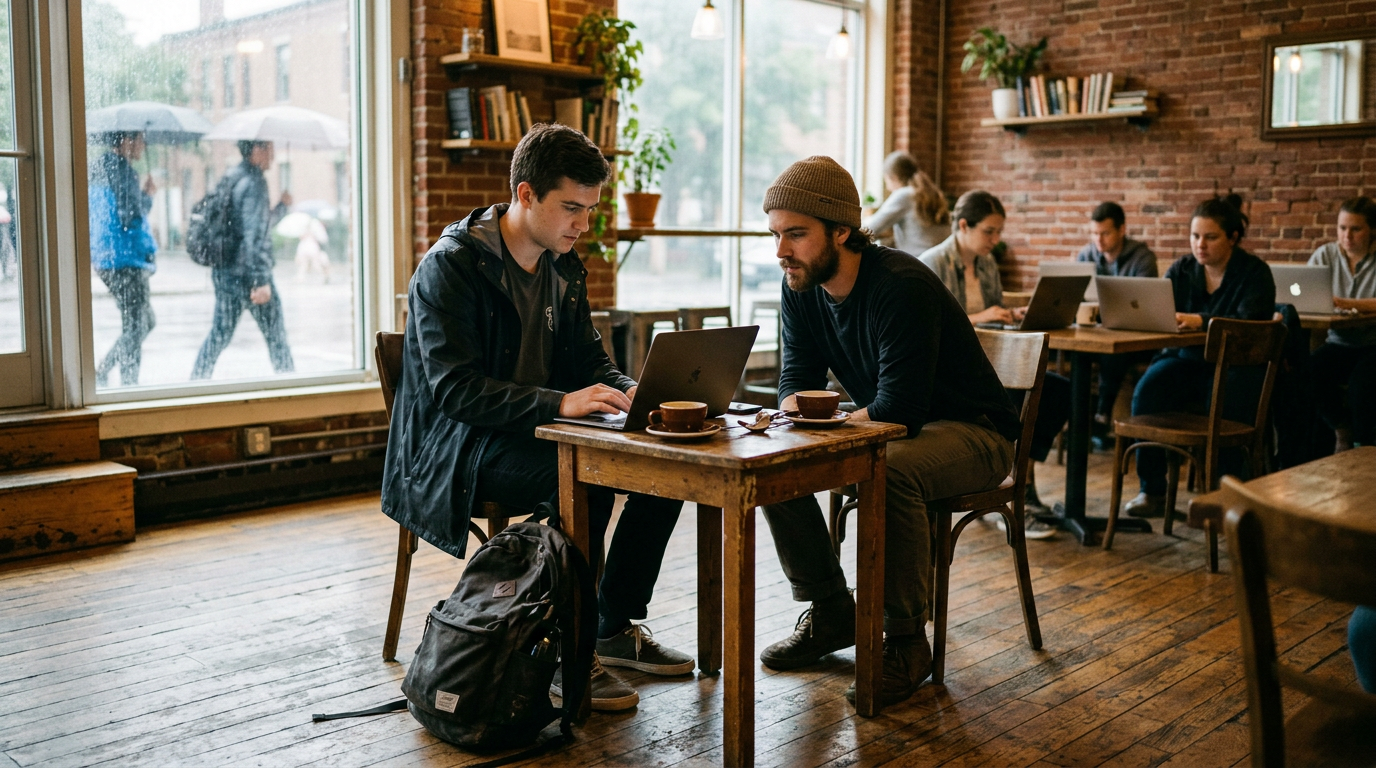
Where Cambridge founders actually take coffee meetings
At 8:37 on a Tuesday in Kendall Square, the room is already split into zones: two MIT grad students arguing through a model, a biotech founder doing a quiet investor pre-brief, one laptop with an AngelList tab open, and three people who clearly came from different labs trying to find a table that is not under a speaker.
That is the Cambridge coffee scene near MIT and Harvard. It is not LA lounge networking. It is not Miami member’s club theater. It is not Brooklyn creative sprawl. It is compressed, practical, credential-aware, and slightly allergic to people who talk louder than they build.
For founders, freelancers, technical operators, and investors working the Boston coffee shops near MIT and Harvard, the job is not just finding good espresso. The job is finding the right room for the meeting you are actually having: fast intro, sensitive advisor conversation, recruiting coffee, cofounder therapy, customer discovery, or the awkward first chat after a warm intro.
The good news: Cambridge still has real third places. The bad news: the unwritten rules matter.
The Cambridge founder coffee map is really four micro-scenes
Boston outsiders say Boston. Locals doing startup work usually mean Cambridge, Somerville, and the Kendall-to-Harvard corridor. The Red Line is the spine, even when it misbehaves.
Kendall Square and MIT
Kendall is the highest-density founder coffee zone because it sits between MIT, labs, CIC, The Engine, pharma offices, AI teams, and venture traffic. This is where you go for a 25-minute meeting that needs to feel serious but not formal.
Reliable venue types here:
- A polished bakery-cafe with fast turnover and enough seating for two-person meetings, like Tatte in Kendall.
- A practical lunch-and-coffee room near offices, like Flour Bakery + Cafe.
- A cafe attached to a real neighborhood restaurant rhythm, like Area Four, where breakfast coffee can slide into lunch if the conversation earns it.
Use Kendall for investor intros, technical recruiting, biotech partnerships, and pre-event coffees before something at MIT, CIC, or a nearby office. Do not use it for long, emotional cofounder conversations. Too many people you know will walk past.
Central Square
Central is messier in a useful way. It catches MIT people moving west, Harvard people moving east, independent builders, musicians, grad students, and operators who do not want the glass-box Kendall feel.
1369 Coffee House in Central Square has long been part of the Cambridge workday circuit. Cicada Coffee Bar adds a more food-forward, slower, neighborhood layer. Central is better for conversations that need a little oxygen: early customer discovery, founder-to-founder reality checks, writing mornings, and warm intros that are not yet investor-shaped.
Harvard Square
Harvard Square is more status-coded, more academic, and more likely to include advisors, visiting speakers, fellows, and people who still carry institutional gravity. George Howell Coffee at The Charles Hotel works well when you want excellent coffee and a calmer, polished setting. Broadsheet Coffee Roasters, near Harvard, is the move for people who care about coffee quality without needing a hotel-lobby mood.
Tatte and Pavement Coffeehouse also serve the Harvard-side meeting circuit, especially for casual founder chats and student-heavy days. Expect tighter seating and more churn during the academic calendar.
Inman and East Cambridge
Inman and East Cambridge are where you go when you do not want to perform. Curio Coffee in East Cambridge is known for coffee and waffles, and 1369 in Inman still has that neighborhood regular energy. These are better for one-on-ones with people you already know, early team conversations, or a Saturday morning reset with a founder friend.
What to order / what to look for
!Two coffees and a notebook on a small Cambridge cafe table
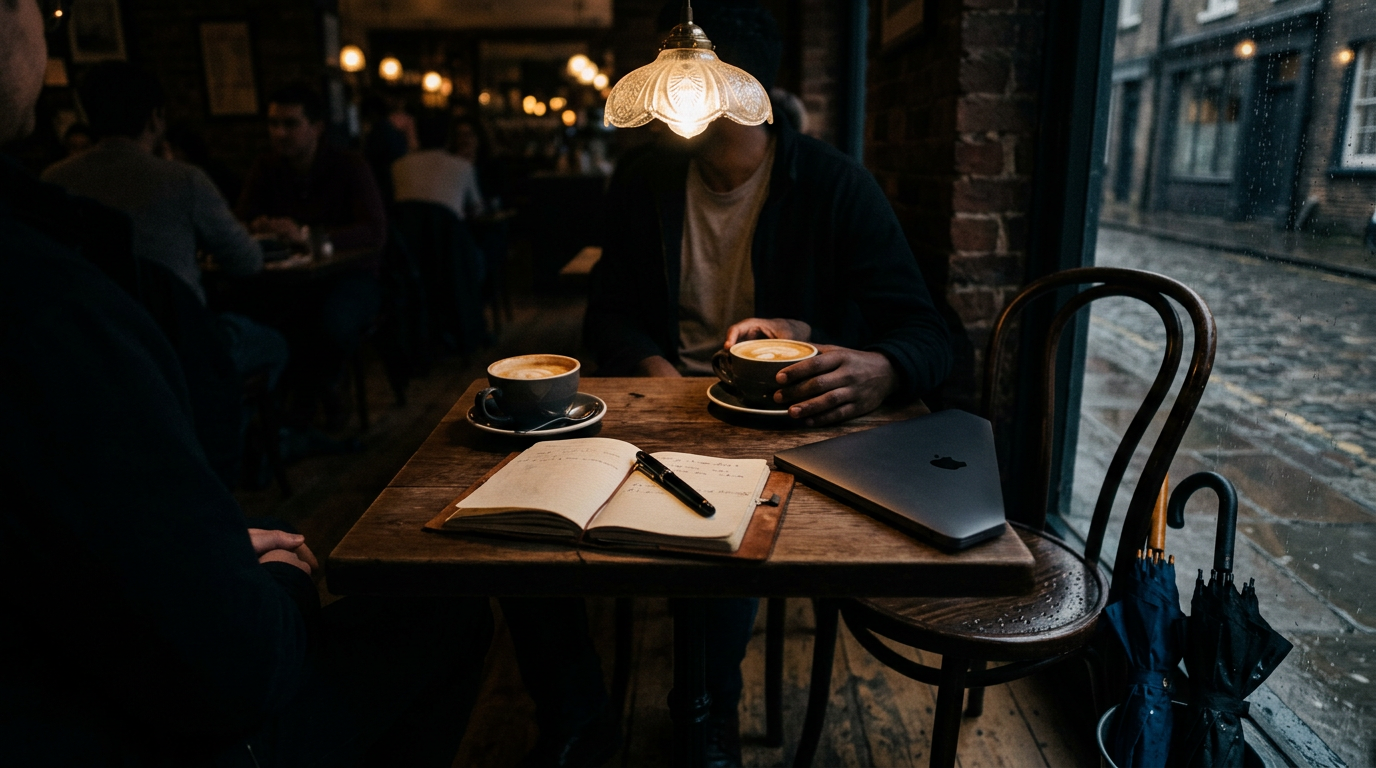
Order for the meeting, not your Instagram habits.
For a 20-minute intro, get drip coffee, cold brew, espresso, or a simple latte. You want speed, a hand free for notes, and no ceremony. If the cafe has a single-origin pour-over and the bar is quiet, fine. If there is a line behind you, do not make your meeting start with a brewing seminar.
For a longer conversation, buy food. At places like Tatte or Flour, ordering a pastry or lunch is not just appetite; it is rent. Cambridge cafes tolerate work, but they are not free hot desks.
What to look for before you commit:
- Two-tops that are close enough for conversation but not shoulder-to-shoulder with strangers.
- Outlets only if you truly need them. Outlet hunting can make you look like you plan to camp.
- Moderate noise. Too quiet makes sensitive conversations awkward; too loud kills nuance.
- Staff tempo. If the room is clearly in a rush, keep the meeting short.
- Table geometry. A tiny round table is fine for intros. A rectangular table is better for laptops, product demos, or note-taking.
For founder meetings near MIT and Harvard, coffee quality matters, but room quality matters more. The best cup in the wrong room is a bad business decision.
Best time of day to go
The Cambridge founder week has a pattern in 2026. Tuesday through Thursday carry the most in-person density. Monday is uneven. Friday is softer, with more remote work, fewer serendipitous meetings, and a higher chance that the person you want is already in Maine, Vermont, or on a Cape-adjacent weekend plan.
Best windows:
- 8:00 to 9:15 a.m. for focused operator coffees before calendars get wrecked.
- 10:00 to 11:15 a.m. for investor, advisor, and recruiting chats after the first rush clears.
- 1:30 to 3:30 p.m. for longer, lower-pressure conversations.
- 4:00 to 5:30 p.m. for pre-event coffees before founder dinners, Meetup events, university talks, or small AngelList-adjacent gatherings.
Avoid 12:00 to 1:15 p.m. unless the venue is explicitly lunch-friendly and you are both eating. Avoid 9:30 a.m. at popular Kendall spots if you need a guaranteed seat. Avoid Harvard Square immediately after a major campus event unless you like standing with a laptop bag and pretending that is fine.
Season matters. September and October are crowded with new students, fellows, visiting founders, and Boston networking events restarting after summer. Late January through April is strong for technical hiring and venture conversations. July is quieter, but the people still taking meetings are often serious.
Etiquette and unwritten rules
!People gathering outside a Cambridge coffee shop after work

Cambridge is polite until it is not. People may not call you out in the moment, but they remember bad room behavior.
The basics:
- Buy something when you arrive. If you stay past 90 minutes, buy again.
- Do not take a four-top with one laptop during peak hours.
- Keep calls off speaker. Headphones do not make a sales call cafe-appropriate.
- Do not run a team standup from a coffee shop.
- Do not ask strangers what school they went to as your first question.
- Do not open with fundraising unless the meeting is explicitly about fundraising.
- Tip like you expect the place to exist next year.
There is also a local founder rule: be specific quickly. Boston tolerates ambition; it has less patience for vague ambition. If someone asks what you are working on, answer in one clean sentence, then add the current problem.
Bad: I am building an AI platform for the future of work.
Better: I am building scheduling software for hospital float pools, and right now I am trying to get three more nurse managers to tear apart the workflow.
That second answer gives the other person a way to help.
How to actually meet people there
Do not wander into Broadsheet or 1369 expecting the room to magically network you. Cambridge coffee shops are not conferences. They are better used as soft infrastructure around real nodes: MIT events, Harvard i-lab programming, founder dinners, On Deck alumni meetups, South Park Commons visitors, Lunchclub matches, Meetup groups, angel coffees, and the Slack communities that never fully disappeared after the pandemic.
Use cafes as the before-and-after layer.
Good tactics:
- Book coffee 30 minutes before a nearby talk, demo night, or seminar, then walk over together.
- After an event, skip the loud group drift and invite one person to a nearby cafe the next morning.
- Ask a mutual connection for a tight intro with a clear reason, then choose a cafe near the other person’s campus or office.
- Use recurring presence. Same cafe, same two mornings a week, same general table area. Familiarity lowers the social temperature.
One useful concept here is weak ties, from Mark Granovetter’s work. Your next customer, hire, advisor, or investor is often not your closest friend. It is the person one ring out who knows a different room. Cambridge is unusually good at those one-ring-out connections because academia, venture, labs, hospitals, and startups overlap in a small geography.
Conversation openers that work without sounding needy:
- I am trying to understand how founders here are finding technical design partners. Have you seen anything working?
- Are you coming from MIT, Harvard, or one of the Kendall offices?
- I am sanity-checking a customer segment, not pitching. Could I ask one specific question?
- What events around Cambridge have actually been worth showing up for lately?
- Is this a heads-down morning, or do you have two minutes for a local recommendation?
The follow-up matters more than the chat. Send it the same day. Keep it short.
A strong follow-up has four parts:
- One line reminding them where you met.
- One line naming the useful point they made.
- One specific next step, not three.
- One offer back: an intro, a note, a resource, or a useful event invite.
If they do not respond, wait a week. Then send one clean bump. No guilt. No essay.
Picking the right room for the meeting
For MIT-heavy technical meetings, choose Kendall or Central. The walk matters. If someone is coming from a lab, a class, or an office near Main Street, do not drag them to Harvard Square because you like the look of it.
For Harvard advisor meetings, Harvard Square or the Charles Hotel area is usually easier. George Howell is a strong choice when the conversation benefits from a grown-up room and good coffee. Broadsheet works when the person appreciates a serious coffee bar and does not need the square’s most obvious meeting spot.
For sensitive cofounder discussions, go slightly off-axis: Inman, East Cambridge, or a quieter Central Square window. You want enough public accountability to stay civil and enough privacy to be honest.
For first-time investor coffees, pick the place that minimizes friction for the investor without making yourself look unserious. Kendall is usually the safe default for deep tech, climate, biotech, robotics, AI infrastructure, and university spinout conversations.
For working sessions longer than two hours, use a coworking day pass, a university room if you have access, or a proper office. WeWork, Industrious, Spaces, and local coworking operators exist for a reason. A cafe is not your dedicated desk.
Mistakes to avoid
The fastest way to look new in Cambridge is to treat every cafe like a stage.
Avoid these:
- Choosing a place only because it is famous. The wrong acoustics can ruin a warm intro.
- Asking for a coffee meeting with no agenda. Busy people here will still say yes, then give you 18 minutes and nothing else.
- Camping through the lunch rush with an empty cup.
- Taking confidential calls about hiring, fundraising, or cap table drama in a room full of founders.
- Assuming Harvard Square and MIT are basically next door. On a bad transit day, they are not.
- Confusing student energy with buyer intent. A room full of smart people is not a market.
- Pitching the barista, the table next to you, and the person waiting for oat milk. Restraint reads as confidence.
Also avoid over-optimizing for serendipity. The better move is planned proximity: be near the right institutions, at the right time, with one clear ask.
The local read
Boston coffee shops near MIT and Harvard are not magic rooms. They are filters. Kendall filters for urgency and technical seriousness. Central filters for range. Harvard filters for academic and advisory gravity. Inman and East Cambridge filter for people who value lower-pressure conversations.
Use them that way.
Pick the room based on the meeting. Order like a regular, not a camper. Speak specifically. Leave before the table turns against you. Follow up the same day.
That is the Cambridge coffee circuit when it is working: not networking theater, not laptop camping, not founder cosplay. Just the right two people at a small table, with enough caffeine, enough context, and a next step that survives the walk back to campus.
Discussion (0)
Loading comments…