
Where Miami investors still take dinner meetings
The money in Miami does not announce itself at 6 p.m. with a name badge. It shows up at 8:45, orders for the table, checks a phone under the bar, and somehow knows three people walking through the door.
That is the Miami restaurant scene in 2026 for founders, operators, real estate people, family-office staff, crypto holdouts, fintech builders, hospitality groups, and visiting New York investors pretending they are only here for two days. The room matters. The table matters less than you think. Your behavior matters most.
Miami is not San Francisco, where an engineer will talk product at a coffee shop for 90 minutes. It is not New York, where the calendar invite does half the work. Miami is social proof in motion. Restaurants are where people test taste, patience, confidence, and whether you understand the local rhythm.
This is not a list of places to camp out and pitch strangers. That is how you get ignored. This is a working map of the types of rooms where investor conversations actually happen, plus the moves that help you leave with a real follow-up instead of a vague Instagram connection.
The Miami investor dinner map in 2026
Miami has several investor rooms, and they do not all reward the same behavior.
Brickell and Downtown are transactional, international, and finance-heavy. You will see private equity visitors, Latin American family-office operators, fintech people, wealth managers, attorneys, and founders taking meetings before a fund dinner. Restaurants near Brickell City Centre, downtown waterfront spots, and established power-dining rooms work for this crowd. Think polished service, strong wine lists, and tables that can handle a serious conversation without becoming silent.
Miami Design District is where taste becomes a credential. Investors here often sit at the overlap of consumer brands, real estate, luxury, fashion, hospitality, and creative tech. COTE Miami, Michael’s Genuine, and the restaurants around the district work because people can float between dinner, a store event, and a private gathering without changing the energy of the night.
Miami Beach is louder and more status-conscious. Carbone Miami, Casa Tua, The Surf Club Restaurant, Joe’s Stone Crab, Prime 112, and Soho Beach House all carry different versions of social capital. You are not going there for easy access. You are going because the room compresses people who already know each other, and an introduction can move quickly if you have a reason to be there.
Wynwood and Edgewater are better for earlier-stage founders, operators, creators, and visiting tech people who do not want a white-tablecloth night. Pastis Miami in Wynwood is a useful modern example: familiar to New Yorkers, visible enough for out-of-towners, casual enough that a founder can talk without performing too hard. Natural wine bars, chef-driven counters, and smaller group dinners around these neighborhoods often beat the obvious flex restaurants.
Coconut Grove and Coral Gables are underrated for serious capital. The rooms skew more established, more local, and less impressed by noise. Ariete in Coconut Grove is the kind of place where a calm, thoughtful dinner can do more than three splashy nights on South Beach.
What to order / what to look for
!Small business dinner in a Miami Design District restaurant
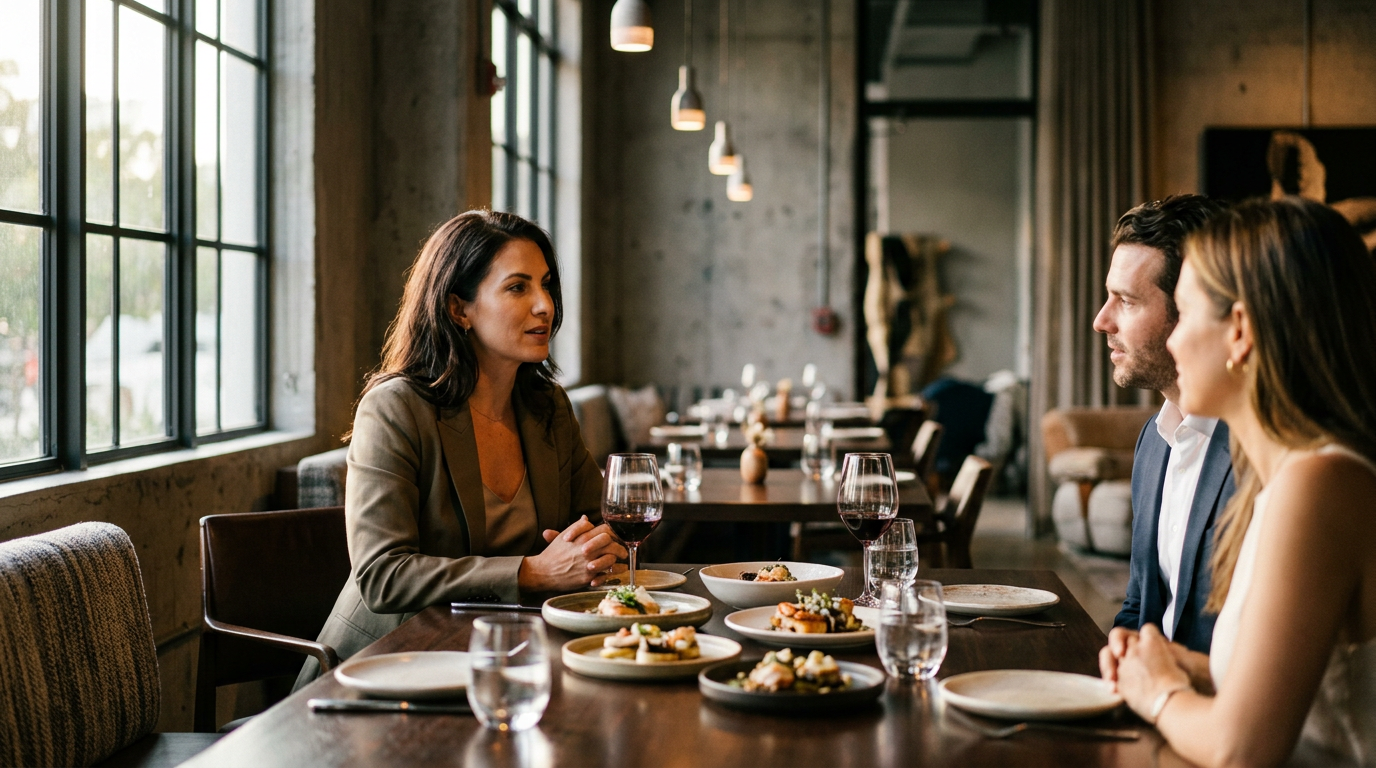
You are not ordering to impress. You are ordering to keep the table moving.
Look for restaurants with:
- A bar where people actually stand before sitting
- Tables spaced well enough for private conversation
- A menu that supports sharing without turning the meal into logistics
- A wine program that lets someone else take the lead gracefully
- A check-in area where people naturally pause and say hello
- A second nearby stop, such as a hotel bar, member’s club, or quieter lounge
At a steakhouse or high-energy Miami Beach room, do not turn the ordering process into a personality test. Let the host steer. If you are hosting, order two or three anchor dishes, one clean vegetable, and enough for the table without making everyone negotiate. If the restaurant is seafood-heavy, share strategically. At Joe’s Stone Crab, the point is not to give a speech over the menu; the point is to let the institution do its work.
At COTE Miami or another polished Korean steakhouse-style room, the format helps because food arrives in waves. That gives you natural breaks for business, personal background, and introductions. At Michael’s Genuine, the move is often a real dinner, not a spectacle. At Pastis Miami, keep it simple and conversational. At Casa Tua or The Surf Club Restaurant, restraint reads better than volume.
Drinks matter, but not the way newcomers think. Miami has a high tolerance for celebration and a low tolerance for sloppy. If you are the founder raising capital, two drinks is usually the ceiling unless the night clearly becomes social and you already know the room.
Best time of day to go
Investor access in Miami runs later than in most American cities, but not randomly.
Breakfast and coffee meetings work best in Brickell, Coconut Grove, and hotel-adjacent settings. These are for people already in your network or one degree away. You are unlikely to meet a new investor at breakfast unless the intro has already happened.
Lunch is excellent for local operators, real estate people, attorneys, and family-office connectors. Miami lunch can be more useful than people admit because the room is less theatrical. Michael’s Genuine, Coconut Grove dining rooms, and Brickell restaurants with steady business traffic can work well here.
The 6:30 to 7:30 p.m. slot is for scheduled dinners with people who need to get home, catch another event, or avoid the late-night scene. This is often the best slot for serious fundraising conversations.
The 8:30 to 10 p.m. window is where Miami’s social investor network becomes visible. This is when you see who knows whom. If you are trying to meet new people, sit at the bar first, arrive slightly early, and do not bury yourself in your phone.
Late night is not for pitching. It is for bonding, reading the room, and earning a softer invitation. If a dinner moves to a hotel bar or private room, your job is to be normal. The business follow-up happens tomorrow.
Etiquette and unwritten rules
!Dinner meeting arrivals outside a Brickell restaurant at dusk
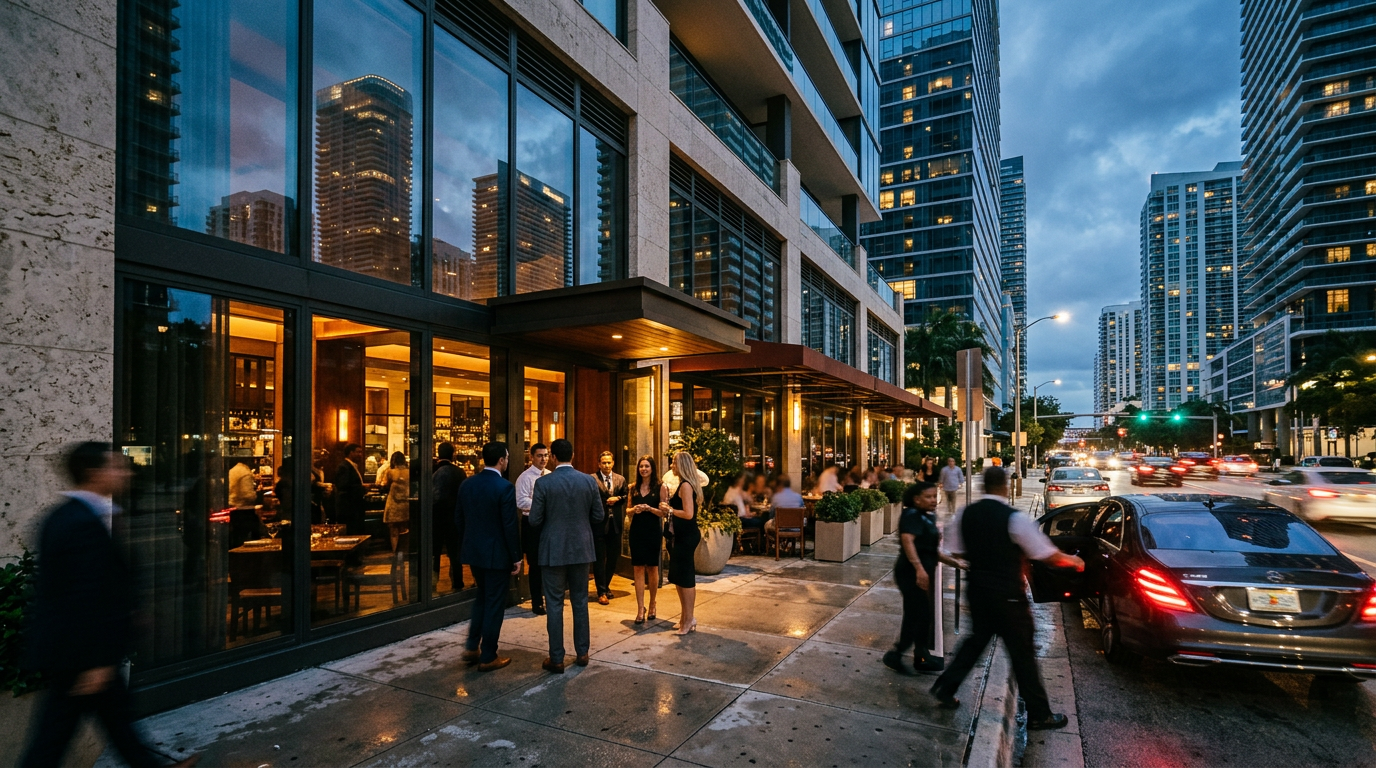
Miami rewards confidence but punishes neediness. The line is thin.
Do not open with your raise. Do not ask someone what fund they are with before you have established why the conversation exists. Do not linger near a table hoping to be noticed. The city runs on introductions, and cold approaches inside restaurants are risky unless the setting is clearly social and casual.
The better move is to become easy to introduce.
Have a clean one-sentence answer ready:
- We help independent hotels cut chargebacks and payment disputes.
- I run a profitable creator-commerce software company moving into hospitality.
- We buy and modernize small logistics businesses in Florida and Texas.
- I’m building a healthcare payments company and spending the month meeting Miami operators.
Notice what those lines do. They give someone a handle. They do not beg for attention.
Dress with the room. Brickell wants polished but not costume-finance. Miami Beach tolerates more style but can smell rented confidence. Design District rewards taste. Coconut Grove and Coral Gables prefer ease. If you look like you are auditioning for a nightlife table, many serious investors will put you in that box.
Respect the gatekeepers. Hosts, bartenders, sommeliers, and regulars know the real map. Being kind and consistent gets remembered. Acting important gets you managed.
One more Miami rule: do not confuse proximity with access. Sitting near investors is not the same as having permission to pitch them.
How to actually meet people there
The strongest Miami restaurant networking move happens before dinner. You use the restaurant as the setting, not the strategy.
Start with a small table of four to six. Invite one person you know well, one person you want to know better, and ask each of them to bring one operator or investor who would enjoy the group. Keep the theme narrow enough to be useful.
Good dinner frames in Miami:
- Founders selling into hospitality groups
- Latin America fintech operators in Miami for the week
- Real estate tech and property management operators
- Consumer brand founders with Florida distribution
- Healthcare founders who work with clinics and payers
- Search fund and small-business acquisition people
This works because restaurants act as Schelling points: obvious meeting places where people already expect to gather. In Miami, the right dinner table can do more than a formal networking event because the social proof is built into the room.
At the restaurant, do not dominate. Your goal is to create cross-conversation.
Use openers that are specific but low-pressure:
- What brought you into Miami this week, work or life?
- Are you based here now, or still doing the New York-Miami shuffle?
- What kinds of companies are actually getting funded in your circle right now?
- Which Miami rooms are still worth the time, and which ones are mostly theater?
- Who is the most useful operator you have met here recently?
If someone mentions a thesis, do not immediately pitch. Ask one clarifying question first. Then offer context.
A strong transition sounds like:
- That is close to what we are seeing with independent hotel groups. Not exactly the same, but adjacent.
- We are a little earlier than what you usually back, but I would value your read on the market.
- I do not think we are a fit for you yet, but there may be two people in my circle you should know.
That last line works because it shows you are not extracting. Miami remembers connectors.
The follow-up should land by late morning the next day. Not midnight. Not three days later.
Send:
- A short note referencing the specific conversation
- One useful link, deck, or intro offer
- A clear next step with two time windows
- No giant attachment unless requested
Example:
Good meeting you at dinner last night. Your point about hotel groups buying tools only when ops owns the budget was useful. We are seeing the same pattern with 40 to 120 room independents. If useful, I can send the two-page memo and grab 20 minutes next week. Tuesday 11:30 or Wednesday 2:00 both work.
That is enough.
Restaurant types that work better than obvious flex spots
The loudest restaurants are not always the highest-yield rooms. In 2026, the Miami investor circuit has become more selective. People are tired of performative relocation energy. They still go out, but they increasingly choose rooms that protect the conversation.
The most useful categories:
Hotel restaurants with real locals. Miami hotels are not just for tourists. The right hotel dining room pulls visiting investors, conference speakers, local attorneys, wealth managers, and founders in one place. Avoid lobby chaos when you need substance. Use the bar before dinner for soft introductions.
Design District power dining. Strong for consumer, luxury, creative, and real estate crossover. If your company touches brand, commerce, hospitality, or culture, this district gives you better context than a generic steakhouse.
Established Miami institutions. Joe’s Stone Crab, Prime 112, Casa Tua, and The Surf Club Restaurant carry history. You do not go there to discover people. You go when someone has invited you into a room where trust already exists.
Operator-friendly neighborhood restaurants. Coconut Grove, Coral Gables, and parts of Wynwood are better for founders who need thoughtful conversation instead of spectacle. Ariete and Michael’s Genuine fit this lane better than most newcomers expect.
Natural wine bars and chef counters. These rooms help when you are meeting emerging managers, creative capital, consumer founders, and operators who dislike formal investor dinners. The key is choosing a place where conversation is possible, not a room built for bottle service energy.
Mistakes to avoid
The fastest way to waste Miami dinner access is treating the restaurant like a conference floor.
Avoid these moves:
- Pitching within the first three minutes
- Asking for a check size before asking about a thesis
- Bringing a 15-slide deck to dinner uninvited
- Name-dropping New York or Silicon Valley as your main credential
- Assuming every wealthy-looking person invests in startups
- Splitting the check awkwardly when you clearly invited the person
- Overstaying after the host signals the night is moving on
- Posting the table on social without permission
- Talking badly about Miami while trying to raise money in Miami
The last one is more common than it should be. If you think Miami is only tax, weather, and hype, people will hear it. The serious local scene includes healthcare, logistics, hospitality, real estate, fintech, Latin America commerce, aviation, marine businesses, and family capital with long memories. Treat it like a real market.
Another mistake: chasing only brand-name rooms. Yes, Carbone Miami and Soho Beach House can matter if you are already inside that circle. But an investor who will not take you seriously at a quiet four-person dinner will not magically become useful because the reservation was harder to get.
The practical playbook for one week in Miami
If you are in Miami for a focused fundraising or relationship-building week, build around meals rather than random events.
Monday: coffee or lunch in Brickell with a connector who understands the finance map. Ask who is actually writing checks, who is just attending dinners, and which rooms fit your category.
Tuesday: host a four-person dinner in Design District or Coconut Grove. Keep the theme narrow. No speeches. Make two thoughtful introductions before asking for anything.
Wednesday: attend a real community event through Meetup, an AngelList-adjacent founder circle, a coworking space event at Industrious, Spaces, or WeWork, or a curated founder dinner if you have access. Use the event to identify one or two dinner-worthy people, not to collect twenty weak contacts.
Thursday: schedule the serious investor dinner. Choose a room with controlled noise and professional service. Arrive early. Sit at the bar for ten minutes if appropriate. Let the conversation breathe.
Friday: lunch follow-ups. Miami Fridays can either disappear into weekend mode or become surprisingly productive before 2 p.m. Keep it tight.
The goal is not to meet every investor in Miami. The goal is to become credible to a small chain of people who can keep introducing you. That is how the city works when it works.
Miami restaurants will not raise your round for you. They will reveal whether you know how to move in rooms where money, taste, trust, and timing sit at the same table. Get that right, and dinner becomes more than dinner.
Discussion (0)
Loading comments…