Where SF coffee still turns into term sheets
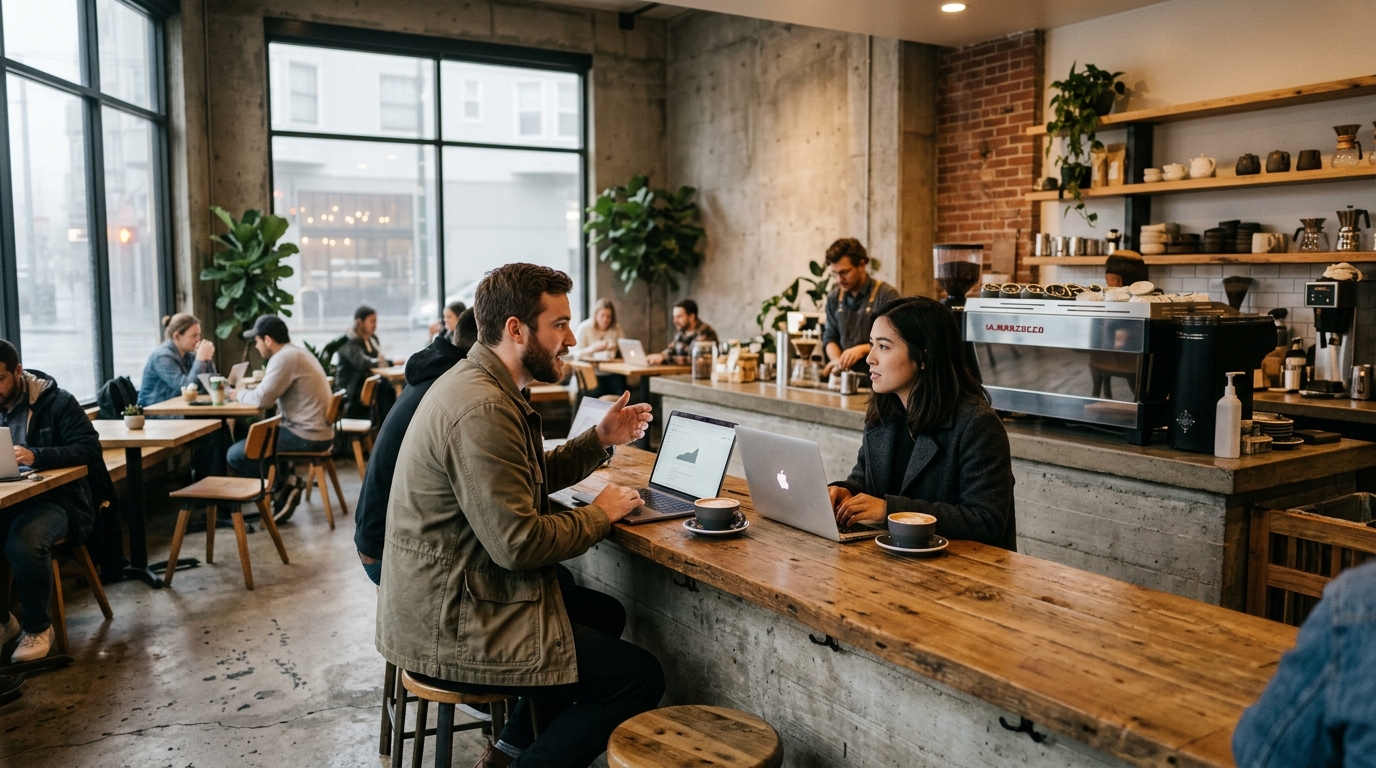
At 9:12 on a Tuesday, the room tells you what kind of San Francisco you are in. One table is marking up a SAFE. Two founders are arguing quietly over churn. Someone in a black vest is doing the VC half-stand, one hand on a cappuccino, already scanning for the next person walking in.
This is not a romance piece about coffee. San Francisco third-wave coffee has matured past the point where a single-origin pour-over is the story. The better question in 2026 is whether the room helps you do the work: meet a lead investor, recruit a founding engineer, pressure-test a customer intro, or turn a loose Twitter DM into an actual relationship.
The answer is yes, but only in the right rooms and only if you behave like a local operator. SF coffee shops can double as deal rooms. They are not free offices, demo-day lobbies, or places to perform founder cosplay.
The SF coffee room is a filter, not a stage
San Francisco has a very specific coffee-meeting culture. New York likes speed and status. LA spreads across neighborhoods and parking realities. Austin still has more social looseness around founder hangs. SF is denser and more coded. The cafe is often a Schelling point: a default place two people choose because everyone in the network already understands what it means.
A coffee meeting near SoMa or South Park says one thing. A Hayes Valley or Mission cafe says another. A quieter Pacific Heights or Russian Hill room often means you are meeting someone senior who does not want to sit inside a WeWork fishbowl. A Dogpatch or Potrero coffee run can mean hardware, climate, design, or someone commuting between a lab and a pitch.
Post-pandemic coworking shifted the pattern. WeWork is no longer the automatic default. Industrious, Spaces, boutique studios, South Park Commons, founder houses, and member's clubs handle structured work. Coffee handles the in-between: pre-meeting calibration, warm intro qualification, small recruiting conversations, and the twenty minutes after a bigger meeting when the real answer comes out.
The coffee shop is not where you close everything. It is where you decide whether a second room is worth booking.
The rooms that work, and what they are good for
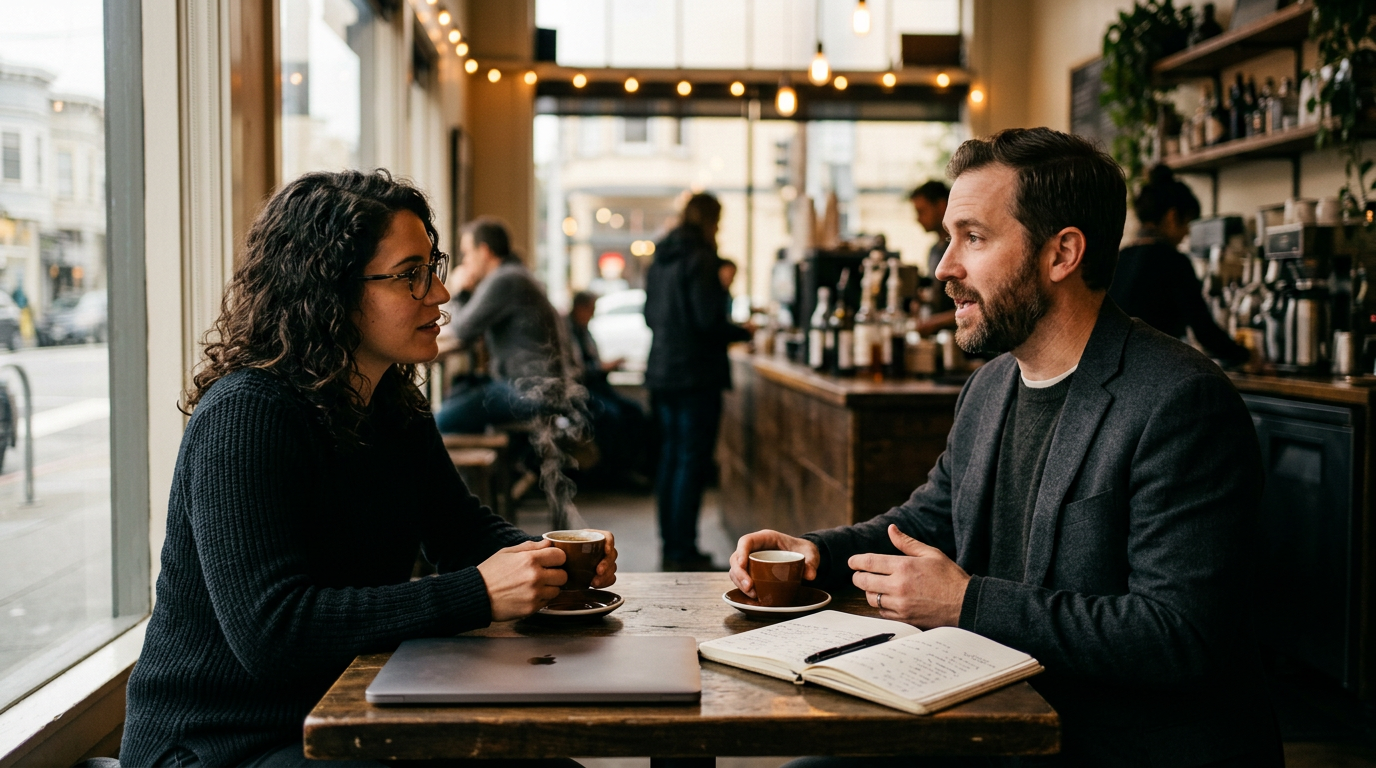
!Two founders meeting quietly over espresso in a San Francisco cafe
Do not pick purely by coffee quality. Pick by the job.
For investor or advisor first meetings, use an established third-wave room with enough table turnover and enough anonymity. Sightglass is still a useful reference point for serious coffee and spacious industrial energy. Blue Bottle locations, especially around downtown patterns, remain easy defaults for people who do not want to negotiate taste. Saint Frank has the polished, adult feel that works when you need calm instead of scene.
For founder-to-founder sorting, the Mission and Hayes Valley style of cafe works better than a hushed room. Ritual has long been part of the city’s specialty coffee muscle memory. The Mill on Divisadero is not a secret and should not be treated like one; it works when you want a real neighborhood room with good coffee and enough movement to keep the meeting from feeling stiff.
For recruiting conversations, choose a place that is not too close to the candidate’s current office, current coworking space, or obvious investor cluster. A quieter third-wave cafe with two-tops, outdoor seating, or a less performative neighborhood rhythm is safer. You are not there to make the candidate feel watched.
For remote operators in town for two days, anchor near transit. Caltrain, BART access, and a short walk to SoMa or FiDi matter more than finding the most photogenic espresso machine. If you need to stack five meetings, beauty loses to reliability.
For real confidentiality, do not use a cafe. Use a private room, dedicated desk, member's club corner, or office. Coffee is for shaping trust, not discussing cap table drama in earshot of three ex-coworkers.
What to order / what to look for
Order like you understand the length of the meeting.
- For a 20-minute intro: espresso, macchiato, drip coffee, or iced coffee. Fast, clean, no ceremony.
- For a 45-minute founder conversation: cappuccino, latte, or tea if you need pace and a natural pause.
- For a proper coffee person: single-origin pour-over only if the bar is not slammed and you are not making your guest wait.
- For back-to-back meetings: drip or tea. Your nervous system does not need three cortados before noon.
Look for the room before you look for the menu.
- Two-tops that are close enough for conversation but not close enough for accidental disclosure.
- A line that moves. Long queues kill punctuality and make you look unserious.
- Natural noise, not blender noise. You want cover, not chaos.
- Clear laptop norms. Some SF cafes tolerate long laptop sessions; others clearly want turnover.
- Outdoor or sidewalk spillover when the topic is sensitive but not private.
- A bathroom situation that does not turn a 30-minute meeting into logistics.
One practical rule: if you would feel awkward opening a laptop for five minutes, it is probably a better relationship room than work room. If everyone has a laptop open, it is probably better for quick working sessions than sensitive chemistry.
Best time of day to go
!Morning sidewalk scene outside a San Francisco specialty coffee shop
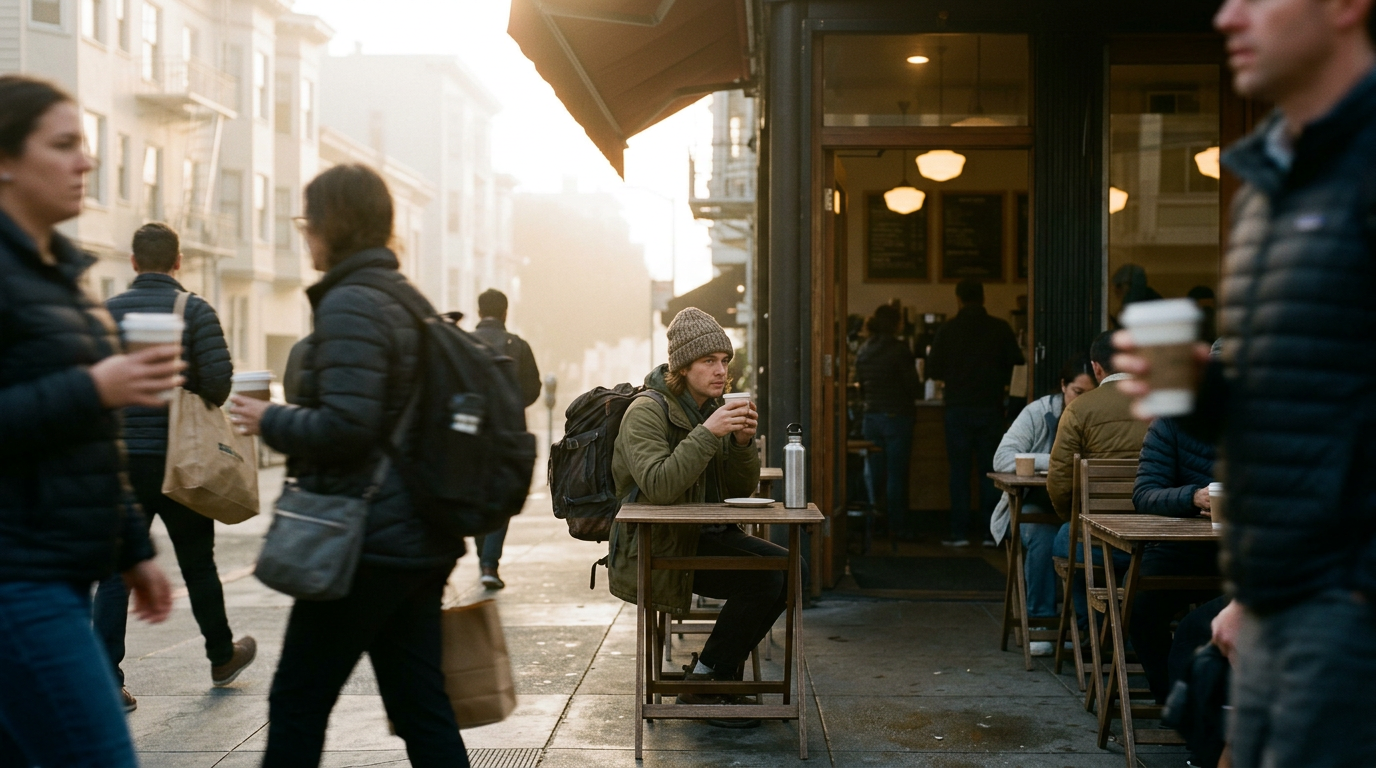
Tuesday through Thursday still carries the most density. Monday mornings are planning-heavy. Fridays are fragmented, especially in summer, and August in SF has its own half-in, half-out rhythm.
The strongest windows:
- 8:30 to 10:15 a.m. for investor check-ins, hiring coffees, and pre-office conversations.
- 1:30 to 3:30 p.m. for founder-to-founder meetings after lunch pressure clears.
- 4:00 p.m. onward only if the cafe comfortably supports lingering and you have a natural next move to a bar, office, or event.
Avoid 10:45 to 12:30 if the cafe doubles as a lunch stop. Avoid the final hour before closing unless you already know the place. Staff should not have to drag your fundraising update out with the chairs.
If you are trying to meet people organically, become regular at one time slot. Same room, same two mornings a week, same general seat. Ambient awareness does a lot of work in San Francisco. People notice repeat presence before they ever say hello.
Etiquette and unwritten rules
SF is casual, but not loose. The room may look relaxed; the norms are not.
Buy something immediately. If you stay past an hour, buy again. Tip. Do not turn a four-top into your personal dedicated desk. Do not take speaker calls. Do not run a pitch rehearsal at full volume. Do not put your backpack on the neighboring chair when the room is full.
Treat confidentiality as your problem, not the room’s. Avoid company names when you can. Say 'the marketplace company' instead of naming the startup if the conversation is sensitive. Keep valuation, runway, layoffs, and acquisition talk for somewhere private.
Do not approach someone who is wearing headphones, typing intensely, or sitting with an open notebook and no drink movement. That is not an invitation. SF has enough forced networking already.
If you recognize a well-known founder or investor, let them be unless there is real context. A cold interruption that starts with admiration usually goes nowhere. A warm, specific reason may work, but only if you can say it in ten seconds and leave cleanly.
Good local energy is calm competence. You do not need to broadcast that you are raising, hiring, advising, or angel investing. The people worth meeting can usually tell.
How to actually meet people there
The easiest path is not walking up to strangers. It is stacking weak ties so the room starts working for you.
Before you go, set one light anchor:
- Message a founder you already know and say you will be at a specific cafe from 9 to 10.
- Post a restrained note on LinkedIn or X: 'Working near Hayes this morning. Open to one founder coffee if there is a useful overlap in AI infra, dev tools, or B2B sales.'
- Use AngelList, Lunchclub, Meetup, or a founder Slack to set a soft coffee window before an evening event.
Once there, be observant without being weird. The best openers are contextual and easy to decline.
- 'I keep seeing operator meetings happen here. Are you based nearby or just between offices?'
- 'That looked like a product review, not casual email. Are you building in SF full time?'
- 'I am heading to a founder dinner later and killing thirty minutes. Are you in the startup world or wisely avoiding it?'
If the person gives short answers, stop. If they ask you a question back, you have a conversation.
Keep your self-intro tight: what you do, who you help, why you are in that neighborhood. No deck. No five-minute origin story. No stealth-mode fog machine.
The follow-up matters more than the hello. Send it the same day.
- 'Good running into you at coffee. The customer intro I mentioned is Sarah at a healthcare ops company. Want me to make it?'
- 'Useful chat on PLG pricing. Here is the benchmark piece I mentioned. No need to reply unless helpful.'
- 'If you are back near SoMa next week, I can do Tuesday morning before 10.'
Specificity is the local currency. Vague 'let us stay in touch' messages die fast.
Mistakes to avoid
The biggest mistake is confusing visible startup density with permission. A cafe full of MacBooks is not a networking event.
Avoid these moves:
- Booking a make-or-break investor meeting at a tiny cafe with no seating plan.
- Asking the barista where founders hang out. They are working, not running your BD pipeline.
- Taking a Zoom call without headphones and then apologizing with facial expressions.
- Opening a pitch deck across a tiny table where the next person can read your metrics.
- Turning every overheard keyword into an approach.
- Name-dropping South Park Commons, On Deck, Soho House, or a partner at a fund to create status by proximity.
- Assuming the best coffee is the best meeting room.
Also avoid over-scheduling. Four coffee meetings in a row sounds efficient until your fourth guest gets a tired version of you and the room has changed twice. Leave buffers. Walk between neighborhoods when you can. Some of the best SF follow-up happens on the sidewalk after both people have already agreed the formal meeting is over.
A simple SF coffee circuit that actually works
If you are new to the city or back after time away, build your week around neighborhood intent rather than a venue checklist.
Start with one downtown or SoMa-adjacent morning for investor and operator coffees. Use a known, easy-to-find third-wave room. Keep meetings short. Move quickly.
Use Hayes Valley, the Mission, or Divisadero for founder-to-founder conversations where you want more texture and less boardroom energy. These are better for comparing notes on hiring, GTM, AI tooling, customer discovery, and who is actually useful in town.
Save quieter northern or western neighborhoods for senior people, recruiting, or conversations where the room should fade into the background. If the meeting needs to feel human before it feels transactional, do not force it into the loudest startup corridor.
Then connect coffee to the rest of the city’s in-person graph: a Meetup, an AngelList-adjacent conversation, a small founder dinner, a South Park Commons event if you are in that orbit, or a natural wine bar after work. Coffee opens the loop. The second room tells you whether the relationship has weight.
San Francisco still rewards proximity. Not performative proximity. Real, repeated, low-friction presence. Pick the right cafe, buy properly, keep your voice down, make one useful intro, and leave before you become furniture. That is how coffee turns into deal flow here.
Discussion (0)
Loading comments…