Where SF coffee still turns into founder meetings
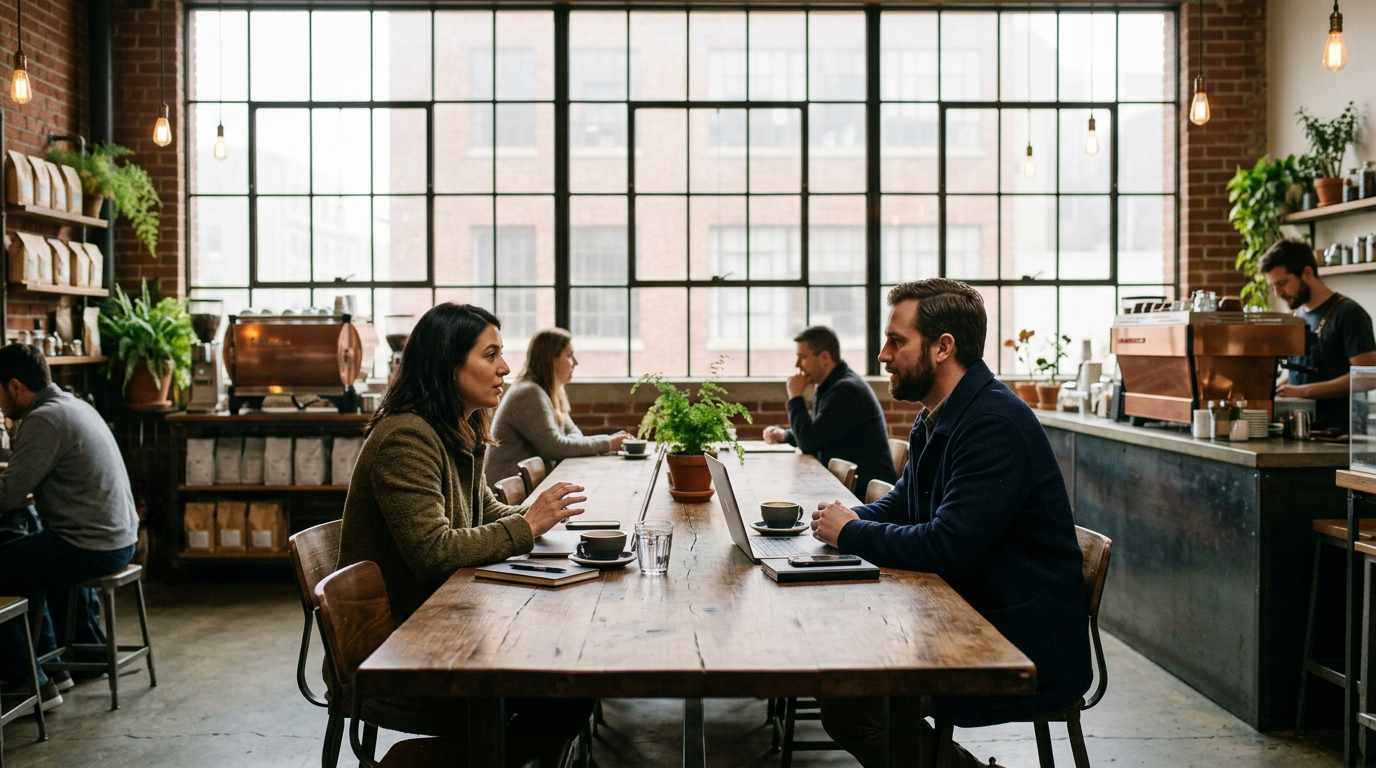
At 9:12 on a Tuesday morning in SoMa, the good tables are already taken by people pretending not to pitch. One founder has a notebook open but no laptop. A partner at a seed fund is drinking espresso like it is a calendar invite. Two engineers are comparing customer calls in the tone other cities reserve for gossip.
San Francisco has plenty of formal networking now: South Park Commons dinners, AngelList intros, On Deck alumni threads, Lunchclub matches, AI founder meetups, member's club happy hours, coworking demo nights at Industrious, Spaces, and the surviving WeWork floors. But the city's most efficient room is still a serious coffee shop with good light, good beans, and enough ambient noise to say something sensitive without performing for the whole room.
Not every third-wave cafe works as a deal room. Some are for laptops. Some are for dates. Some are for espresso and leaving. The valuable ones sit in the middle: credible enough for a first investor coffee, casual enough for a warm intro, and public enough that no one feels trapped.
The SF coffee deal room is not a lounge
San Francisco's coffee culture grew up around people who care too much about process. Single-origin pour-over, natural process beans, precise milk texture, not much tolerance for people treating a barista like office staff. That matters. The room has rules before your meeting starts.
The best founder coffee in SF is usually not the prettiest cafe on Instagram. It is the place where a 25-minute conversation can happen without a host, a QR code, or a two-hour restaurant commitment. Sightglass, Ritual, Saint Frank, Blue Bottle, Four Barrel, The Mill, Andytown, Equator, Verve, and similar serious coffee rooms all carry different signals. You are not choosing a brand. You are choosing a social container.
A few local patterns still hold in 2026:
- SoMa and South Park-adjacent coffee works for venture, AI, enterprise SaaS, product, and B2B operator meetings.
- Hayes Valley works for pre-dinner chats, design conversations, and people who refuse to cross town during the day.
- Mission cafes work for repeat founders, builders, creative operators, and people who want less VC theater.
- FiDi and Embarcadero coffee works for compact meetings with investors, lawyers, finance people, and executives between office obligations.
- Outer Sunset and west-side rooms work when you already have trust and want a calmer, more human conversation.
The trick is not finding the most famous cafe. The trick is matching the stage of the relationship to the room.
Which room for which meeting
!Barista preparing espresso while a founder meeting happens in the background
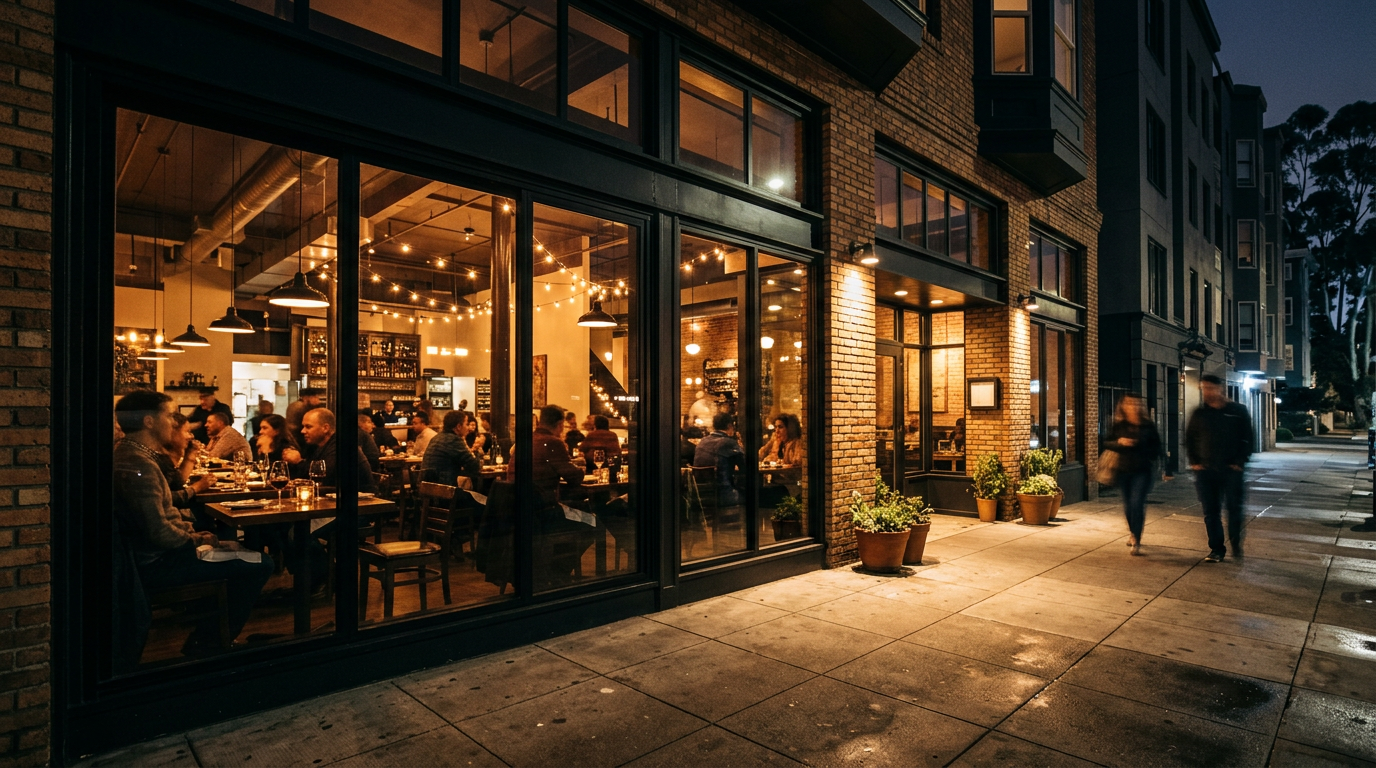
For a first investor coffee, choose a central, easy room with predictable seating turnover. A well-known third-wave shop near SoMa, FiDi, Jackson Square, or Hayes Valley beats the cool neighborhood spot that requires a rideshare and faith. The investor is doing you a small favor by showing up. Do not make logistics the tax.
For a cofounder conversation, pick somewhere with a little more privacy and less churn. You need time to hear how someone thinks. The Mill or a quieter Mission room can work better than a pure grab-and-go espresso bar. If the discussion may get emotional or strategic, avoid the table six inches from the line.
For a customer discovery chat, choose convenience over aesthetics. If your buyer works downtown, meet near their office. A clean cafe with good drip coffee is enough. The customer is not grading your taste in roasters. They are grading whether you respect their day.
For a warm intro from a mutual friend, pick a room with clear arrival points. Small counters and crowded doorways create awkwardness. You want the other person to spot you without scanning every laptop. Communal tables can work if the meeting is light. They are bad for any conversation involving cap tables, layoffs, terms, revenue, or conflict.
For a casual creator or operator meetup, neighborhood cafes are stronger. Andytown in the Sunset has a different social temperature than SoMa. Ritual on Valencia says Mission operator energy. Saint Frank says polished, quick, serious. Blue Bottle near downtown says efficient and neutral. None of these are personality tests, but locals read the signal.
What to order / what to look for
Order like an adult who plans to occupy space.
If it is a short meeting, espresso, macchiato, drip, or cold brew is enough. If you are staying longer, buy a real drink and something else if the shop offers food. If your guest arrives after you, tell them you are grabbing another round. Small move. Strong signal.
For a cafe that doubles as a deal room, look for:
- A real espresso program with baristas who move quickly and still care.
- Single-origin pour-over or batch brew for coffee credibility without ceremony.
- Tables that are not all two-tops touching elbows.
- Enough sound to cover sensitive conversation, but not so much that you shout ARR or churn.
- Good standing room near the entrance so arrivals do not feel lost.
- No aggressive laptop ban during the hour you need.
- A neighborhood that matches the meeting's stakes.
Do not order the most complicated drink if there is a line behind you. Do not ask the barista for a five-minute bean lecture while your investor waits. If you are the host, get there early, buy first, and claim a table that does not punish the other person with glare, traffic, or a speaker overhead.
One useful move: choose batch brew for yourself when you are hosting a high-stakes chat. It keeps your hands free, arrives fast, and avoids the tiny delay of waiting for a pour-over while the other person is already seated.
Best time of day to go
!People gathering outside a San Francisco cafe before weekday coffee meetings
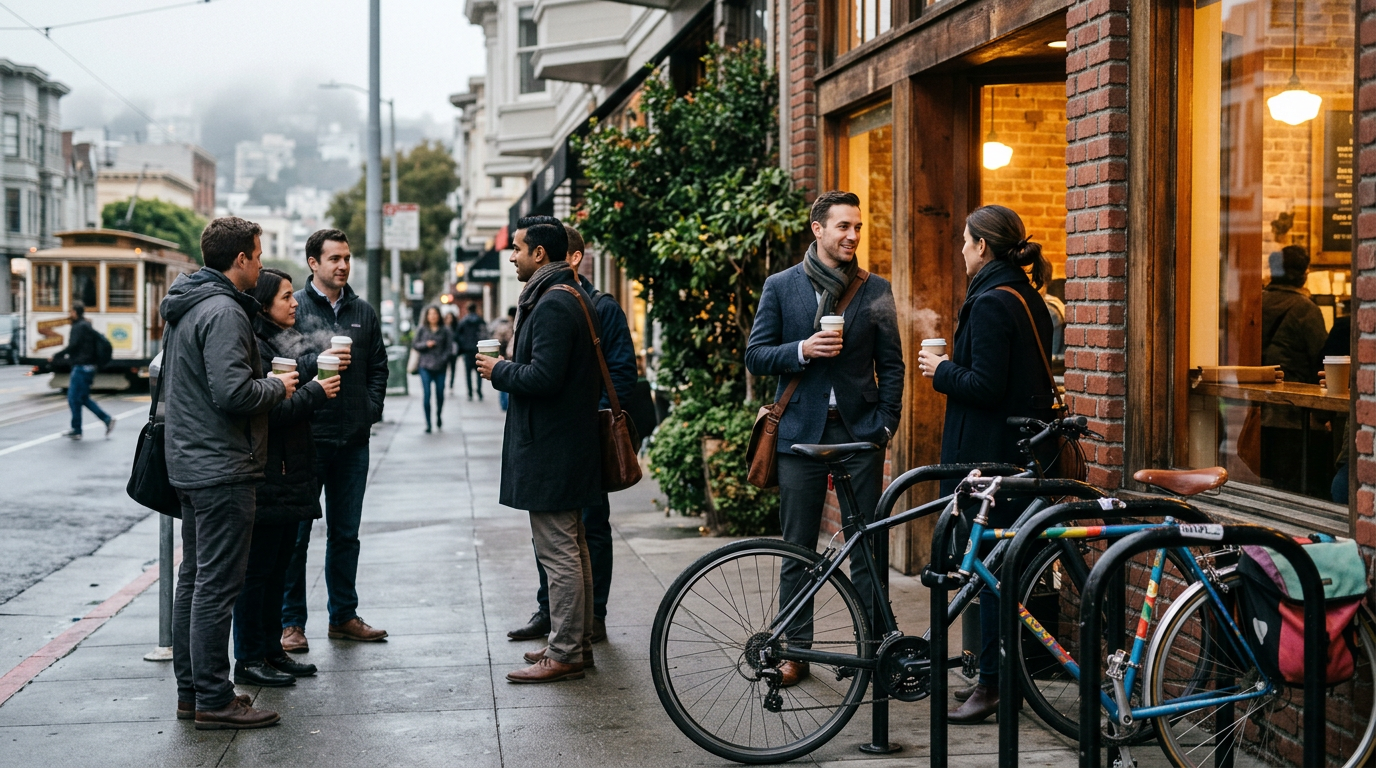
San Francisco deal coffee has a clock.
8:00 to 9:15 a.m. is for serious people with packed calendars. Good for investors, executives, and founders who have kids or back-to-back calls. The tone is sharp. Keep it tight.
9:30 to 11:00 a.m. is the strongest window for founder meetings. The first rush has thinned, the room is still awake, and nobody has been ruined by Slack yet. If you want a thoughtful conversation, start here.
11:30 a.m. to 1:30 p.m. is messy. Lunch traffic, calendar drift, people trying to squeeze in errands. Use this window only if the cafe has enough seating or the meeting is intentionally brief.
2:00 to 4:00 p.m. is underrated for warm intros and operator chats. People are more candid. The room is less performative. You may get a better read on someone's real priorities.
After 4:30 p.m. coffee becomes a bridge to dinner, natural wine bar plans, izakaya, omakase, supper club, or a member's club event. Good for relationship building, weaker for disciplined decision-making. If the ask is money, hiring, or partnership terms, do it earlier.
Tuesday through Thursday still wins. Monday is internal reset. Friday is founder chaos disguised as flexibility. Weekends are for friends, tourists, and the occasional intense cofounder walk that probably should have been scheduled as a walk.
Etiquette and unwritten rules
SF cafes tolerate ambition. They do not tolerate extraction.
The room is not your free hot desk. If you need a three-hour work block, buy accordingly or use a coworking day pass. If you are taking calls, keep your voice down and use headphones. If you need to present a deck, do not turn your screen toward half the cafe. Send the deck after.
Do not pitch the person before they sit down. Do not bring a second founder without warning. Do not ask for an intro in the first five minutes unless the meeting was explicitly about that. Do not name-drop half of South Park Commons, AngelList, or your On Deck cohort as proof you are credible. Locals have heard it.
Good SF coffee etiquette:
- Arrive ten minutes early.
- Buy first if you requested the meeting.
- Keep the first conversation to 25 or 30 minutes unless there is momentum.
- Put your phone face down.
- Ask one clean question at a time.
- Leave the table when the meeting is over.
- Tip well and learn the flow of the shop if you go often.
The barista is not part of your pitch environment. Treating staff well is not optional, and in San Francisco people notice. The founder who is rude at the counter has already lost the room.
How to actually meet people there
Cold-walking up to a stranger with a laptop and a Patagonia vest is usually bad. SF is friendly in a narrow way: people will help if the context is clean, the ask is specific, and the interruption is low-risk.
Start with weak ties, not strangers. Granovetter's point still applies: the people who unlock new opportunities are often not your closest friends. They are the ex-coworker, the founder you met once at a Meetup, the designer from a Launch House-era group chat, the operator you keep seeing at the same cafe.
Use the cafe as the second touch, not the first touch. Better sequence:
- Send a short note: "I liked your point about pricing in the AI agents thread. If you are around Hayes or SoMa next week, coffee is on me for 25 minutes."
- Give two neighborhood options, not five specific demands.
- Make the ask honest: feedback, customer angle, hiring advice, investor fit, not a fake catch-up.
- Confirm the morning of with the cafe and a simple identifier.
In the room, open with something grounded:
- "What are you seeing that founders are still getting wrong this summer?"
- "Which part of this market feels real to you, and which part feels funded theater?"
- "If you were meeting my customer this week, what would you ask first?"
- "Who is the most useful person for me to learn from if this thesis is wrong?"
Those questions work because they do not trap the other person into yes-or-no politeness. They invite judgment. San Francisco respects judgment.
If you see someone familiar across the room, use a 20-second interruption: "Good to see you. I am in a meeting, but I wanted to say hi. I will send you the note I owe you." Then leave. That is how you build ambient awareness without becoming the cafe pest.
Follow-up moves that do not feel needy
The follow-up matters more than the coffee.
Send it the same day. Not three days later with a grand summary. Same day, short, useful.
A strong follow-up looks like:
- "Thanks again for the 25 minutes at Sightglass. Your point about selling to the security buyer before the platform buyer changed how I am framing the next five calls. I will send the revised one-pager Friday. Also, if Maya at the healthcare fund is still a fit after you see it, I would appreciate the intro."
Notice the structure:
- Specific gratitude.
- One thing you actually heard.
- One next action you own.
- One conditional ask.
If someone offered an intro, make it effortless. Send a forwardable blurb under 120 words. Include what you do, why the intro makes sense, and what you are asking for. No deck attachment unless requested. No giant founder manifesto.
If the meeting was social, still follow up with value. Send the article, candidate, customer reference, or venue recommendation you mentioned. San Francisco runs on receipts. People remember who closes the loop.
Mistakes to avoid
The biggest mistake is treating every good cafe as interchangeable. A crowded espresso bar is not a place to negotiate a SAFE. A laptop-heavy cafe is not a room for emotional cofounder conflict. A beautiful neighborhood cafe may be terrible for a visiting investor with only 40 minutes between meetings.
Other mistakes that mark you as new:
- Scheduling in the Mission when both people are downtown and calling it casual.
- Taking a four-person meeting at a two-top.
- Asking for a dedicated desk experience from a cafe that sells coffee, not office space.
- Talking loudly about runway, layoffs, or investor names.
- Camping through peak hours after buying one small drink.
- Opening with your deck instead of a real question.
- Turning a warm intro into a sales ambush.
- Choosing a cafe because it photographs well, not because it works.
Also, do not confuse coffee with community. The cafe is a node. The relationship gets built across repeated touches: a founder dinner, a Meetup, a coworking day pass, a quick walk, a helpful email, a second coffee where there is already trust.
The practical SF playbook
If you are new to San Francisco, build a three-cafe rotation instead of chasing every room.
Pick one downtown or SoMa cafe for investor and operator meetings. Pick one Hayes or Mission cafe for founder and product conversations. Pick one calmer neighborhood room for deeper relationship work. Learn when each one is usable. Learn where the bad tables are. Learn whether laptops are tolerated, whether the line spikes, and whether the afternoon light makes half the seats unusable for a serious chat.
Then become predictable in a good way. Not the person always pitching. The person who can host a clean 25-minute conversation, make a useful introduction, and leave the table better than they found it.
That is the San Francisco coffee advantage in 2026. The city's formal networking stack is crowded again, but a good third-wave cafe still does something software cannot. It compresses trust. You see how someone treats time, staff, ambiguity, silence, and a small ask.
That is often enough to know whether you want the next meeting.
Discussion (0)
Loading comments…