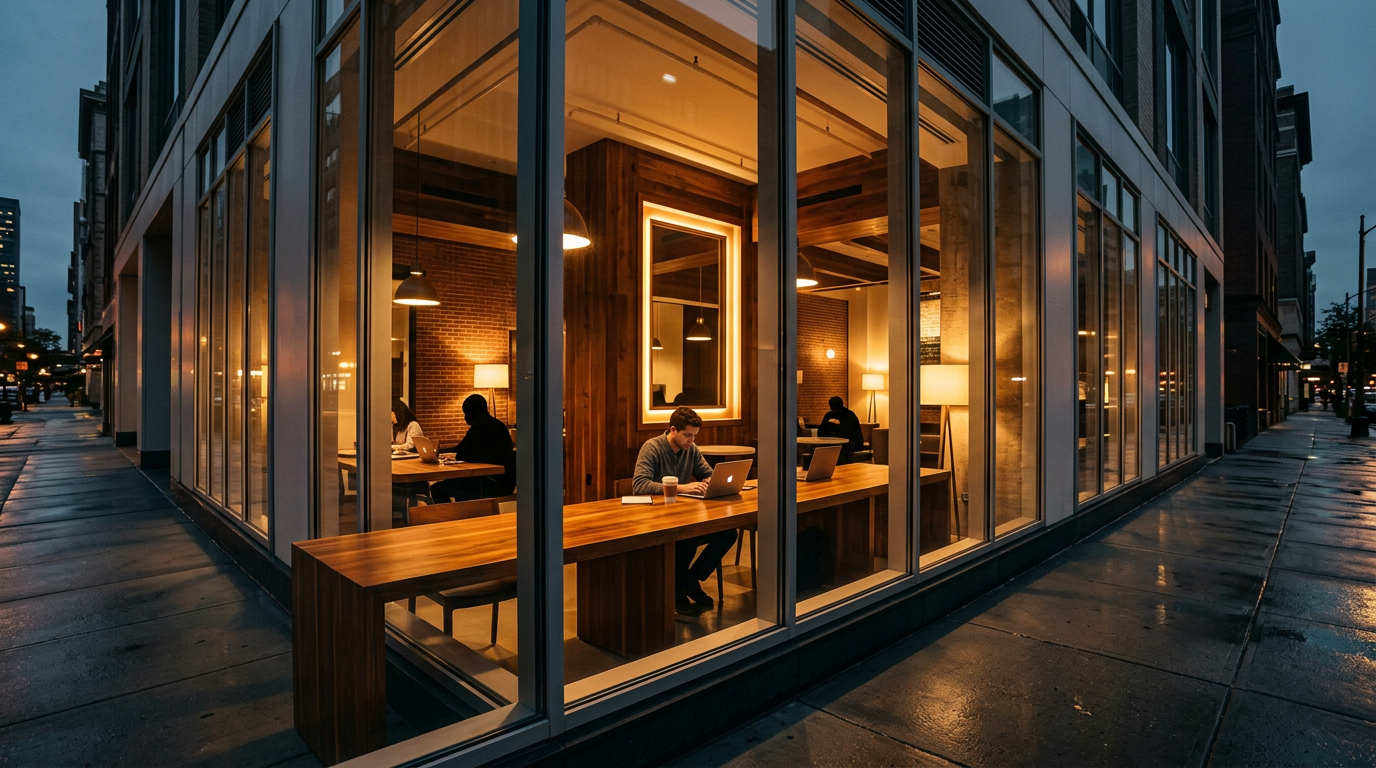
Where US digital nomads should base this year
At 8:40 on a Tuesday morning in Austin, the good tables are already gone. Not because the coffee is miraculous. Because every solo operator, fractional marketer, seed-stage founder, newsletter person, and product consultant has learned the same thing: the room matters as much as the rent.
The wrong city gives you a pretty apartment, a lonely laptop, and one bad networking event per week. The right city gives you repeat contact with useful strangers, work-friendly cafés that do not hate you, coworking day passes that are not dead, and dinner tables where people actually follow up.
This ranking is for digital nomads who are not on vacation. You need a base. You need the right room. You need to know how to behave once you get there.
The honest 2026 ranking
1. Austin
Austin is still the cleanest default base for remote operators who want startup adjacency without New York rent or Bay Area social sorting. The useful zone is not the whole city. It is a triangle of East Austin coffee, coworking day passes, founder dinners, and casual weeknight hangs where people are open to a second conversation.
The upside: low-friction introductions, strong founder density, plenty of hot desk options, and a culture that does not punish you for saying you are building something weird. The downside: summer is brutal, the sprawl is real, and the scene can get repetitive if you only attend pitch-adjacent events.
Base here if you are testing a company, selling to startups, freelancing for venture-backed teams, or rebuilding your professional network from scratch.
2. New York City
NYC is expensive, exhausting, and still the strongest weak-tie machine in the country. Granovetter was right: loose contacts often move your work forward faster than close friends. New York produces those contacts at scale if you show up consistently.
Do not treat the city like one scene. Brooklyn is different from SoHo, Flatiron is different from Williamsburg, and a member's club crowd is not the same as a serious operator breakfast. Devoción, Joe Coffee, Cafe Grumpy, Birch, Blue Bottle, and La Colombe all sit inside broader workday patterns, but cafés are not your office here. They are staging areas.
Base here if you sell services, raise capital, work in media, fashion, fintech, AI, consumer, or anything where proximity to people still moves money.
3. San Francisco and the Bay Area
San Francisco is not cheap and not casual about ambition. That is the point. If your work touches AI, developer tools, climate, biotech, robotics, or venture-backed software, the Bay Area still compounds faster than any other US base.
The best rooms are specific: serious coworking spaces, South Park Commons orbit, small founder dinners, investor office hours, and coffee bars where people actually take technical work seriously. Sightglass and Blue Bottle are safe references, but the real value is not the espresso. It is the fact that the person next to you may be debugging something that becomes a company.
Base here if the density of builders matters more than lifestyle efficiency. If you mainly need affordable comfort, pick elsewhere.
4. Los Angeles
LA works when you pick a lane. Westside for tech and creator economy. Hollywood and Los Feliz for entertainment-adjacent work. Downtown and Arts District for design, agencies, and hybrid operators. Try to cover the whole city and you will spend your month inside a car.
NeueHouse and Soho House are real parts of the LA work-social map, but they are not magic. A strong LA week is built around planned coffees, small dinners, workout-adjacent meetings, and one or two credible events. Verve and Blue Bottle are dependable coffee anchors; the better tactic is choosing a neighborhood and becoming familiar there.
Base here if you work in creator tools, media, brand strategy, entertainment, wellness, design, or consumer startups.
5. Miami
Miami is useful, but not subtle. The scene rewards presence, polish, and relationship-building. It also punishes people who arrive with a laptop and expect the city to hand them a network.
The strongest lanes are finance, real estate, crypto remnants, Latin America-facing businesses, hospitality, health, and events. Coworking matters here because apartment work can get isolating fast. Natural wine bars, hotel lobbies, supper club-style dinners, and member's club programming often do more than formal panels.
Base here if you are good at follow-up, comfortable with social velocity, and can tell the difference between a serious capital conversation and pure nightlife.
6. Chicago
Chicago is the adult in the room. It has excellent neighborhoods, a strong food and coffee baseline, serious business culture, and less scene theater than the coastal cities. Intelligentsia is part of the city's coffee DNA, but the workday opportunity is broader: neighborhood cafés, Loop meetings, coworking hot desks, and industry-specific meetups that do not require personal branding gymnastics.
The tradeoff is fewer random rocket-ship encounters than SF or NYC. The benefit is that people are often more grounded, more responsive, and more willing to introduce you if you are clear and useful.
Base here if you run a service business, work with B2B clients, need affordability relative to the coasts, or want a city that supports actual routine.
7. Seattle
Seattle is strong for deep work and serious technical networks. It is weaker for spontaneous social momentum. People here do not always broadcast availability. That does not mean the scene is closed. It means you need repeat presence and a low-pressure approach.
The best base pattern is simple: reliable coworking, one neighborhood coffee rotation, tech meetups, and outdoor-adjacent weekend plans that are not forced. Starbucks is the old global reference, but the digital nomad layer is more about independent cafés, tech offices, and communities around cloud, AI, gaming, and product.
Base here if you value focus, technical depth, and calmer weeks over constant events.
8. Denver
Denver is a good base for remote workers who need air, structure, and a less frantic business scene. It has SaaS, agency, wellness, outdoor, and startup communities, but the rhythm is earlier and more lifestyle-protective than New York or Miami.
Do not schedule like a coastal operator. People hike, ski, train, and protect evenings. The strongest networking often happens through activity, not panels. Coworking day passes are useful, but your best conversations may come from recurring fitness groups, small founder breakfasts, and industry meetups.
Base here if you need balance but still want credible business contact.
9. Boston and Cambridge
Boston is serious, credentialed, and not always warm to drive-by networkers. Cambridge matters for AI, biotech, university talent, robotics, research, and hard science. The catch: many rooms are built around existing institutions. You need a reason to be there.
La Colombe and Blue Bottle can cover the coffee layer, but the real access points are university-adjacent events, research talks, technical meetups, and industry dinners. Do not fake expertise here. Ask sharper questions.
Base here if your work touches deep tech, healthcare, education, biotech, or research commercialization.
10. Nashville
Nashville is better for creators, music-adjacent business, brand operators, hospitality, and service entrepreneurs than for pure startup density. The city is social, but not always professionally structured for nomads.
It can work well if you arrive with a clear niche and plug into songwriter rooms, creator meetups, agency circles, and small-business communities. It is not the strongest base for venture networking. It is a strong base for people who understand relationships before transactions.
11. Portland
Portland has excellent coffee culture, including Stumptown's long shadow, and a strong maker-designer-independent-operator sensibility. It is not the highest-velocity networking city on this list.
That can be good. If you want focus, craft, calmer days, and less status theater, Portland may fit. If you need weekly investor density or aggressive founder energy, you will feel the ceiling quickly.
What to order / what to look for
!Remote workers using laptops in a bright third-wave coffee shop
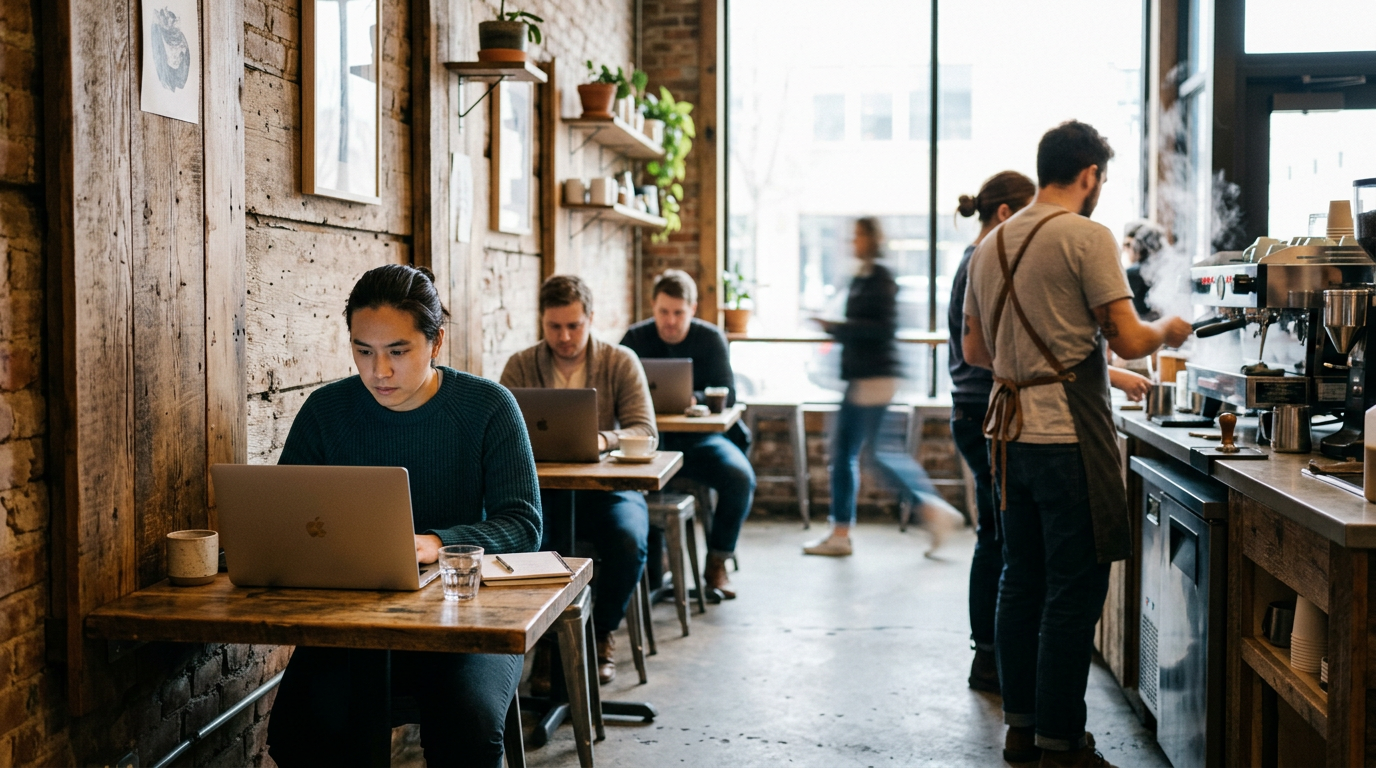
The order is less important than the signal you send. You are not camping for free. You are using a local room with respect.
In a third-wave coffee shop, order something that fits the pace:
- Single-origin pour-over when you are not in a rush and the bar is not slammed
- Batch brew when the line is long and you need to sit down fast
- Espresso or cortado if you are taking a short meeting
- Food if you plan to stay through a meal window
Look for room traits, not just coffee reputation:
- Two-person tables along a wall, not only communal chaos
- Outlets that do not require crawling under strangers
- Staff who seem used to laptops before noon
- A noise level that allows quiet conversation without becoming a phone booth
- A neighborhood with a second stop nearby, in case the first room is full
For coworking, learn the difference between a hot desk, dedicated desk, and day pass. A hot desk is fine for a short base. A dedicated desk only makes sense if you are staying long enough to become known. Day passes are best for testing whether the room has actual operators or just people hiding from home.
WeWork, Industrious, and Spaces are still useful, but treat them as infrastructure. The network is not automatic. You have to earn it.
Best time of day to go
The best digital nomad schedule is not romantic. It is tactical.
7:30 to 9:30 a.m. is the coffee window. This is when regulars appear, staff are fresh, and quick conversations feel natural. If you want to become recognizable, show up at the same spot three mornings in a row.
10 a.m. to 2 p.m. is deep work. Do not force networking here. People are on calls, shipping client work, or trying to protect their attention.
2 to 4 p.m. is the coworking tour and soft-introduction window. Community managers are less slammed. Ask what events actually draw members, not what is printed on the calendar.
4 to 6 p.m. is the transition zone. This is when a café can become conversational, a hotel lobby can work, and a natural wine bar can become a better networking room than another panel.
Tuesday through Thursday still wins. Monday is catch-up. Friday is slippery. Tuesday night founder dinners, Wednesday meetups, and Thursday member events are the backbone of most serious city scenes.
Etiquette and unwritten rules
!Small groups talking outside an urban wine bar after work
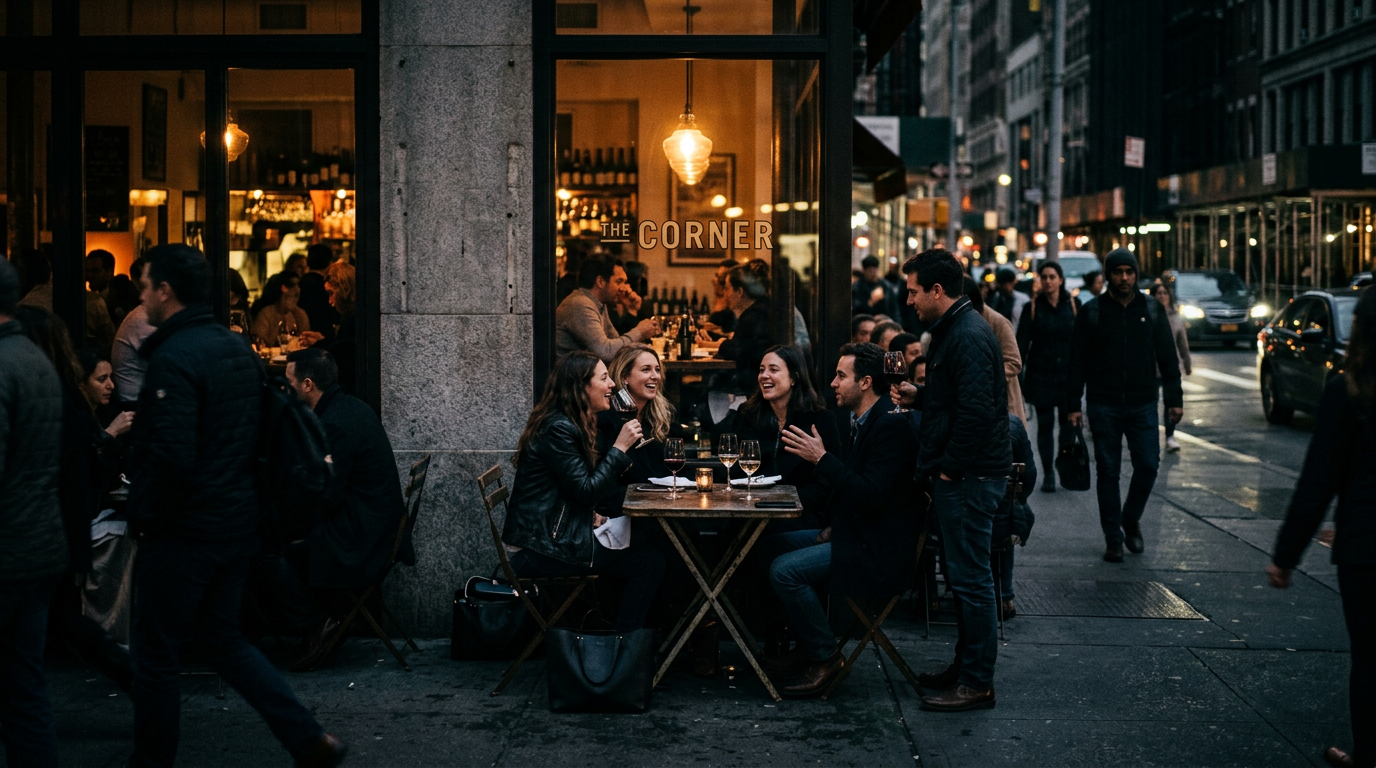
Every city has its own operating system.
In NYC, be concise. People will help if you are clear, but they do not want a rambling life story before coffee arrives. Lead with what you do, what you are looking for, and one useful point of context.
In LA, respect geography. A casual meeting across town is not casual. Suggest a neighborhood, offer two time windows, and do not act offended if someone keeps it near their side of the city.
In Austin, do not pitch immediately. The culture is open, but people get tired of transactional arrivals. Ask what someone is building, then listen long enough to understand the actual stage.
In San Francisco, specificity wins. Vague founder talk dies quickly. Say the market, the user, the technical problem, or the distribution wedge.
In Miami, presentation matters, but follow-through matters more. If you say you will introduce someone, do it by the next day.
In Chicago, be straight. Overpolished networking language lands badly. Practical, respectful, and specific works.
In Seattle, do not mistake quiet for disinterest. Give people space, follow up thoughtfully, and avoid cornering strangers into high-energy chats.
In Boston and Cambridge, credibility matters. You do not need to name-drop. You do need to ask informed questions.
In Denver, do not pretend to be outdoorsy for social access. People can tell.
In Nashville and Portland, relationships often move through trust before opportunity. Slow down.
Basic café rule everywhere: buy regularly, tip, keep calls outside or in phone booths, do not occupy a four-top alone at lunch, and never treat staff like office support.
How to actually meet people there
The move is not to ask strangers to pick their brain. The move is to create small, low-pressure openings and then follow up like a professional.
Use openers that fit the room:
- At coworking: I am testing this space for the week. Are people here mostly heads-down, or does the community actually show up?
- At a founder event: What brought you here tonight besides the calendar invite?
- At a coffee bar: I have seen a lot of laptops here in the morning. Is this a regular work spot or just overflow?
- At a dinner: What kind of work has been sending you the most interesting problems lately?
- At a Meetup or AngelList-adjacent event: Are you looking for customers, collaborators, talent, or just signal?
Then make the next step easy:
- Send one specific article, intro, candidate, customer lead, or venue suggestion
- Follow up within 24 hours while the context is still fresh
- Offer a 20-minute coffee, not a vague sometime soon
- If you are new in town, say so without making it someone else's job to host you
- Build a three-person dinner instead of begging your way into a twenty-person one
Lunchclub, Meetup, On Deck alumni circles, South Park Commons-adjacent rooms, and local Slack or WhatsApp groups can all work. The filter is whether people show up twice. One-off energy is cheap. Repeat attendance is where the network forms.
Mistakes to avoid
Do not choose a city only from rent spreadsheets. The cheaper base can become expensive if it produces no meetings, no energy, and no reason to leave your apartment.
Do not confuse member's clubs with community. Soho House and NeueHouse can be useful if you already know how to work a room. They will not fix a weak offer, a vague identity, or bad follow-up.
Do not make cafés carry your whole work life. A great café is a morning anchor, not a headquarters. Use coworking when you need calls, stability, and repeat exposure.
Do not move every two weeks and expect local trust. A month is the minimum useful test. Six to eight weeks is better if you are trying to build real connections.
Do not attend only founder events. The best contacts may be at an izakaya dinner, a natural wine bar pop-up, a design meetup, a run club, a gallery opening, or a small supper club where nobody is wearing a name tag.
Do not overtalk your remote freedom. Locals live with the costs and tradeoffs of these cities. Act like a temporary neighbor, not a consumer of scenes.
The city I would pick by job-to-be-done
If you need the most balanced US digital nomad base in 2026, pick Austin. It has the strongest mix of access, openness, cost relative to opportunity, and founder density.
If you need money, media, clients, and weak ties at maximum speed, pick New York.
If you are building something technical and venture-scale, pick San Francisco.
If your work touches creators, entertainment, brand, or culture, pick Los Angeles.
If you sell across capital, hospitality, Latin America, or high-social-trust rooms, pick Miami.
If you need a sane operating base with real business culture, pick Chicago.
If you need technical depth and focus, pick Seattle.
If your best work happens when life has altitude and boundaries, pick Denver.
If you need research, biotech, education, or hard technical credibility, pick Boston and Cambridge.
If your business is relationship-heavy and creator-adjacent, pick Nashville.
If you want craft, coffee, and quieter independent work, pick Portland.
The ranking matters less than your weekly pattern. Same coffee bar. Same coworking floor. Same Tuesday event series. One dinner you host yourself. That is the play. Pick the city where you will actually do it.
Discussion (0)
Loading comments…